

Waste Tracking Requirements: Legal and Practical Impact
Waste tracking across the UK is undergoing a significant transformation as the government replaces paper records with a mandatory digital system beginning October 2026. For facilities managers in hospitals and universities, adapting to these changes means mastering new protocols for documenting every waste movement and ensuring all contractors comply. This guide explains how comprehensive digital tracking supports regulatory compliance and transparency, while highlighting what your institution must do to avoid legal and operational risks.
Table of Contents
- Defining Waste Tracking Requirements In The UK
- Types Of Waste And Digital Tracking Coverage
- Legal Duties And Sector-Specific Rules For 2026
- How The Digital Waste Tracking System Works
- Common Compliance Risks And Avoidable Errors
Key Takeaways
| Point | Details |
|---|---|
| Digital Tracking Compliance | All waste businesses in the UK must transition to digital waste tracking systems by October 2026, impacting healthcare and educational institutions directly. |
| Responsibilities for Facilities Managers | Facilities managers must ensure contractors comply with digital tracking obligations and verify the accuracy of waste data. |
| Types of Waste Requiring Tracking | Nearly all waste generated by healthcare and educational facilities falls under the digital tracking system, necessitating comprehensive documentation. |
| Consequence of Non-compliance | Failing to adhere to waste tracking regulations can lead to significant financial penalties and regulatory scrutiny for organisations. |
Defining Waste Tracking Requirements in the UK
Waste tracking in the UK has fundamentally changed. The government now requires all waste businesses to move away from paper-based records and shift to digital waste tracking systems. For facilities managers at healthcare and educational institutions, this shift means understanding what waste tracking actually entails and how it applies to your operations.
At its core, waste tracking means documenting the journey of every waste material from the point it leaves your facility until it reaches its final destination. This includes recording who handled the waste, where it went, what happened to it, and whether it was ultimately recycled, treated, or disposed of. The system creates a complete audit trail that demonstrates compliance with environmental regulations and accountability throughout the waste management process.
The UK Government’s Digital Waste Tracking service mandates that all waste receiving sites must log waste data digitally, eliminating the previous patchwork of handwritten records. Implementation begins with phased beta testing in 2025, with mandatory use commencing in October 2026. This affects you directly if your hospital or school produces waste that gets collected and transported by external contractors.
What makes this requirement particularly relevant to your role is that you become responsible for ensuring your waste contractor complies with digital tracking obligations. You cannot simply hand over waste and assume everything is handled correctly. Instead, you must verify that waste documentation is submitted digitally, that data matches your own records, and that your facility is correctly represented in the tracking system. Healthcare waste, confidential document destruction, and hazardous materials all require meticulous documentation under these new standards.
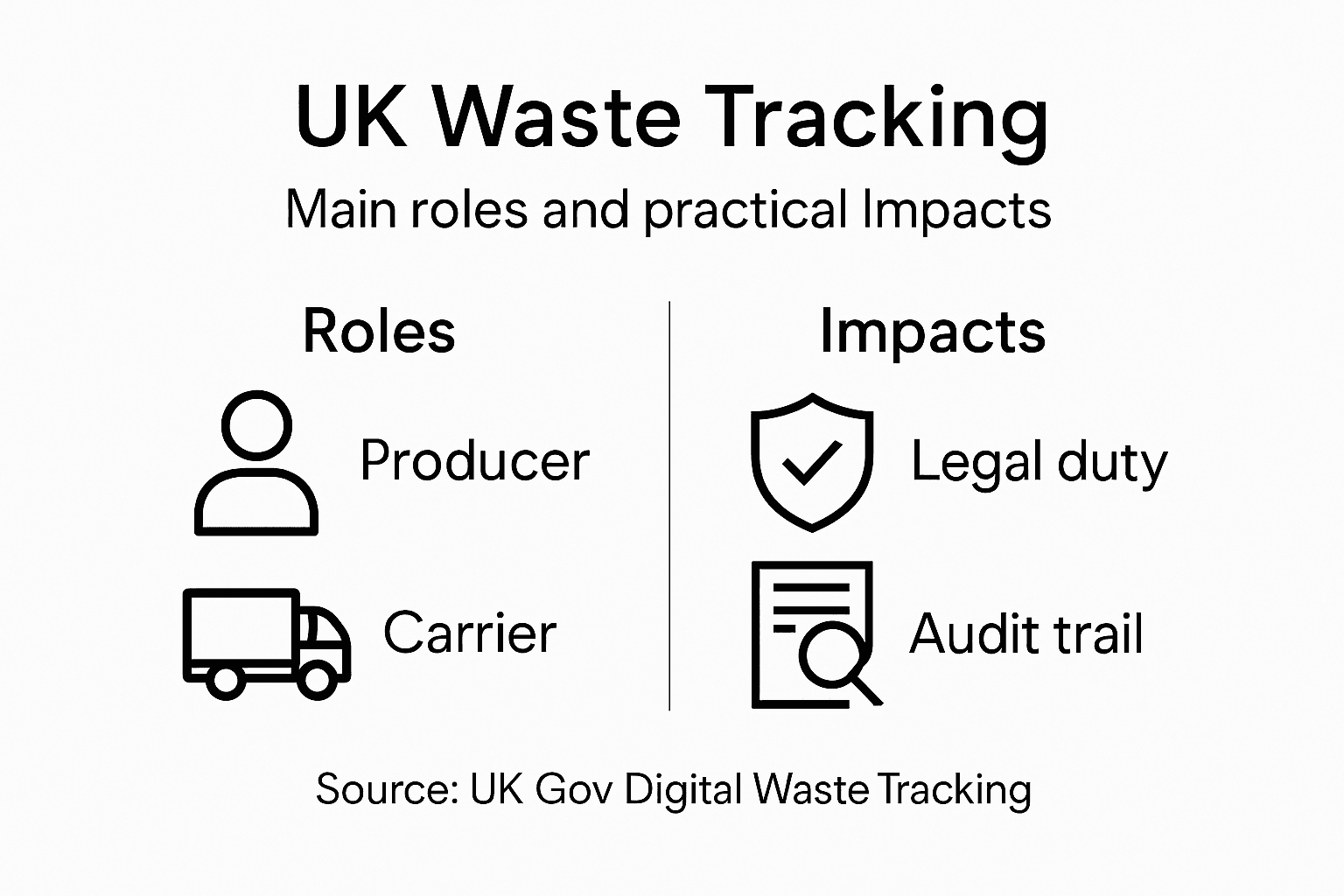
The regulatory framework covers producers (that is, your institution), waste carriers, and treatment facilities. Each party must input their own data at each stage. If you produce clinical waste in Newcastle or run a large educational campus in Durham, your waste management practices will feed directly into this national tracking system. Inconsistencies or missing records can result in regulatory scrutiny, fines, or enforcement action against your organisation.
Here is a summary of how digital waste tracking changes responsibilities for key parties:
| Party Involved | Main Responsibility | Impact on Compliance |
|---|---|---|
| Waste Producers | Accurate initial data entry | Ensures full traceability |
| Waste Carriers | Timely record submission | Reduces discrepancies |
| Receiving Facilities | Confirm receipt and treatment details | Closes audit trail |
| Facilities Managers | Record verification and oversight | Prevents legal penalties |
Pro tip: Request your waste contractor’s digital tracking login credentials and establish a monthly verification routine to cross-check that all waste movements recorded in the system match your internal disposal records, catching discrepancies before they escalate into compliance issues.
Types of Waste and Digital Tracking Coverage
Not all waste falls under the digital tracking system, but most of what your healthcare or educational facility produces will. Understanding which waste types require tracking is essential for compliance. The system covers controlled waste encompassing hazardous and non-hazardous materials, including household, commercial, and industrial streams. If you manage a hospital in Leeds or a university campus in Manchester, nearly every waste stream you generate falls within this scope.
Controlled waste includes clinical waste from medical procedures, pharmaceutical waste, chemical waste from laboratories, and general household or commercial refuse. Confidential document destruction also requires digital tracking since it involves waste handling and movement. Even waste that seems minor—such as redundant electrical equipment or empty aerosol cans—must be logged within the system.
Extractive waste from mining and quarrying operations also requires tracking, though this typically does not apply to educational or healthcare settings. However, if your institution participates in any demolition projects or maintains quarried materials on site, those streams trigger digital tracking obligations.
What catches many facilities managers off guard is that hazard classification does not determine whether waste needs tracking. A non-hazardous cardboard box containing office waste must be tracked just as carefully as clinical waste from an operating theatre. The system applies universally across all controlled waste types, creating comprehensive traceability. This universal approach means you cannot pick and choose which waste streams to monitor.
Waste containing Persistent Organic Pollutants (POPs) requires particularly detailed recording. These include legacy chemicals found in old equipment, certain pesticides, and contaminated materials. If you are disposing of equipment manufactured before the 2000s, check whether POPs documentation applies before handing waste to your contractor.
Your role demands familiarity with all waste types your institution generates. Create an inventory listing every waste stream you produce, from general refuse to specialist clinical or laboratory waste. This proactive approach prevents tracking gaps and ensures your facility remains compliant across every waste category.
Pro tip: Audit your facility’s waste streams with your environmental coordinator or facilities team, then cross-reference each against the government’s waste classification list to confirm all types are accounted for in your digital tracking records before the October 2026 deadline.
Legal Duties and Sector-Specific Rules for 2026
October 2026 marks the moment when waste tracking shifts from optional to legally mandatory. Your institution will face real legal obligations, not voluntary guidelines. Licensed and permitted waste receiving sites must report waste receipt data digitally as a primary legal duty from this date onwards. This means every waste contractor you work with in Newcastle, Brighton, Edinburgh, or anywhere else in the UK must comply.
As a facilities manager, you become part of this enforcement chain. Your organisation produces the waste, and your contractor receives and processes it. Both of you have separate but interconnected legal duties under the new regulations. If your contractor fails to submit data, you could face scrutiny for selecting an unreliable partner. The responsibility flows both ways.
Waste receiving site operators must familiarise themselves with their duties ahead of enforcement, which includes compliance with revised waste carrier regulations and potentially new restrictions on exemptions. Some exemptions may vary across waste sectors, meaning clinical waste handling might differ from general commercial waste tracking requirements. Healthcare facilities often face stricter scrutiny than educational institutions because clinical waste involves greater regulatory complexity.
Educational institutions have slightly different obligations depending on waste type. General refuse from a school cafeteria follows standard tracking rules. However, laboratory waste from science departments or IT equipment disposal requires additional documentation. University campuses in areas like Durham or Bristol must account for these variations when establishing their tracking systems.
The phased rollout initially focuses on licensed and permitted waste receiving sites, but regulations will expand to other waste operators later. Exemptions for certain household waste at recycling centres will apply initially, but do not assume your institution qualifies. Most healthcare and educational facilities operate at a scale requiring full compliance from day one.
Non-compliance carries financial and reputational consequences. Regulatory bodies can impose fines, revoke waste handling licences, or initiate enforcement action. Your institution’s environmental credentials matter, particularly for educational facilities with sustainability commitments or healthcare providers promoting responsible practice.
Pro tip: Schedule a meeting with your waste contractor before 2026 to confirm they hold current licences, understand the digital tracking system, and agree in writing on who manages data submission for each waste stream from your facility.
How the Digital Waste Tracking System Works
The Digital Waste Tracking System operates as a centralised UK-wide platform where waste data flows continuously from point of origin to final destination. Think of it less like a filing cabinet and more like a live tracking system similar to parcel delivery software. Authorised waste receiving sites must log all incoming waste data using application programming interfaces (APIs) or compatible software, enabling seamless digital submission across the entire waste journey.
When your healthcare facility in York or educational institution in Belfast hands waste to a contractor, that contractor immediately enters the data into the system. Instead of paper waste transfer notes that sit in filing cabinets for years, you now have real-time, auditable digital records. The system creates an automatic audit trail, meaning every movement gets logged, timestamped, and verified. No more lost paperwork or unclear handoffs between parties.
Your waste contractor inputs specific information at each stage: waste type, quantity, origin point, destination, and treatment method. The system then moves the record forward as waste progresses through the supply chain. When waste arrives at a treatment facility, operators confirm receipt and log what happens next. This continuous documentation prevents waste disappearing mid-journey without explanation.

Integration with existing software matters for practical implementation. Most waste management companies use their own systems, but the Digital Waste Tracking platform connects via APIs, meaning your contractor’s software talks directly to the government system. You do not need to manually re-enter data multiple times. Data flows seamlessly between your internal records, your contractor’s system, and the regulatory platform.
The phased rollout approach means you have time to prepare. Private beta testing occurs during 2025, allowing waste operators to identify technical issues before mandatory compliance begins in October 2026. This staged approach gives you breathing room to work with your contractors, test procedures, and resolve software compatibility issues before enforcement takes effect.
Accessing the system yourself depends on your contractor’s permissions, but you can request read access to your facility’s waste records. This allows you to verify that submissions match your internal documentation and catch discrepancies early.
Pro tip: Request direct access to your waste tracking records from your contractor now, during the beta testing phase, so you can familiarise yourself with the interface and identify any data mismatches before the October 2026 deadline becomes legally binding.
Common Compliance Risks and Avoidable Errors
Waste tracking compliance failures rarely stem from malice. Most errors occur because facilities managers underestimate the system’s complexity or assume their contractor handles everything. The truth is more nuanced. You share responsibility for data accuracy, timing, and completeness. Missing this distinction costs organisations money and credibility.
Incomplete waste descriptions represent the most common early error. Your facility generates clinical waste, but does the system record what type of clinical waste? Infectious? Pharmaceutical? Chemical? Vague entries create audit flags. Regulators cannot verify compliance when descriptions lack specificity. A hospital in Manchester might record “medical waste” when the system requires “sharps and contaminated instruments.” That gap invites scrutiny.
Timing mismatches cause significant problems. Your facility generates waste on Monday, but your contractor does not submit the digital record until Wednesday. Meanwhile, you have already recorded the disposal in your internal system. When regulators cross-reference records, discrepancies emerge. The waste appears to vanish for two days. Always verify submission timelines with your contractor in writing.
Incorrect waste classification creates regulatory chaos. Your school’s science department produces laboratory chemicals, but the waste gets classified as general commercial refuse. This error cascades through the system, potentially triggering hazard investigations or fines. Audit your internal waste categorisation against the official government classification scheme before handing anything to your contractor.
Data entry errors in quantity fields invite questions too. If your facility consistently reports vastly different waste volumes week to week, regulators may suspect unreliable tracking procedures. Establish baseline waste volumes and flag unusual variations immediately.
Confidential document destruction requires meticulous attention. Patient records from a healthcare facility or student information from a school must be tracked with particular care. Handling confidential waste improperly exposes your organisation to data protection violations beyond simple waste tracking failures. Verify your contractor holds appropriate confidentiality certifications and submits records within legally mandated timeframes.
Contractor selection matters enormously. Choosing an unreliable waste management partner shifts compliance burdens onto your shoulders. Demand proof of digital tracking readiness, software compatibility testing, and staff training completion before October 2026.
The table below outlines typical errors in waste tracking and how to prevent them:
| Common Error | Consequence | Prevention Method |
|---|---|---|
| Vague waste descriptions | Regulatory audit queries | Use precise classification terms |
| Timing mismatches | Apparent gaps in audit trail | Synchronise submission schedules |
| Incorrect waste classification | Fines or investigations | Cross-check with official categories |
| Data entry mistakes | Unusual volume trends flagged | Implement double-check routines |
Pro tip: Run a waste tracking audit with your current contractor now, generating sample submissions through the beta system and comparing their data against your internal records to identify and correct systematic errors before mandatory enforcement begins.
Stay Ahead of Waste Tracking Compliance with Venture Waste
Navigating the new legal and practical waste tracking requirements can feel overwhelming for facilities managers responsible for ensuring full traceability and accuracy in your waste records. The shift to mandatory digital tracking demands careful oversight of waste descriptions, timing, and data submission alongside your waste contractors. Explore how the Waste Collection Process in the UK for Businesses 2025 – Venture Waste supports your need for seamless compliance and reliable waste management solutions.

Take control today by partnering with Venture Waste. Benefit from our transparent three-step booking system, industry expertise, and a comprehensive waste collection network designed for modern UK businesses. Verify your digital tracking readiness, prevent costly compliance risks, and protect your organisation’s reputation. Visit Venture Waste and learn more about How the Waste Collection Network in UK Serves Businesses in 2025 – Venture Waste to secure your facility’s waste management future now.
Frequently Asked Questions
What are the main responsibilities of waste producers under the new digital tracking system?
Waste producers must ensure accurate initial data entry for their waste. This is crucial to guarantee full traceability throughout the waste management process and to comply with legal obligations.
How does the digital waste tracking system enhance compliance for healthcare and educational facilities?
The digital waste tracking system creates an automatic audit trail, ensuring that all waste movements are logged, timestamped, and verified. This prevents discrepancies and helps facilities demonstrate compliance with environmental regulations.
What types of waste require tracking under the UK government’s new requirements?
Almost all controlled waste, including clinical waste, pharmaceutical waste, chemical waste, and even non-hazardous materials, must be tracked digitally. This also includes confidential document destruction and redundant electrical equipment.
What are the consequences of non-compliance with the new waste tracking regulations?
Non-compliance can lead to financial penalties, revocation of waste handling licences, or enforcement actions by regulatory bodies. It can also damage an organisation’s reputation, particularly for educational institutions and healthcare providers committed to sustainability.
Recommended
- 7 Steps to Waste Compliance for UK Businesses in 2025 – Venture Waste
- Waste Management News UK 2025: What Businesses Need to Know – Venture Waste
- Waste Disposal Legal Requirements UK 2025: What Businesses Must Know – Venture Waste
- Waste Disposal Fines UK 2025: What Every Business Must Know – Venture Waste


Leave a Reply
Want to join the discussion?Feel free to contribute!