

Waste Segregation Colour Codes: Legal Compliance and Safety
Sorting waste in a bustling hospital or busy university campus often becomes a race against time and distractions. For facilities managers, mistakes in segregation can endanger staff safety, disrupt recycling, and result in breaches of UK regulations. Colour coding bins is not just a visual aid—it forms the core of legal compliance and safer workplaces, as emphasised by the Health and Safety Executive. Understanding these waste segregation colour codes brings clarity, reduces confusion and contamination risks, and helps your institution protect both people and the environment.
Table of Contents
- Waste Segregation Colour Codes Defined
- UK Colour Coding Categories And Materials
- How Colour Codes Ensure Safe Handling
- Legal Standards And Documentation Requirements
- Common Mistakes And How To Avoid Them
Key Takeaways
| Point | Details |
|---|---|
| Waste segregation colour codes | Utilising a standardised colour coding system simplifies waste disposal for staff, enhancing compliance and safety in healthcare and educational settings. |
| Legal documentation is essential | Facilities must maintain accurate records of waste segregation and disposal methods to comply with UK regulations and avoid fines or legal issues. |
| Training and communication are key | Regular staff training on waste segregation protocols and clear labelling can significantly reduce contamination and improve compliance rates. |
| Proactive monitoring practices | Conducting routine audits and documenting discrepancies helps identify training gaps and ensures continuous improvement in waste management processes. |
Waste Segregation Colour Codes Defined
Waste segregation colour codes form the backbone of responsible waste management across UK healthcare facilities and educational institutions. These standardised visual systems enable staff to quickly identify which bin or container accepts specific types of waste, reducing contamination and ensuring compliance with environmental regulations. Rather than relying on written labels alone, colour coding provides an immediate, intuitive method that works regardless of language or literacy levels, making it particularly valuable in busy clinical or campus environments where decisions happen fast.
The UK employs a structured approach to waste classification that goes beyond simple colour coding. The List of Waste codes and waste classification guidance establish the legal framework for categorising different waste streams. In healthcare settings, you’ll typically encounter four main colour categories: yellow for infectious and hazardous waste, black for general non-recyclable waste, blue for paper and cardboard, and green for compostable materials. However, the specific colour scheme your institution uses may vary slightly depending on local authority requirements and your waste contractor’s specifications. For example, some healthcare providers in Newcastle and Durham follow slightly different protocols than those in Sheffield, so verification with your local waste management partner remains essential.
Educational institutions follow similar principles but often adapt the system to their context. Universities in Leeds and Manchester frequently implement modified colour schemes that account for research laboratory waste, which requires additional hazard identification beyond standard office recycling. Clinical waste in particular demands rigid adherence to colour codes, as improper segregation can create serious health risks for waste handlers and contaminate recycling streams. Understanding the reasoning behind each colour designation helps staff internalise the system more effectively than memorising rules by rote. Black bins contain general refuse that poses no special hazard. Yellow containers hold items contaminated with bodily fluids, pharmaceuticals, or infectious materials. Blue receptacles receive clean paper and cardboard only. Green bins accept food waste and biodegradable materials suitable for composting or anaerobic digestion. Each colour represents a distinct end-of-life pathway, with different treatment processes and legal handling requirements.
Pro tip: Create laminated reference cards showing your facility’s specific colour codes and acceptable contents, then position them at eye level near each segregation point; refresh them quarterly and whenever your waste contractor updates protocols to ensure staff always follow current requirements.
UK Colour Coding Categories and Materials
Understanding which materials go into which coloured bins forms the practical foundation of waste segregation. The UK regulatory framework establishes clear categories that healthcare facilities and educational institutions must follow, though the visual presentation through colour codes makes compliance straightforward for staff at the point of disposal. Each colour represents not just a container, but an entire treatment pathway with different legal requirements, environmental outcomes, and handling protocols.
Yellow bins capture infectious and hazardous clinical waste that poses genuine health risks. This includes items contaminated with bodily fluids, blood-stained dressings, needles, syringes, anatomical waste, and pharmaceutical residues. In healthcare settings, yellow waste undergoes high-temperature incineration or specialised treatment to eliminate pathogens before any potential disposal. Educational institutions rarely use yellow bins unless they operate on-campus health centres or research laboratories. Black bins receive general non-recyclable waste that contains no hazardous properties. Think of items like contaminated food packaging, non-recyclable plastics, soiled paper towels, and general refuse that cannot enter other streams. The recyclable waste categories defined in current regulations clarify what should never reach black bins.

Blue bins accept clean paper and cardboard exclusively. This means office paper, printed materials, cardboard boxes, and packaging paper. Contaminated paper that has absorbed liquids or biological material must go to yellow or black bins instead. Green bins receive compostable and food waste suitable for industrial composting or anaerobic digestion. This includes food scraps, garden waste, and biodegradable packaging. Some facilities also implement additional colours: brown for garden waste alone, red for certain hazardous chemicals, or orange for specific pharmaceutical waste streams. The variation depends on your facility’s activities and your waste contractor’s capabilities. In Manchester and Birmingham, many NHS trusts implement slightly different secondary colour schemes based on their on-site treatment infrastructure.
Beyond these core categories, some facilities use supplementary colours for specialised streams. Clear or transparent bags sometimes separate confidential paper or sensitive documents requiring destruction. Purple or lilac bins occasionally contain cytotoxic or chemotherapy waste that requires segregated incineration. The key principle remains consistent: segregation at source prevents contamination, reduces treatment costs, and ensures regulatory compliance. Staff confusion about correct placement directly increases costs for your institution, as misplaced items contaminate entire loads and force disposal as hazardous waste rather than recyclable material.
Here is a quick reference guide comparing the main UK waste segregation colour codes and their handling protocols:
| Colour Code | Typical Waste Contents | Required Handling | Final Disposal Method |
|---|---|---|---|
| Yellow | Infectious clinical items | Use PPE, sealed containers | High-temperature incineration |
| Black | General non-recyclable waste | Minimal precautions, closed bins | Landfill or non-recycling |
| Blue | Clean paper and cardboard | Keep dry, avoid contamination | Recycling facility |
| Green | Food and compostable materials | Decant food, exclude non-biodegradables | Composting or digestion |
| Purple/Lilac | Cytotoxic/chemotherapy waste | Specialist PPE, never compress | Specialist incineration |
Pro tip: Conduct a quarterly audit by photographing each bin station and cross-referencing contents against the colour coding system; identify problem areas and provide targeted retraining to departments showing persistent contamination, which typically reduces disposal costs by 12-18% annually.
How Colour Codes Ensure Safe Handling
Colour codes transform waste segregation from a theoretical concept into a practical safety system that protects your staff every single day. When waste handlers encounter a clearly colour-coded bin, they make instantaneous decisions about how to approach it, what protective equipment to use, and which disposal pathway applies. This split-second recognition prevents the catastrophic mistakes that occur when workers accidentally mix incompatible materials or handle hazardous waste without proper precautions. The visual clarity of colour coding works far more effectively than written instructions alone, particularly in high-pressure clinical environments where staff manage multiple tasks simultaneously.
The safety mechanism operates on several levels simultaneously. First, colour coding prevents mixing incompatible materials that could trigger chemical reactions. Yellow infectious waste containers never receive general refuse, meaning hazardous pathogens cannot contaminate landfill-bound material. Second, handlers can immediately identify hazard levels and apply appropriate personal protective equipment before opening containers. A staff member approaching a yellow bin knows to wear nitrile gloves and ensure proper hand hygiene procedures, whereas black bin handling requires minimal precautions. Third, hazardous waste handling protocols remain consistent across your facility because visual systems eliminate ambiguity. Workers in different departments segregate materials using identical colour standards, reducing training complexity and human error. Research from the Health and Safety Executive demonstrates that colour-coded waste systems dramatically reduce workplace injuries related to waste handling by enabling workers to recognise hazards quickly and apply protective measures instinctively.
Educational institutions benefit from this safety architecture particularly well. A university laboratory assistant handling cytotoxic research waste immediately recognises a purple bin as requiring specialist incineration and knows not to compress or manipulate contents. Teaching hospital staff in Leeds and Glasgow use identical colour systems, creating muscle memory that prevents dangerous decisions under fatigue. Facilities in Edinburgh managing clinical skills laboratories employ the same visual language as their main hospital departments, ensuring consistent safety culture. When a temporary staff member or contractor arrives, colour codes provide instant orientation without lengthy explanations. This becomes critical during emergencies when communication channels become congested. During a spillage incident, response teams can immediately identify waste type from container colour, enabling appropriate containment strategies and decontamination protocols. The HSE specifically recommends colour coding as a primary control measure because it operates independently of language, literacy, or time pressure.
Consistency across your facility amplifies these benefits exponentially. When every department uses identical colour schemes with the same material definitions, staff develop reliable habits that transfer across contexts. Conversely, facilities using multiple colour systems create confusion that increases contamination and safety incidents. Healthcare workers switching between departments must essentially relearn the system, introducing mental load that leads to mistakes.
Pro tip: Introduce your colour coding system during induction using practical demonstrations rather than lectures, requiring new staff to sort sample waste items into appropriate bins while explaining their reasoning; this active learning approach produces 40% better retention than reading protocols alone.
Legal Standards and Documentation Requirements
Complying with waste segregation regulations goes far beyond simply choosing the right coloured bins. UK law mandates that your facility maintains detailed records demonstrating how you classify, segregate, and handle waste. These requirements exist because regulators need auditable proof that your institution manages waste responsibly and according to legal standards. Skipping documentation creates significant liability, and enforcement authorities take this seriously. The Environment Agency and local authorities conduct regular inspections specifically looking for evidence of proper segregation and record-keeping systems.
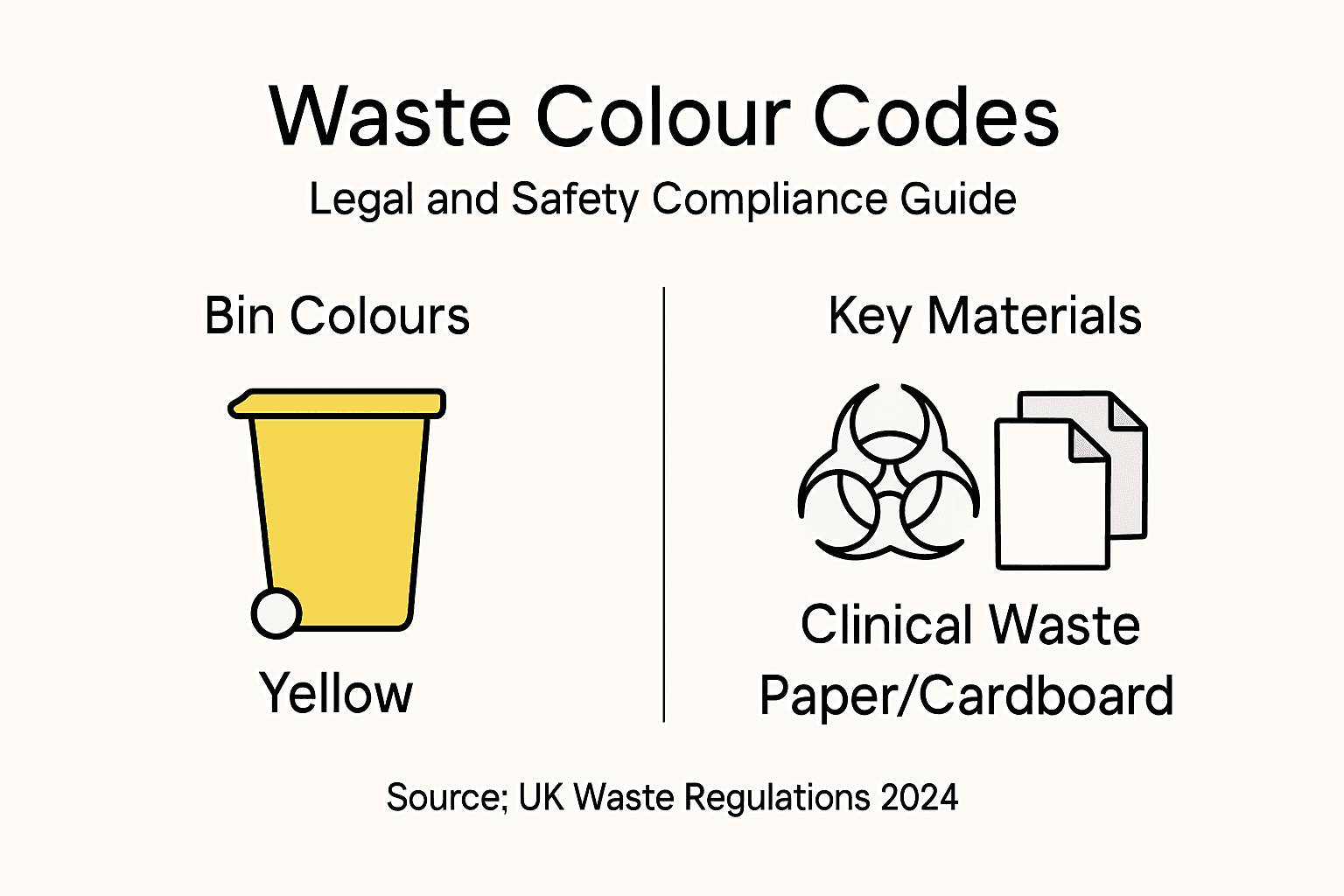
The Separation of Waste (England) Regulations 2024 establishes mandatory standards for how organisations must handle specific waste streams. Your institution must demonstrate that plastic, paper, glass, metal, and food waste undergo separate collection according to these officially mandated waste segregation requirements. Failure to comply exposes your facility to enforcement action, fines, and reputational damage. Beyond these specified streams, you must maintain duty of care responsibilities that apply to all waste producers in England and Wales. This means documenting waste classification, describing materials accurately, and maintaining transfer notes that track waste from generation through final disposal. When waste leaves your facility, you become legally responsible for ensuring the contractor who collects it possesses proper authorisation and operates legitimate treatment facilities.
Practically speaking, your documentation system must capture several critical elements. First, maintain waste transfer notes whenever external contractors collect segregated waste streams. These documents record waste type, quantity, disposal method, and the contractor’s authorisation details. Second, implement internal segregation records showing which departments generate which waste categories and the volumes segregated monthly. Many NHS trusts and universities in Birmingham, Bristol, and Newcastle now use digital systems that photograph bin contents at segregation points, creating timestamp-verified evidence of compliance. Third, retain records of staff training demonstrating that your team understands colour coding systems and segregation requirements. Regulators increasingly expect proof that staff possess current knowledge, not just that training occurred years ago. Fourth, document any segregation failures or contamination incidents, along with corrective actions taken. This transparency demonstrates genuine commitment to improvement rather than neglect.
The legal consequence of poor documentation extends beyond regulatory penalties. If a waste contractor mishandles your facility’s waste improperly, your institution retains shared liability because you failed to monitor their operations adequately. A healthcare facility in Manchester discovered this painfully when clinical waste supposedly destined for incineration appeared in a landfill; despite the contractor’s primary culpability, the hospital faced significant enforcement action because documentation showed inadequate oversight. Your colour coding system provides the visual foundation for segregation, but documentation provides the legal proof that segregation actually occurred.
Pro tip: Photograph your bin stations quarterly and cross-reference images against your documentation system to identify discrepancies between what staff claim they segregate and what actually appears in containers; this simple audit catches training gaps before regulators do.
Common Mistakes and How to Avoid Them
Waste segregation failures don’t happen because staff lack good intentions. They occur because systems are ambiguous, training becomes outdated, or pressures mount during busy periods. Understanding these mistakes before they occur in your facility allows you to build safeguards that catch problems before regulators do. The most common errors cluster around three areas: contamination through mixing incompatible materials, hazardous waste handling failures, and inadequate system documentation.
Mixing recyclable materials stands as the single most frequent problem across UK healthcare and educational facilities. Staff place cardboard and paper together in blue bins, then add plastic packaging, reducing the entire load’s value and forcing contamination-level disposal costs. Food waste creates similar chaos when someone deposits a yoghurt cup in the paper bin, rendering the entire collection unsuitable for recycling. The separate collection of different recyclable materials requires maintaining distinct streams, yet many facilities ignore this requirement through unclear bin labelling or insufficient staff communication. In Leeds teaching hospitals, one audit discovered that 34 percent of blue bins contained contaminating plastic items, doubling disposal costs for that stream. Prevention requires explicit labelling showing not just the colour but photographic examples of acceptable materials. A label reading “blue bin” means nothing; a label showing “paper and cardboard only” with images of actual acceptable items transforms compliance dramatically. Second, many facilities fail to segregate hazardous waste by category. Prohibited mixing of hazardous wastes with each other creates chemical reaction risks and violates regulations. Yellow bins sometimes receive pharmaceutical residues alongside sharps, when regulations require separate handling. Purple cytotoxic bins occasionally receive standard clinical waste, necessitating expensive reclassification. These errors stem from staff confusion about hazard categories rather than deliberate rule-breaking.
Third, many facilities underestimate documentation requirements. Staff segregate materials correctly at point of generation but maintain inadequate records demonstrating this compliance. Transfer notes lack detail about waste composition, contractor authorisation remains unverified, and staff training records prove non-existent. When regulators inspect, correct segregation becomes irrelevant because the facility cannot prove it occurred systematically. This documentation gap disproportionately affects university research facilities in Manchester and Glasgow where multiple departments generate specialised waste requiring categorisation.
To help prevent common segregation errors, consider how mistakes affect compliance and costs:
| Mistake Type | Impact on Compliance | Financial Consequence | Prevention Strategy |
|---|---|---|---|
| Mixing recyclables | Breaches recycling protocols | Higher disposal fees, lost value | Clear labels, staff retraining |
| Hazardous waste error | Regulatory violations | Costly reclassification, legal risks | Colour-coded bins, regular audits |
| Poor documentation | Inspection failure | Fines, reputational harm | Systematic record keeping |
Pro tip: Conduct monthly bin audits by photographing random selections from each colour category, then cross-reference contents against your facility’s segregation guidelines to catch drift patterns before they become systemic problems.
Simplify Your Waste Segregation Compliance with Expert Support
Navigating the complexities of waste segregation colour codes and legal compliance can be challenging for healthcare facilities and educational institutions alike. The need to prevent contamination, ensure safe handling, and maintain detailed documentation creates pressure on your staff and systems. At Venture Waste, we understand these critical pain points and offer tailored solutions that align with your operational requirements and regulatory responsibilities.

Benefit from our comprehensive waste management services that make compliance straightforward and efficient. From precise segregation guidance to reliable collection and documentation, we support you at every step. Explore how our Waste Collection Process in the UK for Businesses 2025 and insights into How the Waste Collection Network in UK Serves Businesses in 2025 can enhance your protocols today. Stay informed on regulations through our dedicated regulation Archives. Visit us now at https://venturewaste.co.uk and secure a safer, more legally compliant waste management system for your organisation.
Frequently Asked Questions
What are the waste segregation colour codes used in healthcare settings?
The common waste segregation colour codes in healthcare settings are yellow for infectious and hazardous waste, black for general non-recyclable waste, blue for clean paper and cardboard, and green for compostable materials. Each colour represents specific handling and disposal procedures to ensure safe waste management.
Why is it important to segregate waste properly in healthcare facilities?
Proper waste segregation is crucial in healthcare facilities to reduce contamination, lower disposal costs, and ensure compliance with legal regulations. Incorrectly disposed waste can pose health risks and lead to violations, which may result in fines and reputational damage.
How can staff ensure compliance with waste segregation regulations?
To ensure compliance, staff should be trained on colour coding systems, maintain accurate documentation of waste types and quantities, and conduct regular audits of waste segregation practices. Providing clear labels and visual aids at disposal points can also help prevent mistakes.
What are the consequences of poor waste segregation and documentation?
Poor waste segregation can lead to regulatory violations and increased disposal costs. Inadequate documentation can result in fines, legal risks, and reputational damage, as regulators need proof of compliance. Facilities must ensure they keep accurate records to avoid these pitfalls.
Recommended
- Waste Segregation in Factories: Legal and Sustainable Impact – Venture Waste
- Waste Handling Best Practices for UK Businesses in 2025 – Venture Waste
- Hazardous Waste Regulations UK 2025: Essential Guide for Businesses – Venture Waste
- Waste Disposal Fines UK 2025: What Every Business Must Know – Venture Waste
- Is it a Legal Requirement to Have Emergency Lighting? | LED Supply & Fit


Leave a Reply
Want to join the discussion?Feel free to contribute!