

Waste Management Trends 2026 UK: 30% Efficiency Gains
UK facility managers face unprecedented pressure to navigate evolving waste regulations while controlling costs in 2026. IoT-enabled waste monitoring reduces collection frequency by 30%, transforming operational efficiency. This guide examines five critical trends reshaping waste management, from digital optimization to circular economy practices, helping you select solutions that balance compliance, sustainability, and budget requirements.
Table of Contents
- Selection Criteria For Evaluating Waste Management Solutions In 2026
- 1. Digital And IoT-Enabled Waste Collection Optimization
- 2. Automated Waste Sorting Technologies
- 3. Circular Economy And Sustainability Practices
- 4. On-Site Waste Treatment Solutions
- 5. Waste Service Models Comparison
- Summary Comparison And Situational Recommendations
- Discover Tailored UK Waste Management Solutions For 2026
- Frequently Asked Questions About Waste Management Trends 2026 UK
Key Takeaways
| Point | Details |
|---|---|
| IoT sensors | Cut waste collection trips by 30% through real-time monitoring |
| Automated sorting | Increases recycling rates from 55% to 75% in commercial facilities |
| Circular economy | Reduces annual waste generation by 15% through reuse strategies |
| On-site treatment | Lowers disposal costs by 25% while cutting transport emissions |
| Service models | Subscription plans offer predictable costs; segregated skips boost recycling 35% |
Selection Criteria for Evaluating Waste Management Solutions in 2026
Choosing the right waste management approach demands a structured evaluation framework. Effective waste management integrates regulatory compliance, technological efficiency, cost control, and sustainability alignment, essential for UK facilities in 2026.
Compliance forms your foundation. Updated UK waste regulations in 2026 mandate stricter segregation and reporting, making regulatory adherence non-negotiable. Technology integration follows closely, with IoT sensors and analytics platforms driving measurable efficiency gains.
Cost-effectiveness determines long-term viability. Calculate total ownership costs, including capital investment, operational expenses, and potential savings from reduced pickups or improved recycling rates. Solutions must scale appropriately for your facility size and waste types, whether you manage a small office or large industrial complex.
Sustainability alignment increasingly influences selection. Circular economy principles now feature in 70% of UK facility sustainability reports, reflecting stakeholder expectations and regulatory trends. Evaluate how solutions support your environmental targets while maintaining operational practicality.
Key selection factors include:
- Transparent compliance monitoring and documentation capabilities
- Integration with existing facility management systems
- Vendor track record with similar UK facilities
- Scalability for future waste stream changes
- Support for waste handling best practices
Pro Tip: Prioritize vendors offering transparent compliance monitoring dashboards. Real-time visibility into regulatory adherence eliminates guesswork and provides audit-ready documentation, giving you peace of mind during inspections.
1. Digital and IoT-Enabled Waste Collection Optimization
IoT technology revolutionizes waste collection through precision timing. Digital platforms integrating IoT sensors reduce waste collection frequency by 30% through real-time monitoring of fill levels, eliminating unnecessary pickups.
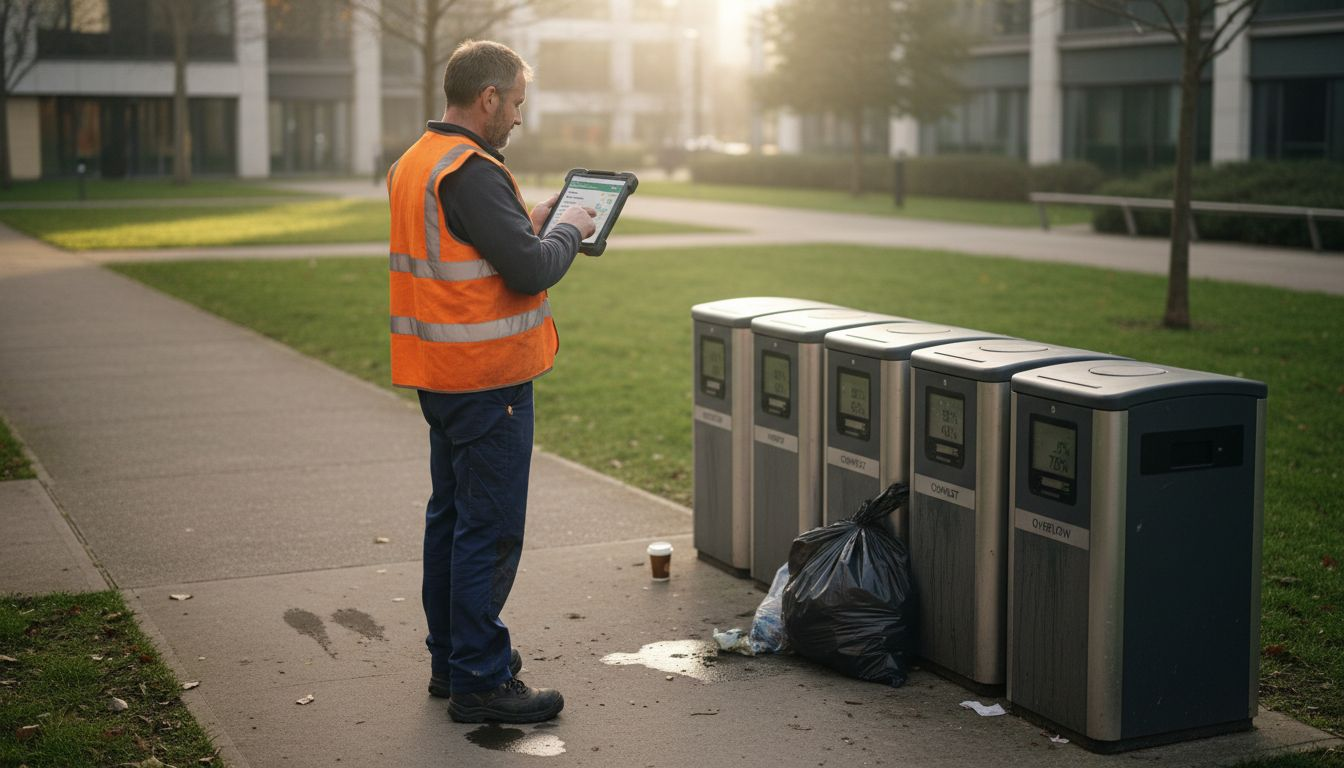
Smart sensors installed in bins transmit fill-level data continuously, allowing collectors to optimize routes based on actual need rather than fixed schedules. This data-driven approach saves fuel costs, reduces vehicle emissions, and frees staff time previously spent on premature collections.
Medium and large UK commercial facilities gain maximum benefit. A Manchester office park with 50 bins reduced annual collections from 260 to 180 pickups after implementing IoT monitoring, cutting costs by £12,000 annually while improving sustainability metrics.
Implementation considerations matter. Upfront sensor investment typically ranges from £50 to £150 per bin, with monthly platform fees between £200 and £500 depending on scale. Battery-powered sensors last 3-5 years, minimizing maintenance.
Compliance documentation improves automatically. Digital platforms generate detailed collection records, waste volumes, and timing data required for regulatory reporting. This eliminates manual logging errors and provides auditors with comprehensive evidence trails.
Key implementation steps:
- Conduct waste audit to identify high-volume collection points
- Calculate ROI based on current collection frequency and costs
- Select sensors compatible with existing bin infrastructure
- Train staff on platform dashboards and alert systems
- Review UK waste management news 2026 for regulatory updates affecting digital monitoring
Pro Tip: Pilot IoT-enabled bins in one high-traffic area for three months. Document savings in collection costs, staff time, and emissions to build an evidence-based business case before facility-wide rollout.
Integration with waste handling best practices creates compound benefits, combining technological efficiency with operational excellence.
2. Automated Waste Sorting Technologies
Automated sorting transforms recycling efficiency through mechanical precision. Automated sorting increases recycling rates from 55% to 75% compared to manual sorting in UK commercial facilities, a 20-percentage-point improvement that significantly impacts sustainability goals.
Optical scanners, air jets, and magnetic separators process mixed recyclables at speeds exceeding 60 items per second. These systems identify materials by composition, color, and shape, directing each item to appropriate processing streams with 95% accuracy.
Labor cost reductions prove substantial. A Birmingham distribution center reduced sorting labor by 40% after installing automated equipment, reallocating three staff members to higher-value roles while improving sorting consistency. Contamination rates dropped from 8% to 2%, increasing the value of recycled materials.
Capital investment requires careful evaluation. Entry-level sorting systems start at £80,000, with enterprise solutions exceeding £500,000 for high-volume operations. Payback periods typically range from 18 to 36 months, depending on waste volumes and avoided disposal costs.
Facilities handling diverse recyclable streams gain optimal returns. Manufacturing sites generating metal, plastic, cardboard, and glass waste benefit most, as automated systems efficiently separate multiple material types simultaneously. Single-stream recycling programs particularly benefit from contamination reduction.
Compliance with UK recycling mandates becomes straightforward. Automated systems generate detailed reports on material types, volumes, and diversion rates required for regulatory submissions.
Implementation considerations:
- Assess waste composition and volumes to determine system capacity needs
- Calculate avoided landfill costs and improved material values
- Plan for staff training on equipment operation and maintenance
- Verify compliance with UK health and safety regulations for automated equipment
- Consider modular systems for future scalability
Space requirements vary. Compact units fit within 50 square meters, while comprehensive sorting lines may require 200-300 square meters. Evaluate existing facility layouts before committing to specific equipment configurations.
3. Circular Economy and Sustainability Practices
Circular economy principles deliver measurable waste reduction. Circular economy strategies reduce waste generation by 15% annually among UK businesses through systematic reuse, refurbishment, and material recovery approaches.
Seventy percent of UK facility managers now incorporate waste metrics in sustainability reports, reflecting stakeholder demands for environmental accountability. This shift transforms waste from an operational afterthought to a strategic performance indicator affecting brand reputation and investor relations.
Implementing circular practices requires operational culture shifts. A Leeds manufacturing facility achieved 18% waste reduction by redesigning packaging for reusability, establishing supplier take-back programs, and training staff on material recovery techniques. Initial resistance faded as cost savings became apparent.
Practical circular strategies include:
- Product lifecycle design emphasizing durability and repairability
- Supplier partnerships for packaging return and refill systems
- Internal reuse programs for office furniture, electronics, and materials
- Donation channels for functional items no longer needed
- Material exchange platforms connecting waste generators with users
Regulatory alignment strengthens. UK waste policy increasingly favors circular approaches through extended producer responsibility schemes and landfill restrictions. Facilities demonstrating circular practices gain competitive advantages in procurement evaluations and public tenders.
Cost savings compound over time. Beyond disposal fee reductions, circular practices decrease raw material purchases, extend asset lifecycles, and create revenue from recovered materials. A Bristol office complex generated £15,000 annually by selling segregated cardboard, metals, and electronics.
Reducing business waste in 2026 requires systematic assessment. Conduct quarterly waste audits to identify reduction opportunities, track material flows, and measure progress against baseline metrics.
Staff engagement proves critical. Employees closest to processes often identify practical improvement opportunities managers overlook. Establish feedback mechanisms and recognize contributions to build momentum for cultural change.
4. On-site Waste Treatment Solutions
On-site processing capabilities deliver significant operational advantages. On-site waste treatment reduces disposal costs by 25% while lowering transport emissions through localized handling of high-volume waste streams.
Compaction equipment reduces waste volumes by 75-90%, dramatically decreasing collection frequency and costs. A Cardiff hotel chain installed compactors at five properties, reducing weekly pickups from three to one per location, saving £42,000 annually in collection fees.
Organic waste digesters suit facilities generating food waste. Aerobic digestion units process kitchen waste on-site, producing compost for landscaping while eliminating disposal costs and methane emissions from landfill decomposition. Processing capacity ranges from 50 to 500 kilograms daily.
Large industrial and commercial facilities with consistent high-volume waste generation gain maximum benefit. Distribution centers, manufacturing plants, hotels, and hospitals typically achieve fastest ROI due to substantial baseline disposal costs.
Compliance control improves. On-site treatment provides direct oversight of waste handling, ensuring proper procedures and documentation. This visibility reduces regulatory risk compared to relying entirely on third-party disposal.
Implementation requires:
- Space allocation for equipment installation and operation
- Staff training on operation, safety, and maintenance procedures
- Utility connections for power and potentially water
- Ventilation and odor control for organic processing
- Regular maintenance schedules to ensure optimal performance
Capital costs vary widely. Compactors range from £3,000 for small vertical units to £25,000 for heavy-duty horizontal models. Organic digesters start at £15,000 for small capacity, reaching £150,000 for industrial-scale systems.
Permitting requirements differ by location and waste types. Consult local authorities regarding planning permission, environmental permits, and operational restrictions before proceeding. Some on-site treatments may require waste carrier licenses.
Waste handling best practices integrate seamlessly with on-site treatment, combining equipment efficiency with procedural excellence for comprehensive waste management.
5. Waste Service Models Comparison
Service model selection significantly impacts operational efficiency and costs. Subscription waste services are favored by 40% of UK commercial facilities for predictable monthly expenses and simplified budgeting.
Subscription models provide fixed pricing regardless of collection frequency variations. Monthly fees typically range from £150 to £600 depending on waste volumes and service levels. This predictability helps finance teams forecast expenses accurately and eliminates surprise invoices during high-generation periods.
Segregated skip hire offers superior recycling performance. Segregated skips increase recycling rates by 35% compared to mixed skips, as material contamination decreases and sorting accuracy improves. Dedicated skips for cardboard, metals, plastics, and general waste enable higher material recovery values.
Confidential waste requires specialized handling. Secure tracking is preferred by 90% of commercial clients for sensitive documents, with chain-of-custody documentation and destruction certificates providing audit trails. This service proves essential for financial, legal, healthcare, and government facilities managing personal data.
| Service Model | Best For | Key Advantage | Typical Cost |
|---|---|---|---|
| Subscription | Predictable waste volumes | Budget stability | £150-£600/month |
| Segregated Skip Hire | High recycling targets | 35% higher diversion | £180-£400/skip |
| Confidential Destruction | Sensitive documents | Secure chain of custody | £120-£300/collection |
| On-Demand Collection | Variable waste generation | Pay only when needed | £80-£200/pickup |
Facility size and waste characteristics determine optimal model selection. Small offices with consistent low volumes benefit from subscription simplicity, while larger facilities with variable generation may prefer on-demand flexibility. Manufacturing sites generating recyclable materials maximize value through segregated collection.
Combining models creates tailored solutions. A Glasgow business park uses subscription service for general waste, segregated skips for recyclables, and quarterly confidential destruction collections. This hybrid approach optimizes costs while addressing diverse waste stream requirements.
Compliance considerations vary by model. Subscription services typically include documentation as standard, while on-demand models may charge separately for detailed reporting. Verify included services before committing to ensure regulatory requirements are met.
Skip hire options and confidential waste collections provide specialized solutions for distinct facility needs.
Summary Comparison and Situational Recommendations
Tailoring waste solutions to facility characteristics boosts compliance, recycling performance, and cost efficiency through strategic alignment of technology, service models, and operational requirements.
| Solution | Cost Savings | Recycling Rate | Compliance Ease | Best Application |
|---|---|---|---|---|
| IoT Collection | 30% reduction in pickups | Moderate improvement | High (automated tracking) | Medium to large facilities |
| Automated Sorting | 25% labor cost decrease | 75% rate achieved | High (detailed reporting) | High-volume recyclables |
| Circular Economy | 15% waste reduction | Significant increase | Moderate (requires documentation) | All facility types |
| On-site Treatment | 25% disposal cost cut | Varies by method | High (direct control) | Large consistent volumes |
| Subscription Model | Predictable budgeting | Depends on segregation | Moderate to High | Stable waste generation |
Recommendations by facility profile:
Medium to Large Commercial Facilities: Implement IoT-enabled collection optimization to reduce pickup frequency by 30%. Combine with subscription models for budget predictability. Expected annual savings range from £8,000 to £25,000 depending on baseline collection costs.
Recycling-Focused Operations: Deploy automated sorting technology to achieve 75% recycling rates. Pair with segregated skip hire to maximize material recovery values. Initial investment of £80,000-£150,000 typically pays back within 24-30 months.
High-Volume Generators: Install on-site treatment equipment to reduce disposal costs by 25% while cutting transport emissions. Compaction or organic digestion suits different waste streams. Facilities generating over 10 tonnes monthly achieve fastest ROI.
Budget-Conscious Managers: Adopt subscription services providing cost certainty. Supplement with selective circular economy initiatives requiring minimal capital investment. Focus on staff training and procedural improvements before major technology investments.
Compliance-Driven Facilities: Combine IoT monitoring with automated sorting for comprehensive documentation and reporting. Digital platforms generate audit-ready records reducing regulatory burden. Healthcare, financial, and government facilities benefit most.
Implement solutions incrementally. Pilot one approach, measure results for three to six months, then expand based on demonstrated value. This phased strategy minimizes risk while building organizational confidence in new methods.
Waste management solutions must align with your specific operational context, regulatory environment, and sustainability objectives for optimal results.
Discover Tailored UK Waste Management Solutions for 2026
Navigating waste management complexity requires expert guidance and proven solutions. Whether you need optimized collection schedules, specialized handling for hazardous materials, or secure confidential waste destruction, professional support ensures compliance and efficiency.

Explore comprehensive waste collection best practices tailored to UK facilities seeking 2026 regulatory alignment. Access specialized hazardous waste collection services meeting stringent safety and environmental standards. Secure your sensitive documents through certified confidential waste collections providing complete chain-of-custody tracking. Implementing these solutions positions your facility for sustainable operations, reduced costs, and effortless compliance throughout 2026 and beyond.
Frequently Asked Questions about Waste Management Trends 2026 UK
What compliance requirements changed for UK waste management in 2026?
UK facilities now face stricter segregation mandates, enhanced duty of care documentation, and expanded producer responsibility schemes. Digital record-keeping became mandatory for commercial waste transfers, requiring detailed tracking of waste types, volumes, and disposal methods. Review waste compliance steps for comprehensive guidance.
How does real-time waste monitoring benefit facility operations?
Real-time monitoring reduces collection frequency by 30% through data-driven scheduling, eliminating unnecessary pickups. Sensors provide fill-level visibility, optimize collection routes, and generate automatic compliance documentation. This technology cuts costs, reduces emissions, and frees staff time while improving regulatory adherence.
Can circular economy principles integrate with daily facility operations?
Circular practices integrate through systematic approaches: redesigning processes for reusability, establishing supplier take-back programs, creating internal reuse channels, and training staff on material recovery. Start with waste audits identifying reduction opportunities, then implement changes incrementally. Facilities achieve 15% waste reduction annually through consistent application of circular principles.
What are cost implications of adopting automated sorting technology?
Automated sorting systems require £80,000 to £500,000 capital investment depending on capacity needs. However, they reduce labor costs by 40%, increase recycling rates from 55% to 75%, and decrease contamination from 8% to 2%. Payback periods typically range from 18 to 36 months, with facilities processing over 50 tonnes monthly achieving fastest returns.
How is data security maintained in confidential waste management?
Confidential waste services provide chain-of-custody documentation tracking materials from collection through destruction. Secure containers with tamper-evident seals protect contents during transport. Destruction occurs at certified facilities using cross-cut shredding or incineration, with certificates of destruction providing audit evidence. Ninety percent of commercial clients require this secure tracking for regulatory compliance and risk management.
Recommended
- Waste Reduction for SMEs: Practical UK Strategies for 2025 – Venture Waste
- Waste Management Challenges UK: Solutions for Businesses 2025 – Venture Waste
- Waste Management News UK 2025: What Businesses Need to Know – Venture Waste
- How UK Businesses Can Save Money on Waste Management in 2025 – Venture Waste


Leave a Reply
Want to join the discussion?Feel free to contribute!