

Waste Management Legal Issues in the UK – Business Impact
British businesses face more waste management legal issues today than ever before. With over 200 different regulations affecting commercial disposal, companies often struggle to keep up with changing requirements and avoid heavy fines. This complicated legal framework matters because missing even one detail can put your entire operation at risk. Here, you will uncover what every organisation needs to know to stay compliant, safeguard reputation, and support truly responsible waste practices.
Table of Contents
- Defining Waste Management Legal Issues
- Key UK Regulations Governing Waste Disposal
- Types of Waste and Classification Rules
- Legal Duties for Businesses and Organisations
- Risks, Penalties and Common Mistakes
Key Takeaways
| Point | Details |
|---|---|
| Understanding Legislation | Familiarise yourself with key waste management laws like the Environmental Protection Act 1990 and the Landfill Directive to ensure compliance. |
| Waste Classification | Properly categorise waste types to adhere to handling and disposal regulations, especially for hazardous materials. |
| Proactive Compliance | Conduct regular audits and maintain documentation to stay compliant with evolving regulations and mitigate risks. |
| Consequences of Non-Compliance | Be aware that failing to comply can result in substantial fines and reputational damage, making rigorous waste management essential. |
Defining Waste Management Legal Issues
Waste management legal issues represent a complex framework of regulations designed to control and minimise environmental impact from commercial and industrial waste disposal practices across the United Kingdom. The legislative landscape is primarily governed by key statutes like the Environmental Protection Act 1990, which establishes comprehensive guidelines for waste classification, handling, and responsible disposal.
Businesses operating in the UK must navigate a multifaceted legal environment that encompasses multiple regulatory requirements. Waste management regulations encompass diverse areas including waste categorisation, transportation, treatment, and final disposal methods. These legal frameworks mandate that organisations develop systematic approaches to waste reduction, recycling, and environmentally sustainable practices. Companies are legally obligated to demonstrate due diligence in tracking waste streams, maintaining accurate documentation, and ensuring compliance with local and national environmental protection standards.
The legal complexities surrounding waste management extend beyond simple disposal protocols. Organisations must understand nuanced distinctions between different waste categories, such as hazardous and non-hazardous materials, each carrying specific legal requirements for handling and processing. Non-hazardous waste treatment guidelines provided by government agencies offer critical insights into the precise legal expectations for businesses across various industrial sectors.
Pro Tip: Conduct a comprehensive waste audit annually to ensure your organisation remains fully compliant with current waste management legal requirements and identifies potential areas for improved environmental sustainability.
Understanding these legal frameworks is not merely about avoiding potential penalties but represents a fundamental commitment to responsible environmental stewardship and sustainable business practices in the modern UK commercial landscape.
Key UK Regulations Governing Waste Disposal
Waste disposal regulations in the United Kingdom represent a sophisticated legal framework designed to protect environmental integrity and promote sustainable waste management practices. The Waste and Emissions Trading Act 2003 stands as a cornerstone legislation that introduced critical mechanisms like the Landfill Allowance Trading Scheme, fundamentally transforming how businesses approach waste management and disposal strategies.
Key regulatory frameworks encompass multiple interconnected statutes that businesses must comprehensively understand. The Landfill Directive, implemented across the UK, establishes stringent requirements for waste disposal operations, including precise waste acceptance criteria and comprehensive environmental protection measures. These regulations mandate that organisations develop robust waste management systems that prioritise reduction, recycling, and responsible disposal methods. Businesses must demonstrate meticulous compliance through detailed documentation, tracking waste streams, and implementing environmentally sustainable practices.
The regulatory landscape is further complicated by additional legislative instruments such as the Environmental Protection Act and the Hazardous Waste Regulations. These laws create a comprehensive framework that classifies different waste types, prescribes specific handling protocols, and establishes significant financial penalties for non-compliance. Waste disposal legal requirements have become increasingly complex, requiring businesses to invest in specialised knowledge and systematic waste management approaches.
Pro Tip: Develop an annual compliance review process that systematically evaluates your organisation’s waste management practices against current regulatory standards, ensuring proactive adaptation to evolving legal requirements.
Understanding and navigating these intricate regulations is not merely a legal obligation but represents a fundamental commitment to environmental stewardship and sustainable business practices in the modern UK commercial ecosystem.
Here is a summary of major UK waste management regulations and their primary purposes:
| Legislation | Main Focus | Impact on Businesses |
|---|---|---|
| Environmental Protection Act 1990 | Waste classification and control | Establishes duties and guidelines |
| Landfill Directive | Regulation of landfill sites | Imposes landfill restrictions |
| Waste and Emissions Trading Act 2003 | Emissions and landfill trading | Introduces trading schemes |
| Hazardous Waste Regulations | Hazardous waste management | Prescribes handling procedures |
| Radioactive Substances Act 1993 | Radioactive waste management | Sets strict disposal protocols |
Types of Waste and Classification Rules
Waste classification in the United Kingdom represents a sophisticated regulatory mechanism designed to ensure environmental protection and responsible disposal practices. The Environmental Protection Act 1990 provides a comprehensive framework that categorises waste into distinct types, including household, industrial, and commercial waste, each requiring specific management protocols and disposal strategies.

The waste classification system in the UK is intricate, distinguishing between multiple waste categories based on their origin, composition, and potential environmental impact. Hazardous waste receives particular attention, encompassing materials that pose significant risks to human health and environmental safety. These include chemical waste, medical biological waste, electronic equipment, batteries, and substances containing toxic or potentially harmful components. Hazardous waste regulations mandate stringent handling, transportation, and disposal requirements to mitigate potential environmental and health risks.
Moreover, the regulatory landscape extends to specialised waste categories with unique management protocols. The Radioactive Substances Act 1993 establishes rigorous guidelines for radioactive waste management, highlighting the complexity of waste classification beyond conventional industrial and commercial waste streams. Businesses must implement comprehensive waste tracking systems, maintain detailed documentation, and ensure strict compliance with classification rules that dictate appropriate disposal or recycling methodologies.
Pro Tip: Conduct a comprehensive waste audit quarterly to accurately categorise your organisation’s waste streams, ensuring precise classification and compliant disposal strategies.
Navigating these intricate waste classification rules requires a proactive approach, combining technical understanding, regulatory awareness, and a commitment to environmental responsibility.
The following table contrasts key waste categories with their management requirements:
| Waste Type | Risk Level | Management Requirement |
|---|---|---|
| Household Waste | Low to moderate | Standard segregation and disposal |
| Commercial Waste | Moderate | Record-keeping and authorised carriers |
| Hazardous Waste | High | Strict labelling and safe transport |
| Radioactive Waste | Extremely high | Licensed handling and storage |
| Electronic Waste | Moderate to high | Recycling and WEEE compliance |
Legal Duties for Businesses and Organisations
Businesses in the United Kingdom face complex legal obligations regarding waste management, with comprehensive regulatory requirements governing non-hazardous waste treatment and disposal. These legal duties extend far beyond simple waste removal, demanding meticulous compliance with environmental protection standards, documentation protocols, and responsible disposal practices.
The legal framework imposes specific responsibilities on organisations across multiple dimensions of waste management. Businesses must ensure they use only authorised waste carriers, maintain detailed and accurate waste transfer records, and implement robust tracking systems for their waste streams. Waste disposal legislation particularly emphasises electronic waste management, requiring strict adherence to the Waste Electrical and Electronic Equipment (WEEE) regulations, which mandate proper recycling and environmentally conscious disposal of electronic equipment.
Moreover, legal duties encompass a broad spectrum of compliance requirements, including proper waste classification, segregation, and reporting. Organisations must demonstrate due diligence in identifying and managing different waste types, understanding their environmental implications, and implementing appropriate disposal strategies. Financial penalties for non-compliance can be substantial, making it imperative for businesses to develop comprehensive waste management strategies that align with current regulatory standards.
Pro Tip: Develop a dedicated compliance team or appoint a waste management coordinator responsible for staying updated on evolving waste disposal regulations and ensuring your organisation’s continuous legal adherence.
Ultimately, these legal duties represent more than bureaucratic obligations—they reflect a fundamental corporate responsibility to protect environmental resources and contribute to sustainable business practices.
Risks, Penalties and Common Mistakes
Waste management regulations in the United Kingdom impose significant financial and legal risks for businesses that fail to comply with established disposal protocols. Improper disposal practices can result in substantial penalties, with fines potentially reaching up to £400 for seemingly minor infractions such as incorrect waste categorisation or inappropriate bin usage.
The most common mistakes businesses encounter involve misunderstanding waste classification, inadequate record-keeping, and negligent handling of specialised waste streams. Hazardous materials like electronic equipment, chemical waste, and biological substances require meticulous documentation and specific disposal pathways. Business waste penalties can escalate quickly for organisations that fail to implement comprehensive waste management protocols, with potential legal consequences extending beyond monetary fines to include potential criminal prosecution and reputational damage.
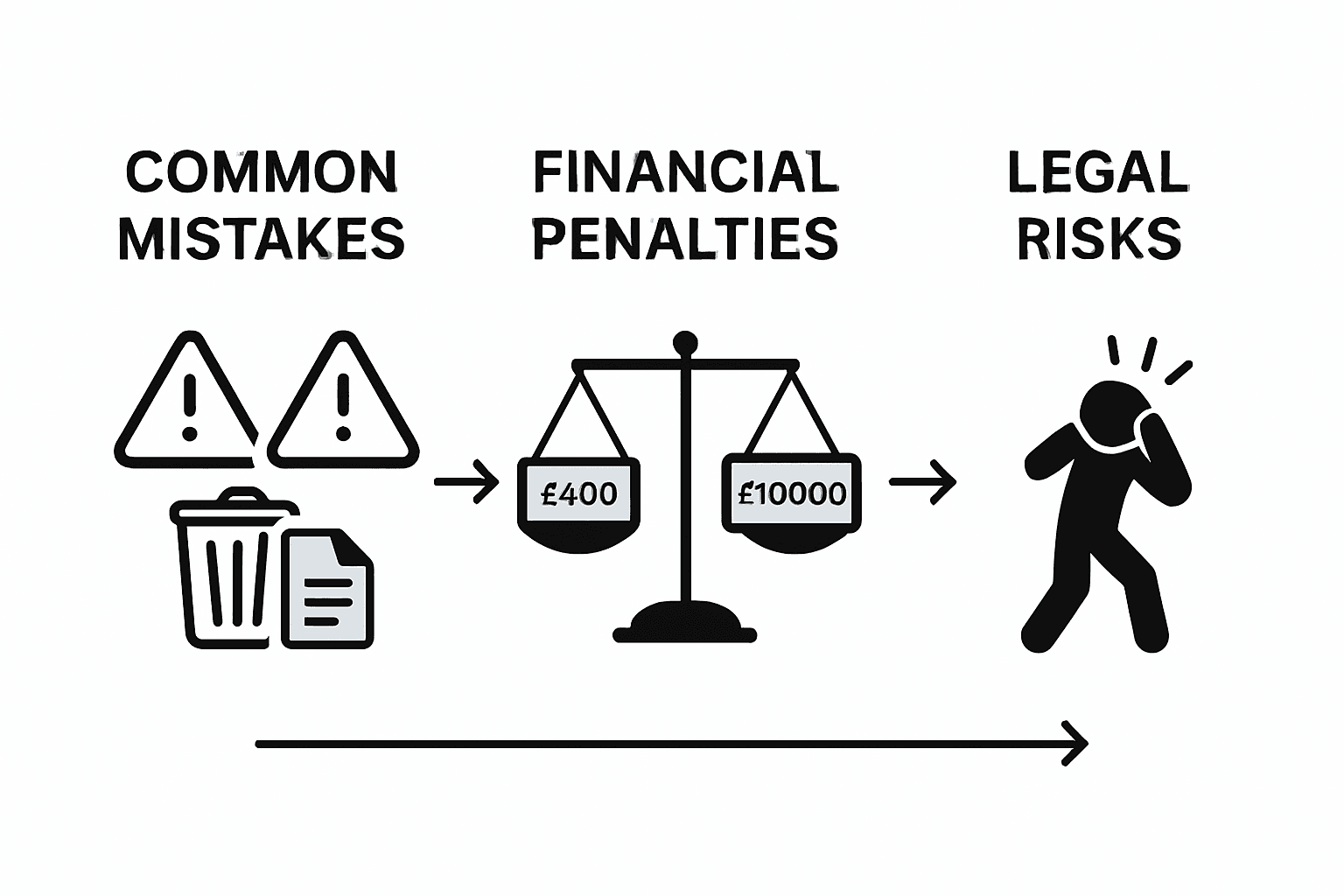
Risks extend beyond immediate financial penalties, encompassing broader environmental and operational implications. Businesses that do not maintain rigorous waste management systems may face increased regulatory scrutiny, potential suspension of operational licences, and significant rehabilitation costs. The regulatory landscape demands not just compliance, but a proactive approach to waste reduction, recycling, and responsible environmental stewardship.
Pro Tip: Implement a quarterly internal waste management audit to proactively identify potential compliance gaps and develop corrective strategies before regulatory intervention becomes necessary.
Navigating the complex terrain of waste management regulations requires vigilance, continuous education, and a commitment to sustainable business practices that prioritise environmental responsibility.
Take Control of Your Waste Management Compliance Today
Navigating the complexities of waste management legal issues in the UK can feel overwhelming for many businesses. From understanding detailed waste classification rules to ensuring full compliance with hazardous waste regulations, the risks of non-compliance are high and penalties can be severe. To meet these challenges effectively, having an experienced partner to simplify your waste disposal process and guarantee adherence to current laws is critical. Discover how How the Waste Collection Network in UK Serves Businesses in 2025 – Venture Waste provides tailored solutions that tackle your compliance headaches while supporting environmental responsibility.

Don’t let complex regulations put your business at risk. With Venture Waste Management, you gain a reliable service that streamlines legal compliance through our straightforward three-step booking process, efficient waste collection systems, and expert handling of all waste types, including hazardous and electronic waste. Take the next step to protect your business and environment by exploring our Waste Collection Process in the UK for Businesses 2025 – Venture Waste. Visit Venture Waste now to secure peace of mind and maintain full legal compliance with confidence.
Frequently Asked Questions
What are the main legal obligations for businesses related to waste management?
Businesses must use authorised waste carriers, maintain detailed waste transfer records, implement tracking systems, and comply with specific waste classification and segregation requirements outlined in various legislative acts.
What are the consequences of failing to comply with waste management regulations?
Non-compliance can result in significant financial penalties, potentially reaching up to £400 for minor infractions, and can lead to legal repercussions, operational licence suspension, and reputational damage.
How can businesses ensure they are compliant with waste management legal standards?
Organisations should conduct regular waste audits, maintain comprehensive documentation, train staff on waste classification, and stay updated on evolving regulations to ensure compliance with waste management standards.
What types of waste require special handling and legal compliance?
Hazardous waste, including chemical, medical, and electronic waste, requires stringent handling protocols, specific documentation, and compliance with additional regulations to mitigate environmental and health risks.
Recommended
- Waste Management Definition for UK Businesses 2025 – Venture Waste
- Waste Management News UK 2025: What Businesses Need to Know – Venture Waste
- Business Waste Penalties UK: Avoid Fines in 2025 – Venture Waste
- Waste Management Challenges UK: Solutions for Businesses 2025 – Venture Waste
- Website Design for Asbestos Abatement Companies


Leave a Reply
Want to join the discussion?Feel free to contribute!