

Waste Management for Offices: Improve Efficiency and Compliance
Managing office waste has never been more complex, especially with the new UK government legislation requiring clear separation of dry recyclables, food waste, and residual waste by March 2025. Facilities managers must now take a closer look at how waste is assessed and separated on-site to remain compliant and avoid operational headaches. This guidance explains each step needed to create a practical, compliant system for handling both general and confidential waste while supporting sustainability and cost control.
Table of Contents
- Step 1: Assess Office Waste Streams And Requirements
- Step 2: Implement Dedicated Waste Separation Stations
- Step 3: Coordinate Scheduled Waste Collection Services
- Step 4: Verify Legal Compliance And Documentation
- Step 5: Review And Optimise Office Waste Practices
Quick Summary
| Key Takeaway | Explanation |
|---|---|
| 1. Conduct a thorough waste assessment | Map your office’s waste streams to identify types and volumes for better management and compliance. |
| 2. Set up effective waste separation stations | Implement colour-coded bins to simplify waste sorting and ensure regulatory compliance in the workplace. |
| 3. Coordinate regular waste collection services | Establish a collection schedule that aligns with your waste production to maintain cleanliness and sustainability. |
| 4. Ensure legal compliance and documentation | Maintain accurate records of waste management processes to avoid penalties and demonstrate environmental responsibility. |
| 5. Regularly review and optimise waste practices | Continuously assess waste performance to identify improvement opportunities and adapt to changing regulations. |
Step 1: Assess office waste streams and requirements
Effectively managing waste in your office begins with a comprehensive waste stream assessment. This critical first step helps you understand exactly what types of waste your organisation produces and how to handle them efficiently.
To conduct a thorough assessment, start by mapping workplace waste categories according to UK government guidelines. Your evaluation should focus on identifying and categorising different waste types:
- General office waste (paper, packaging)
- Electronic equipment waste
- Confidential document waste
- Recyclable materials
- Food waste
- Hazardous waste materials
Measure the volume of each waste category by conducting a week-long waste audit. This involves carefully tracking and weighing different waste types to understand your precise disposal requirements. Consider using digital tracking tools or simple spreadsheets to log your findings.
Accurate waste stream mapping is crucial for developing an effective waste management strategy that ensures legal compliance and environmental responsibility.
Once you have completed your assessment, you’ll be prepared to select appropriate waste containers, determine collection frequencies, and develop targeted waste reduction strategies.
Practical advice: Involve your team in the waste assessment process to increase awareness and encourage active participation in sustainable waste management practices.
Step 2: Implement dedicated waste separation stations
Establishing effective waste separation stations is crucial for meeting UK workplace recycling regulations and improving your organisation’s environmental performance. By creating strategically located waste collection points, you’ll streamline your waste management process and support sustainable practices.
To implement compliant waste stations, design clear waste segregation infrastructure that aligns with the 2025 workplace recycling guidelines. Your waste stations should include distinctly colour-coded and clearly labelled bins for different waste streams:
- Blue bins: Dry recyclable materials
- Brown bins: Food waste
- Grey bins: Residual waste
- White/clear bins: Confidential document disposal
- Green bins: General office paper waste
Position these waste stations strategically throughout your workplace, ensuring easy accessibility in high-traffic areas such as kitchens, photocopying rooms, and communal spaces. Each station should feature:
- Clear visual signage explaining waste categories
- Consistent bin colours matching national standards
- Compact, ergonomic bin designs
- Separate containers for different waste types
Effective waste separation begins with making recycling simple, intuitive, and convenient for every employee.
Consider the specific waste generation points in your office and install smaller desk-side bins or department-specific collection points to encourage immediate, correct waste sorting.
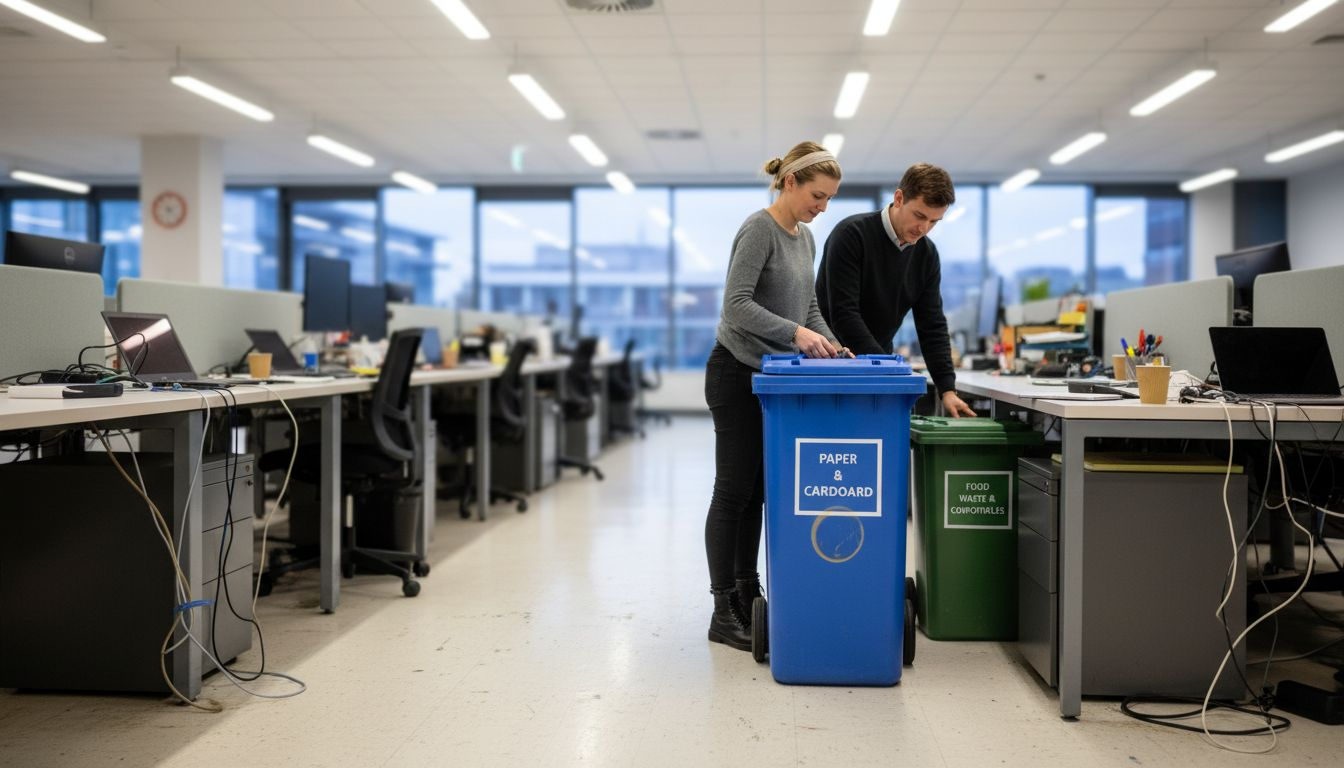
Practical advice: Conduct a brief training session to familiarise staff with the new waste separation system and explain the importance of proper waste categorisation.
Here is a quick reference for colour codes and their associated office waste streams:
| Bin Colour | Waste Stream | Typical Location |
|---|---|---|
| Blue | Dry recyclables | Kitchens, print areas |
| Brown | Food waste | Break rooms, kitchens |
| Grey | Residual waste | Common rooms, corridors |
| White/Clear | Confidential documents | Offices, admin areas |
| Green | Office paper | Meeting rooms, workstations |
Step 3: Coordinate scheduled waste collection services
Successfully managing your office’s waste requires strategic planning and coordination with waste collection services. By establishing efficient collection schedules, you’ll ensure regulatory compliance and maintain a clean, sustainable workplace environment.
To develop an effective waste collection strategy, consider the following key steps:
- Assess waste volume: Determine the quantity of waste generated by each waste stream
- Review collection frequency: Match collection schedules to your specific waste production
- Negotiate service agreements: Secure flexible contracts with waste management providers
- Confirm segregation requirements: Ensure alignment with 2025 workplace recycling regulations
- Set up digital tracking: Monitor waste collection and disposal performance
When engaging waste collection services, prepare a comprehensive brief that outlines:
- Exact waste stream volumes
- Preferred collection frequencies
- Specific segregation requirements
- Compliance with new workplace recycling regulations
Proactive waste collection coordination prevents operational disruptions and supports environmental sustainability goals.
Regularly review and adjust your waste collection arrangements to maintain operational efficiency and regulatory compliance. This might involve quarterly meetings with your waste management provider to discuss performance and potential improvements.
Practical advice: Develop a digital waste management log to track collection schedules, volumes, and compliance, enabling quick adjustments and informed decision-making.
Step 4: Verify legal compliance and documentation
Ensuring your office’s waste management practices meet legal standards is crucial for avoiding potential penalties and maintaining environmental responsibility. By documenting waste management processes, you’ll create a robust framework that demonstrates your commitment to regulatory compliance.
To effectively verify legal compliance, compile and maintain the following critical documentation:
- Waste audit reports: Detailed records of waste volumes and streams
- Collection service contracts: Formal agreements with waste management providers
- Staff training logs: Evidence of employee waste management education
- Waste segregation protocols: Written guidelines for proper waste handling
- Collection and disposal receipts: Proof of proper waste management
Your compliance documentation should address key regulatory requirements:
- Demonstrate consistent waste stream separation
- Show evidence of staff training
- Maintain up-to-date waste management records
- Prepare for potential Environment Agency inspections
Legal compliance is not just about avoiding penalties, but about demonstrating your organisation’s commitment to sustainable practices.
Regularly review and update your documentation to ensure it reflects current regulations and your organisation’s waste management practices. Consider scheduling bi-annual internal audits to identify and address any potential compliance gaps.
Practical advice: Digitise your compliance documents and create a centralized, secure digital repository to ensure easy access and long-term preservation of critical waste management records.
Step 5: Review and optimise office waste practices
Transforming your office’s waste management requires a strategic and continuous approach to evaluating waste performance. By implementing a systematic review process, you’ll uncover opportunities to reduce waste, improve recycling rates, and enhance your organisation’s environmental sustainability.
Develop a comprehensive waste optimisation strategy through these key activities:
- Conduct quarterly waste audits: Measure and analyse waste volumes
- Track recycling percentages: Monitor progress against baseline measurements
- Identify waste reduction opportunities: Analyse waste stream composition
- Engage employee feedback: Understand practical challenges in waste management
- Benchmark against industry standards: Compare performance with sector best practices
Your review process should include systematic evaluation of:
- Current waste generation patterns
- Effectiveness of existing waste separation practices
- Staff understanding and compliance with waste protocols
- Cost implications of waste management strategies
Continuous improvement in waste management is not just an environmental imperative, but a strategic business opportunity.
Regularly update your waste management approach based on audit findings, technological advancements, and changing regulatory requirements. This dynamic approach ensures your office remains adaptable and compliant.
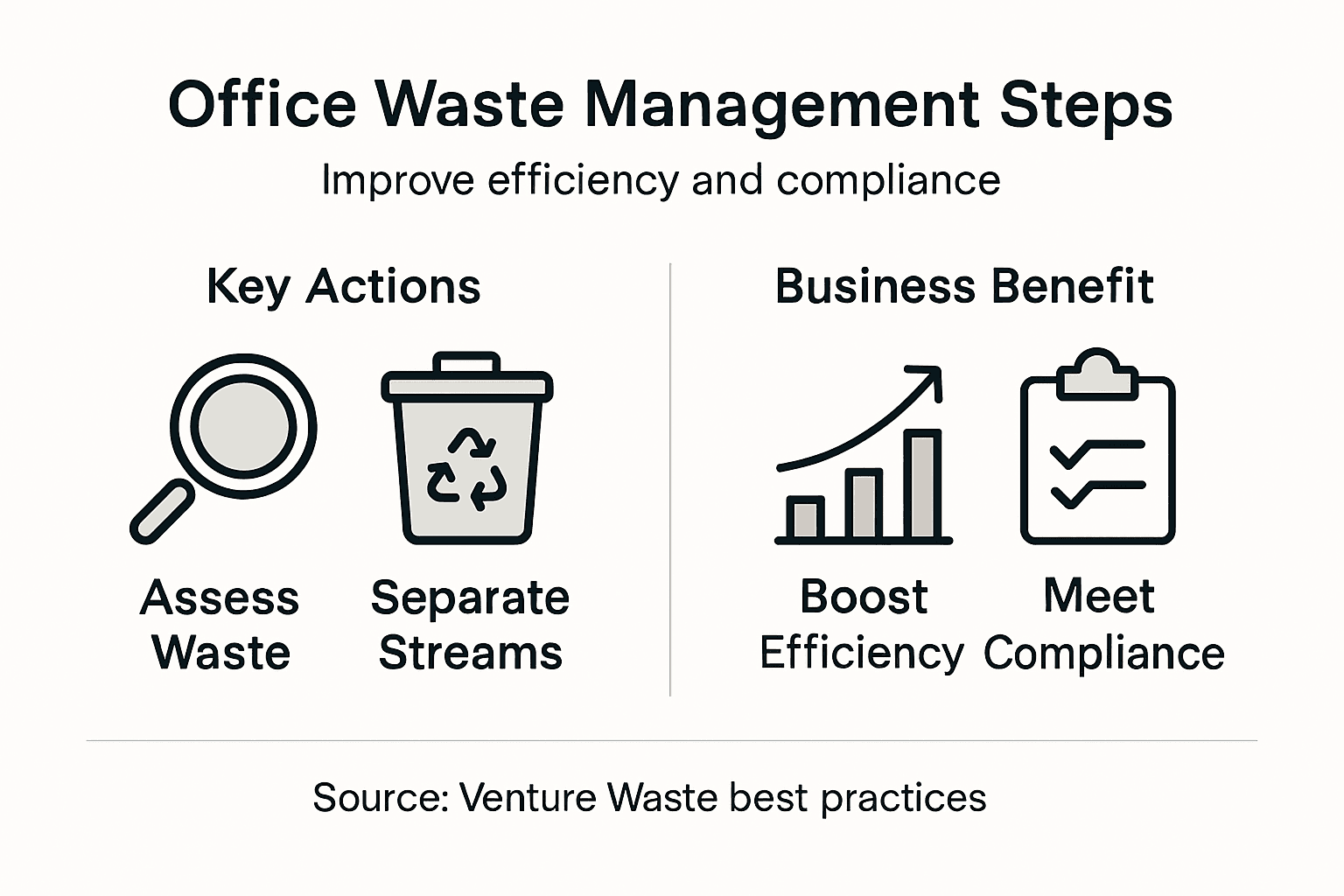
Practical advice: Create a visual dashboard to track waste management metrics, making performance data accessible and engaging for your entire team.
The following table summarises the impact of each recommended office waste management step:
| Step | Main Objective | Business Benefit |
|---|---|---|
| Waste Assessment | Identify and measure waste streams | Informs bins, processes, and policy |
| Separation Stations | Achieve proper waste segregation | Meets regulations, boosts recycling rates |
| Scheduled Collection | Manage collection logistics | Minimises disruption, supports compliance |
| Legal Compliance | Maintain accurate records | Avoids penalties, proves responsibility |
| Ongoing Review | Continually optimise processes | Cuts waste costs, ensures adaptability |
Transform Your Office Waste Management with Venture Waste
Struggling to navigate the complexities of office waste segregation and compliance with evolving UK regulations The article highlights the importance of accurate waste stream assessments and scheduled waste collections to keep your business both efficient and legally compliant. Common pain points include confusion over waste separation, meeting strict documentation requirements and adapting to new workplace recycling laws. By embracing clear waste station setups and regular reviews you take control of your environmental impact and operational costs.

At Venture Waste, we understand these challenges and offer tailored solutions that make managing your office waste simpler and more effective. Explore our detailed Waste Collection Process in the UK for Businesses 2025 – Venture Waste page for practical insight on compliant collection scheduling. If your office handles sensitive documents, our confidential waste Archives – Venture Waste ensures secure disposal meeting legal requirements. Learn more about how the Waste Collection Network in UK Serves Businesses in 2025 – Venture Waste supports your sustainability goals.
Take the next step today by visiting https://venturewaste.co.uk to book a consultation and simplify your journey towards efficient office waste management that protects your business and the environment.
Frequently Asked Questions
How can I assess the waste streams in my office?
Start by conducting a comprehensive waste stream assessment to identify and measure different types of waste your organisation generates. Track and categorise waste over a week to understand your disposal needs and implement efficient management strategies.
What should I include in my office’s waste separation stations?
Create dedicated bins that are clearly labelled and colour-coded for each waste type, such as dry recyclables, food waste, and general office paper. Position these stations in high-traffic areas to encourage proper waste disposal and engagement from all employees.
How do I develop a collection schedule for office waste?
Review the volume and type of waste generated in your office to create an effective waste collection schedule. Coordinate with collection services to ensure regular pickups that align with your organisation’s waste production, adjusting as necessary to maintain cleanliness.
What records should I keep for legal compliance in waste management?
Compile key documents such as waste audit reports, collection service contracts, and staff training logs. Keep your records updated to demonstrate compliance and ensure your organisation is prepared for potential inspections.
How often should I review my office’s waste management practices?
Conduct regular reviews, ideally quarterly, of your waste management practices and strategies. This helps identify waste reduction opportunities and ensures your office adapts to any new regulations or improvements in recycling practices.
What actions can I take to improve employee participation in waste management?
Engage employees with training sessions that highlight the importance of proper waste disposal and recycling. Foster a culture of sustainability by regularly sharing updates on waste performance metrics and celebrating achievements in reducing waste.
Recommended
- Office Confidential Waste Policy UK: Compliance and Best Practices 2025 – Venture Waste
- Office Waste Solutions – Enhancing Compliance and Sustainability – Venture Waste
- How UK Businesses Can Save Money on Waste Management in 2025 – Venture Waste
- Reducing Business Waste in 2025: Practical Strategies for UK Organisations – Venture Waste
- Clean Hacks for Homeowners Tips to Maximize Cleaning Product


Leave a Reply
Want to join the discussion?Feel free to contribute!