

Waste Crime Prevention: Reducing Legal Risks in the UK
Fly-tipping and illegal waste dumping can quickly turn routine waste management into a serious legal and financial risk for institutions in England and Wales. Facilities managers face a growing threat from organised crime networks exploiting weak compliance systems, leaving healthcare and educational sites exposed to environmental damage, public health risks, and prosecution. This guide uncovers the types of waste crime that impact your facility and outlines practical prevention steps to help protect your organisation from costly mistakes and legal liability.
Table of Contents
- Defining Waste Crime And Its Impact
- Common Types Of Waste Crime Offences
- Legal Duties Under Uk Waste Regulations
- Effective Prevention Strategies For Facilities
- Risks And Liabilities For Non-Compliance
Key Takeaways
| Point | Details |
|---|---|
| Understanding Waste Crime | Waste crime involves illegal activities such as fly-tipping and fraudulent waste management, requiring strict compliance to protect organisational integrity. |
| Legal Responsibilities | Institutions must adhere to the duty of care under UK waste regulations, ensuring proper waste handling and documentation to avoid severe penalties. |
| Vetting Contractors | It is crucial to independently verify waste contractors’ licences and maintain clear documentation to mitigate risks associated with unlicensed operators. |
| Implementing Prevention Strategies | Effective strategies, such as secure storage and staff training, are essential for preventing waste crime and reducing institutional liability. |
Defining Waste Crime and Its Impact
Waste crime encompasses far more than simply disposing of rubbish illegally. It includes unlawful dumping of waste, fly-tipping, fraudulent waste management activities, and systematic breaches of environmental regulations. For facilities managers in healthcare and educational institutions, understanding what constitutes waste crime is essential because your organisation’s compliance directly affects your legal exposure and operational integrity.
The definition of waste crime is deliberately broad because the activities it covers are equally varied. At its core, waste crime involves any unauthorised handling, transportation, or disposal of waste materials that violates UK environmental legislation. This ranges from a hospital discarding medical waste without proper documentation to a university paying an unlicensed contractor to remove construction debris. The Environment Agency actively investigates these offences, and organisations face prosecution regardless of whether the illegal activity was intentional or resulted from poor oversight.
Why the Impact Extends Beyond Environmental Damage
When you think about waste crime, the immediate concern is environmental degradation. Illegal dumping sites contaminate groundwater, damage ecosystems, and create public health hazards in communities across the North East and beyond. But the consequences penetrate deeper into your institution’s operations. Academic research highlights that waste crime creates economic consequences, enforcement challenges, and systemic risks to public health that directly affect your organisation’s reputation and finances.
For your healthcare facility or educational institution, the practical impact is significant. Your organisation becomes liable for penalties, remediation costs, and reputational damage if waste crime occurs under your watch. If you unknowingly contract with an unlicensed waste handler who then fly-tips your organisation’s waste, you remain legally responsible. The fines are substantial, and criminal convictions can result in imprisonment for senior managers. Beyond the legal consequences, waste crime disrupts your institution’s ability to operate cleanly and safely, potentially affecting patient care or student wellbeing.
Waste crime also thrives where organised networks exploit weak compliance systems. Fraudulent waste management operations deliberately target institutions with unclear waste procedures or under-resourced facilities teams. They offer discounted rates that seem attractive until investigators arrive at an illegal dumping site and trace the waste back to your organisation. Understanding this ecosystem helps you recognise when something feels wrong, whether that is a contractor who avoids formal contracts or unusually cheap disposal quotes.
Pro tip: Establish a waste contractor vetting checklist that requires proof of correct environmental permits, liability insurance, and waste carrier licensing before signing any disposal agreement. This single step eliminates the vast majority of waste crime risks that catch unprepared facilities teams off guard.
Common Types of Waste Crime Offences
Waste crime offences take many forms, and as a facilities manager, you need to recognise them to avoid inadvertently becoming involved. The most visible offence is fly-tipping, where waste is dumped illegally on land without permission. But this is just one category within a broader spectrum of criminal activities. Illegal waste disposal, unauthorised waste treatment, and fraudulent misclassification represent the main types of waste crime prosecuted across the UK. Understanding each one helps you spot red flags in your own operations.
Fly-tipping itself ranges from a single individual dumping a mattress in a field to sophisticated criminal enterprises disposing of tonnes of contaminated industrial waste. In the North East, enforcement teams have caught operations dumping construction rubble, medical waste, and even hazardous chemicals. What makes fly-tipping particularly problematic for your institution is that you remain liable even if a contractor you hired commits the offence on your behalf. Operating without proper waste carrier licences is another common offence, where individuals or companies transport waste without the required Environment Agency authorisation. These unlicensed operators frequently cut corners on safety, environmental protection, and documentation. Your organisation faces prosecution if you knowingly or negligently use an unlicensed carrier.
Fraudulent Practices and Misclassification
One of the most insidious types of waste crime involves fraudulent practices in waste handling and disposal, including deliberate misclassification of waste types. This happens when hazardous waste is deliberately mislabelled as non-hazardous to avoid expensive disposal costs, or when waste that should undergo specialist treatment gets sent to standard landfills instead. For healthcare facilities and universities handling chemical or biological waste, this risk is particularly acute. Criminals operate what appear to be legitimate waste management businesses but actually divert hazardous materials to illegal dumping sites.
Unauthorised waste treatment is another significant offence category. This occurs when waste processing happens without proper permits or environmental controls. A contractor might claim they can recycle your institution’s materials but actually operate from an unregistered facility without pollution prevention measures. The financial motivation is clear: legitimate waste treatment is expensive, so criminal operations undercut licensed providers by cutting every corner. Your institution’s waste could end up processed in a disused warehouse with no environmental safeguards, potentially creating liability for contamination that persists for years.
The scale of these offences varies dramatically. Small-scale littering might involve a few bags of rubbish, whilst organised criminal networks handle thousands of tonnes. The common thread is that someone profits whilst the environment and public health suffer. For your facilities team, the practical consequence is the same regardless of scale: if your waste is involved in any illegal activity, your institution faces penalties, cleanup costs, and reputational damage.
The following table compares different types of waste crime offences and their key characteristics:
| Offence Type | Typical Method | Main Risk to Institutions |
|---|---|---|
| Fly-tipping | Illegal dumping of waste on unauthorised land | Legal liability if waste traced |
| Unauthorised transport | Using unlicensed waste carriers | Prosecution and fines |
| Fraudulent misclassification | Mislabel hazardous waste as general waste | Severe clean-up costs |
| Unauthorised treatment | Processing waste without permits | Long-term environmental liability |
Pro tip: Request and verify your waste contractor’s Environment Agency waste carrier licence number directly on the Environment Agency website before every contract renewal, rather than accepting copies they provide—this single check prevents the vast majority of unlicensed operator risks.
Legal Duties Under UK Waste Regulations
Your institution’s legal obligations under UK waste regulations are not optional suggestions. They are mandatory duties enforced by the Environment Agency with significant penalties for non-compliance. The foundation of these duties is the duty of care, which applies to everyone involved in waste production, handling, and disposal. Under the Environmental Protection Act 1990, you and your institution must ensure that waste is stored, transported, and disposed of in a manner that prevents environmental harm and protects public health. This duty extends across your entire waste management chain, from the moment waste is generated in your healthcare facility or educational institution through to its final disposal.
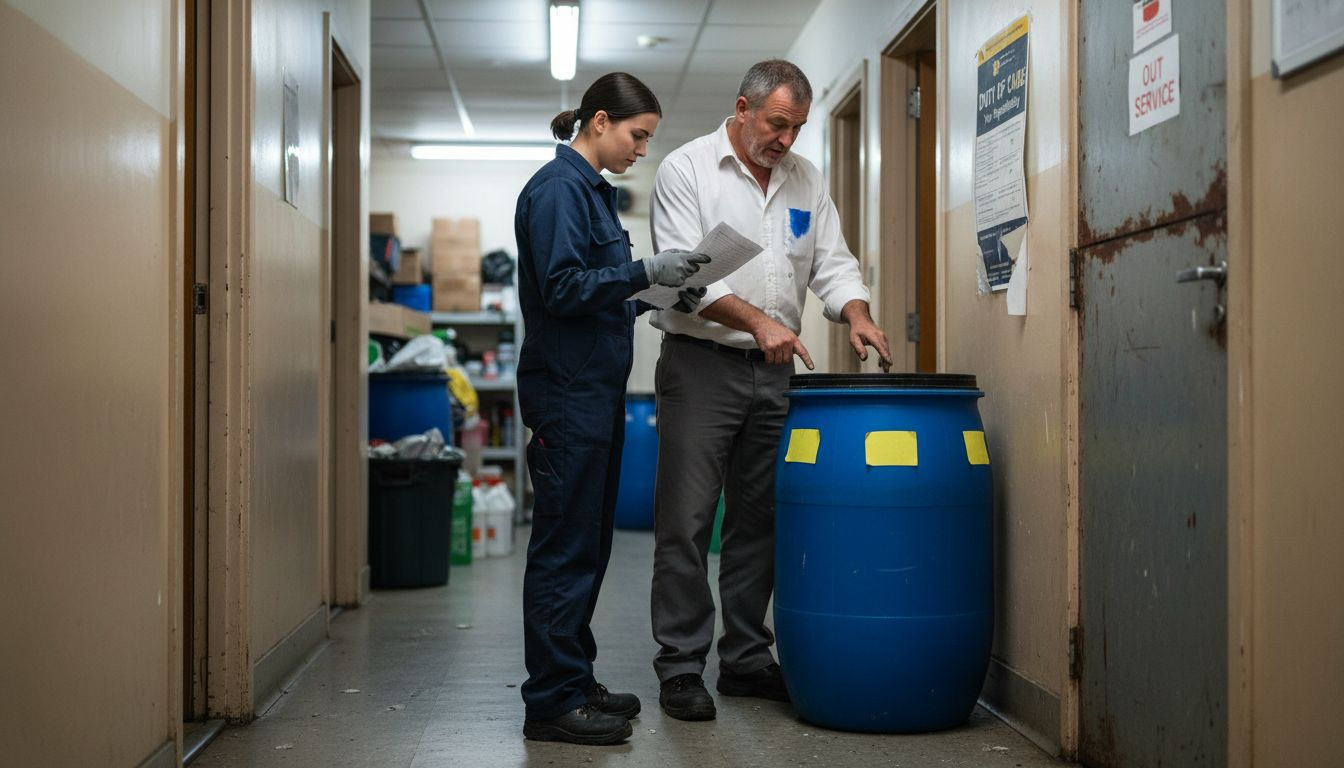
The duty of care creates a cascading responsibility that touches every member of your facilities team. When you produce waste, you become a waste producer with specific obligations. You must classify your waste correctly, store it securely to prevent unauthorised removal or leakage, and only hand it to authorised waste carriers. You cannot simply assume a contractor is legitimate because they offer a competitive price or present themselves professionally. Legal responsibilities require proper documentation and authorised handling throughout the waste management lifecycle, meaning you must maintain records proving that waste left your premises with a licensed carrier who then disposed of it legally. This traceability is your defence against liability if something goes wrong downstream. If waste you handed to a contractor ends up fly-tipped in Sunderland or Newcastle, you need evidence that you fulfilled your duty of care by using a legitimate operator.
Your Specific Institutional Responsibilities
As a facilities manager, your institution’s duties break down into practical, daily actions. You must ensure all waste is properly classified according to its hazard level. Healthcare waste requires different handling than general office waste. Chemical waste from laboratories demands segregation and documentation. You cannot mix waste streams or rely on contractors to sort materials you should have separated. Your team must maintain waste transfer notes for every collection, proving that waste left your building with an authorised carrier and reached its destination. These documents are not paperwork bureaucracy. They are your protection against criminal liability.
Your institution also has a duty to prevent unauthorised persons from accessing your waste. A skip left unlocked overnight where someone deposits illegally dumped materials creates liability for your institution. You must store waste securely, use locked containers when appropriate, and supervise collection to prevent diversion or theft. For hazardous waste, this duty becomes even stricter. You cannot compromise on security or cut corners on storage conditions simply to save money or space.
Breaches of these duties carry real consequences. The Environment Agency prosecutes facilities managers personally, not just institutions, meaning senior staff can face criminal convictions and imprisonment. Your institution faces substantial fines, remediation costs for environmental damage, and reputational harm that affects recruitment, student applications, and public trust.
Pro tip: Create a simple waste management checklist that your team completes weekly, verifying contractor licences are current, transfer notes are filed, and storage areas remain secure and locked—this single document demonstrates your duty of care to regulators and protects your institution from criminal liability.
Effective Prevention Strategies for Facilities
Prevention is far more effective than dealing with the fallout of waste crime. Your facilities team can implement practical strategies that significantly reduce your institution’s legal risk and prevent criminal activity at source. The foundation starts with robust contractor vetting and ongoing monitoring. Before signing any waste management contract, conduct background checks on the company and verify their Environment Agency waste carrier licence independently. Many facilities managers accept documentation provided by contractors, but criminals operate with forged credentials. Ring the Environment Agency directly or check their online register. After contracting, maintain regular contact with your waste provider, requesting proof that collections are occurring on schedule and asking to see their current licensing status quarterly.
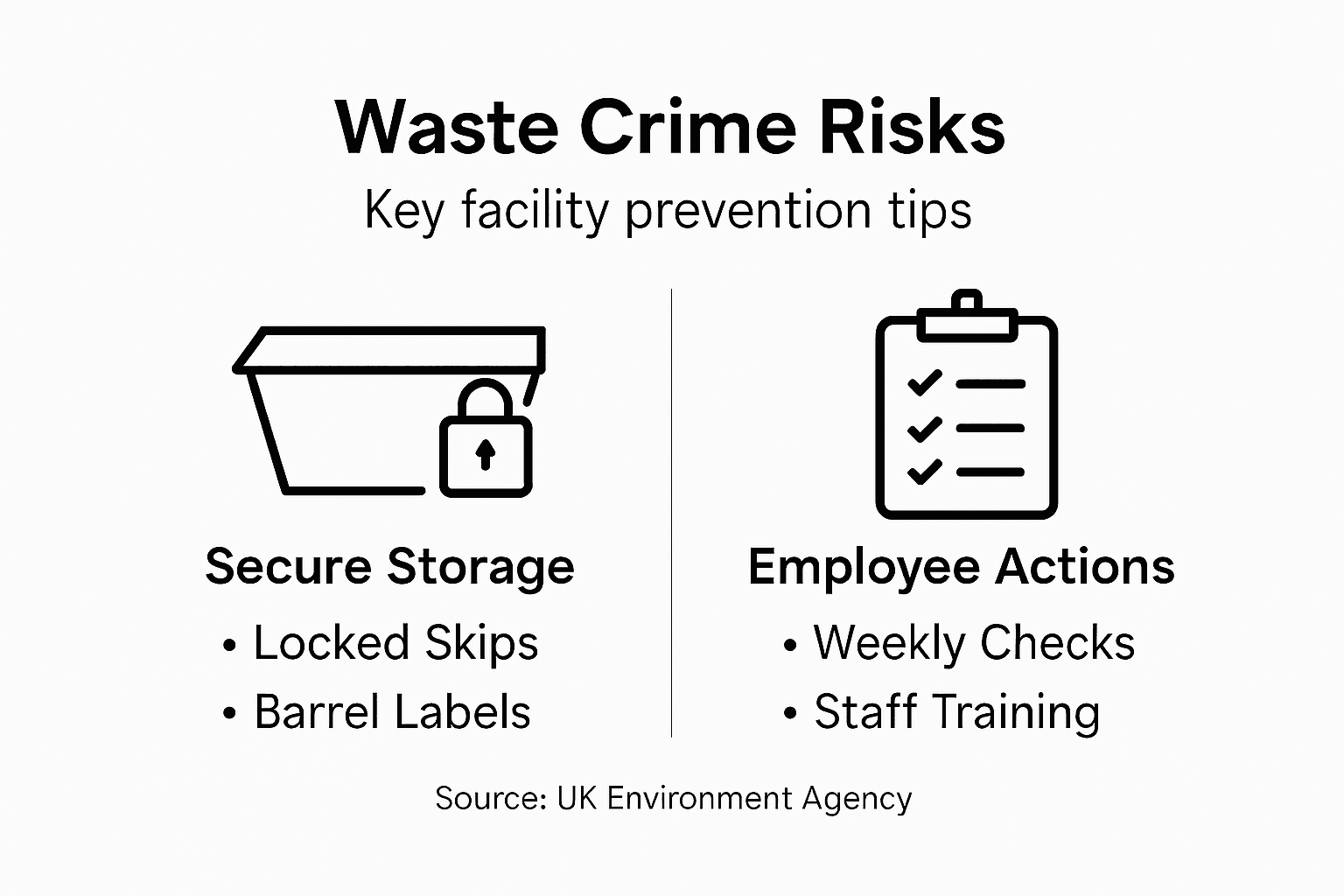
Second, implement secure waste storage across your institution. Waste stored in accessible areas overnight or over weekends becomes a target for theft and illegal diversion. Locked containers, fenced enclosures, and restricted access points prevent unauthorised persons from removing waste or depositing illegally dumped materials into your skips. For healthcare facilities handling pharmaceutical or medical waste, segregation and security are not negotiable. Locked storage also demonstrates to regulators that you have implemented reasonable precautions, which strengthens your legal position if something goes wrong. Third, establish a comprehensive waste documentation system. Rigorous auditing and staff training on proper waste management procedures reduce incidents caused by human error. Your team should complete waste transfer notes for every collection, retain copies, and periodically audit them to ensure consistency. These documents prove your institution fulfilled its duty of care.
Technology and Surveillance
Technology provides additional layers of protection. Deploying CCTV surveillance to monitor waste storage areas and collection points deters criminal activity and provides evidence if unauthorised dumping occurs. For universities and hospitals in the North East with large waste volumes, consider installing cameras overlooking waste enclosures. The deterrent effect alone prevents opportunistic criminals from targeting your site. Additionally, maintain a waste register documenting the type, quantity, and destination of all waste streams. This register becomes invaluable if investigators later question how your institution managed specific waste. You can quickly prove that hazardous materials were sent to licensed facilities or that general waste reached legitimate landfills.
Finally, engage your entire facilities team through regular training. Staff must understand why waste security matters, how to identify suspicious activities, and what to report. A single employee who questions why a contractor arrived without prior notice might prevent a significant incident. Create a simple reporting mechanism where staff can flag concerns without fear of consequences. When combined with clear procedures and accountability, training transforms your team from passive waste producers into active crime preventers.
Here is a summary of effective prevention strategies and the institutional benefits they offer:
| Prevention Strategy | Key Action | Benefit to Institution |
|---|---|---|
| Contractor vetting | Independently verify licences | Reduces legal risk |
| Secure storage | Lock waste areas and restrict access | Prevents theft and illegal dumping |
| Documentation system | Maintain and audit all transfer notes | Provides legal defence and traceability |
| Staff training and awareness | Regular education on waste risks | Early detection and incident prevention |
| CCTV and monitoring | Use cameras at waste collection points | Deters crime and provides evidence |
Pro tip: Photograph and document your waste storage area monthly, timestamping images to build a visual record of your security measures and waste management practices—this photographic evidence becomes invaluable if your institution faces enforcement action, proving you maintained proper controls.
Risks and Liabilities for Non-Compliance
The consequences of non-compliance with waste regulations are severe and extend far beyond a simple fine. Your institution faces multiple overlapping liabilities that can cripple operations, drain finances, and damage reputation irreparably. Under UK law, non-compliance exposes organisations to significant legal risks including fines, prosecution, and enforcement notices. These are not abstract legal concepts. They are real penalties enforced by the Environment Agency with criminal conviction records that follow your institution and its managers personally.
Start with financial penalties. The Environmental Protection Act 1990 allows magistrates to impose unlimited fines for serious breaches of waste management duties. A healthcare facility caught disposing of pharmaceutical waste illegally might face fines ranging from tens of thousands to hundreds of thousands of pounds. But fines represent only the beginning. Your institution becomes liable for remedial costs when waste causes environmental contamination. If your waste ends up polluting groundwater or damaging soil, you pay for investigation, assessment, and remediation. These costs spiral quickly. A single fly-tipping incident involving hazardous chemicals discovered in Gateshead or Durham can generate cleanup bills exceeding £50,000. Beyond financial penalties, enforcement officers can issue stop notices requiring your institution to cease specific waste management practices immediately, disrupting operations until you demonstrate compliance. They can also order your institution to take corrective measures at your expense, which might involve hiring environmental consultants or installing new waste infrastructure.
Criminal Liability and Personal Accountability
The most troubling aspect of waste crime non-compliance is personal criminal liability. Facilities managers and senior staff can face prosecution under the Environmental Protection Act. This is not corporate liability that gets absorbed by your institution. This is criminal conviction on your personal record. Depending on offence severity, guilty verdicts can result in imprisonment for up to two years for serious breaches. A facilities manager convicted of knowingly allowing hazardous waste to be dumped faces prison time, loss of professional reputation, and difficulty finding future employment. Your institution must also forfeit vehicles used in illegal waste transport. If a contractor using a vehicle you arranged commits fly-tipping, law enforcement can seize and destroy that vehicle.
Failing to comply with waste management legal obligations can lead to prosecution, enforcement action by regulators, and reputational damage that extends beyond financial penalties. Your institution’s reputation becomes collateral damage. Student recruitment suffers when universities face environmental prosecution. Patient trust diminishes when hospitals are linked to waste crime. Staff morale declines when employees learn their workplace failed basic environmental responsibilities. Insurance companies may refuse to renew coverage for non-compliant facilities, leaving you exposed to uninsured liabilities.
Crucially, your institution bears responsibility not just for direct violations but for due diligence failures in overseeing contracted waste handlers. If you failed to verify a contractor’s licensing or ignored warning signs of illegal activity, you face liability regardless of whether you directly committed the offence. The law presumes you should have known better and taken preventive action. This creates a stark reality: non-compliance is not something that happens to other organisations. It is a realistic risk that demands your constant attention.
Pro tip: Obtain and maintain comprehensive environmental liability insurance that specifically covers waste management risks, ensuring your institution has financial protection if enforcement action occurs despite your best prevention efforts.
Protect Your Institution from Waste Crime with Trusted Waste Solutions
The risk of waste crime brings serious legal challenges for facilities managers in the UK including hefty fines, reputational damage, and personal liability. You must ensure every waste transfer follows strict compliance and is handled by authorised carriers to avoid costly enforcement action. Companies that cut corners with unlicensed operators put your institution at risk of penalties and environmental harm. At Venture Waste Management, we understand these challenges and provide fully licensed, transparent waste services designed to meet your duty of care obligations and safeguard your organisation against waste crime.

Take control of your waste management with our straightforward approach. Explore how the waste collection process in the UK for businesses supports compliant and secure transfers. Learn more about how the waste collection network in UK serves businesses in 2025 to ensure your waste is handled responsibly from start to finish. Visit Venture Waste today for reliable, fully licensed waste management solutions that protect your legal interests and promote environmental safety. Act now to secure your institution’s future and avoid the devastating consequences of waste crime.
Frequently Asked Questions
What constitutes waste crime in the UK?
Waste crime includes the unlawful disposal, handling, or transportation of waste materials that violate environmental legislation, such as fly-tipping, fraudulent waste management activities, and unauthorized waste treatment.
How can organisations prevent waste crime?
Organisations can prevent waste crime by implementing robust contractor vetting processes, maintaining secure waste storage, creating comprehensive documentation systems, and providing regular staff training on waste management procedures.
What are the legal responsibilities of facilities managers regarding waste management?
Facilities managers must ensure waste is properly classified, securely stored, handed over to licensed carriers, and that thorough records are maintained to demonstrate compliance with the duty of care under UK waste regulations.
What are the potential consequences of failing to comply with waste regulations?
Consequences of non-compliance may include significant financial penalties, remediation costs for environmental damage, potential criminal liability for managers, and reputational harm to the institution, impacting recruitment and public trust.


Leave a Reply
Want to join the discussion?Feel free to contribute!