

Waste Audits for Businesses: Boosting Compliance and Savings
Every facility manager knows that, in the UK healthcare sector, waste can quickly become more than just a nuisance if left unchecked. Without a clear understanding of your waste streams, hidden costs and compliance risks may undermine your operational goals. Comprehensive waste audits shine a light on exactly what your facility discards, revealing both financial savings and opportunities to meet legal and environmental obligations. This practical guide explains how tailored waste audits can help your institution meet duty of care, reduce unnecessary spend, and strengthen your sustainability credentials.
Table of Contents
- Defining Waste Audits In UK Businesses
- Types Of Waste Audits And Key Differences
- How The Waste Audit Process Works
- Legal Compliance And Regulatory Standards
- Financial Benefits And Cost Reduction Impacts
Key Takeaways
| Point | Details |
|---|---|
| Importance of Waste Audits | Waste audits are essential in UK healthcare for compliance, cost reduction, and sustainability, providing insights into waste streams and disposal practices. |
| Types of Audits | Different audit types, such as preliminary assessments and detailed analyses, cater to varying facility needs and objectives, helping to identify specific waste management issues. |
| Regulatory Compliance | Conducting waste audits ensures adherence to legal obligations under the Environmental Protection Act and other regulations, serving as documentation in case of scrutiny. |
| Financial Benefits | Waste audits offer significant cost savings, often recovering their costs within months, by optimising waste disposal practices and enhancing recycling opportunities. |
Defining Waste Audits in UK Businesses
A waste audit is a systematic examination of the waste streams your healthcare facility generates, designed to identify exactly what you’re throwing away, how much of it there is, and where it’s going. Think of it as taking an inventory of your rubbish before you bin it. For UK healthcare institutions, this process goes beyond curiosity—it forms the backbone of compliance with environmental regulations, cost reduction strategies, and sustainability commitments.
At its core, a waste audit involves three essential activities: categorising waste types (clinical waste, general waste, recyclables, hazardous materials), quantifying volumes and weights, and tracking disposal routes. Pre-demolition audits and renovation assessments aligned with the EU Waste Framework Directive provide a practical model for this approach, though healthcare facility managers typically focus on operational waste streams rather than construction materials. What makes waste audits particularly valuable for your setting is their ability to reveal patterns you won’t spot from monthly invoices alone. You might discover that certain departments consistently over-order single-use items, or that perfectly serviceable equipment is being discarded when it could be refurbished or donated.
In the UK context, waste audits serve a dual purpose. First, they document your compliance with duty of care obligations under the Environmental Protection Act 1990 and your adherence to hazardous waste regulations such as the Environmental Permitting (England and Wales) Regulations 2016. Second, they identify cost savings by exposing inefficiencies in procurement, handling, and disposal. For instance, many healthcare facilities discover they’re paying for specialist waste collection for items that could be managed through standard waste streams, or they find that segregating waste more rigorously unlocks recycling revenues they didn’t know existed. The Environment Agency expects businesses to demonstrate that they understand what waste they produce and can justify their disposal methods—a waste audit provides exactly that evidence.
Whilst waste audits are not yet legally mandatory for all UK healthcare operations, regulatory pressure continues to increase. The Environment Agency’s Waste and Contaminated Land guidance increasingly emphasises the need for documented waste assessments. Moreover, bodies such as NHS England are embedding waste reduction and circular economy principles into their procurement standards and environmental targets. A formal waste audit also supports your ability to claim sustainability credentials, whether you’re pursuing ISO 14001 environmental management certification or responding to tender requirements that ask for evidence of waste reduction efforts. In healthcare settings from Newcastle to Plymouth, facility managers are discovering that audits pay for themselves within months through identified savings alone, whilst simultaneously strengthening your regulatory position and reputation.
Pro tip: Schedule your initial waste audit over a full operational week that includes your busiest days, not a quiet period, to capture a realistic picture of what your facility actually generates. Request separate collection data from your waste contractor for the past 12 months before the audit begins—this baseline data allows you to measure improvement and identify seasonal variations in waste volumes.
Types of Waste Audits and Key Differences
Not all waste audits are created equal. Depending on your healthcare facility’s size, complexity, and specific regulatory obligations, you’ll encounter several distinct audit types, each serving different purposes and requiring different levels of investigation. Understanding which audit type suits your needs prevents wasted effort and ensures you capture the data that actually matters for your operation.
The most common starting point is a preliminary waste assessment, which provides a high-level overview of your waste streams without exhaustive detail. This type typically takes a few days and involves walking through your facility, photographing waste areas, interviewing staff about disposal practices, and reviewing your waste collection contracts. It’s ideal for facilities new to formal auditing or those wanting a quick snapshot before committing to deeper analysis. Next is the detailed material analysis, sometimes called a comprehensive waste audit, which goes several layers deeper. Here, you’ll actually sort and weigh waste across representative operational periods, categorising everything from clinical sharps containers to food waste to office recyclables. This audit demands more resources and time but gives you granular data that reveals exactly where your disposal costs concentrate and where reduction opportunities hide. A third type, waste characterisation studies, involves systematic segregation and analysis of waste stream components to assess composition, contamination levels, and recycling potential. Healthcare facilities sometimes use this approach when they’re considering new waste processing contracts or want to understand whether their current segregation practices are effective. The methodology differs significantly from simpler audits—you might employ mechanical sampling methods alongside manual sorting, and results get compared against the European Waste Catalogue classifications for standardised reporting.
Key differences between these audit types centre on scope, depth, cost, and duration. A preliminary assessment costs relatively little and takes one to two weeks, but delivers broad-brush findings. A detailed material analysis typically costs more and requires two to four weeks, yet identifies specific cost-saving opportunities worth thousands annually. Waste characterisation studies are the most technical and expensive, sometimes requiring specialist consultants, but they generate defensible data if you’re facing regulatory scrutiny or planning major operational changes. Your choice also depends on your audit objectives. Are you primarily chasing cost reduction? A detailed material analysis focusing on your highest-volume waste streams works best. Facing environmental compliance questions from your NHS trust or local authority? A characterisation study with formal documentation proves your diligence. Simply wanting a baseline to track improvement over time? A preliminary assessment followed by annual repeat audits makes practical sense. For facilities across Greater Manchester, Yorkshire, and the North East, many healthcare managers find that combining a preliminary assessment in year one with an annual detailed analysis of top waste streams creates the optimal balance of insight and resource efficiency.
Another critical distinction relates to who conducts the audit. Internal audits, performed by your own staff trained in waste sorting and documentation, cost nothing beyond staff time and foster operational ownership of waste reduction. External audits, conducted by specialist waste consultants, bring objectivity and technical expertise but carry consultant fees typically ranging from £2,000 to £8,000 depending on facility size. Some facilities use a hybrid approach, with external consultants designing the methodology and training internal teams to execute ongoing audits. One final consideration involves frequency. A one-off audit gives you a snapshot but misses seasonal variations and operational changes. Annual or biennial audits capture these shifts and let you measure progress against baseline data. Many healthcare facilities now schedule their detailed audits every 18 months, using simpler quarterly spot checks to monitor trends between comprehensive reviews.
Pro tip: Choose your audit type based on what question you’re actually trying to answer—if you need to identify cost savings within three months, a detailed material analysis of your top three waste streams delivers faster ROI than a full facility characterisation study.
Here’s a concise comparison of waste audit types often used in UK healthcare facilities:
| Audit Type | Scope and Depth | Typical Duration and Cost | Main Benefit |
|---|---|---|---|
| Preliminary Assessment | High-level overview, limited detail | 1-2 weeks, low cost | Quick baseline for improvement |
| Detailed Material Analysis | In-depth, physical sorting and weighing | 2-4 weeks, moderate cost | Identifies targeted cost savings |
| Characterisation Study | Technical composition and contamination analysis | Up to 1 month+, highest cost | Regulatory compliance and contract support |
How the Waste Audit Process Works
A waste audit might sound like a mysterious process, but it follows a logical sequence that any facility manager can understand and execute. The entire workflow breaks down into distinct phases, each building on the previous one to transform raw waste data into actionable insights. Getting these phases right determines whether you emerge with findings that actually drive change or simply accumulate paperwork that gathers dust.
The process starts with planning and team assembly. Before you touch a single bin, you need to clarify your audit objectives (are you chasing cost savings, environmental targets, or regulatory compliance?), define who will participate, and decide your audit scope and timeline. For healthcare facilities, this means bringing together your waste management contractor, a representative from your clinical areas, someone from your facilities team, and ideally a member of senior management to signal commitment. You’ll also establish your audit period—typically three to five consecutive working days that capture your normal operational rhythm. Don’t audit during a bank holiday week or a department closure; you’ll get skewed data that misrepresents your actual waste patterns. Next comes data collection and waste segregation. During your designated audit period, all waste from selected areas gets collected separately instead of going into your regular bins. Staff place waste into clearly labelled containers organised by category—clinical waste, general waste, recyclables, food waste, and anything else specific to your operation. This is where comprehensive waste segregation and storage procedures become critical; poor segregation at this stage contaminates your findings and invalidates the entire audit.
Once your collection period ends, the sorting and weighing phase begins. You’ll systematically sort all collected waste into your predetermined categories, removing any obvious contaminants (such as food waste mixed with clinical materials). Each category gets weighed using calibrated scales and the results recorded meticulously. This is labour-intensive work—a full audit of a medium-sized hospital department might generate several hundred kilograms of waste to sort and weigh—but the precision matters. You’re establishing your baseline. Record everything: exact weights, percentages of each waste type, contamination rates, and any anomalies you observe. Photograph your sorting process and final results; visual evidence proves invaluable when presenting findings to stakeholders. The next critical step involves analysis and insight generation. Once your data is complete, calculate what percentage of your waste falls into each category. Compare this against your waste disposal invoices to identify cost drivers. Cross-reference your findings against your current waste management contracts—you might discover you’re paying premium rates for waste types that could be handled through standard collections. For facilities across the North West, from Liverpool through to Manchester and beyond, many healthcare managers discover that clinical waste comprises only 15 to 20 percent of total waste volume, yet accounts for 40 to 50 percent of disposal costs due to specialist handling requirements. This insight alone often justifies the entire audit cost.

Finally comes the documentation and action planning phase. Compile your audit report with clear tables showing waste volumes by category, comparison against previous years if available, identified cost-saving opportunities, and specific recommendations. Don’t just present numbers; propose concrete actions such as department-specific training on proper segregation, changes to procurement to reduce packaging waste, or renegotiation of waste collection contracts. Set realistic timelines and assign ownership. A waste audit delivers maximum value when findings translate into documented changes that you can measure in subsequent audits. Many facilities schedule follow-up mini-audits every six months to verify that waste reduction initiatives are actually delivering the promised results. This cycle of audit, action, and re-audit creates continuous improvement rather than a one-off compliance exercise.
Pro tip: Schedule your waste audit during your busiest operational period, not your slowest, and involve frontline staff in the sorting process itself—they’ll spot inefficiencies in your waste streams that managers miss, and their participation builds buy-in for the waste reduction recommendations that follow.
To clarify core phases in the waste audit process, here’s a summary table:
| Phase | Key Actions | Typical Participants | Output Produced |
|---|---|---|---|
| Planning and Team Setup | Define objectives, assemble team | Facility, clinical, management | Audit scope and timeline agreed |
| Data Collection & Segregation | Gather and sort waste by type | Staff and contractor input | Segregated waste for analysis |
| Sorting and Weighing | Categorise, weigh, record data | Dedicated audit team | Detailed waste statistics |
| Analysis & Action Planning | Review findings and recommend actions | Management and stakeholders | Insightful report, action plan |
Legal Compliance and Regulatory Standards
Waste audits matter legally because they provide documented evidence that your healthcare facility understands its waste streams and manages them responsibly. The UK regulatory framework for waste management is layered and demanding, and waste audits function as your primary defence against non-compliance. Without them, you’re essentially flying blind when the Environment Agency or your NHS trust asks you to justify your waste disposal practices.
Your legal obligations centre on several key pieces of legislation. The Environmental Protection Act 1990 imposes a duty of care on businesses regarding waste—you must know what you’re producing, how you’re storing it, and where it’s going. The Environmental Permitting (England and Wales) Regulations 2016 requires you to hold appropriate permits or exemptions for waste operations. The Hazardous Waste Regulations 2005 govern anything classified as hazardous (including many clinical waste streams). Then there’s the overarching waste hierarchy embedded in UK waste management regulations aligned with the EU Waste Framework Directive, which mandates that you prioritise prevention, then reuse, then recycling, before considering energy recovery or disposal. A waste audit directly addresses this framework by demonstrating that you’ve systematically examined your waste streams and can prove you’re moving up the hierarchy.
Specifically, regulatory bodies expect you to maintain detailed documentation of your waste management activities. This means waste transfer notes for every load leaving your facility, contracts with your waste contractors clearly defining what you’re paying for, and records proving you’ve selected contractors properly vetted and licensed. The Environment Agency or Scottish Environmental Protection Agency (depending on your location) can request these documents at any time. A waste audit produces exactly the evidence they’re seeking: documented waste volumes by category, proof of segregation, identification of cost drivers, and action plans showing you’re addressing inefficiencies. For healthcare facilities across Edinburgh, Glasgow, Newcastle, and Leeds, regulators increasingly view audits as evidence of responsible management rather than a nice-to-have initiative. Your audit report becomes your legal insurance policy. Beyond the basic duty of care, the waste hierarchy creates a specific legal imperative. You must demonstrate that you’ve attempted to reduce waste before treating it, reuse materials before recycling them, and recycle before sending material to landfill or incineration. A waste audit quantifies whether you’re actually achieving this. If your audit reveals that 30 percent of your general waste is actually recyclable material going to incineration, that’s a regulatory red flag. You now have documented proof of non-compliance, and worse, the regulators now know you know about it. That documentation obligation cuts both ways—it protects you if you’re genuinely trying, but it exposes you if you’re not.
NHS England and NHS Scotland have also embedded waste reduction targets into their environmental commitments and procurement standards. These aren’t yet legally binding in the way that Environment Agency enforcement is, but they’re moving in that direction. Trusts increasingly ask their facility managers for documented waste reduction evidence during contract negotiations and performance reviews. A waste audit report provides that evidence. Additionally, if your facility is pursuing sustainability certifications like ISO 14001 or responding to tender requirements that specifically ask for waste management documentation, an audit becomes essential. Many healthcare facilities now treat waste audits as a compliance requirement rather than an optional improvement exercise, scheduling them every 18 to 24 months to demonstrate continuous compliance and improvement.
Pro tip: Commission your waste audit during a year when you know your waste management might face scrutiny—perhaps ahead of a contract renewal with your NHS trust or when you’re implementing new waste reduction initiatives—so your audit report can serve as contemporaneous evidence of your compliance efforts.
Financial Benefits and Cost Reduction Impacts
Here’s the reality that motivates most facility managers to commission a waste audit: money. Waste audits pay for themselves. A typical audit costs between £2,000 and £5,000 for a medium-sized healthcare facility, yet the savings identified often exceed £15,000 to £40,000 annually. That’s not hyperbole—that’s what facility managers across Manchester, Birmingham, Bristol, and Newcastle consistently report. The financial case for audits is compelling once you understand where the money actually leaks away in your waste management system.
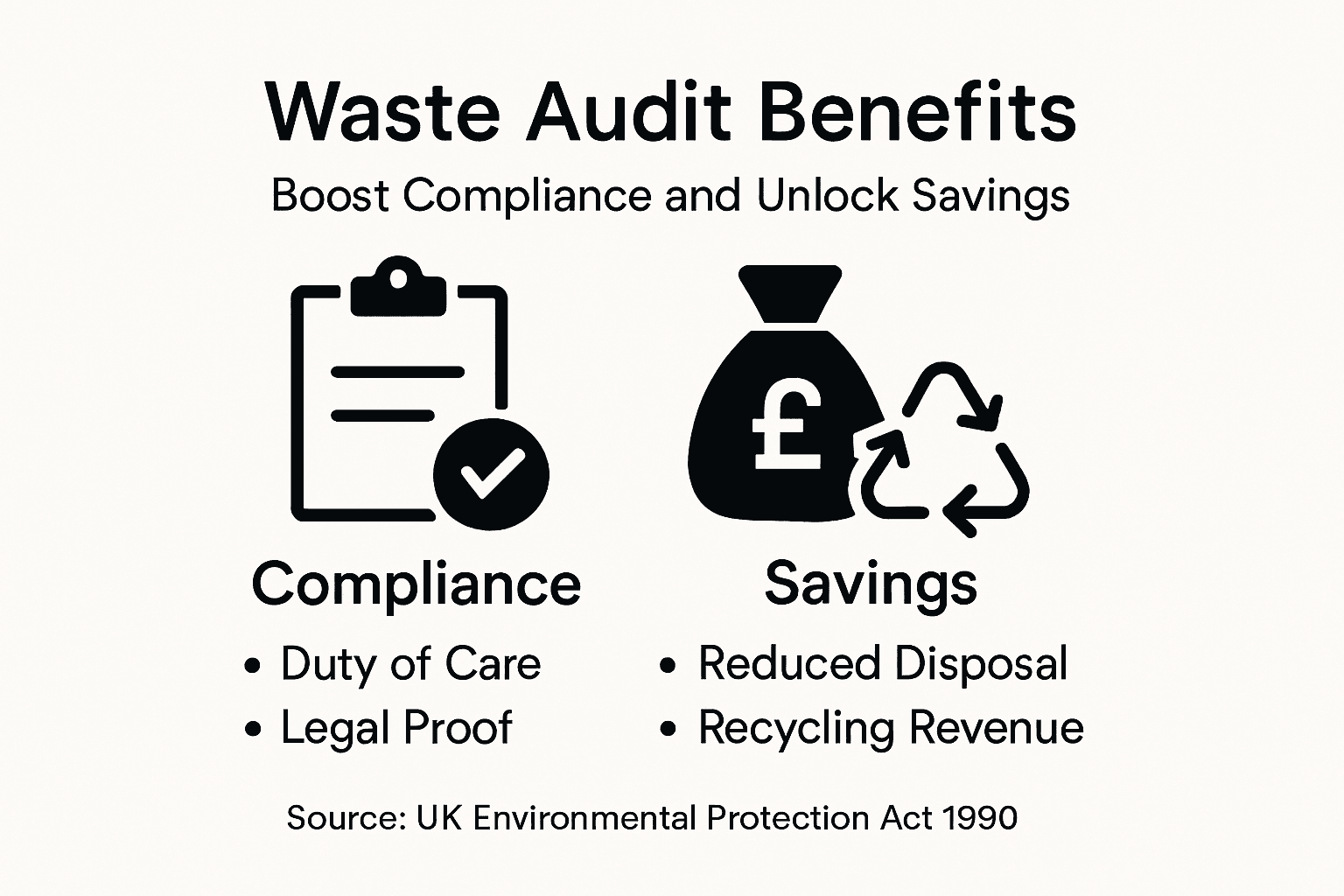
Most healthcare facilities overpay for waste disposal by failing to understand their waste composition and segregation efficiency. Clinical waste commands premium disposal rates, sometimes £150 to £250 per tonne, because it requires specialist handling and incineration. General waste typically costs £40 to £80 per tonne. If your audit reveals that 20 to 30 percent of what you’re paying to dispose as clinical waste is actually general waste that got mixed in due to poor segregation, you’ve just identified immediate savings. One large hospital trust discovered through audit that they were paying for approximately 15 tonnes of incorrectly classified clinical waste annually—a cost error worth nearly £30,000. The fix wasn’t complicated: staff training on proper segregation. The financial upside became visible only because the audit quantified the problem. Beyond segregation errors, audits expose over-specification in waste contracts. Many healthcare facilities inherit waste collection arrangements from predecessors without questioning whether they match current needs. An audit might reveal that you’re paying for daily collection of a waste stream you only generate three times weekly, or that you’re using a specialist hazardous waste contractor for materials that could be handled through standard waste streams at a fraction of the cost. Identifying inefficiencies through waste audits enables businesses to reduce disposal fees and procurement costs substantially, often recovering audit costs within the first quarter of implementation.
Recycling and recovery opportunities represent another significant financial benefit that audits unlock. Many healthcare facilities assume their recyclable streams are worthless, but that’s increasingly untrue. Cardboard, paper, mixed metals, and certain plastics have genuine market value. If your audit reveals that you’re sending 10 tonnes of mixed cardboard and paper to general waste each month instead of recycling, you’ve identified material worth £200 to £400 monthly to a recycling contractor—potentially £2,400 to £4,800 annually. Some facilities discover they can generate modest revenue from metal scrap, electrical equipment recycling, and even furniture refurbishment. One healthcare facility in Leeds realised through audit that they were discarding functional medical equipment worth thousands simply because departmental staff didn’t know refurbishment options existed. The financial impact extends beyond disposal savings into procurement optimisation. When your audit quantifies exactly how much single-use packaging your facility consumes, you can negotiate volume discounts with suppliers or explore alternatives. Many healthcare facilities have reduced packaging waste by 15 to 25 percent through procurement strategy changes informed by audit data. That translates to lower purchasing costs alongside lower disposal costs—a double saving.
The financial benefits compound over time. A baseline audit costs £3,000. Annual follow-up audits cost £1,500 each. If year one savings total £30,000 and you achieve 60 percent sustainability of those savings in year two (accounting for some slippage), you’ve saved £18,000 net of audit costs. By year three, you’re in pure upside territory. Many healthcare trusts now budget waste audits as standard practice because the financial case is undeniable. Additionally, documented waste reduction feeds into tender evaluations and contract negotiations. When you can demonstrate that your facility reduced waste costs by £30,000 annually through systematic improvement, you strengthen your negotiating position with suppliers and your credibility with procurement teams. For facilities pursuing sustainability certifications or responding to NHS England environmental commitments, the audit also supports your ability to claim verified environmental progress, which increasingly influences contract awards and stakeholder confidence.
Pro tip: Focus your initial audit specifically on your three highest waste cost categories identified from your monthly invoices—this narrow scope reduces audit costs whilst guaranteeing you’ll identify the major savings opportunities within your first 90 days of implementation.
Maximise Compliance and Savings with Expert Waste Audits
Navigating the complexities of waste audits in your UK healthcare or commercial facility can feel overwhelming. The challenge lies in accurately analysing your waste streams to ensure legal compliance while unlocking hidden cost-saving opportunities. From clinical waste segregation to optimising your waste contracts, a thorough understanding of your waste composition is essential. At Venture Waste Management, we specialise in helping businesses like yours streamline this process through our tailored waste collection services and informed guidance on regulatory standards.

Take control of your waste management strategy today by exploring how our expert team supports comprehensive waste audits and effective disposal solutions that keep your facility compliant and financially efficient. Discover how the Waste Collection Process in the UK for Businesses 2025 – Venture Waste and How the Waste Collection Network in UK Serves Businesses in 2025 – Venture Waste combine to create a seamless experience. Visit Venture Waste now and book your tailored service to start turning waste data into real savings while meeting your legal and environmental commitments.
Frequently Asked Questions
What is a waste audit and why is it important for businesses?
A waste audit is a systematic examination of a business’s waste streams. It helps identify what waste is produced, how much there is, and where it goes. This process is crucial for compliance with environmental regulations, cost reduction, and improving sustainability efforts.
How can a waste audit lead to cost savings for my business?
A waste audit can reveal inefficiencies in waste management, such as misclassified waste that incurs higher disposal costs. By identifying these issues, businesses can optimise waste handling, reduce unnecessary expenditure, and even discover potential revenue from recyclable materials.
Are waste audits legally required for all businesses?
While waste audits are not legally mandatory for all businesses, they can significantly aid in demonstrating compliance with the Environmental Protection Act and other regulations. Regulatory pressure is increasing, and conducting waste audits can help ensure that businesses meet their duty of care obligations.
What are the different types of waste audits?
There are three main types of waste audits: preliminary assessments, detailed material analyses, and waste characterisation studies. Each type serves different purposes and varying levels of detail, allowing businesses to choose based on their specific needs and objectives.
Recommended
- How UK Businesses Can Save Money on Waste Management in 2025 – Venture Waste
- Waste Reduction for SMEs: Practical UK Strategies for 2025 – Venture Waste
- Business Waste Penalties UK: Avoid Fines in 2025 – Venture Waste
- Small Business Security Solutions That Actually Work – IRVINEi
- Make Your Log Cabin Energy Efficient | LogCabinKits.co.uk


Leave a Reply
Want to join the discussion?Feel free to contribute!