

Understanding Recycling in Businesses: Importance and Impact
Recycling is reshaping how businesses handle their waste, turning unwanted materials into new resources and reducing their impact on the planet.
Most people picture recycling as just another tick box for compliance, but the numbers tell a different story. Recycling one tonne of paper saves about 17 mature trees and can put money back in a company’s pocket through reduced disposal costs and even fresh revenue. This changes what waste looks like for businesses and opens up a world of surprising opportunities.
Table of Contents
- What Is Recycling In Businesses And Why Is It Important?
- The Environmental And Economic Benefits Of Recycling In Businesses
- How Recycling Works In Different Business Sectors
- Key Concepts And Best Practices For Effective Recycling
- Real-World Examples Of Successful Recycling In Businesses
Quick Summary
| Takeaway | Explanation |
|---|---|
| Implement systematic recycling practices | Establish clear procedures for collecting, processing, and repurposing recyclable materials effectively. |
| Engage with certified recycling processors | Partnering with professional recyclers enhances material recovery and ensures compliance with regulations. |
| Educate employees on recycling protocols | Training staff on proper segregation and contamination prevention maximises recycling efficiency and effectiveness. |
| Track and report recycling performance | Monitoring recycling efforts helps identify improvements and demonstrates corporate responsibility to stakeholders. |
| Recognise recycling as an economic opportunity | Embracing recycling can reduce costs and create revenue from reclaimed materials, fostering sustainability. |
What is Recycling in Businesses and Why is it Important?
Recycling in businesses represents a strategic approach to waste management that transforms discarded materials into valuable resources. Unlike traditional waste disposal methods, recycling enables organisations to minimise environmental impact while potentially generating economic benefits. Our comprehensive guide on waste management provides deeper insights into this crucial process.
Understanding Business Recycling Fundamentals
At its core, business recycling involves systematically collecting, processing, and repurposing waste materials that would otherwise end up in landfills. These materials can include paper, plastics, electronics, metals, and organic waste. Businesses across sectors from manufacturing in Newcastle to retail in Durham can implement recycling strategies that significantly reduce their carbon footprint.
Key characteristics of effective business recycling include:
- Identifying and segregating recyclable materials
- Establishing dedicated collection and sorting systems
- Partnering with certified recycling processors
- Tracking and reporting recycling performance
Economic and Environmental Significance
According to the Environmental Protection Agency, recycling delivers multifaceted benefits for businesses. Environmentally, it conserves natural resources, reduces greenhouse gas emissions, and minimises waste sent to landfills. Economically, companies can reduce waste disposal costs, potentially generate revenue from recycled materials, and enhance their corporate social responsibility profile.
Businesses that prioritise recycling demonstrate commitment to sustainable practices, which can attract environmentally conscious customers, investors, and talent. Moreover, many industries now have regulatory requirements around waste management, making recycling not just an ethical choice but a legal necessity.
By integrating systematic recycling processes, businesses transform waste from a cost centre into a strategic opportunity for environmental stewardship and potential economic advantage.
The Environmental and Economic Benefits of Recycling in Businesses
Recycling represents a powerful mechanism for businesses to simultaneously address environmental challenges and create economic opportunities. By transforming waste materials into valuable resources, organisations can achieve significant sustainability objectives while potentially generating financial advantages. Learn about potential rebates from waste materials and discover the hidden economic potential within your waste streams.
Environmental Impact Reduction
Businesses play a crucial role in mitigating environmental degradation through strategic recycling initiatives. By diverting waste from landfills, companies directly contribute to reducing greenhouse gas emissions, conserving natural resources, and minimising ecological disruption. Recycling one tonne of paper, for instance, can save approximately 17 mature trees and significantly reduce water and energy consumption associated with raw material extraction.
Key environmental benefits include:
- Reducing carbon footprint
- Conserving natural resources
- Minimising landfill waste
- Protecting biodiversity
- Decreasing pollution levels
Economic Advantages of Recycling
According to McKinsey & Company, businesses that embrace circular economy principles through recycling can unlock substantial economic opportunities. By reimagining waste as a potential resource, companies can reduce operational costs, generate alternative revenue streams, and enhance their competitive positioning.
Potential economic benefits encompass:
- Reduced waste disposal expenses
- Potential revenue from recycled materials
- Enhanced brand reputation
- Compliance with environmental regulations
- Attracting environmentally conscious investors and customers
Moreover, businesses implementing comprehensive recycling strategies demonstrate corporate social responsibility, which can significantly improve stakeholder perception and long-term organisational sustainability. The transition from a linear ”
waste-and-dispose” model to a circular ”
reduce-reuse-recycle” approach represents a transformative strategy for modern enterprises seeking both environmental stewardship and economic resilience.
How Recycling Works in Different Business Sectors
Recycling strategies vary significantly across different business sectors, reflecting the unique waste management challenges and opportunities each industry faces. Our comprehensive waste management guide offers deeper insights into sector-specific recycling approaches.
Manufacturing and Industrial Sector Recycling
Manufacturing businesses generate substantial quantities of recyclable materials, including metals, plastics, packaging, and industrial byproducts. These organisations typically implement sophisticated recycling systems that involve precise material segregation, on-site processing, and strategic partnerships with specialised recycling processors.
Key recycling strategies in manufacturing include:
- Implementing closed-loop recycling systems
- Identifying potential material reuse opportunities
- Investing in advanced sorting technologies
- Developing partnerships with specialised recycling facilities
- Training workforce in effective waste management
Retail and Service Industry Approaches
According to Environmental Protection Agency research, retail and service industries focus on recycling packaging materials, electronic waste, and office consumables. Businesses in these sectors often develop comprehensive recycling programmes targeting cardboard, paper, plastics, and electronic equipment.
Retail and service sector recycling typically involves:
- Segregating packaging and shipping materials
- Implementing electronic waste collection programmes
- Reducing single-use plastic consumption
- Creating circular economy initiatives
- Developing sustainable product packaging
Each business sector requires a tailored approach to recycling, recognising that one-size-fits-all solutions are ineffective. Successful recycling programmes demand continuous assessment, technological innovation, and a commitment to sustainable waste management practices that balance environmental responsibility with economic efficiency.
The following table offers a side-by-side comparison of how recycling practices differ between the manufacturing/industrial sector and the retail/service industry, as described in the article.
| Aspect | Manufacturing & Industrial Sector | Retail & Service Industry |
|---|---|---|
| Main Types of Recyclable Materials | Metals, plastics, packaging, industrial byproducts | Packaging materials, e-waste, office consumables |
| Core Recycling Strategies | Closed-loop systems, advanced sorting, material reuse | Segregating packaging, e-waste programmes |
| Technology Investment | Advanced sorting equipment, material processing | Packaging redesign, electronic waste tools |
| Staff Training Focus | Waste management, sorting protocols | Segregation, consumer recycling education |
| Key Partnerships | Specialised recycling facilities and processors | Take-back schemes with suppliers |
| Typical Initiatives | Material recovery systems, industrial waste transformation | Waste reduction, circular economy initiatives |
Key Concepts and Best Practices for Effective Recycling
Effective recycling requires a strategic and systematic approach that goes beyond simply collecting recyclable materials. Businesses must develop comprehensive frameworks that integrate environmental responsibility with operational efficiency. Learn how to optimise your cardboard recycling strategy to maximise your waste management potential.
Material Segregation and Classification
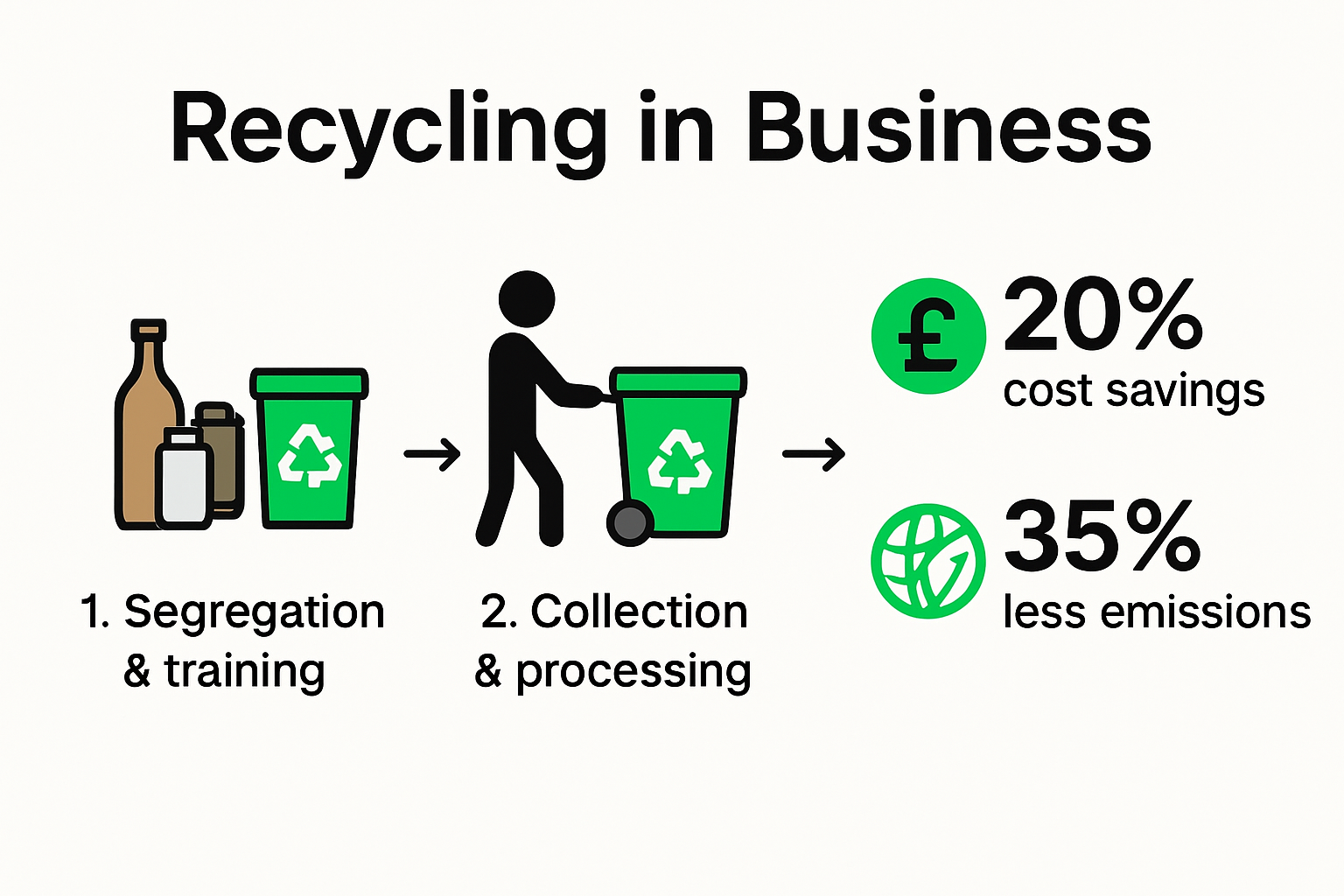
Successful recycling begins with precise material segregation. Businesses must implement robust systems that enable accurate identification and separation of different recyclable materials. This process involves training employees, installing clearly marked recycling stations, and developing internal protocols that prevent contamination and ensure maximum material recovery.
Key principles of effective material segregation include:
- Implementing colour-coded recycling bins
- Creating clear signage explaining recyclable materials
- Developing comprehensive staff training programmes
- Establishing strict contamination prevention protocols
- Regular auditing of waste management processes
Technology and Infrastructure Development
According to Environmental Protection Agency research, advanced technological solutions are crucial for modern recycling strategies. Businesses increasingly rely on sophisticated sorting technologies, data tracking systems, and automated processes to enhance their recycling efficiency and accuracy.
Critical technological considerations for recycling include:
- Investing in advanced sorting equipment
- Implementing digital tracking and reporting systems
- Developing real-time waste composition analysis tools
- Creating integrated waste management platforms
- Exploring artificial intelligence for waste categorisation
By embracing these comprehensive approaches, businesses can transform recycling from a compliance requirement into a strategic opportunity for environmental stewardship and operational innovation.
Real-World Examples of Successful Recycling in Businesses
Business recycling success stories demonstrate how strategic waste management can drive environmental sustainability and economic efficiency. Explore our comprehensive waste management strategies to understand practical implementation approaches.
Manufacturing Sector Innovations
Manufacturing businesses have pioneered innovative recycling approaches that transform waste into valuable resources. According to Small Business Administration research, companies like CT Polymers have developed advanced processes that convert plastic waste into reusable thermoplastic resins, creating jobs and reducing dependence on virgin materials.
Notable manufacturing recycling strategies include:
- Developing closed-loop material recovery systems
- Converting industrial waste into new production inputs
- Implementing advanced sorting and processing technologies
- Creating partnerships with specialised recycling processors
- Investing in research for material transformation techniques
Retail and Service Industry Approaches
Retail and service sectors have made significant strides in waste reduction and recycling. Companies like Peerless Coffee & Tea Company have demonstrated how targeted investments in packaging technologies can dramatically reduce waste and generate substantial cost savings.
Successful recycling initiatives in retail and services often involve:
- Redesigning packaging for improved recyclability
- Implementing comprehensive waste segregation programmes
- Creating consumer-facing recycling education initiatives
- Developing take-back and product recycling schemes
- Tracking and reporting waste reduction metrics
These real-world examples illustrate that effective recycling is not just an environmental imperative but a strategic business opportunity that can drive innovation, reduce costs, and enhance corporate reputation.
Transform Your Business Recycling with Venture Waste Management
Struggling to put effective recycling into practice within your business? The journey from understanding recycling’s importance to actually implementing the right systems can be challenging. Many companies face obstacles like proper waste segregation, collection logistics, and staying compliant—all while aiming to protect the environment and save costs. Our Waste Collection Process in the UK for Businesses 2025 page shows how we simplify these concerns for businesses just like yours.

Do not let inefficiencies or uncertainty hold your business back. With Venture Waste Management you get expert guidance from recycling to confidential waste handling all delivered through a transparent and seamless service. Discover how our responsible solutions can address your commercial recycling goals and boost legal compliance. Take action now by visiting Venture Waste Management and step into a cleaner, more sustainable future for your organisation.
Frequently Asked Questions
What are the key benefits of recycling for businesses?
Recycling offers businesses environmental benefits such as reducing waste sent to landfills, conserving natural resources, and lowering greenhouse gas emissions. Economically, it can reduce disposal costs, generate income from recyclable materials, and enhance the company’s reputation.
How can businesses effectively implement a recycling programme?
To implement an effective recycling programme, businesses should identify and segregate recyclable materials, establish dedicated collection systems, partner with certified recycling processors, and regularly track and report recycling performance.
What types of materials can businesses recycle?
Businesses can recycle various materials including paper, plastics, metals, electronics, packaging materials, and organic waste. The specific types of materials may vary based on the industry and company operations.
How do recycling practices differ across various business sectors?
Recycling practices vary by sector; for example, manufacturing focuses on metals and plastics, while retail emphasises packaging and electronic waste. Each sector requires tailored strategies to address its unique waste management challenges.
Recommended
- General Waste vs Recycling: Business Guide for 2025 – Venture Waste
- why recycle confidential waste Archives – Venture Waste
- Cardboard Recycling Guide 2025: Essential Tips for UK Businesses – Venture Waste
- cardboard recycling north east Archives – Venture Waste
- Sustainable Marketing Strategies for Businesses in 2025 – Zoo Digital
- Eco-Friendly Consulting for IT: A Guide for Canada and USA


Leave a Reply
Want to join the discussion?Feel free to contribute!