

Understanding Confidential Data Destruction: What, Why, and How
Every business handles sensitive information, from hard drives full of client data to stacks of personal paperwork waiting in filing cabinets. You might assume simply deleting files or shredding paper does the trick. Yet, regulations can impose fines up to £17.5 million or 4 percent of global annual turnover for improper data disposal and that is only part of the risk. There is far more at stake and the real impact of confidential data destruction reaches well beyond deleting and shredding.
Table of Contents
- What Is Confidential Data Destruction?
- Why Confidential Data Destruction Matters for Businesses
- How Confidential Data Destruction Works: Key Concepts
- Real-World Applications of Confidential Data Destruction
- Legal Regulations Surrounding Confidential Data Destruction
Quick Summary
| Takeaway | Explanation |
|---|---|
| Confidential data destruction is essential for safeguarding sensitive information | Properly destroying confidential data prevents unauthorized access and protects against data breaches and legal penalties. |
| Use specialized techniques for effective data destruction | Techniques like overwriting and physical shredding ensure that data cannot be recovered after destruction. |
| Compliance with data protection regulations is mandatory | Adhering to laws like GDPR and the Data Protection Act is critical to avoid significant fines and legal repercussions. |
| Implement tailored protocols for different industries | Sector-specific destruction methods are necessary to address unique data handling needs effectively. |
| Training staff is crucial for effective data protection | Ensuring employees understand proper procedures for data disposal can significantly reduce organizational vulnerabilities. |
What is Confidential Data Destruction?
Confidential data destruction represents a comprehensive security process designed to permanently eliminate sensitive information from physical and digital storage mediums, ensuring that data cannot be recovered or accessed by unauthorized parties. This critical practice protects organizations from potential data breaches, legal complications, and reputational damage.
The Core Definition
Confidential data destruction involves systematically rendering data unreadable and irretrievable through various specialized techniques. Unlike simple deletion, which merely removes file references, true confidential data destruction physically or digitally obliterates information so that reconstruction becomes mathematically impossible. According to the UK Ministry of Justice data destruction guidelines, this process applies to multiple storage formats including:
- Hard drives and solid-state drives
- Paper documents
- USB drives and external storage devices
- Backup tapes and optical media
- Cloud storage repositories
Strategic Importance for Organizations
For businesses across Newcastle, Durham, and the broader North East region, confidential data destruction is not merely a technical procedure but a legal and ethical imperative. Organizations handling personal, financial, medical, or proprietary information must implement robust destruction protocols to comply with data protection regulations.
The process becomes particularly crucial when considering the potential consequences of improper data handling. A single overlooked document or improperly wiped digital storage device could expose an organization to significant risks such as:
- Financial penalties from regulatory bodies
- Reputational damage and loss of client trust
- Legal liability for compromised personal information
- Potential industrial espionage risks
Businesses seeking comprehensive guidance can explore our detailed confidential waste management resources to develop robust data destruction strategies tailored to their specific operational requirements.
Why Confidential Data Destruction Matters for Businesses
Confidential data destruction transcends simple information management, representing a critical strategic safeguard for modern businesses navigating increasingly complex regulatory landscapes and cybersecurity challenges. The imperative extends far beyond technical compliance, touching core aspects of organizational integrity, reputation management, and legal accountability.
Legal and Regulatory Compliance
In the United Kingdom, businesses face stringent data protection regulations that mandate comprehensive approaches to information disposal. The General Data Protection Regulation (GDPR) and Data Protection Act 2018 establish clear expectations for how organizations must handle sensitive data throughout its lifecycle. Research from the UK Parliament’s Public Accounts Committee emphasizes that improper data disposal can result in significant legal and financial consequences, including:
- Substantial monetary penalties of up to £17.5 million or 4% of global annual turnover
- Mandatory public disclosure of data breaches
- Potential criminal investigations and prosecutions
- Permanent reputational damage
Protecting Organizational Vulnerabilities
Beyond regulatory requirements, confidential data destruction serves as a critical defence mechanism against multifaceted security threats. Businesses in Newcastle, Durham, and across the North East region face increasing risks from sophisticated cyber criminals and industrial espionage actors who can reconstruct seemingly deleted information. Proper data destruction prevents unauthorized access by ensuring that sensitive materials are permanently and irrecoverably eliminated.
Key vulnerabilities that confidential data destruction mitigates include:
- Intellectual property theft
- Corporate identity fraud
- Competitive intelligence gathering
- Potential blackmail or extortion scenarios
Businesses looking to develop robust information security strategies can explore our comprehensive confidential waste management guide to understand best practices in data protection and destruction.
How Confidential Data Destruction Works: Key Concepts
Confidential data destruction represents a sophisticated technological and procedural approach to permanently eliminating sensitive information across multiple storage platforms. The process involves intricate methodologies designed to ensure absolute data elimination, preventing even advanced forensic recovery techniques from reconstructing original information.
Digital Data Destruction Techniques
In the digital realm, confidential data destruction goes beyond simple file deletion. Sophisticated digital erasure methods include multiple approaches that render data mathematically unrecoverable. According to the University of Essex data management guidelines, these techniques typically encompass:
- Overwriting: Replacing existing data with random binary patterns multiple times
- Degaussing: Using powerful magnetic fields to scramble magnetic storage media
- Cryptographic erasure: Destroying encryption keys that protect data repositories
- Physical destruction: Physically shredding or pulverizing digital storage devices
Physical Media Destruction Protocols
Physical media destruction requires precise, validated processes that guarantee complete information elimination. Organizations in Newcastle and across the North East must implement rigorous protocols that address various storage formats. The destruction process involves systematically rendering physical documents and electronic media unreadable through methods such as:
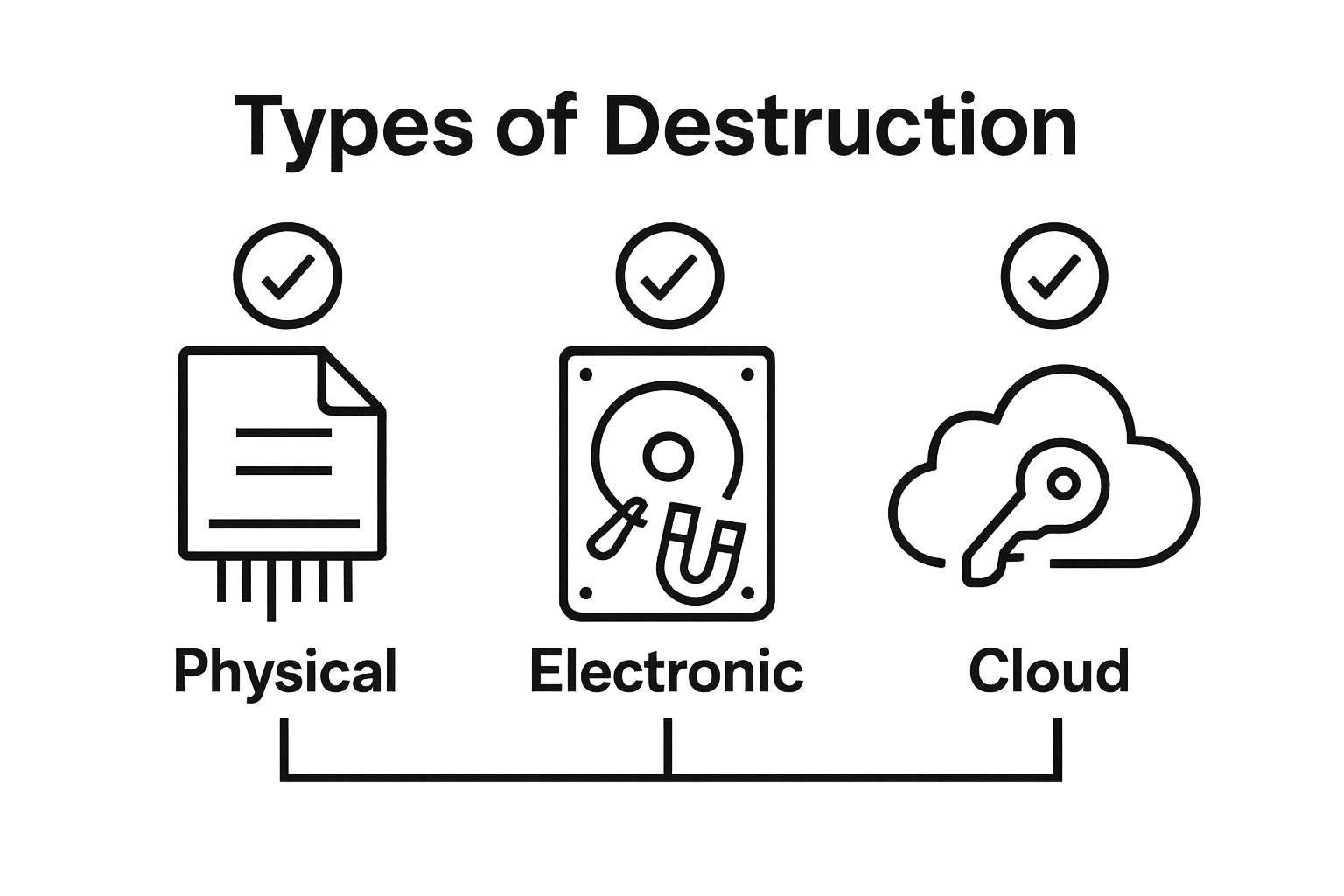
- Cross-cut industrial shredding for paper documents
- Professional hard drive and solid-state drive crushing
- Comprehensive sanitization of magnetic tapes
- Complete disintegration of optical media
Businesses seeking detailed insights can explore our comprehensive confidential document shredding resources to understand advanced destruction methodologies.
The ultimate goal of confidential data destruction transcends mere deletion: it represents a holistic security strategy designed to protect organizational integrity, prevent unauthorized information access, and maintain strict compliance with data protection regulations.
Below is a comparison of the principal digital and physical data destruction methods referenced in the article, showing their characteristics and typical usage contexts.
| Method | Type | Key Characteristics | Typical Usage Context |
|---|---|---|---|
| Overwriting | Digital | Replaces data with random patterns, repeated runs | Hard drives, SSDs, digital archives |
| Degaussing | Digital | Uses strong magnetic fields to destroy data | Magnetic tapes, hard drives |
| Cryptographic Erasure | Digital | Destroys encryption keys, rendering data inaccessible | Encrypted drives, cloud storage |
| Physical Shredding | Physical | Mechanically shreds media into small fragments | Paper, hard drives, tapes |
| Crushing | Physical | Uses force to irreparably damage storage devices | Hard drives, SSDs |
| Disintegration | Physical | Reduces materials to fine particles | Optical media, sensitive documents |
Real-World Applications of Confidential Data Destruction
Confidential data destruction extends far beyond theoretical concepts, playing a critical role across numerous industries and organisational contexts. From healthcare and legal sectors to financial institutions and educational establishments, robust data destruction practices represent a fundamental component of comprehensive information security strategies.
Sector-Specific Implementation Scenarios
Confidential data destruction is not a one-size-fits-all approach, but rather a nuanced process tailored to specific industry requirements. According to the Information Commissioner’s Office guidance, different sectors demand unique destruction methodologies:
- Healthcare: Destroying patient records with absolute precision
- Financial Services: Eliminating transaction histories and sensitive client information
- Legal Firms: Protecting privileged communications and case documentation
- Educational Institutions: Managing student records and research data
- Government Departments: Safeguarding classified and sensitive administrative documents
Practical Implementation across North East Businesses
Businesses operating in Newcastle, Durham, and surrounding regions must develop comprehensive data destruction protocols that address both digital and physical information repositories. This involves creating systematic approaches that:
- Establish clear data retention and destruction timelines
- Train staff on proper information handling procedures
- Implement secure storage and destruction mechanisms
- Document and verify the entire destruction process
- Maintain audit trails for regulatory compliance
Businesses seeking advanced insights can explore our comprehensive confidential waste management resources to understand industry-specific implementation strategies.

Ultimately, confidential data destruction represents more than a technical requirement. It is a critical risk management strategy that protects organisational integrity, maintains client trust, and ensures compliance with evolving data protection regulations.
This table outlines the major industries highlighted in the article and the types of confidential data they commonly handle, illustrating why sector-specific destruction methods are essential.
| Industry Sector | Examples of Confidential Data Handled | Importance of Tailored Destruction Methods |
|---|---|---|
| Healthcare | Patient medical records, test results | Prevents data breaches and protects patient confidentiality |
| Financial Services | Transaction histories, client account information | Guards against fraud and financial crime |
| Legal Firms | Case files, privileged correspondence | Ensures legal privilege and client confidentiality |
| Educational Institutions | Student records, research data | Protects sensitive personal and academic information |
| Government Departments | Classified, administrative, and public records | Maintains national and administrative data security |
Legal Regulations Surrounding Confidential Data Destruction
Confidential data destruction is not merely a technical process but a critical legal obligation embedded within complex regulatory frameworks. Businesses across the United Kingdom must navigate intricate legislative requirements that mandate precise, verifiable methods for eliminating sensitive information across digital and physical platforms.
Foundational Legal Frameworks
Data protection regulations establish stringent guidelines for information management and destruction. According to the UK Government’s data protection guidance, businesses must adhere to comprehensive legal standards that encompass multiple legislative instruments:
- UK GDPR: Establishing core data protection principles
- Data Protection Act 2018: Defining specific UK implementation requirements
- Environmental Protection Regulations: Addressing electronic waste disposal
- Freedom of Information Act: Managing public sector information management
- Industry-Specific Compliance Codes: Sector-dependent destruction protocols
Compliance and Enforcement Mechanisms
Businesses operating in Newcastle, Durham, and across the North East face significant legal and financial risks for non-compliance. The regulatory landscape demands meticulous documentation and verifiable destruction processes. Key enforcement mechanisms include:
- Substantial financial penalties up to £17.5 million or 4% of global turnover
- Mandatory reporting of data breaches
- Potential criminal investigations for severe non-compliance
- Reputational damage and loss of operational licenses
- Mandatory external audits and compliance assessments
Businesses seeking comprehensive guidance can explore our detailed confidential document shredding resources to understand nuanced legal requirements.
Ultimately, legal compliance in confidential data destruction transcends simple regulatory adherence. It represents a fundamental commitment to protecting individual privacy, maintaining organisational integrity, and demonstrating responsible information management practices.
Secure Your Business with Professional Confidential Data Destruction
Are you struggling with the challenge of permanently erasing confidential information The risks of data breaches, regulatory fines and loss of customer trust are all too real as outlined throughout this article. Whether you need dependable destruction for digital devices or sensitive documents, your peace of mind depends on a solution that truly eliminates every trace.
Take control of your data protection journey by learning more about dedicated services on our confidential waste category page. Ensure you understand critical techniques such as secure shredding and hard drive destruction found in our hard drive destruction resource.

Do not leave your organisation exposed to unnecessary risk. Visit Venture Waste Management today to arrange a compliant and hassle-free confidential data destruction service. Take advantage of our simple three-step booking process and safeguard your reputation, your clients and your legal compliance now.
Frequently Asked Questions
What is confidential data destruction?
Confidential data destruction is a comprehensive security process designed to permanently eliminate sensitive information from physical and digital storage mediums, ensuring that data cannot be recovered or accessed by unauthorised parties.
Why is confidential data destruction important for businesses?
Confidential data destruction is crucial for businesses to comply with data protection regulations, protect against data breaches, avoid legal liabilities, and maintain client trust. It serves as a key defence against the unauthorized access of sensitive information.
What methods are used for digital data destruction?
Digital data destruction techniques include overwriting data with random patterns, degaussing magnetic media, cryptographic erasure, and physical destruction of storage devices. Each method ensures that data is rendered irretrievable.
How does physical data destruction work?
Physical data destruction involves validated processes that guarantee complete information elimination. Techniques include cross-cut industrial shredding for paper documents, crushing hard drives, and disintegration of optical media, ensuring sensitive information is unreadable and irrecoverable.


Leave a Reply
Want to join the discussion?Feel free to contribute!