

Why Dispose Confidentially: Essential Guide for UK Businesses 2025

Confidential waste might seem like just another office headache. Yet data breaches involving paper records hit around 75 percent of small businesses and 90 percent of large companies every year. Most think the worst that could happen is a privacy wobble or some scolding from the boss. In reality strong confidential disposal can be the difference between minor embarrassment and crippling fines or a ruined reputation. The next few minutes could save your business more than you think.
Table of Contents
- Understanding Confidential Waste And Risks
- Legal Requirements For Secure Disposal In The UK
- Benefits Of Confidential Waste Disposal For Businesses
- Best Practices For Confidential Disposal Across Industries
Quick Summary
| Takeaway | Explanation |
|---|---|
| Confidential Waste Management Is Essential | Businesses must secure disposal of sensitive documents to mitigate risks such as identity theft, corporate espionage, and regulatory non-compliance. |
| Legal Compliance Is Mandatory | Organisations must adhere to the Environmental Protection Act 1990 and GDPR, maintaining proper documentation and contracts with third-party destruction services to avoid substantial penalties. |
| Investing In Secure Disposal Offers Strategic Benefits | Proper confidential waste disposal not only protects financial interests but also enhances client trust and provides a competitive advantage by showcasing corporate responsibility. |
| Tailored Approaches Are Necessary Across Industries | Different sectors require specific disposal strategies to address unique information sensitivity, emphasizing the importance of sector-specific compliance and best practices. |
| Ongoing Training and Professional Partnerships Are Crucial | Educating employees about secure handling of confidential waste and partnering with certified waste management professionals are key components of an effective waste disposal strategy. |
Understanding Confidential Waste and Risks
Confidential waste represents a critical challenge for businesses, encompassing sensitive documents, digital records, and materials that could compromise organisational security if improperly handled. The risks associated with negligent disposal extend far beyond simple data protection concerns, potentially exposing organisations to significant financial, legal, and reputational damages.
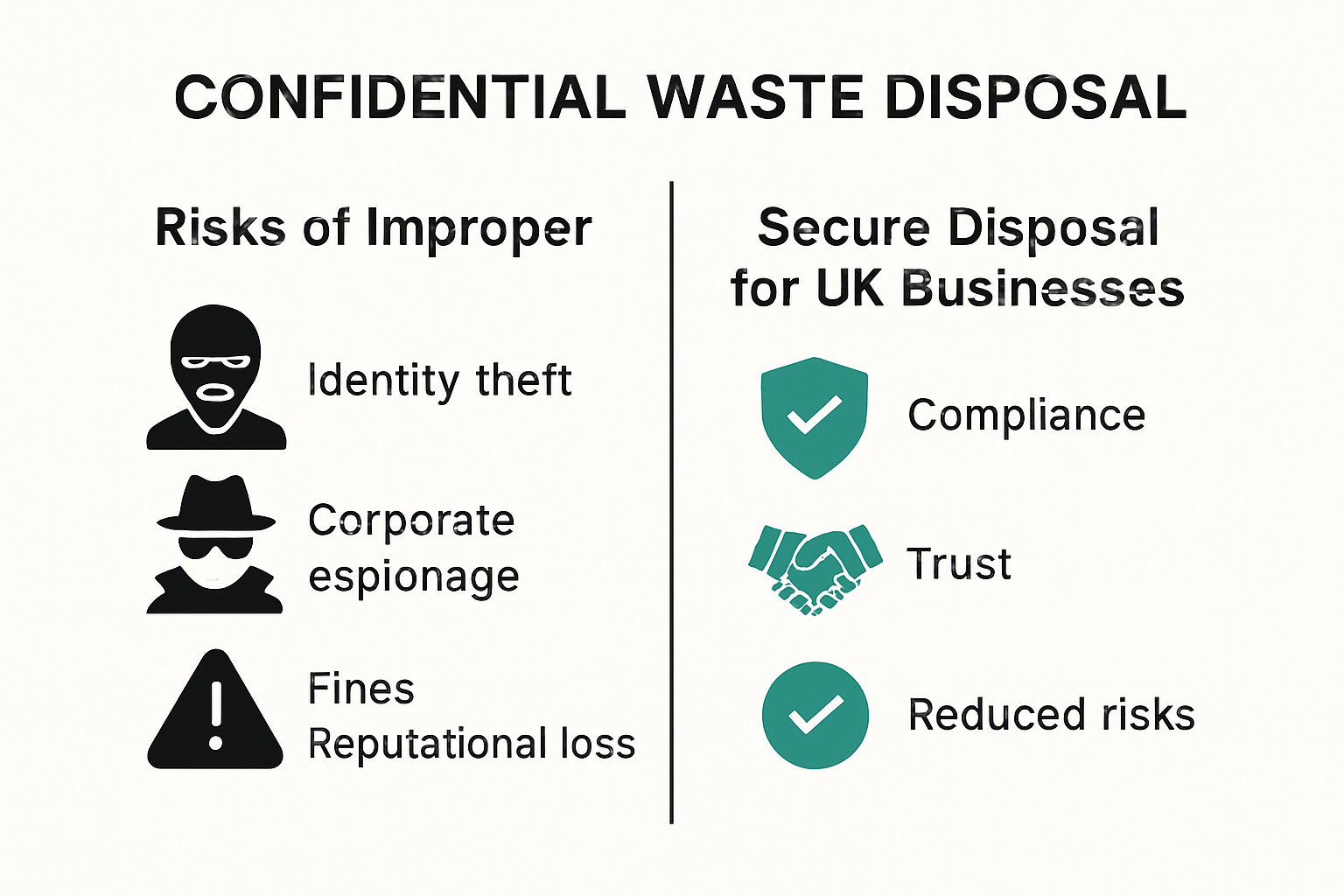
The Hidden Dangers of Improper Waste Management
Businesses generate substantial volumes of confidential waste daily, ranging from financial reports and employee records to client contracts and strategic planning documents. Improper disposal of these materials creates substantial vulnerabilities. According to NHS information governance guidance, sensitive materials should never be discarded through standard waste streams, as they remain accessible to potential unauthorized parties.
The consequences of inadequate confidential waste management are profound. Research from data protection experts indicates that failure to securely dispose of confidential information can result in severe legal penalties under UK data protection regulations, including substantial fines under the General Data Protection Regulation (GDPR) and the Data Protection Act 2018. These penalties can range from warnings to significant financial sanctions that could critically impact a business’s financial stability.
Comprehensive Risk Assessment
Effective confidential waste management requires a holistic approach. Businesses must consider multiple risk vectors, including physical document disposal, digital data destruction, and electronic media handling. Learn more about comprehensive confidential waste strategies to protect your organisation’s sensitive information.
Key risks include:
- Identity Theft: Discarded documents containing personal information can be exploited by malicious actors.
- Corporate Espionage: Sensitive business documents could provide competitors with strategic insights.
- Regulatory Non Compliance: Improper waste disposal can breach data protection regulations.
Moreover, research from information security analysts reveals that data breaches resulting from inadequate waste management can lead to significant reputational damage. Clients and stakeholders lose trust in organisations that cannot demonstrate robust information protection protocols.
A strategic approach to confidential waste management involves implementing comprehensive destruction processes, training employees on secure disposal practices, and partnering with certified waste management professionals who understand the intricate legal and security requirements of modern business environments. By treating confidential waste as a critical security concern, organisations can mitigate risks and protect their most valuable asset: information.
Legal Requirements for Secure Disposal in the UK
Secure disposal of confidential waste is not merely a best practice in the United Kingdom but a legal obligation with complex regulatory requirements that businesses must carefully navigate. The legal landscape surrounding waste management and data protection has evolved significantly, creating a robust framework that demands meticulous compliance from organisations across all sectors.
Regulatory Framework and Compliance Obligations
The Environmental Protection Act 1990 establishes a foundational duty of care for businesses regarding waste management. According to research from waste management experts, organisations are legally required to handle, store, transport, and dispose of waste responsibly, ensuring that confidential materials do not fall into unauthorized hands.
Moreover, the General Data Protection Regulation (GDPR) and the Data Protection Act 2018 impose stringent requirements on businesses. The Information Commissioner’s Office (ICO) advises that organisations must have formal contracts with third-party data destruction services. These contracts should explicitly outline security standards and provide certificates of destruction to confirm the secure disposal of personal data.
Documentation and Audit Trail Requirements
Legal compliance extends beyond the physical act of destruction. Businesses must maintain comprehensive documentation of their confidential waste disposal processes. Explore our detailed guide on document shredding processes to understand the intricate requirements.
Key documentation requirements include:
- Destruction Certificates: Detailed records proving the secure destruction of confidential materials.
- Chain of Custody Documentation: Tracking the movement and handling of sensitive documents from collection to destruction.
- Compliance Logs: Systematic records demonstrating adherence to legal and regulatory standards.
Non-compliance can result in severe consequences. Regulatory bodies can impose substantial financial penalties, with fines potentially reaching up to 4% of annual global turnover or £17.5 million under GDPR regulations. Beyond financial penalties, businesses risk reputational damage and potential legal action from affected parties.
Businesses must adopt a proactive approach to confidential waste management. This involves not only implementing secure destruction processes but also training employees, conducting regular audits, and partnering with certified waste management professionals who understand the nuanced legal landscape.
The legal requirements for secure disposal are dynamic and continually evolving. Staying informed about regulatory changes, maintaining rigorous documentation, and demonstrating a commitment to data protection are essential strategies for businesses seeking to navigate the complex world of confidential waste management in the United Kingdom.
Below is a summary table outlining the major UK legal and compliance requirements for confidential waste disposal referenced in this section.
| Legal Requirement | Description | Potential Penalty |
|---|---|---|
| Environmental Protection Act 1990 | Duty of care for all businesses handling, storing, and disposing of waste responsibly | Fines and enforcement action |
| GDPR & Data Protection Act 2018 | Secure disposal of personal and sensitive data; must have contracts with data destruction service providers | Up to 4% of annual turnover or £17.5 million fine |
| Contracts & Certificates of Destruction | Formal written agreements and proof of secure destruction with third-party service providers | Legal sanctions and proof required for compliance |
| Documentation & Audit Trail | Maintain detailed chain of custody and compliance logs for all confidential waste disposals | Regulatory scrutiny and increased liability |
Benefits of Confidential Waste Disposal for Businesses
Confidential waste disposal represents a critical strategic investment for businesses, offering far more than simple document destruction. It serves as a comprehensive risk management approach that protects organisational integrity, reputation, and operational resilience in an increasingly complex digital landscape.
Financial and Reputational Protection
Businesses face substantial financial risks from improper waste management. According to research from industry experts, identity fraud costs the UK approximately £2 billion annually, with a significant portion stemming from improperly discarded confidential documents. Professional confidential waste disposal dramatically reduces these risks.
Learn more about comprehensive waste management strategies to understand how systematic destruction protects your business’s financial interests. The potential consequences of neglecting secure disposal are profound. Data breaches involving paper records affect approximately 75% of small businesses and 90% of large enterprises each year, highlighting the critical nature of robust waste management protocols.
The following table presents key statistics related to the financial and operational impact of improper confidential waste disposal, as referenced in this section.
| Statistic | Figure | Source/Context |
|---|---|---|
| Identity fraud cost to UK annually | £2 billion | Portion driven by improperly discarded confidential documents |
| Small businesses affected by paper data breaches | 75% | Annual rate of data breaches involving paper records |
| Large businesses affected by paper data breaches | 90% | Annual rate of data breaches involving paper records |
| Maximum GDPR fine for non-compliance | £17.5 million or 4% turnover | Under Data Protection Act 2018 and GDPR |
Compliance and Competitive Advantage
Confidential waste disposal extends beyond risk mitigation. It represents a strategic approach to demonstrating corporate responsibility and professionalism. Regulatory frameworks like the General Data Protection Regulation (GDPR) impose stringent requirements, with potential fines reaching €20 million or 4% of annual global turnover for non-compliance.
Key strategic benefits include:
- Enhanced Client Trust: Demonstrating commitment to data protection
- Legal Risk Reduction: Minimising potential regulatory penalties
- Competitive Differentiation: Showcasing advanced corporate governance
Businesses that implement rigorous confidential waste disposal processes signal to clients, partners, and stakeholders their commitment to data security and ethical practices. This approach transforms a mundane operational task into a powerful statement of organisational integrity.
Moreover, professional waste disposal services provide detailed destruction certificates and comprehensive audit trails. These documents serve not just as proof of compliance but as tangible evidence of an organisation’s systematic approach to information management.
Beyond immediate risk mitigation, confidential waste disposal contributes to broader sustainability goals. Many professional services now incorporate environmentally responsible recycling processes, allowing businesses to simultaneously protect sensitive information and reduce their ecological footprint.
Ultimately, confidential waste disposal is not an expense but a strategic investment. It protects an organisation’s most valuable asset—information—while demonstrating commitment to legal compliance, client trust, and responsible business practices. By treating waste management as a critical component of corporate strategy, businesses can transform a potentially vulnerable process into a source of competitive advantage.
Best Practices for Confidential Disposal Across Industries
Confidential waste disposal is not a one-size-fits-all approach. Different industries require tailored strategies that address their unique information sensitivity and regulatory requirements. Understanding and implementing industry-specific best practices is crucial for maintaining data security and legal compliance.
Sector-Specific Disposal Strategies
The UK government’s Waste Duty of Care Code of Practice mandates that businesses must handle and store waste securely, preventing its unauthorized access or escape. This foundational principle applies across sectors, but the implementation varies significantly.
For instance, explore our comprehensive guide to confidential waste management to understand the nuanced approaches required by different industries. Healthcare organisations must adhere to stricter protocols due to patient confidentiality laws, while financial institutions have complex requirements protecting sensitive financial records.

Practical Implementation Across Key Sectors
Different industries require specific approaches to confidential waste disposal:
- Healthcare: According to Imperial College London’s waste management guidelines, sensitive medical documents must be placed in designated confidential waste bins or sacks, then shredded on-site by licensed contractors.
- Education: University of Liverpool recommends that educational institutions should never place confidential materials in standard waste or recycling bins. Instead, they should use cross-cut shredding or secure confidential waste consoles.
- Financial Services: Banks and financial institutions must implement multi-stage destruction processes, including digital sanitization and physical document destruction, to protect sensitive financial information.
Below is a comparative table illustrating sector-specific confidential waste disposal strategies as referenced in this section.
| Sector | Distinctive Disposal Approach | Rationale |
|---|---|---|
| Healthcare | Use dedicated bins/sacks; on-site shredding by licensed contractors | Patient confidentiality and NHS guidance |
| Education | Avoid standard waste; use cross-cut shredders or secure consoles | Student/employee record protection |
| Financial Services | Multi-stage: digital sanitization and physical destruction | Sensitive financial record security |
Universal Best Practice Principles
Regardless of industry, several universal principles apply to confidential waste disposal:
- Secure Storage: Use locked, access-controlled containers for confidential waste
- Documented Processes: Maintain clear chain of custody documentation
- Professional Destruction: Partner with certified waste management professionals
- Regular Training: Educate employees about confidential waste handling
The complexity of confidential waste disposal extends beyond simple document destruction. It requires a comprehensive approach that considers physical security, digital protection, and ongoing employee education. Each industry faces unique challenges, from medical record confidentiality to financial information protection.
Businesses must adopt a proactive, strategic approach to confidential waste management. This involves understanding sector-specific regulations, investing in secure disposal technologies, and creating a culture of information protection. By treating confidential waste disposal as a critical business function rather than an afterthought, organisations can effectively mitigate risks and demonstrate their commitment to data security.
Frequently Asked Questions
What is confidential waste?
Confidential waste refers to sensitive documents and materials that, if improperly disposed of, could lead to data breaches or identity theft. This includes personal data, financial records, and strategic business information.
Why is secure disposal of confidential waste important for businesses in the UK?
Secure disposal is crucial to prevent data breaches, which can result in significant financial penalties, legal repercussions, and damage to an organisation’s reputation. Adhering to regulations such as GDPR is essential for compliance.
What are the legal requirements for disposing of confidential waste in the UK?
Businesses must comply with the Environmental Protection Act 1990 and the GDPR, ensuring that confidential materials are stored, handled, and disposed of securely, often requiring contracts with certified third-party destruction services.
What are some best practices for confidential waste disposal?
Best practices include using locked containers for secure storage, partnering with certified waste management professionals, maintaining chain of custody documentation, and providing regular training to employees on secure disposal methods.
Protect Your Business from Confidential Waste Pitfalls
Do worries about data breaches or regulatory fines keep you up at night? As highlighted throughout this guide, the true risks of mishandling confidential waste include severe legal penalties, reputational damage, and even the loss of client trust. Many businesses underestimate how quickly a simple oversight in document or digital record disposal could escalate into a crisis. With data compliance laws tightening and the threat of costly mistakes rising, acting now has never been more urgent. For expert solutions and detailed insights tailored to UK businesses, be sure to visit our confidential waste resource hub.

Take control of your sensitive waste journey today. Book secure collection and destruction with Venture Waste Management and guarantee your compliance and peace of mind. Explore our confidential waste solutions or see our home page to get started. Let us handle your confidential waste so you can focus on growing your business.
Recommended Articles
- Confidential Waste FAQ: Secure UK Business Disposal in 2025 – Venture Waste
- confidential waste FAQ Archives – Venture Waste
- Confidential Document Shredding Process for UK Businesses 2025 – Venture Waste
- What Is Confidential Waste? Guide for UK Businesses 2025 – Venture Waste
- confidential document shredding process Archives – Venture Waste
- what is confidential waste Archives – Venture Waste


