

Seasonal Waste Management – UK Healthcare Compliance
Busy winter months in England often bring a surge in patient admissions that leaves healthcare facilities facing overflowing bins and mounting compliance challenges. For facility managers, keeping up with these seasonal spikes is crucial to avoid regulatory penalties and protect both patients and staff. This article offers practical guidance for efficient seasonal waste management, helping you adjust collection schedules and storage capacity in line with real-world demand while meeting strict UK standards year-round.
Table of Contents
- Seasonal Waste Management Defined and Debunked
- Types of Seasonal Healthcare Waste in the UK
- Legal Standards for Healthcare Seasonal Waste
- Risks of Non-Compliance in Peak Periods
- Practical Strategies for Efficient Waste Management
Key Takeaways
| Point | Details |
|---|---|
| Seasonal Waste Management is Essential | Healthcare facilities must adjust waste handling practices based on predictable seasonal peaks in waste generation to ensure compliance and efficiency. |
| Common Myths Debunked | Misunderstandings about waste management can lead to improper strategies; flexible contracts and monitoring are crucial for effective management. |
| Legal Compliance is Non-Negotiable | Facilities must adhere to strict regulatory standards throughout the year, especially during peak periods when waste volumes increase. |
| Proactive Planning Saves Costs | Implementing flexible collection schedules and training staff ahead of peak seasons can significantly reduce compliance risks and operational costs. |
Seasonal Waste Management Defined and Debunked
Seasonal waste management in UK healthcare isn’t a buzzword—it’s a practical necessity. Healthcare facilities generate vastly different waste volumes throughout the year, particularly during winter months when patient admissions spike and Christmas festivities generate additional materials.
Let’s clarify what seasonal waste management actually means in the healthcare context.
Definition: What It Really Is
Seasonal waste management refers to the strategic adjustment of waste collection, storage, and disposal practices to accommodate fluctuating demand. In healthcare settings, this means adjusting your systems in response to predictable peaks in waste generation.
Think of it like staffing levels. A GP practice in Newcastle doesn’t maintain the same waste collection schedule in July as it does in January. Winter brings respiratory infections, festive period increase waste from packaging and single-use items, and summer holidays reduce patient numbers significantly.
Under healthcare waste management guidance, facilities must establish systems that accommodate these natural fluctuations without compromising safety or compliance.
Common Misconceptions About Seasonal Waste
Most facility managers hold at least one false belief about seasonal waste management. Here are the biggest myths debunked:
-
Myth 1: Seasonal variation is minor and predictable — Reality: Winter waste can increase by 40-60% in some healthcare settings. Christmas creates unpredictable spikes that vary year to year.
-
Myth 2: You can manage seasonal waste with static contracts — Reality: Fixed collection schedules often leave you paying for unused capacity in summer or struggling with inadequate collection in winter.
-
Myth 3: Seasonal waste management means complex planning — Reality: It requires monitoring and communication with your waste provider, but most adjustments happen automatically through flexible service agreements.
-
Myth 4: Extra waste equals extra hazard risk — Reality: Volume alone doesn’t create compliance risk. Proper segregation and storage protocols manage risk regardless of quantity.
Why Healthcare Facilities Get This Wrong
Facility managers in busy hospitals across Scotland, Northern England, and the Midlands often treat waste management as set-and-forget. You arrange a collection schedule in spring and assume it works year-round. Then December arrives with emergency admissions, and suddenly your storage capacity becomes inadequate.
The reality is simpler than you’d think. Seasonal adjustment protects your compliance, reduces costs, and prevents last-minute scrambling.
Seasonal waste management isn’t about having different rules—it’s about aligning your resources with actual demand throughout the year.
What Seasonal Waste Management Is NOT
It isn’t a way to avoid compliance. It isn’t permission to relax safety protocols. It isn’t an excuse for poor segregation or inadequate training. These standards remain consistent regardless of season.
What it actually does is match collection frequency, storage capacity, and staff resources to your genuine waste volume patterns.
Pro tip: Contact your waste provider in September to arrange flexible contracts that automatically increase collections before peak winter months, rather than manually requesting changes when demand suddenly surges.
Types of Seasonal Healthcare Waste in the UK
Healthcare facilities across the UK generate multiple waste streams, and seasonal patterns significantly affect which types dominate throughout the year. Understanding what waste you’re managing helps you prepare storage and collection capacity before demand spikes.
UK healthcare waste falls into distinct categories, each with specific handling requirements and seasonal fluctuations. Winter months bring predictable increases in certain types whilst summer creates different challenges entirely.
The Six Main Healthcare Waste Types
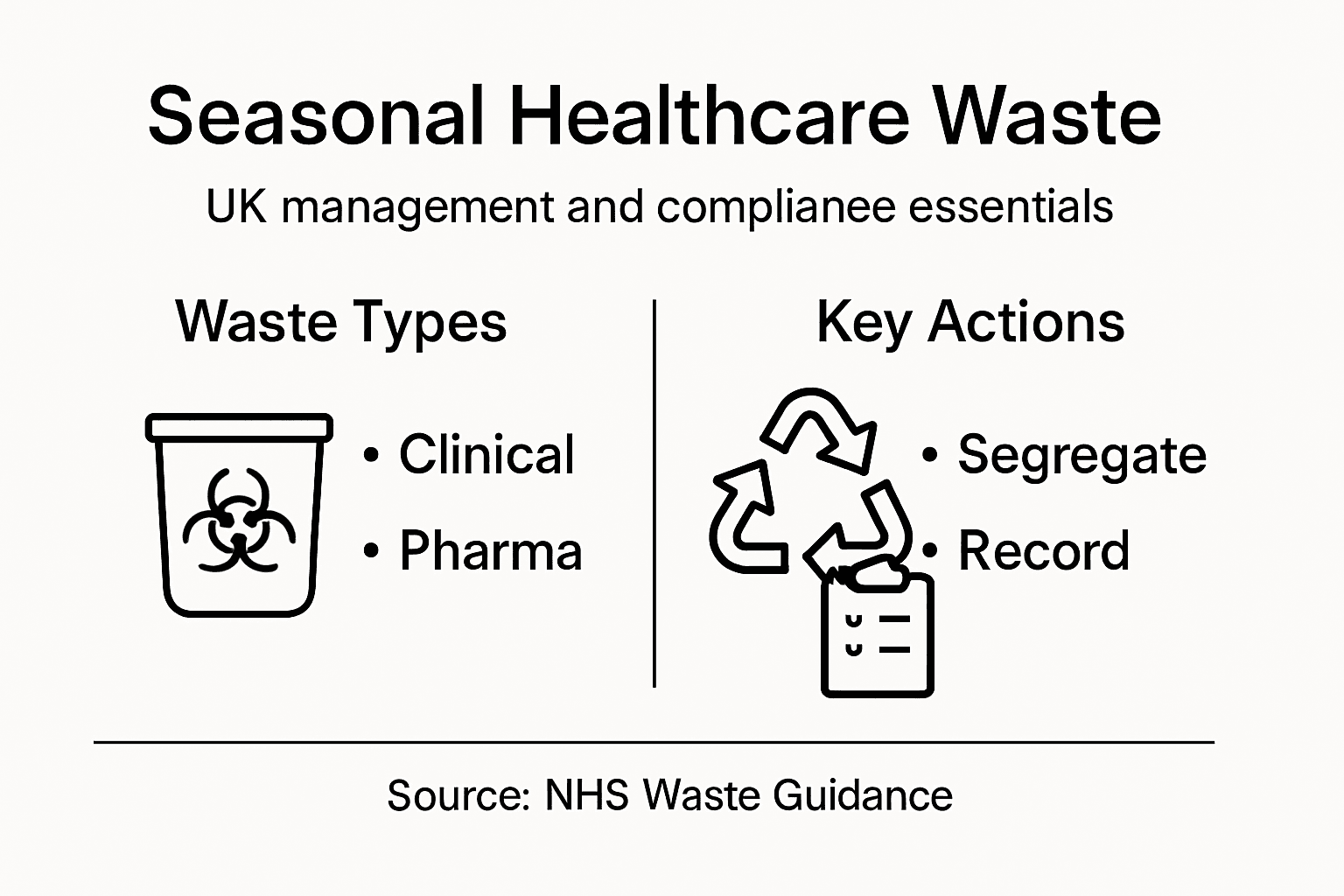
Healthcare waste categories include clinical waste, offensive waste, pharmaceutical waste, sharps, pathological waste, and cytotoxic waste. Each type requires different segregation, storage, and disposal methods.
Your facility likely generates all six types in varying quantities. What changes seasonally is the volume and urgency of collection.
Clinical Waste
This is the largest waste stream in most healthcare settings. Clinical waste includes contaminated materials like dressings, tissues, and used medical equipment. Winter respiratory seasons dramatically increase clinical waste volumes in hospitals across Manchester, Leeds, and Birmingham.

During December through February, expect 35-50% increases in clinical waste compared to summer months. Spring and autumn represent moderate baseline volumes.
Offensive Waste
Offensive waste is non-hazardous but hygienically unpleasant material. Think incontinence pads, body fluids, and contaminated textiles. Seasonal variation in offensive waste mirrors patient admission patterns.
Winter admissions spike offensive waste. Summer holidays and reduced elective procedures lower offensive waste volumes significantly.
Pharmaceutical Waste
Unused medicines and expired medications create pharmaceutical waste. Seasonal variation occurs around medication stocktaking periods and prescription pattern changes.
Christmas typically sees increased pharmaceutical waste from medication reviews before year-end. Spring cleaning and annual stock audits create secondary peaks.
Sharps and Needles
These dangerous materials require specialised sharps containers and secure transport. Sharps waste correlates directly with patient activity levels and clinical procedures.
Winter increases follow clinical waste patterns. Summer sees reduced sharps generation as emergency procedures decrease.
Pathological Waste
Tissues, organs, and bodily samples constitute pathological waste. This type fluctuates based on diagnostic activity and laboratory workload, not admission volumes.
Winter creates pathological waste increases from diagnostic testing during illness peaks. Summer maintains lower baseline volumes.
Cytotoxic Waste
Cancer treatment waste requires careful handling and secure disposal. Cytotoxic waste volumes remain relatively stable year-round because cancer services operate consistently.
However, seasonal variation occurs indirectly through staffing changes and treatment scheduling adjustments around holidays.
Below is a summary of how seasonal changes impact different healthcare waste streams in the UK:
| Waste Type | Winter Impact | Summer Impact | Management Consideration |
|---|---|---|---|
| Clinical | 35-50% volume increase | Lower, baseline level | Extra collections needed |
| Offensive | Admissions spike volume | Reduced volumes | Adjust storage capacity |
| Pharmaceutical | Stock reviews increase | Baseline/clean-out | Stocktake coordination |
| Sharps | Matches clinical spike | Lower emergency use | Sharps disposal safety |
| Pathological | Diagnostic surge peaks | Lower laboratory work | Lab workflow planning |
| Cytotoxic | Stable, minor fluctuation | Stable year-round | Maintain strict protocols |
Seasonal Patterns Across England
Facility managers in hospitals serving areas like Newcastle, Sheffield, and Liverpool experience predictable seasonal waste patterns:
- Winter (December–February): Clinical and offensive waste peak; pharmaceutical waste increases from reviews
- Spring (March–May): Gradual decline toward baseline; spring cleaning generates temporary spikes
- Summer (June–August): Lowest overall volumes; reduced admissions mean less sharps and clinical waste
- Autumn (September–November): Moderate increase; back-to-school epidemics create early peaks
Understanding your facility’s specific seasonal patterns is more valuable than national statistics. Track your own data for three years to predict peaks accurately.
Why This Matters for Your Planning
Knowing which waste types increase seasonally helps you allocate storage space, schedule collections appropriately, and avoid overflow situations. A GP practice with limited storage space needs different collection strategies than a large hospital.
Pharmaceutical waste planning differs from clinical waste planning. You can’t simply increase all collections uniformly and expect efficiency.
Pro tip: Audit your actual waste volumes from the previous three winters in September, then schedule your waste provider to increase collection frequency specifically for clinical and offensive waste categories before October, leaving pharmaceutical and sharps collection at baseline until December stocktake periods.
Legal Standards for Healthcare Seasonal Waste
Healthcare waste management isn’t optional in the UK. It’s governed by strict legal standards that apply equally during quiet summer months and chaotic winter peaks. Seasonal fluctuations don’t reduce your compliance obligations—they increase the pressure to maintain them.
Understanding the legal framework protects your facility from penalties, protects patients from harm, and protects the environment from contamination.
The Core Legal Requirements
Healthcare waste management standards apply year-round under HTM 07-01 and environmental protection laws. These standards don’t ease during winter peaks or summer quiets. Your facility must comply consistently.
The requirements cover waste segregation, storage conditions, transport safety, and final disposal methods. Each category has specific legal thresholds and prohibited actions.
Waste Segregation Requirements
You must separate waste into distinct categories before collection. This isn’t guidance—it’s a legal requirement under Environmental Protection Act 1990. Mixing waste categories breaches law regardless of seasonal volume.
Winter surges can create pressure to skip segregation steps for speed. This is precisely when compliance matters most.
Storage and Capacity Standards
Healthcare waste cannot exceed storage capacity limits. Legal standards specify maximum storage periods: 48 hours for most clinical waste, seven days in winter conditions below 5 degrees Celsius.
Your facility must have adequate storage for peak seasonal volumes. Overfilled containers breach storage regulations and create infection control risks.
Health and Safety Executive Requirements
Healthcare waste safety standards from the HSE cover infection control and transportation safety. These legal requirements intensify during seasonal peaks when waste volumes stress your systems.
Breaches can result in enforcement action, fines, or prosecution. The HSE takes seasonal compliance seriously because seasonal peaks create higher failure risk.
Key Legal Obligations During Peak Periods
Your facility must:
- Maintain proper segregation even when staff shortages occur
- Provide adequate storage capacity for predicted peak volumes
- Schedule collection frequency matching actual seasonal demand
- Train staff to manage higher volumes without cutting corners
- Keep detailed waste records documenting seasonal changes
- Review and update procedures before seasonal peaks
Environmental Compliance Year-Round
Environmental regulations apply whether you generate 100 kilograms or 1,000 kilograms of waste monthly. The Environmental Protection Act and Environmental Permitting Regulations don’t provide seasonal exemptions.
Incinerators, landfill sites, and treatment facilities have strict capacity limits. Seasonal overproduction can breach permitted waste limits and trigger regulatory action.
Seasonal waste increases don’t exempt you from compliance standards—they require better planning to maintain the same standards under greater pressure.
Regulatory Penalties and Consequences
Non-compliance carries serious consequences. The HSE and Environment Agency enforce regulations actively, and penalties scale with breach severity.
Healthcare providers across England face investigation costs, fines ranging from thousands to millions of pounds, reputational damage, and service suspension in serious cases. Seasonal claims of “we didn’t expect the volume” don’t excuse non-compliance.
Pro tip: Create a pre-winter compliance checklist in August that documents your current storage capacity, confirms collection schedules with your provider, verifies staff training completion, and calculates projected waste volumes based on previous three years’ data—then address any capacity gaps before October when demand begins rising.
Risks of Non-Compliance in Peak Periods
Winter peaks expose compliance weaknesses. When waste volumes spike, pressure increases to cut corners, skip procedures, and prioritise speed over safety. This is precisely when non-compliance risks multiply and consequences become severe.
Facility managers who manage seasonal demand poorly face public health risks, legal liability, and financial penalties that extend beyond the peak period itself.
Public Health and Safety Risks
Healthcare waste policy risks highlight increased infection transmission when clinical waste handling fails during peak periods. Improper segregation means infectious materials contaminate general waste streams.
Winter peaks in hospitals across Glasgow, Bristol, and Southampton create conditions where cross-contamination risk peaks. Staff rushing through peak volume periods make segregation errors that wouldn’t occur during quieter months.
Infection Control Failures
Mishandled clinical waste spreads infections. Overfilled sharps containers create needle-stick injury risks. Improperly stored pathological waste attracts pests and contaminates surrounding areas.
These aren’t theoretical risks. Healthcare workers and patients face real harm when waste management systems fail during seasonal peaks.
Environmental Contamination
Overwhelmed treatment facilities can breach environmental permits. Waste exceeding capacity limits goes to unsuitable locations. Cytotoxic waste mishandled during peak periods contaminates soil and water systems.
Environmental damage from seasonal non-compliance persists long after winter ends.
Financial and Legal Consequences
NHS clinical waste management strategy emphasises operational costs soaring when non-compliance occurs. Emergency response costs, remediation expenses, and investigation fees accumulate rapidly.
A single compliance breach during peak periods can cost your facility tens of thousands of pounds.
Regulatory Penalties and Enforcement
The HSE and Environment Agency investigate complaints during peak periods aggressively. Penalties include:
- Fixed penalty notices (£300 to £500 per violation)
- Investigation costs (thousands of pounds)
- Prosecution fines (tens of thousands to millions)
- Service restrictions or suspension
- Reputational damage affecting patient numbers and staff recruitment
Operational Cost Increases
Non-compliance creates cascading costs. You pay for emergency waste collections, regulatory investigations, staff retraining, system upgrades, and insurance increases.
A facility facing enforcement action often pays more in remediation costs than proactive seasonal planning would have cost initially.
Reputational Damage
Mediacia reports of healthcare waste mismanagement spread quickly. Local news outlets in Manchester, Liverpool, and Leeds cover waste compliance failures extensively.
Patient trust erodes when waste management fails. Staff morale drops. Recruitment becomes harder. Some facilities lose contracts entirely following publicised non-compliance incidents.
Non-compliance during peak periods costs more in penalties, lost business, and reputational damage than proactive seasonal planning ever would.
Staff Liability and Burnout
When systems fail during peaks, frontline staff shoulder blame. Healthcare workers face potential disciplinary action for segregation errors made under pressure. Burnout increases when staff work unsafe conditions created by inadequate seasonal planning.
Your team’s safety depends on proper seasonal capacity planning.
Pro tip: Document your waste volumes and collection schedules monthly from September through March, then present this data to senior management in April with a written recommendation for specific collection frequency increases before the next winter season—this creates accountability and ensures budget approval for enhanced services before peak demand arrives.
Practical Strategies for Efficient Waste Management
Efficiency in seasonal waste management isn’t about doing more with less. It’s about doing the right things at the right times with proper planning. Healthcare facilities that manage seasonal waste successfully use proven strategies that reduce costs, maintain compliance, and protect staff safety year-round.
The difference between struggling facilities and successful ones comes down to preparation and systematic processes.
Strategy 1: Implement Flexible Collection Schedules
Fixed collection schedules create waste management chaos during peaks. You’re paying for unused capacity in summer and scrambling for collections in winter.
Effective waste collection practices emphasise responsive scheduling that adjusts to actual seasonal demand. Contact your waste provider by September to arrange flexible contracts that automatically increase frequency before winter peaks.
Flexible schedules mean collecting twice weekly in January instead of once weekly. Costs increase during peaks, but total annual costs decrease because you’re not overpaying for unused summer capacity.
Strategy 2: Strengthen Staff Training Before Peak Periods
Errors increase when staff feel rushed. Winter peaks create pressure that exposes training gaps you didn’t know existed.
Implement mandatory refresher training in September before peak season begins. Focus on proper segregation procedures, hazard recognition, and handling protocols under high-volume conditions.
Well-trained staff make fewer mistakes during busy periods. This reduces compliance risks and improves safety for everyone.
Key Training Topics for Peak Seasons
- Correct segregation of clinical, pharmaceutical, and offensive waste
- Sharps container management and overfill prevention
- Storage temperature and duration limits
- Documentation requirements for increased volumes
- Emergency procedures when storage capacity reaches limits
Strategy 3: Optimise On-Site Waste Segregation
Proper segregation at the point of generation prevents costly downstream problems. Sustainable healthcare recycling solutions include on-site treatment technologies that reduce volume before collection.
Compacting clinical waste reduces collection frequency needs. Incinerating certain waste types on-site decreases transport costs and environmental impact.
These technologies pay for themselves through reduced collection costs during peak periods.
Strategy 4: Monitor and Record Seasonal Patterns
You can’t plan for peaks you haven’t measured. Track your waste volumes monthly from September through March across all waste categories.
After three years of data, you’ll have accurate predictive patterns. Use this data to forecast January peaks and schedule collections accordingly.
Documentation also demonstrates compliance to regulators. Records showing deliberate seasonal adjustments prove proactive management.
Strategy 5: Establish Storage Capacity Buffers
Your storage must accommodate predicted peak volumes plus contingency space. Calculate your winter peak volume, then add 20% buffer capacity.
Adequate storage prevents overflow situations that trigger regulatory breaches. It also prevents staff frustration when containers fill faster than expected.
Efficient seasonal waste management requires planning three months before peaks arrive, not scrambling when winter demand explodes.
Strategy 6: Create Contingency Plans for Emergencies
Unexpected surges happen. Flu outbreaks, emergency admissions, or collection delays can overwhelm planned capacity.
Establish agreements with alternative waste providers before peak season. Document procedures for emergency overflow situations. Train staff on contingency protocols.
Emergency preparedness prevents compliance breaches when unexpected peaks occur.
To efficiently manage seasonal waste, consider these strategic approaches:
| Strategy | Main Benefit | Key Seasonal Focus |
|---|---|---|
| Flexible collection schedules | Cost and efficiency gains | Increase before winter |
| Refresher staff training | Fewer compliance errors | Focus pre-winter months |
| Storage buffer planning | Regulatory breach avoidance | 20% extra for winter peak |
| Monitoring waste patterns | Predictive planning | Track September–March data |
| Emergency contingency planning | Risk mitigation | Prepare for unexpected surges |
Pro tip: In August, meet with your waste provider and document an agreed peak-season schedule showing collection frequencies for each waste category from October through March, with specific dates and volume thresholds that trigger automatic frequency increases—then share this schedule with all staff and post it in waste handling areas so everyone understands when collection changes occur.
Take Control of Your Seasonal Healthcare Waste with Venture Waste
Managing seasonal peaks in healthcare waste requires precision, compliance, and flexibility to avoid costly risks and legal breaches. This article highlights the urgent need for tailored waste solutions that adapt to fluctuating volumes of clinical, pharmaceutical, and hazardous waste during UK winters and festive periods. If your facility struggles with storage capacity, fluctuating collection demands, or meeting strict legal standards like those explained in the regulation Archives, it is time to partner with an expert who understands these challenges deeply.

At Venture Waste, we specialise in providing healthcare waste management services that offer flexible collection schedules, robust hazardous waste handling, and seamless compliance support. Our services are designed to protect your staff, patients, and the environment while reducing operational stress during peak seasons. Explore how our hazardous waste Archives provide solutions specifically shaped for critical materials like sharps and cytotoxic waste. Take action today by visiting our website to streamline your seasonal waste management and secure peace of mind before the next peak arrives.
Frequently Asked Questions
What is seasonal waste management in UK healthcare?
Seasonal waste management refers to the strategic adjustment of waste collection, storage, and disposal practices in healthcare to accommodate fluctuating waste volumes throughout the year, particularly during peak periods like winter.
Why is flexible collection important for healthcare waste management?
Flexible collection is essential because fixed schedules can lead to overpayment during low demand periods and inadequate collection during peaks, leading to compliance risks and overflow situations.
How can healthcare facilities improve staff training for seasonal waste management?
Healthcare facilities can enhance staff training by implementing mandatory refresher courses before peak seasons, focusing on proper waste segregation, hazard recognition, and handling protocols under high-volume conditions.
What are the legal obligations for healthcare waste management during peak periods?
Healthcare facilities must maintain proper waste segregation, adhere to storage capacity limits, ensure scheduled collections match seasonal demand, and provide adequate training to staff to remain compliant with legal standards year-round.
Recommended
- Sustainable Waste Solutions – Enhancing UK Healthcare Compliance – Venture Waste
- Types of Commercial Waste – Key Risks for UK Healthcare – Venture Waste
- End-of-Term Waste Management Guide for UK Health Facilities – Venture Waste
- Why Hire Waste Professionals for UK Healthcare – Venture Waste
- Indoor Plant Care Guide for Clinics: Enhance Patient Wellness


Leave a Reply
Want to join the discussion?Feel free to contribute!