

Safeguarding Sensitive Waste in UK Healthcare
British healthcare facilities generate over 600,000 tonnes of medical waste every year, making secure and compliant disposal a top concern for facilities managers across the United Kingdom. With strict legislation and patient safety on the line, managing sensitive waste in a british healthcare context demands unwavering attention to detail. This guide explains the types, risks, and regulatory requirements so you can protect staff, patients, and your institution from costly mistakes.
Table of Contents
- Sensitive Waste In Healthcare Explained
- Major Types And Classification Standards
- UK Legal Duties And Regulatory Framework
- Essential Steps For Secure Handling And Storage
- Common Compliance Risks And How To Avoid Them
Key Takeaways
| Point | Details |
|---|---|
| Importance of Waste Segregation | Rigorous segregation using colour-coded systems is essential to prevent cross-contamination and ensure regulatory compliance. |
| Regulatory Compliance | Healthcare providers must adhere to stringent legal frameworks, maintaining detailed documentation throughout all stages of waste management. |
| Staff Training and Awareness | Comprehensive training programmes are vital to educate staff on correct waste handling procedures and avoid compliance risks. |
| Monitoring and Accountability | Implementing digital tracking systems enhances transparency and real-time monitoring, crucial for maintaining compliance. |
Sensitive Waste in Healthcare Explained
Healthcare waste represents a critical area of management requiring meticulous attention across medical facilities throughout the United Kingdom. Managing healthcare wastes involves understanding the complex landscape of clinical and infectious materials that pose significant health risks if improperly handled.
Healthcare waste encompasses multiple categories, including infectious materials, pharmaceutical remnants, sharps, chemical waste, and anatomical substances. These materials demand specialised disposal protocols to prevent potential transmission of diseases and protect public health. Medical professionals must implement rigorous segregation strategies, using colour-coded packaging systems that distinguish between different waste types and ensure safe containment.
The regulatory framework governing healthcare waste management in the United Kingdom is stringent, requiring healthcare providers to follow precise guidelines for collection, transportation, treatment, and final disposal. Healthcare waste management involves comprehensive tracking mechanisms to maintain accountability and minimise environmental contamination. Healthcare facilities must maintain detailed documentation tracking each waste stream, demonstrating compliance with national health and safety legislation.
Pro tip: Implement a comprehensive staff training programme focused on waste segregation protocols to reduce cross-contamination risks and ensure regulatory compliance.
Major Types and Classification Standards
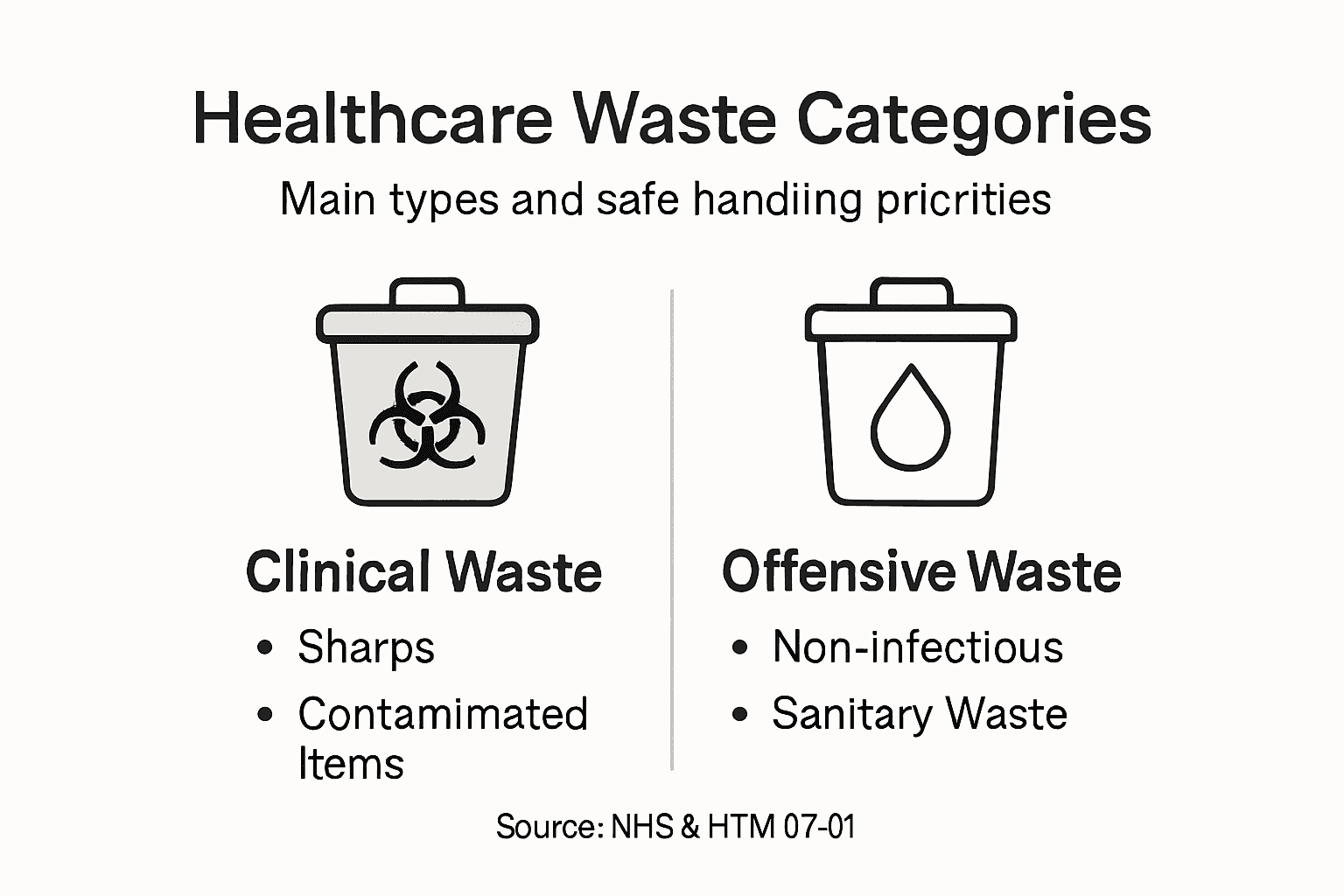
Healthcare waste in the United Kingdom is systematically classified into distinct categories to ensure precise handling and disposal protocols. Healthcare waste definition establishes two primary classifications: clinical waste and offensive waste, each with specific characterisation requirements that guide medical facilities’ waste management strategies.
The clinical waste category encompasses highly sensitive materials that pose significant infection risks. These include sharps such as needles and scalpels, contaminated materials with bodily fluids, pharmaceutical remnants, anatomical waste, and potentially infectious substances from medical procedures. Such waste requires stringent containment protocols, typically involving sealed, colour-coded containers that prevent potential cross-contamination and minimise environmental health risks.

Offensive waste represents a separate classification of medical materials that, while not inherently infectious, still demand careful disposal. This category includes non-infectious body fluids, secretions, and materials from medical settings that do not constitute high-risk biological hazards. Examples include hygiene waste, personal protective equipment without infectious contamination, and certain medical packaging materials. Healthcare facilities must implement distinct segregation and disposal processes for these different waste streams to maintain comprehensive safety standards.
Pro tip: Develop a comprehensive colour-coded waste segregation system with clear staff training to ensure immediate, accurate waste classification in clinical environments.
Here is a summary of key healthcare waste categories and their typical handling requirements:
| Waste Category | Main Examples | Handling Requirements |
|---|---|---|
| Clinical Waste | Sharps, contaminated dressings | Sealed, colour-coded, puncture-resistant containers |
| Pharmaceutical | Expired medicines, residue | Separated from other waste, labelled |
| Anatomical | Human tissue, body parts | Discrete, leak-proof containers, labelled |
| Chemical | Disinfectants, solvents | Special storage, hazard labelling |
| Offensive Waste | Non-infectious PPE, hygiene items | Standard bags, not for infectious waste |
UK Legal Duties and Regulatory Framework
Healthcare organisations in the United Kingdom operate within a comprehensive legal framework that mandates rigorous management of clinical waste. Statutory waste management policies establish clear responsibilities for healthcare providers, ensuring systematic approaches to waste handling that protect public health and environmental safety.
The duty of care principle underpins the UK’s regulatory approach, requiring healthcare providers to maintain accountability for waste from its initial generation through to final disposal. This legal obligation extends across multiple legislative instruments, including the Controlled Waste Regulations and the Health and Social Care Act. Healthcare organisations must demonstrate comprehensive tracking, appropriate segregation, and secure disposal of all potentially hazardous medical materials, with precise documentation evidencing each stage of waste management.
Healthcare waste management standards are comprehensively outlined in the Health Technical Memorandum 07-01 (HTM 07-01), which provides definitive guidance for NHS and independent healthcare providers. These technical standards specify detailed requirements for environmental permitting, waste segregation protocols, storage conditions, transportation mechanisms, and ultimate disposal processes. Non-compliance can result in significant legal penalties, making it imperative for healthcare facilities to maintain meticulous waste management systems that align with national regulatory expectations.
Pro tip: Develop a comprehensive internal audit system to regularly review waste management procedures and ensure ongoing compliance with current regulatory standards.
The following table compares key UK regulations relevant to healthcare waste management:
| Regulation | Area of Focus | Compliance Requirement |
|---|---|---|
| Health Technical Memorandum 07-01 | Segregation, disposal, storage | Detailed protocols, regular auditing |
| Controlled Waste Regulations | Classification, licencing | Record keeping, legal accountability |
| Health and Social Care Act | Duty of care, safety | Tracking from creation to disposal |
Essential Steps for Secure Handling and Storage
Healthcare waste management demands a systematic approach to ensure safety and compliance. Healthcare waste handling procedures require meticulous attention to detail at every stage of collection, storage, and disposal to minimise potential health risks and environmental contamination.
The first critical step involves precise waste segregation. Healthcare facilities must implement a robust colour-coded container system that allows immediate identification of different waste types. Each container must be appropriately sealed, clearly labelled, and strategically positioned to prevent cross-contamination. Specific receptacles are designated for infectious materials, sharps, pharmaceutical waste, and other sensitive categories, ensuring that potentially hazardous materials are isolated and managed with utmost care.
Waste management protocols emphasise the importance of secure storage areas with restricted access. These designated zones must be climate-controlled, pest-resistant, and completely inaccessible to unauthorized personnel. Healthcare facilities should maintain detailed logs tracking waste volume, type, and movement, creating an auditable trail that demonstrates compliance with regulatory standards. Staff training is paramount, with regular workshops ensuring that every team member understands the precise procedures for handling, storing, and documenting sensitive medical waste.
Pro tip: Implement a comprehensive digital tracking system to monitor waste handling processes, ensuring real-time accountability and immediate identification of potential compliance issues.
Common Compliance Risks and How to Avoid Them
Healthcare waste management presents numerous potential compliance challenges that can expose organisations to significant legal and health risks. Compliance risk mitigation strategies require systematic approaches to identify, prevent, and address potential regulatory breaches before they escalate.
One of the most critical compliance risks involves improper waste segregation. Healthcare facilities frequently encounter challenges with mixing hazardous and non-hazardous waste streams, which can lead to serious regulatory violations. Organisations must implement comprehensive training programmes that educate staff about precise waste categorisation protocols. This includes understanding the distinct requirements for infectious materials, pharmaceutical waste, sharps, chemical remnants, and general medical waste. Clear visual guides, colour-coded containers, and regular staff assessments can significantly reduce the likelihood of inadvertent cross-contamination.
Additional compliance risks emerge from inadequate documentation and accountability mechanisms. Healthcare providers must establish robust tracking systems that document each stage of waste management, from initial generation through final disposal. This requires maintaining detailed logs that record waste type, volume, transportation routes, and disposal methods. Electronic tracking systems can provide real-time monitoring, ensuring transparency and creating an auditable trail that demonstrates regulatory adherence. Regular internal audits and third-party compliance assessments can help identify potential vulnerabilities in waste management processes before they result in significant penalties.
Pro tip: Create a dedicated compliance team responsible for continuously reviewing and updating waste management protocols, ensuring your organisation remains proactive in meeting evolving regulatory standards.
Protect Your Healthcare Facility with Expert Sensitive Waste Solutions
Managing sensitive healthcare waste means safeguarding patient safety, meeting strict legal duties, and preventing hazardous contamination. Understanding the complex classifications like clinical waste, sharps, and pharmaceutical materials demands a trusted waste provider who specialises in secure handling and compliance. At Venture Waste Management, we take the pressure off your team by offering expert services tailored to the demanding standards of UK healthcare environments.

Take control of your facility’s waste management today with our comprehensive hazardous waste Archives – Venture Waste solutions. Our streamlined service ensures precise segregation, secure transport, and compliant disposal. Trust us to support your duty of care and reduce the risk of costly breaches. Visit Venture Waste Management now and discover how easy booking can be while protecting public health and your reputation. For sensitive information disposal, explore our confidential waste Archives – Venture Waste services and keep all sensitive materials fully secure.
Frequently Asked Questions
What are the main types of healthcare waste?
Healthcare waste is classified into several categories including clinical waste, which includes sharps and contaminated materials, and offensive waste, which comprises non-infectious items that still require careful disposal protocols.
How is healthcare waste managed in medical facilities?
Healthcare waste management involves precise segregation, following colour-coded packaging systems, secure storage, and compliance with regulatory requirements for collection, transportation, and final disposal.
What are the legal responsibilities for healthcare organisations regarding waste management?
Healthcare organisations are required to adhere to the duty of care principle, ensuring waste is properly handled and documented from its generation to disposal, in accordance with legislation such as the Controlled Waste Regulations and the Health and Social Care Act.
What are the common risks associated with healthcare waste management compliance?
Common risks include improper waste segregation, which can lead to regulatory violations, and inadequate documentation, which must be addressed through robust tracking systems and comprehensive staff training.
Recommended
- Clinical Waste Disposal Requirements for UK Businesses 2025 – Venture Waste
- How to Store Confidential Waste Safely in 2025 – Venture Waste
- Sustainable Waste Solutions – Enhancing UK Healthcare Compliance – Venture Waste
- Office Confidential Waste Policy UK: Compliance and Best Practices 2025 – Venture Waste
- Secure Your Pharmacy Today with Quality Safes – Safes and Security Direct


Leave a Reply
Want to join the discussion?Feel free to contribute!