

Responsible Waste Carriers – Ensuring Legal Compliance UK
Managing waste responsibly can feel daunting when the legal definitions and registration rules keep changing across the United Kingdom. Facilities managers in hospitals and schools must cut through complicated terminology to avoid costly mistakes, yet confusion about terms like ‘waste carrier’ and ‘waste broker’ is still widespread. This article clears up these misconceptions and outlines how to achieve compliant waste carrier registration so your institution stays protected and environmentally responsible.
Table of Contents
- Responsible Waste Carriers Defined And Misconceptions
- Types Of Waste And Carrier Distinctions
- Legal Requirements For Carrier Registration
- Duties, Documentation, And Record Keeping
- Risks, Penalties, And Avoiding Illegal Disposal
Key Takeaways
| Point | Details |
|---|---|
| Legal Requirement | Waste carrier registration is mandatory for all entities transporting controlled waste in the United Kingdom. |
| Tier Classification | Waste carriers are classified into lower and upper tiers, affecting registration requirements based on the type and volume of waste handled. |
| Documentation Obligations | Waste carriers must maintain precise records for waste transfers, including accurate waste transfer notes and compliance with Waste Duty of Care regulations. |
| Risks of Non-Compliance | Failing to comply with registration and documentation can lead to severe penalties, including substantial fines and potential criminal prosecution. |
Responsible Waste Carriers Defined and Misconceptions
Waste carriers represent a critical component of the United Kingdom’s environmental management infrastructure, yet significant misconceptions persist about their precise legal roles and responsibilities. Waste carrier registration is not merely an optional administrative process, but a mandatory legal requirement for businesses and individuals transporting controlled waste across the country.
According to official government guidelines, waste carriers can be categorised into distinct operational types. Some transport waste directly, while others arrange waste handling and disposal through brokerage services. The Department for Environment, Food and Rural Affairs (Defra) has been working to clarify these definitions, proposing to replace current complex terminology with more straightforward classifications like ‘waste controllers’ and ‘waste transporters’ to reduce public confusion.
Most businesses do not realise that waste carrier registration extends beyond traditional waste management companies. Even organisations that generate minimal waste and transport it themselves might require official registration. This includes sectors ranging from construction and healthcare to retail and hospitality. Critically, failing to register can result in substantial financial penalties and potential legal prosecution, making compliance a non-negotiable aspect of responsible business operations.
Pro tip: Before transporting any waste, always verify your specific registration requirements with local environmental authorities to ensure full legal compliance.
Types of Waste and Carrier Distinctions
Understanding the nuanced categories of waste carriers is essential for legal compliance in waste management across the United Kingdom. Upper and lower tier waste carriers represent distinct classifications that determine registration requirements and operational responsibilities.
Lower tier waste carriers typically handle specific, limited waste scenarios. These might include businesses transporting only their own waste, excluding construction and demolition materials. Agricultural enterprises and organisations managing animal by-products also fall into this category. Conversely, upper tier waste carriers have broader responsibilities, including transporting waste for other businesses, managing construction waste, or functioning as waste brokers and dealers.
The regulatory framework distinguishes these carrier types based on the nature and volume of waste handled. Construction companies, waste management firms, and large industrial organisations often require upper tier registration due to the complex and varied waste streams they generate. Small businesses and independent contractors might qualify for lower tier registration, providing a more streamlined approach to legal compliance that matches their specific operational needs.
Pro tip: Carefully assess your waste transportation activities and consult local environmental authorities to determine the precise carrier tier appropriate for your business.
To clarify the distinctions between waste carrier tiers, the following table summarises key differences:
| Tier Type | Typical Activities | Example Businesses | Key Requirement |
|---|---|---|---|
| Lower Tier | Transporting own non-construction waste | Farms, veterinary practices | Simple registration |
| Upper Tier | Transporting waste for others, or construction | Waste management firms, builders | Detailed registration and fees |
Legal Requirements for Carrier Registration
Navigating the legal landscape of waste carrier registration demands meticulous attention to detail and comprehensive understanding of regulatory frameworks. Waste carrier registration is a mandatory process enforced by the Environment Agency for businesses and individuals involved in waste transportation, management, and brokerage across England.
The registration process encompasses two distinct tiers with specific requirements. Businesses transporting exclusively their own waste may qualify for lower tier registration, with notable exceptions for construction and demolition materials. Upper tier registration becomes mandatory for organisations that transport waste on behalf of other entities, broker waste services, or manage complex waste streams. Each registration tier involves precise documentation, accurate information submission, and associated fees that must be paid during initial registration and subsequent renewals.

Non-compliance carries significant legal consequences. Businesses found operating without appropriate waste carrier registration risk substantial financial penalties, potential license revocation, and legal prosecution. The Environment Agency maintains stringent enforcement mechanisms to ensure businesses adhere to waste management regulations, making proactive registration and ongoing compliance crucial for operational legitimacy and environmental responsibility.
Pro tip: Maintain detailed records of your waste transportation activities and set calendar reminders for registration renewal to prevent inadvertent non-compliance.
Duties, Documentation, and Record Keeping
Waste carriers in the United Kingdom bear substantial legal responsibilities that extend far beyond simple transportation. Waste Duty of Care regulations mandate comprehensive documentation and meticulous record-keeping to ensure environmental protection and regulatory compliance.
The documentation process requires waste carriers to maintain precise records for each waste transfer. This includes creating accurate waste transfer notes that comprehensively describe the waste type, quantity, and destination. Critical information must be captured, such as the waste classification, the parties involved in the transfer, and the specific handling requirements. These documents serve as legal evidence of responsible waste management and must be retained for a minimum of two years, providing a transparent audit trail for environmental regulators.
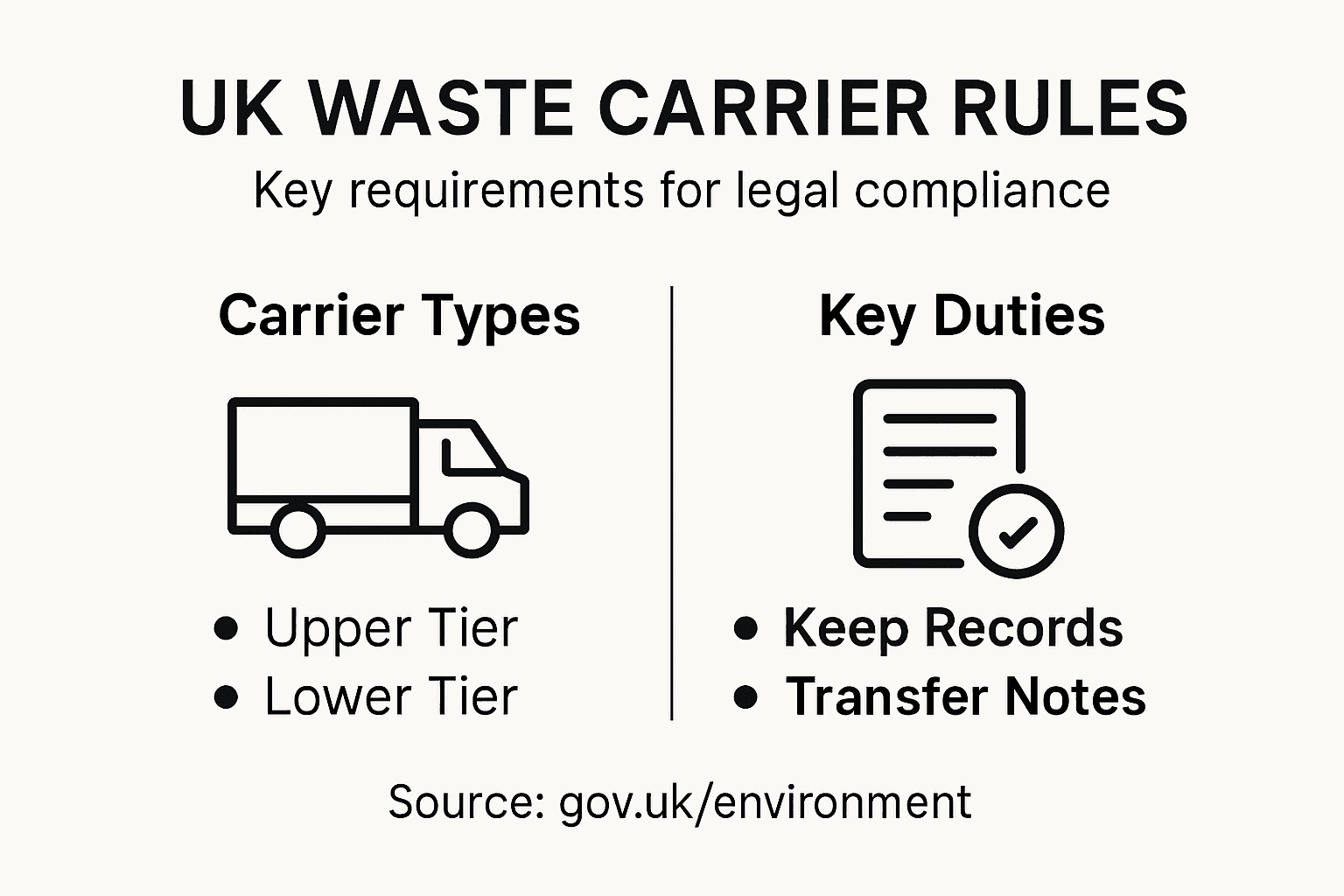
Beyond documentation, waste carriers have a legal obligation to prevent waste from causing environmental damage during transportation. This involves selecting appropriate containment methods, ensuring secure packaging, and implementing robust protocols to mitigate potential waste escape or contamination risks. Carriers must also verify that waste is transferred exclusively to authorised and licensed waste management facilities, maintaining a chain of responsibility that upholds environmental protection standards and legal compliance.
Pro tip: Implement a digital document management system to streamline record-keeping and ensure easy retrieval of waste transfer documentation during regulatory inspections.
Risks, Penalties, and Avoiding Illegal Disposal
Illegal waste disposal represents a significant threat to both environmental sustainability and business integrity across the United Kingdom. Waste crime economic impact reveals that unregulated waste activities cost the national economy over a billion pounds annually, underscoring the critical importance of responsible waste management.
The legal consequences of improper waste handling are severe and multi-faceted. Businesses found engaging in illegal disposal can face substantial financial penalties, including unlimited fines that can potentially cripple organisational finances. Moreover, criminal prosecution is a genuine risk, with potential imprisonment for directors and senior managers responsible for systematic non-compliance. These penalties extend beyond monetary sanctions, potentially damaging a company’s reputation, professional credibility, and future business opportunities.
Preventing illegal disposal requires a proactive and comprehensive approach. Waste carriers must implement rigorous internal controls, including thorough staff training, detailed waste tracking systems, and regular compliance audits. This involves verifying waste destination credentials, maintaining meticulous documentation, and ensuring all transportation and disposal activities align strictly with current environmental regulations. Establishing clear accountability mechanisms and investing in robust waste management infrastructure are essential strategies for mitigating risks and demonstrating corporate environmental responsibility.
Here is a summary of primary legal risks and mitigation strategies for waste carriers:
| Risk Area | Potential Consequence | Mitigation Strategy |
|---|---|---|
| Operating unregistered | Large fines, prosecution | Verify and maintain valid registration |
| Incomplete record keeping | Regulatory penalties | Implement digital tracking of transfers |
| Using unauthorised facilities | License revocation, reputation damage | Maintain current list of licensed outlets |
| Illegal waste disposal | Imprisonment, financial loss | Conduct regular compliance audits |
Pro tip: Conduct quarterly internal compliance reviews and maintain an up-to-date register of authorised waste management facilities to minimise potential legal vulnerabilities.
Stay Legally Compliant with Expert Waste Carrier Services in the UK
Navigating the complex rules around waste carrier registration and waste duty of care can feel overwhelming for businesses big and small. This article highlights key challenges such as the distinction between upper and lower tier carriers, mandatory documentation, and risks of illegal disposal. At Venture Waste, we understand how crucial it is to remain fully compliant with UK environmental regulations while managing your waste responsibly. Explore our regulation Archives – Venture Waste for up-to-date insights and best practices on legal compliance.

Take control of your waste management now with a trusted partner committed to legal compliance and environmental protection. From general waste collection to specialised waste transport services, Venture Waste simplifies your journey with a straightforward three-step booking process. Discover how our network supports UK businesses by reading How the Waste Collection Network in UK Serves Businesses in 2025 – Venture Waste. Ready to ensure your waste operations meet all legal requirements while benefiting from expert service? Visit us at Venture Waste and book your compliant waste solution today.
Frequently Asked Questions
What is the purpose of waste carrier registration?
Waste carrier registration is a mandatory legal requirement for businesses and individuals transporting controlled waste. It ensures compliance with environmental regulations and helps maintain responsible waste management practices.
What are the differences between upper tier and lower tier waste carriers?
Upper tier waste carriers handle a broader range of waste, including that from other businesses and construction sites. Lower tier carriers mainly transport their own non-construction waste, with simpler registration requirements.
What are the legal consequences of operating without waste carrier registration?
Operating without the appropriate waste carrier registration can result in significant financial penalties, potential legal prosecution, and reputational damage to the business involved.
How can waste carriers ensure compliance with the Duty of Care regulations?
Waste carriers can ensure compliance by maintaining accurate records for each waste transfer, selecting suitable containment methods, and verifying that waste is only transferred to licensed waste management facilities.
Recommended
- Secure Waste Transport UK: Legal Standards and Best Practice – Venture Waste
- Complete Guide to Responsible Waste Disposal UK – Venture Waste
- Waste Transport Regulations: Complete UK Guide – Venture Waste
- Responsible Disposal: Protecting Health, Legal Compliance – Venture Waste
- Best Guide about Blocked Drain on Road in 2024


Leave a Reply
Want to join the discussion?Feel free to contribute!