

Packing Materials Recycling – Enhancing UK Healthcare Compliance
Every facilities manager in UK healthcare knows the pressure of managing packing materials that come with unique challenges. Patient safety is always the first priority, but recycling becomes complicated when packaging includes multiple materials or contamination risks. The UK government’s Recyclability Assessment Methodology now provides a clear framework to help healthcare teams assess and report on packaging recyclability, making it easier to align waste management with strict compliance and sustainability goals.
Table of Contents
- Packing Materials Recycling Defined And Misunderstood
- Types Of Packing Materials Suitable For Recycling
- Sorting And Processing In Healthcare Environments
- Legal Duties And Recycling Compliance In 2026
- Risks, Penalties And Costs For UK Healthcare Facilities
Key Takeaways
| Point | Details |
|---|---|
| Recycling Challenges in Healthcare | Healthcare packaging is complex, complicating recycling due to safety and contamination concerns. Specialised processing is often needed for pharmaceutical packaging. |
| Recyclability Assessment Methodology | The UK’s structured methodology provides guidelines for healthcare facilities to evaluate packaging recyclability effectively. Colour-coded ratings aid in understanding environmental impact. |
| Compliance with Upcoming Regulations | New regulations in 2026 will require systematic material separation and regular staff training, imposing penalties for non-compliance. Facilities need to adapt their waste management strategies accordingly. |
| Financial and Operational Risks | Non-compliance with waste management rules can lead to significant fines and reputational damage, but effective recycling can also yield substantial cost savings and lower carbon emissions. |
Packing materials recycling defined and misunderstood
Recycling packing materials in healthcare requires nuanced understanding beyond simple disposal processes. The UK government has established a structured Recyclability Assessment Methodology that provides comprehensive guidelines for evaluating packaging recyclability across various sectors.
Healthcare packaging presents unique challenges that differentiate it from standard recyclable materials. Unlike consumer packaging, medical packaging must prioritise patient safety, which often complicates recycling efforts. Pharmaceutical packaging typically involves complex material combinations that make traditional recycling methods difficult. For instance, many medical packages combine:
- Plastic blister packs
- Aluminium foil barriers
- Multi-layered protective materials
- Contamination-resistant packaging
These intricate material compositions mean that pharmaceutical packaging recycling requires specialised processing techniques. The primary challenge lies in separating different material types without compromising the integrity of medical packaging standards.
The recyclability assessment process involves a detailed classification system where packaging receives colour-coded ratings – red, amber, or green – based on its potential for effective recycling. This systematic approach helps healthcare organisations understand their packaging’s environmental impact and develop more sustainable waste management strategies.
Pro tip: Consult specialised waste management professionals who understand medical packaging complexities to develop targeted recycling strategies for your healthcare facility.
Types of packing materials suitable for recycling
Healthcare facilities must navigate complex requirements when identifying packing materials suitable for recycling. The UK’s Recyclability Assessment Methodology provides a comprehensive framework for evaluating different packaging types, categorising materials based on their potential for effective recycling.
Recyclable Packing Materials in healthcare environments typically include:
- Rigid plastics (PET and high-density polyethylene)
- Clean cardboard and paper packaging
- Single-material metal containers
- Glass containers without contamination
- Transparent plastic packaging
Certain materials present significant challenges for recycling. Pharmaceutical packaging often involves complex multilayer materials that combine different substances, making traditional recycling processes difficult. For instance, blister packs containing medication residues require specialised handling to ensure both environmental safety and medical waste compliance.
Healthcare organisations must carefully assess each packaging type’s composition. The recyclability ratings – red, amber, or green – help facilities understand which materials can be processed efficiently. Metals and glass from medical packaging can often be recycled more straightforwardly, while plastics require more sophisticated separation techniques to ensure they meet environmental and safety standards.
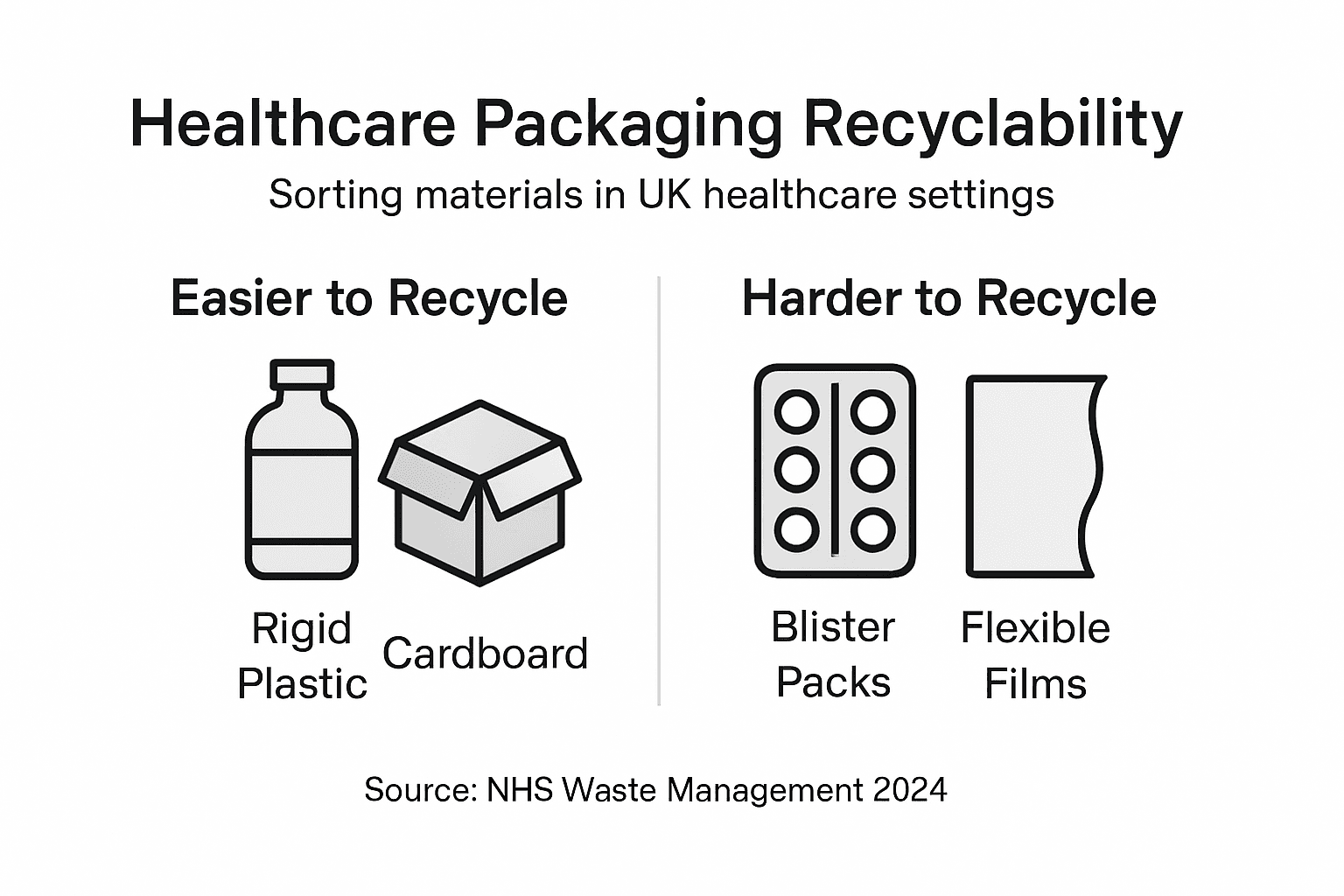
To better understand how different healthcare packaging materials impact recyclability, consider the following comparison:
| Packaging Material | Recycling Complexity | Typical Processing Required | Impact on Sustainability |
|---|---|---|---|
| Rigid plastics | Moderate | Mechanical separation & cleaning | Lower landfill rates |
| Clean cardboard | Low | Simple sorting & baling | High carbon reduction |
| Glass containers | Low | Manual or automated sorting | Promotes reusability |
| Pharmaceutical blister packs | High | Specialist separation techniques | Greater environmental burden |
| Aluminium foil barriers | Moderate | Material extraction needed | Supports circular economy |
Pro tip: Develop a comprehensive material sorting protocol that categorises packaging by recyclability and potential contamination to streamline your healthcare facility’s waste management process.
Sorting and processing in healthcare environments
Healthcare waste management requires meticulous attention to detail, particularly when sorting clinical waste streams. The process involves sophisticated segregation techniques that protect both environmental and public health standards.
Waste Sorting Protocols in healthcare facilities typically follow a structured approach:
- Separate infectious waste from recyclable materials
- Identify pharmaceutical waste requiring specialised disposal
- Categorise packaging by material composition
- Use colour-coded containers for different waste types
- Implement strict contamination prevention measures
Each waste stream demands unique processing considerations. Infectious waste requires high-temperature sterilisation, while recyclable packaging undergoes careful cleaning and material separation. Pharmaceutical waste presents particularly complex challenges, necessitating controlled destruction processes that prevent potential environmental or security risks.

Healthcare organisations must invest in staff training and infrastructure to maintain robust waste management systems. Advanced sorting technologies, including automated scanning and material recognition systems, help streamline the recycling process while ensuring compliance with stringent healthcare waste regulations.
Pro tip: Implement regular staff training programmes focusing on precise waste sorting techniques to minimise cross-contamination and maximise recyclable material recovery.
Legal duties and recycling compliance in 2026
Healthcare facilities face significant regulatory changes with the introduction of Simpler Recycling legislation that mandates comprehensive waste management protocols. These regulations represent a critical shift in environmental responsibility for medical institutions across the United Kingdom.
Key Compliance Requirements for healthcare organisations in 2026 include:
- Systematic separation of recyclable materials
- Mandatory staff training on waste segregation
- Detailed reporting of recycling performance
- Implementation of circular economy principles
- Reduction of plastic waste in medical packaging
- Regular internal waste audits
The legislation introduces stringent penalties for non-compliance, compelling healthcare providers to develop robust waste management strategies. Regulatory frameworks now require precise documentation of waste streams, with particular emphasis on tracking plastics, paper, card, metals, glass, and potential food waste generated within medical facilities.
Organisations must invest in advanced waste management technologies and comprehensive staff education programmes to meet these evolving legal standards. The new regulations aim to transform healthcare waste management from a compliance requirement to a proactive environmental responsibility, encouraging innovative approaches to material recycling and waste reduction.
The following summary highlights key features of Simpler Recycling compliance for UK healthcare in 2026:
| Compliance Aspect | Required Action | Business Impact |
|---|---|---|
| Material separation | Systematic segregation | Lower contamination, improved recycling |
| Staff training | Mandatory, regular | Enhanced awareness, fewer errors |
| Circular economy | Implementation encouraged | Reduced waste, new sustainability goals |
| Reporting & auditing | Detailed documentation | Legal protection, performance tracking |
| Penalty for breaches | Fines £5,000-£50,000 | Potential financial and reputation loss |
Pro tip: Develop a dedicated compliance team within your healthcare facility to continuously monitor and adapt to emerging recycling regulations and waste management best practices.
Risks, penalties and costs for UK healthcare facilities
Healthcare facilities face substantial financial and legal risks when failing to comply with waste management regulations, as detailed in the NHS Clinical Waste Strategy. Non-compliance can result in significant operational challenges and potential financial penalties.
Financial Consequences of inadequate waste management include:
- Potential fines ranging from £5,000 to £50,000
- Increased waste disposal costs
- Loss of environmental certification
- Higher carbon offset expenses
- Potential legal prosecution
- Reputation damage and potential contract terminations
Operational Risks extend beyond immediate financial implications. Healthcare organisations may face suspension of operational licenses, mandatory external audits, and compulsory retraining of staff. The reputational damage can lead to long-term consequences, potentially affecting patient trust and institutional credibility.
The NHS estimates that improved recycling and waste segregation could generate substantial savings, potentially reducing operational costs by approximately £11 million annually while simultaneously decreasing carbon emissions by 30%. Strategic investment in proper waste management infrastructure and staff training can mitigate these risks and transform compliance from a financial burden to a potential cost-saving opportunity.
Pro tip: Conduct quarterly internal waste management audits to proactively identify and address potential compliance vulnerabilities before they escalate into costly penalties.
Streamline Your Healthcare Packaging Recycling with Venture Waste
Navigating the complexities of packing materials recycling in UK healthcare can feel overwhelming. From the challenges of sorting pharmaceutical packaging to meeting the stringent requirements of the 2026 Simpler Recycling legislation, healthcare providers face pressing demands to comply without compromising patient safety. Venture Waste understands these unique pain points and offers tailored waste management solutions that simplify compliance while enhancing your environmental responsibility.

Explore specialised services like our commercial recycling programmes including advanced material segregation supported by our Baler Archives – Venture Waste for efficient packaging compaction. Trust our expertise to help you reduce contamination risks, lower disposal costs, and meet legal obligations effortlessly. Take the first step toward sustainable healthcare waste management today by visiting Venture Waste. Your pathway to simplified compliance and greener practices starts now.
Frequently Asked Questions
What challenges does healthcare packaging recycling face?
Healthcare packaging recycling faces challenges such as the complex combinations of materials in medical packaging, which complicate traditional recycling methods. Ensuring patient safety while trying to recycle these materials adds an additional layer of complexity.
How does the UK government evaluate packaging recyclability in healthcare?
The UK government uses a structured Recyclability Assessment Methodology that categorises packaging materials into colour-coded ratings (red, amber, green) based on their potential for effective recycling, aiding healthcare organisations in their sustainability efforts.
What types of packing materials are generally recyclable in healthcare facilities?
Generally recyclable packing materials in healthcare include rigid plastics (like PET and high-density polyethylene), clean cardboard and paper, single-material metal containers, glass containers without contamination, and transparent plastic packaging.
What are the legal compliance requirements for healthcare waste management in 2026?
In 2026, healthcare facilities must systematically separate recyclable materials, conduct mandatory staff training on waste segregation, report recycling performance, implement circular economy principles, and undergo regular internal waste audits to ensure compliance with new regulations.


Leave a Reply
Want to join the discussion?Feel free to contribute!