

Master chemical waste handling for UK facilities in 2026
Improper chemical waste handling leads to significant compliance failures and safety risks in UK facilities. You face complex regulations, expensive fines, and potential environmental harm when protocols fail. This guide delivers a practical framework to manage chemical waste safely and legally, protecting your operations and meeting UK regulatory standards with confidence.
Table of Contents
- Introduction To Chemical Waste Handling In The UK
- Prerequisites For Safe Chemical Waste Handling
- Step-By-Step Chemical Waste Handling Process
- Common Mistakes And Troubleshooting In Chemical Waste Handling
- Timeline, Costs, And Expected Outcomes Of Chemical Waste Handling
- Alternative Chemical Waste Handling Approaches And Their Tradeoffs
- Explore Expert Chemical Waste Handling Solutions For Your UK Facility
- Frequently Asked Questions
Key takeaways
| Point | Details |
|---|---|
| Legal compliance | UK Hazardous Waste Regulations 2005 require strict classification, documentation, and licensed disposal to avoid fines. |
| Safety essentials | Proper PPE, segregation, and staff training prevent chemical reactions and worker exposure incidents. |
| Handling process | Follow risk assessment, segregation, documentation, licensed collection, and record-keeping steps systematically. |
| Common mistakes | Poor segregation causes 25% of incidents; maintain audit systems and timely disposal schedules. |
| Cost expectations | Disposal costs range £100 to £1,000 per cubic metre, with timelines of 5 to 15 working days. |
Introduction to chemical waste handling in the UK
The UK Hazardous Waste Regulations 2005 impose stringent requirements with severe penalties for non-compliance. Facilities managers and business owners carry direct liability for improper chemical waste disposal, facing unlimited fines and potential prosecution. Environmental contamination from chemical leaks damages ecosystems and triggers costly remediation programmes.
Your responsibilities extend beyond basic waste collection. You must classify hazardous substances accurately, maintain comprehensive documentation, and ensure licensed contractors handle every disposal. Failing these duties puts your workers at risk and exposes your organisation to regulatory action.
Key regulatory obligations include:
- Accurate classification of all chemical wastes using European Waste Catalogue codes
- Segregated storage preventing incompatible chemical reactions
- Complete consignment notes for every waste movement
- Licensed carrier verification before any chemical transport
- Six-year retention of all disposal records for audit purposes
Understanding these UK hazardous waste regulations forms your foundation. The Environment Agency enforces strict compliance monitoring, conducting regular facility inspections. Chemical waste mismanagement ranks among the most heavily penalised environmental offences in the UK. Proper chemical waste risk assessment and safety protocols protect your organisation legally and operationally.
Prerequisites for safe chemical waste handling
Understanding chemical waste classification and risk assessment requirements is essential under UK law before handling. You need specific knowledge, equipment, and verified contractors in place. Rushing into chemical waste management without proper preparation creates dangerous situations and compliance gaps.
Critical prerequisites include:
- Chemical hazard identification using Safety Data Sheets for every substance
- Personal protective equipment meeting British Standards specifications
- Segregated storage containers rated for specific chemical types
- Verified carrier licences checked through Environment Agency registers
- Staff training certificates documenting competency in hazardous waste procedures
Your personal protective equipment standards must match the specific hazards present. Gloves, eye protection, and respirators require selection based on chemical properties and exposure risks. Generic PPE fails to provide adequate protection against concentrated acids, solvents, or reactive substances.
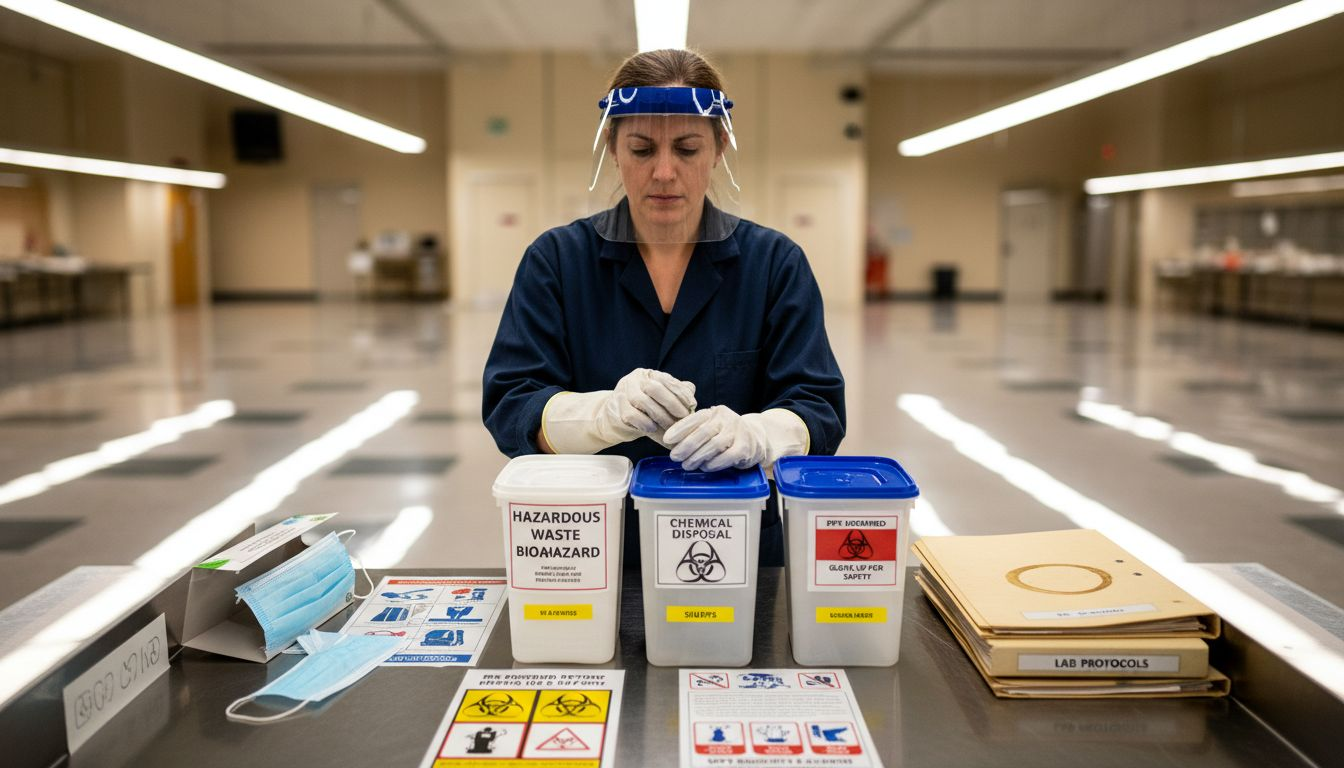
Storage containers need compatibility verification. Acids corrode certain metals, while organic solvents dissolve plastic containers. You must segregate oxidisers from flammable materials, maintaining physical separation to prevent catastrophic reactions.
Pro Tip: Create a chemical compatibility matrix displaying which waste types can share storage areas. Post this prominently in your waste storage zones to prevent dangerous mixing errors by staff.
Verifying contractor credentials protects you legally. Only licensed carriers and disposal facilities can handle chemical waste handling prerequisites legally. Check Environment Agency databases before engaging any service provider. Your liability continues until proper disposal occurs at an authorised facility.
Step-by-step chemical waste handling process
A structured process of risk assessment, segregation, documentation, licensed transport, and record-keeping ensures regulatory compliance. Follow these sequential steps to manage chemical waste safely and legally.
-
Conduct comprehensive risk assessment identifying all chemical wastes generated at your facility. Classify each waste stream using European Waste Catalogue codes and document hazard properties.
-
Implement segregation protocols preventing incompatible chemicals from contact. Use clearly labelled containers meeting UN packaging standards for hazardous materials.
-
Establish documentation systems recording waste type, quantity, storage location, and handling date. Maintain consignment notes for every waste movement off-site.
-
Arrange collection with licensed hazardous waste carriers registered with the Environment Agency. Verify disposal facility permits before authorising any transport.
-
Retain all disposal certificates, carrier licences, and consignment documentation for six years. Implement regular audits confirming compliance with procedures.
| Handling Stage | Key Actions | Documentation Required |
|---|---|---|
| Assessment | Classify wastes, identify hazards | Risk assessment records, SDS files |
| Storage | Segregate, label containers | Waste inventory logs |
| Collection | Verify carrier licence, load safely | Consignment notes, carrier permits |
| Disposal | Confirm facility authorisation | Certificates of disposal |
| Audit | Review procedures quarterly | Compliance audit reports |
Pro Tip: Photograph your waste storage area weekly, dating each image. These visual records demonstrate consistent compliance practices during regulatory inspections.
The chemical waste disposal steps require attention to timing. Schedule collections before storage capacity limits are reached. Overflowing containers create spill risks and violate storage regulations. Build disposal scheduling into your facility maintenance calendar as a non-negotiable recurring task.
Your staff need clear written procedures accessible at waste handling points. Simple visual guides showing proper PPE use and container selection reduce errors. Regular refresher training reinforces critical safety behaviours.
Common mistakes and troubleshooting in chemical waste handling
Improper waste segregation causes up to 25% of hazardous waste incidents in UK facilities. You face serious consequences when basic protocols fail. Understanding frequent errors helps you avoid costly mistakes and regulatory penalties.
Frequent handling mistakes include:
- Mixing incompatible chemical wastes in shared containers
- Incomplete or missing consignment documentation
- Staff handling hazardous materials without proper PPE
- Delayed disposal allowing waste accumulation beyond safe limits
- Using unlicensed carriers for cost savings
These common chemical waste handling mistakes trigger enforcement action. The Environment Agency issues improvement notices for minor violations and prosecution for serious breaches. Financial penalties escalate rapidly with repeated non-compliance.
“Facilities achieving zero segregation errors reduce incident costs by 70% and eliminate regulatory fines through consistent protocol adherence.”
Troubleshooting segregation failures requires immediate action. Stop all waste handling operations when incompatible mixing occurs. Isolate affected containers and contact specialist chemical waste contractors for emergency assessment. Never attempt to separate mixed hazardous wastes yourself.
Documentation gaps create audit failures. Implement daily checklists requiring staff signatures confirming waste logs are current. Digital systems with mandatory fields prevent incomplete record creation. Backup documentation electronically to ensure six-year retention survives facility changes.
PPE compliance issues need systematic solutions. Conduct spot checks verifying proper equipment use during waste handling activities. Replace damaged or expired protective equipment immediately. Budget adequately for PPE supplies, treating them as essential operational costs rather than discretionary expenses.
Disposal delays compound quickly. Set automatic calendar reminders for waste collection scheduling. Establish maximum storage duration policies preventing accumulation. When regular carriers face delays, maintain backup contractor relationships ensuring continuous disposal capacity.
Timeline, costs, and expected outcomes of chemical waste handling
Proper handling reduces compliance fines by 40% and incidents by 70%, with disposal usually within 5 to 15 days. Understanding realistic timelines and budgets helps you plan chemical waste management effectively. Costs vary significantly based on waste classification, volume, and disposal method required.
Typical disposal timelines:
- Initial waste assessment and classification: 1 to 2 working days
- Carrier scheduling and collection: 3 to 7 working days
- Transport to disposal facility: 1 to 2 working days
- Final disposal processing: 1 to 4 working days
- Certificate of disposal receipt: Within 3 working days post-processing
Chemical waste disposal costs range from £100 to £1,000 per cubic metre depending on hazard classification. Highly toxic or reactive wastes command premium pricing. Volume discounts apply for regular contracted collections. Emergency or small-quantity disposals incur higher per-unit costs.
| Handling Approach | Average Cost | Processing Time | Key Benefits |
|---|---|---|---|
| On-site neutralisation | £150-£300/m³ initial setup, £80-£150/m³ ongoing | 2-5 days | Reduced transport, faster processing |
| Off-site licensed disposal | £100-£200/m³ | 5-15 days | Lower upfront costs, less training needed |
| Emergency disposal | £300-£1,000/m³ | 1-3 days | Rapid response, immediate risk reduction |
Measured outcomes from proper chemical waste handling costs and timelines include fewer environmental incidents and improved regulatory standing. Facilities with documented compliance programmes experience faster permit approvals for operational changes. Insurance premiums decrease when risk management demonstrates effectiveness.
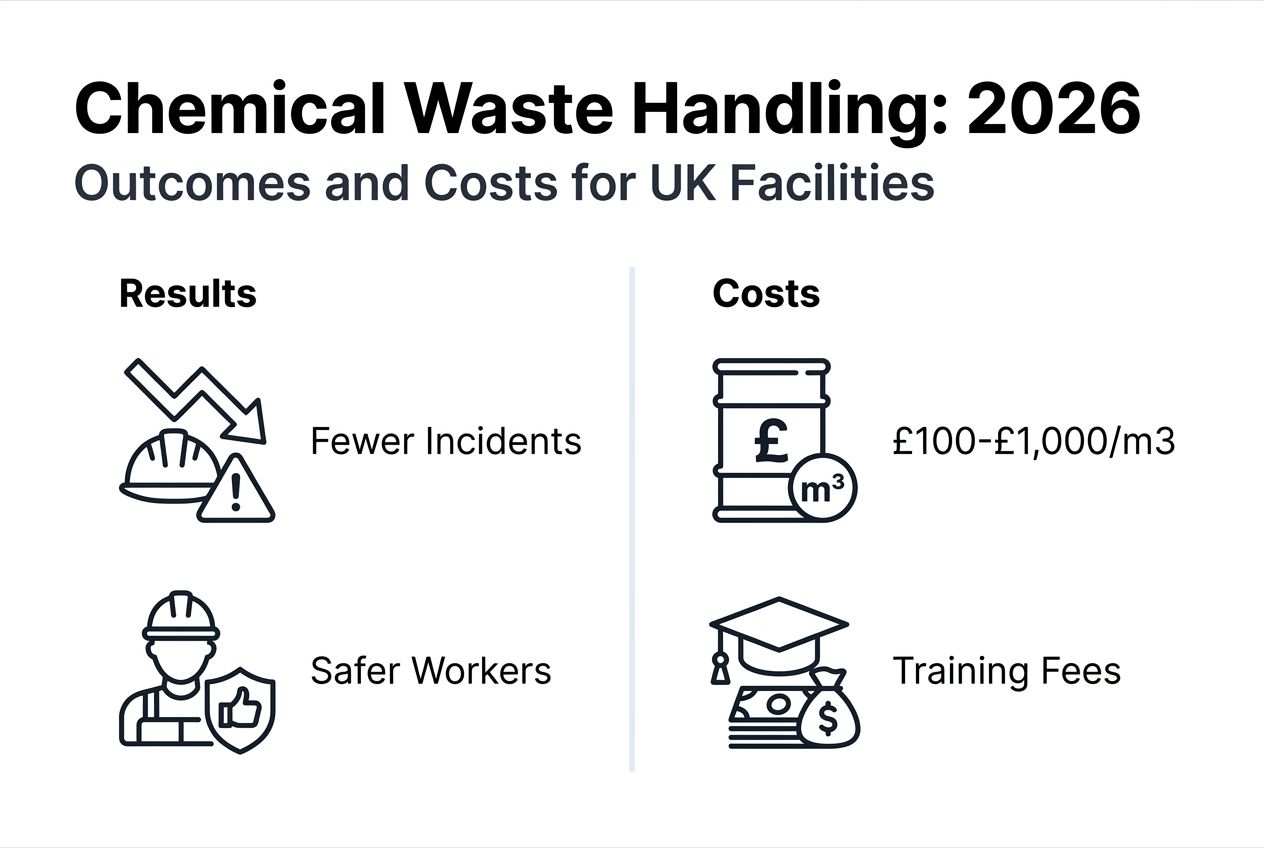
Expect reduced worker compensation claims as exposure incidents decline. Proper chemical waste procedures eliminate the majority of workplace chemical injuries. Environmental liability insurance costs drop when insurers review strong compliance records.
Budget for annual training costs, PPE replacement, and documentation system maintenance. These ongoing expenses represent essential investments protecting against catastrophic fines and incidents. Calculate return on investment by comparing compliance costs against potential penalty amounts and incident remediation expenses.
Alternative chemical waste handling approaches and their tradeoffs
On-site neutralisation reduces transport by 30% but increases upfront costs by 20%; off-site disposal requires less training but is slower. Selecting the right approach depends on your facility’s waste volume, available space, and staff capabilities. Each method offers distinct advantages and limitations.
| Approach | Initial Investment | Operating Costs | Regulatory Complexity | Best Suited For |
|---|---|---|---|---|
| On-site chemical neutralisation | £15,000-£50,000 equipment | £80-£150/m³ plus monitoring | High – requires permits and monitoring | Large facilities, consistent waste streams |
| Off-site licensed disposal | Minimal – storage only | £100-£200/m³ collection fees | Moderate – documentation focus | Smaller facilities, variable waste types |
| Hybrid approach | £5,000-£15,000 partial equipment | £90-£180/m³ blended | Moderate to high | Medium facilities, mixed waste streams |
On-site neutralisation benefits include faster waste processing and reduced transportation risks. You control timing and avoid carrier scheduling delays. However, you need trained chemists or technicians operating neutralisation equipment safely. Permit applications for on-site treatment take months and require detailed operating procedures.
Off-site disposal simplifies your responsibilities. Licensed contractors assume liability once they collect waste from your premises. You avoid equipment maintenance, permit complications, and specialised staff training. The tradeoff involves longer disposal timelines and dependency on external service provider availability.
Pro Tip: Start with off-site disposal while assessing your waste volumes over 12 months. Only invest in on-site equipment after confirming consistent waste generation justifies capital expenditure.
Safety considerations differ between approaches. On-site neutralisation creates additional chemical handling risks during treatment processes. Staff exposure increases during pH adjustment and reaction monitoring. Off-site disposal concentrates risks during loading and transport phases.
Regulatory requirements intensify with on-site treatment. You need environmental permits specifying treatment methods, monitoring requirements, and discharge standards. Regular sampling and reporting obligations create ongoing compliance burdens. Off-site disposal shifts these responsibilities to licensed facilities already holding necessary permits.
Alternative chemical waste handling methods suit different operational contexts. High-volume manufacturers benefit from on-site efficiency despite higher complexity. Service facilities with occasional chemical waste generation find off-site disposal more practical and cost-effective.
Explore expert chemical waste handling solutions for your UK facility
Managing chemical waste demands expertise, reliable service, and unwavering compliance standards. After mastering the essential handling steps, many facilities recognise the value of professional support ensuring continuous regulatory adherence.

Venture Waste provides comprehensive hazardous waste collection services tailored to UK facilities of all sizes. Our licensed carriers and disposal partners maintain full Environment Agency authorisation, guaranteeing legal compliance at every stage. We handle documentation complexities, verify waste classifications, and deliver certificates of disposal confirming proper processing.
Your facility benefits from our waste collection best practices guide approach to chemical waste management. Schedule consultations identifying optimisation opportunities in your current procedures. Receive customised collection schedules matching your waste generation patterns, preventing storage capacity issues.
Venture Waste delivers peace of mind through proven compliance expertise and responsive service. Contact us today to discuss your chemical waste handling requirements and discover how professional management protects your operations.
Frequently asked questions
What is chemical waste handling, and why is it important in UK facilities?
Chemical waste handling encompasses the safe classification, storage, transport, and disposal of hazardous substances according to UK regulations. Proper management protects workers from exposure, prevents environmental contamination, and ensures legal compliance with the Hazardous Waste Regulations 2005. Facilities failing these requirements face unlimited fines, prosecution, and liability for remediation costs.
What personal protective equipment (PPE) is required when handling chemical waste?
You need chemical-resistant gloves, safety goggles or face shields, respirators appropriate for specific vapours, and protective clothing meeting British Standards specifications. PPE selection depends on chemical properties identified in Safety Data Sheets. Regular equipment inspection and immediate replacement of damaged items maintains protection effectiveness.
How can I verify that my chemical waste disposal complies with UK regulations?
Maintain detailed waste logs, obtain certificates of disposal from licensed facilities, and verify all carrier licences through Environment Agency registers. Conduct quarterly internal audits reviewing documentation completeness and procedure adherence. Retain all records for six years as required by law.
What are the penalties for non-compliance with chemical waste regulations in the UK?
Fines can reach millions of pounds for serious violations, with unlimited penalties possible in Crown Court prosecutions. Directors face personal liability and potential imprisonment for deliberate breaches. Additional consequences include environmental remediation costs, reputational damage, insurance premium increases, and operational restrictions imposed by enforcement notices.


Leave a Reply
Want to join the discussion?Feel free to contribute!