

How to Categorise Unidentified Liquid Waste, Want a Clue? Book Our Chemist!
Unidentified liquid waste turns up in labs and factories across the UK, often causing real headaches for safety and compliance teams. Most people do not realise that over 60 percent of hazardous waste incidents involve materials with unclear origins or composition. You might think you can just barrel it up and ship it off, but that move could lead to massive legal and environmental trouble. The real solution comes from expert chemists who turn a mystery drum into a manageable, compliant strategy—saving far more than just paperwork.
Table of Contents
- Understanding Unidentified Liquid Waste Risks
- Key Steps In Waste Identification And Categorisation
- Why Expert Chemist Support Is Essential
- Booking A Chemist For Hassle-Free Waste Disposal
Quick Summary
| Takeaway | Explanation |
|---|---|
| Recognise the risks of unidentified liquid waste | Unidentified liquid waste can pose environmental and health hazards that require immediate attention and expert handling. |
| Employ professional chemists for waste categorisation | Expert chemists provide advanced analytical capabilities essential for accurately identifying and managing hazardous substances. |
| Follow stringent regulatory compliance | Proper categorisation according to UK regulations is crucial for legal compliance and environmental protection. |
| Implement systematic waste identification protocols | Businesses should adopt structured processes for sampling and analysis to ensure safe and compliant waste management. |
| Invest in thorough risk assessment strategies | Comprehensive risk assessment can mitigate legal liabilities and protect worker safety associated with unknown waste. |
Understanding Unidentified Liquid Waste Risks
Unidentified liquid waste represents a significant environmental and safety challenge for businesses across the UK, particularly in industrial areas like Newcastle, Sunderland, and Durham. These mysterious chemical mixtures pose complex risks that demand immediate professional attention and precise categorisation.
Chemical Composition and Potential Hazards
Every unidentified liquid waste stream carries inherent dangers that cannot be overlooked. Explore our comprehensive liquid waste disposal strategies to understand the critical nature of proper identification. The potential hazards range from environmental contamination to severe health risks for workers and surrounding communities. Chemical compositions might include toxic substances, corrosive materials, or reactive compounds that could trigger unexpected interactions when improperly managed.
According to the Environment Agency’s Hazardous Waste Regulations, unidentified liquid waste must undergo rigorous testing to determine its precise chemical profile. This process involves sophisticated analytical techniques that can detect trace elements, molecular structures, and potential reactive properties.
Risk Assessment and Management Strategies
Professional risk assessment becomes paramount when dealing with unidentified liquid waste. Industrial sites in the North East, from chemical processing plants in Teesside to manufacturing facilities in South Shields, must implement stringent protocols for waste categorisation. The risks extend beyond immediate environmental concerns and include potential legal liabilities, worker safety, and regulatory compliance challenges.
Key risk assessment strategies include:
- Comprehensive Chemical Analysis: Utilising advanced spectrographic and chromatographic techniques to break down complex chemical compositions.
- Safety Protocol Development: Creating specific handling and disposal procedures based on initial chemical identification.
- Cross-Referencing Regulatory Standards: Ensuring waste management aligns with UK environmental protection guidelines.
The Health and Safety Executive emphasises that businesses cannot afford to treat unidentified liquid waste as a routine disposal challenge. Each unknown substance represents a potential threat that requires meticulous scientific evaluation and strategic management.
Working with professional chemists who specialise in waste categorisation becomes not just a recommended practice but a critical necessity. These experts employ sophisticated diagnostic tools and extensive knowledge to transform an ambiguous liquid waste stream into a precisely understood and safely manageable substance.
Businesses across industrial sectors must recognise that the cost of professional waste categorisation pales in comparison to the potential financial and environmental consequences of mishandling unidentified liquid waste. Proactive identification and management represent the most responsible approach to protecting both organisational interests and broader environmental ecosystems.
Key Steps in Waste Identification and Categorisation
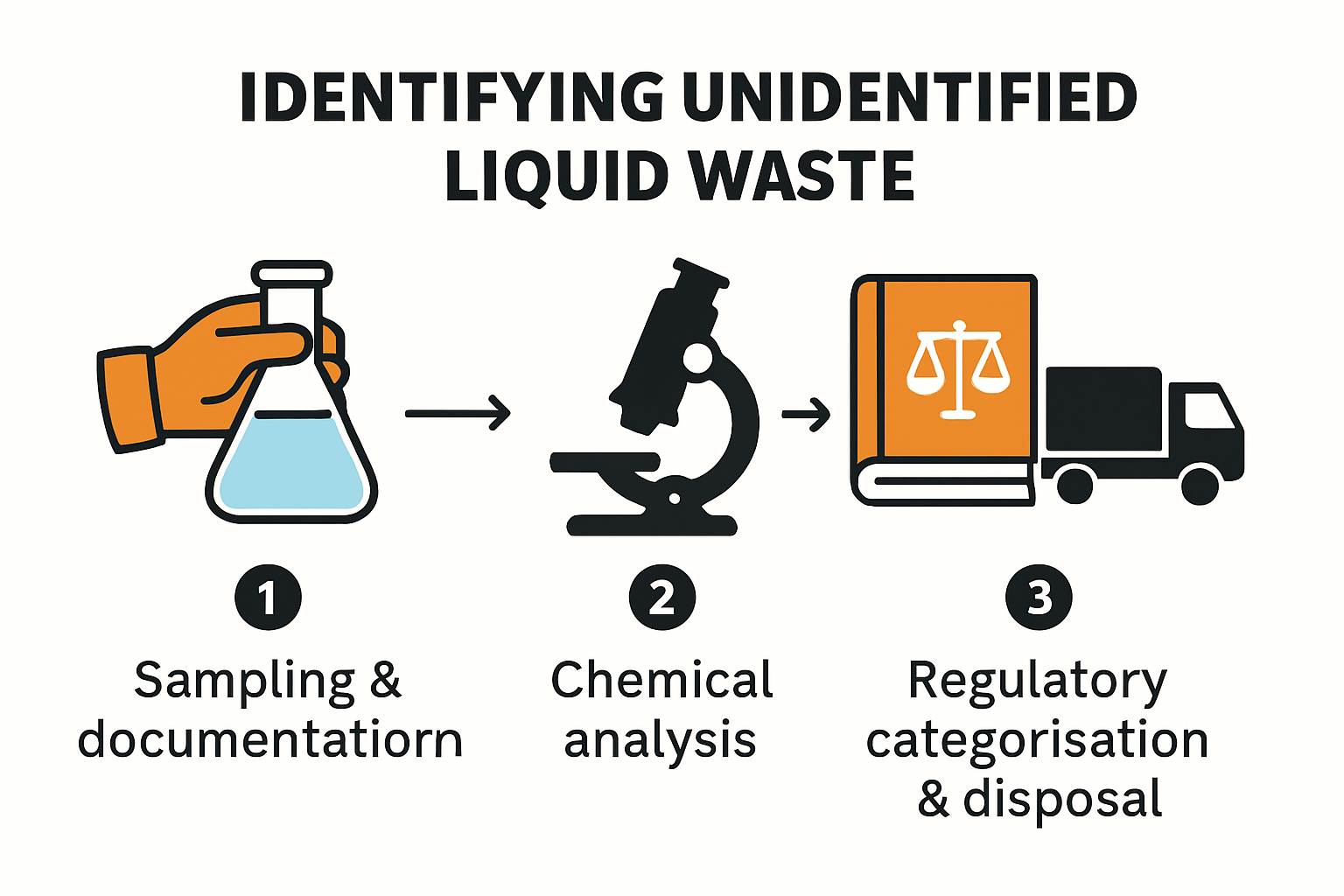
Identifying and categorising unidentified liquid waste demands a systematic and scientific approach that combines technical expertise, regulatory knowledge, and strategic methodology. Businesses in industrial regions like Newcastle, Durham, and Sunderland must follow precise protocols to ensure safe and compliant waste management.
Initial Waste Sampling and Documentation
The first critical step in waste identification involves comprehensive sampling techniques. Learn more about our precise waste management protocols to understand the intricate process. According to the Environment Agency’s Technical Guidance WM3, proper sampling requires trained professionals who can collect representative liquid waste samples without compromising safety or sample integrity.
Key documentation requirements include:
- Chain of Custody Forms: Tracking sample origin, collection method, and transportation details
- Initial Visual Inspection Logs: Documenting colour, consistency, potential contaminants
- Site-Specific Waste Stream Records: Capturing contextual information about waste generation
Advanced Chemical Analysis Procedures
Chemical analysis represents the most sophisticated stage of waste identification. Professional chemists employ multiple advanced techniques to deconstruct complex liquid waste compositions. Spectrographic analysis, gas chromatography, and mass spectrometry provide granular insights into molecular structures, enabling precise categorisation.
The Health and Safety Executive emphasises that comprehensive analysis must include:
- Identifying potential hazardous chemical components
- Determining pH levels and reactivity
- Assessing potential environmental and human health risks
- Evaluating compatibility with different disposal methods
Regulatory Compliance and Categorisation
Once chemical analysis is complete, waste must be categorised according to stringent UK environmental regulations. This process involves matching identified chemical compositions with specific waste classification codes, determining whether the liquid waste is classified as hazardous or non-hazardous.
Businesses must adhere to multiple regulatory frameworks, including:
- Hazardous Waste Regulations
- Environmental Protection Act
- Waste (England and Wales) Regulations
- Transport of Dangerous Goods legislation
Professional waste management experts play a crucial role in translating complex scientific data into actionable regulatory compliance strategies. They ensure that every unidentified liquid waste stream is thoroughly understood, safely managed, and disposed of in full accordance with legal requirements.
By following these systematic steps, businesses can transform potentially dangerous unknown liquid waste into precisely categorised, safely manageable substances. The investment in professional waste identification represents a critical approach to environmental protection, workplace safety, and regulatory compliance.
To clarify the process of identifying and categorising unidentified liquid waste, the following table summarises the key steps, who carries them out, and the main purpose of each stage:
| Step | Responsible Party | Purpose |
|---|---|---|
| Initial Sampling & Documentation | Trained Professionals | Collect representative samples and document key details |
| Advanced Chemical Analysis | Professional Chemists | Identify chemical composition and potential hazards |
| Regulatory Compliance & Categorisation | Waste Management Experts | Match waste type to official codes and ensure legal compliance |
| Disposal Strategy Development | Chemists/Compliance Officers | Formulate safe disposal method based on findings |
Why Expert Chemist Support is Essential
Navigating the complex landscape of unidentified liquid waste requires specialised expertise that goes far beyond basic waste management. Expert chemists play a pivotal role in transforming potentially hazardous unknown substances into safely managed and precisely categorised materials.
Advanced Diagnostic Capabilities
Explore our comprehensive waste identification services to understand the critical role of professional chemists. According to the National Academies Press, laboratories and industrial facilities are strictly prohibited from disposing of materials with unknown hazards. Professional chemists bring sophisticated diagnostic capabilities that allow for nuanced and comprehensive waste characterisation.
Their advanced analytical techniques include:
Below is a table outlining the advanced diagnostic capabilities that expert chemists bring to the process of unidentified liquid waste management, highlighting the analytical technique and its main purpose:
| Analytical Technique | Main Purpose |
|---|---|
| Spectroscopic Analysis | Precisely identify molecular structures |
| Chromatographic Separation | Isolate and analyse complex chemical mixtures |
| Elemental Composition Testing | Determine specific chemical constituents |
- Spectroscopic Analysis: Identifying molecular structures with precision
- Chromatographic Separation: Isolating complex chemical mixtures
- Elemental Composition Testing: Determining precise chemical constituents
Regulatory Compliance and Risk Mitigation
Chemical waste identification is not merely a technical challenge but a critical regulatory requirement. As Purdue University’s Environmental Health and Safety department emphasises, proper identification involves comprehensive research, consultation with laboratory personnel, and thorough documentation.
Expert chemists provide essential support by:
- Interpreting complex safety data sheets
- Conducting systematic characterisation tests
- Ensuring alignment with UK environmental regulations
- Developing targeted disposal strategies
Comprehensive Hazard Assessment
The National Academies Press outlines multiple critical parameters for characterising unknown chemicals. Professional chemists systematically evaluate these parameters, including physical description, water reactivity, solubility, pH levels, ignitability, and the presence of oxidizers or peroxides.
Their comprehensive approach involves:
- Detailed physical and chemical property assessment
- Potential reactivity analysis
- Environmental impact evaluation
- Worker safety risk assessment
Businesses in industrial regions like Newcastle, Durham, and Sunderland cannot afford to treat liquid waste identification as a routine administrative task. Expert chemists transform potentially dangerous unknown substances into precisely understood and safely manageable materials.
The investment in professional chemical waste identification represents more than a regulatory compliance measure. It is a critical strategy for environmental protection, workplace safety, and responsible industrial management. By leveraging specialised expertise, businesses can convert complex waste challenges into systematic, scientifically validated solutions that protect both organisational interests and broader environmental ecosystems.
Booking a Chemist for Hassle-Free Waste Disposal
Booking a professional chemist for liquid waste disposal transforms a potentially complex and risky process into a streamlined, scientifically validated solution. Businesses across the North East, from industrial complexes in Teesside to manufacturing facilities in Newcastle, can significantly benefit from expert waste management support.
Initial Consultation and Assessment
Discover our comprehensive hazardous waste management solutions to understand the seamless process of professional waste categorisation. The initial consultation represents a critical first step where businesses can provide comprehensive details about their unidentified liquid waste. According to the Health and Safety Executive’s Guidelines, this preliminary assessment helps chemists understand the potential composition, origin, and associated risks of the waste stream.
Key elements of the initial consultation include:
- Detailed Waste Description: Comprehensive documentation of waste characteristics
- Site Inspection Scheduling: Arranging on-site evaluation of waste generation environment
- Preliminary Risk Assessment: Initial identification of potential hazards
Technical Sampling and Analysis Process
Once the initial consultation is complete, professional chemists deploy sophisticated sampling and analytical techniques. The sampling process is meticulously designed to ensure representative analysis while maintaining strict safety protocols. Chemists utilise advanced equipment and methodologies to extract and analyse liquid waste samples with remarkable precision.
The technical analysis typically involves:
- Collecting multiple representative samples
- Employing spectrographic and chromatographic techniques
- Conducting comprehensive chemical composition tests
- Generating detailed scientific reports
Disposal Strategy and Compliance Reporting
Following thorough analysis, chemists develop a tailored disposal strategy that ensures full regulatory compliance. This strategy goes beyond mere waste removal, providing businesses with a comprehensive approach to environmental responsibility and legal adherence.
The disposal strategy includes:
- Precise waste categorisation
- Recommended disposal methodologies
- Compliance documentation
- Environmental impact assessment
Businesses in industrial regions like Durham, Sunderland, and Newcastle can dramatically reduce their environmental risk by engaging professional chemists. The investment in expert waste management represents a proactive approach to environmental stewardship, workplace safety, and regulatory compliance.
The booking process is designed to be straightforward and user-friendly. Companies can typically initiate the waste management journey through online platforms, telephone consultations, or direct site assessments. Trained customer service representatives guide businesses through each step, ensuring a smooth and transparent experience.
Ultimately, booking a chemist for liquid waste disposal is more than a service transaction. It is a strategic partnership that transforms potential environmental and safety challenges into systematically managed, scientifically validated solutions. By leveraging professional expertise, businesses can convert complex waste streams into precisely understood and responsibly managed materials.
Frequently Asked Questions
What is unidentified liquid waste?
Unidentified liquid waste refers to liquids whose composition or origin is unknown, often found in labs and industrial settings. It can pose significant safety and environmental risks.
Why is it important to categorise unidentified liquid waste?
Categorising unidentified liquid waste is crucial for compliance with regulations, ensuring safe handling, and mitigating potential health and environmental hazards associated with unknown chemicals.
How can a chemist help with liquid waste categorisation?
A professional chemist utilises advanced analytical techniques to identify the chemical composition of unknown substances, ensuring accurate categorisation and regulatory compliance for safe disposal.
What steps are involved in the waste identification process?
The waste identification process typically involves initial sampling and documentation, advanced chemical analysis, and regulatory compliance checks to ensure safe and compliant waste management.
Ready to Turn Unknown Liquid Waste Into a Problem Solved?
If you feel overwhelmed by the risks and legal worries that come with unidentified liquid waste, you are not alone. Many UK businesses find the task of safe categorisation and compliant disposal daunting, especially when chemical origins are unclear. Mishandled liquid waste can lead to major fines, environmental harm, and even reputational damage. That is where Venture Waste steps in. Our professional chemists take the uncertainty out of the process, providing you with peace of mind and full compliance every step of the way. Learn more about how our Waste Collection Process for UK Businesses tackles even the toughest unknown waste challenges.

Do not risk an expensive mistake or regulatory breach when help is just a click away. Visit Venture Waste now and experience our fast three-step booking system. Contact us today to schedule your expert chemist and secure a compliant, hassle-free solution for even the most complex liquid waste issues.


Leave a Reply
Want to join the discussion?Feel free to contribute!