

Hazardous Waste UK Guidelines: Compliance in 2026
Hazardous waste poses real dangers that can lead to serious legal and environmental consequences for facilities across England and Wales. Proper classification and disposal are not just recommended, but required under strict government regulations. Many facilities managers still hold misconceptions that risk compliance and safety. This article clarifies what counts as hazardous waste, covers updated legal duties, and cuts through common errors that could impact your business and staff wellbeing.
Table of Contents
- Defining Hazardous Waste And Key Misconceptions
- Categories And Examples In Healthcare And Industry
- Legal Duties And 2026 Regulatory Changes
- Safe Handling, Storage, And Digital Record-Keeping
- Risks, Liabilities, And Common Compliance Errors
Key Takeaways
| Point | Details |
|---|---|
| Understanding Hazardous Waste | Hazardous waste includes materials that can harm human health or the environment, such as medical sharps and industrial solvents. Correct classification and handling are essential for compliance. |
| Duty of Care Obligation | The UK mandates a legal duty of care for hazardous waste, requiring proper identification, safe storage, and accurate documentation to avoid severe penalties. |
| Common Misconceptions | Misunderstandings, like believing only large quantities require special handling, can lead to serious compliance risks and liabilities. |
| Upcoming Regulatory Changes | Significant reforms in 2026 will introduce mandatory digital tracking for hazardous waste, requiring facilities to adopt new systems for record-keeping and compliance. |
Defining Hazardous Waste and Key Misconceptions
Hazardous waste presents real risks to your facilities, your staff, and the environment around them. Understanding what counts as hazardous waste is the foundation of compliance, yet many facilities managers still hold misconceptions that could land them in serious trouble with regulators.
What is hazardous waste?
Hazardous waste is harmful material that poses threats to human health or the environment. It includes substances like asbestos, chemicals, batteries, solvents, and oils that require special handling and disposal.
In healthcare facilities across Newcastle, Manchester, and Birmingham, this might include:
- Medical sharps and contaminated materials
- Pharmaceutical waste and expired medications
- Chemical disinfectants and sterilising agents
- Laboratory reagents and solvents
In manufacturing plants, hazardous waste commonly includes spent oils, industrial solvents, metal-laden sludges, and paint thinners. The key distinction is simple: if it can harm people or poison the environment, it is hazardous.
The duty of care requirement
The UK government mandates that your business follows the “duty of care” principle for all hazardous waste produced, stored, and handled on site. This is not optional guidance—it is a legal obligation.
Your duty of care means:
- You must identify and classify all hazardous waste correctly
- You must store it safely to prevent leaks or spillage
- You must transfer it only to authorised waste handlers
- You must keep detailed records of all movements
- You must ensure documentation is complete before waste leaves your site
Failing your duty of care can result in unlimited fines and criminal prosecution—this is not a minor compliance issue.
Common misconceptions about hazardous waste
Facilities managers often get this wrong. Here are the mistakes we see repeatedly:
Misconception 1: “Only large quantities need special handling”
Actually, even small amounts of hazardous waste require the same classification and care as large volumes. A single litre of industrial solvent demands proper disposal just as much as a drum of the same substance.
Misconception 2: “Mixing waste reduces the hazard”
This could not be further from the truth. Combining hazardous wastes often creates worse problems—mixing certain chemicals can cause reactions, explosions, or toxic fumes during storage or transport.
Misconception 3: “We can dispose of hazardous waste ourselves”
Your facility cannot treat or dispose of hazardous waste on-site in most cases. You must contract with an authorised waste handler. Venture Waste Management handles hazardous waste disposal across the North East and beyond, ensuring full compliance and proper treatment.
Misconception 4: “Documentation is just paperwork”
Regulators scrutinise waste records heavily. Incomplete or inaccurate paperwork demonstrates a failure in duty of care and invites enforcement action. Every transfer, every storage date, every quantity must be documented.
Getting classification right
Proper classification prevents costly mistakes. You should conduct a waste identification and classification review of all materials you currently store and discard. If you are unsure whether something is hazardous, treat it as hazardous until proven otherwise.
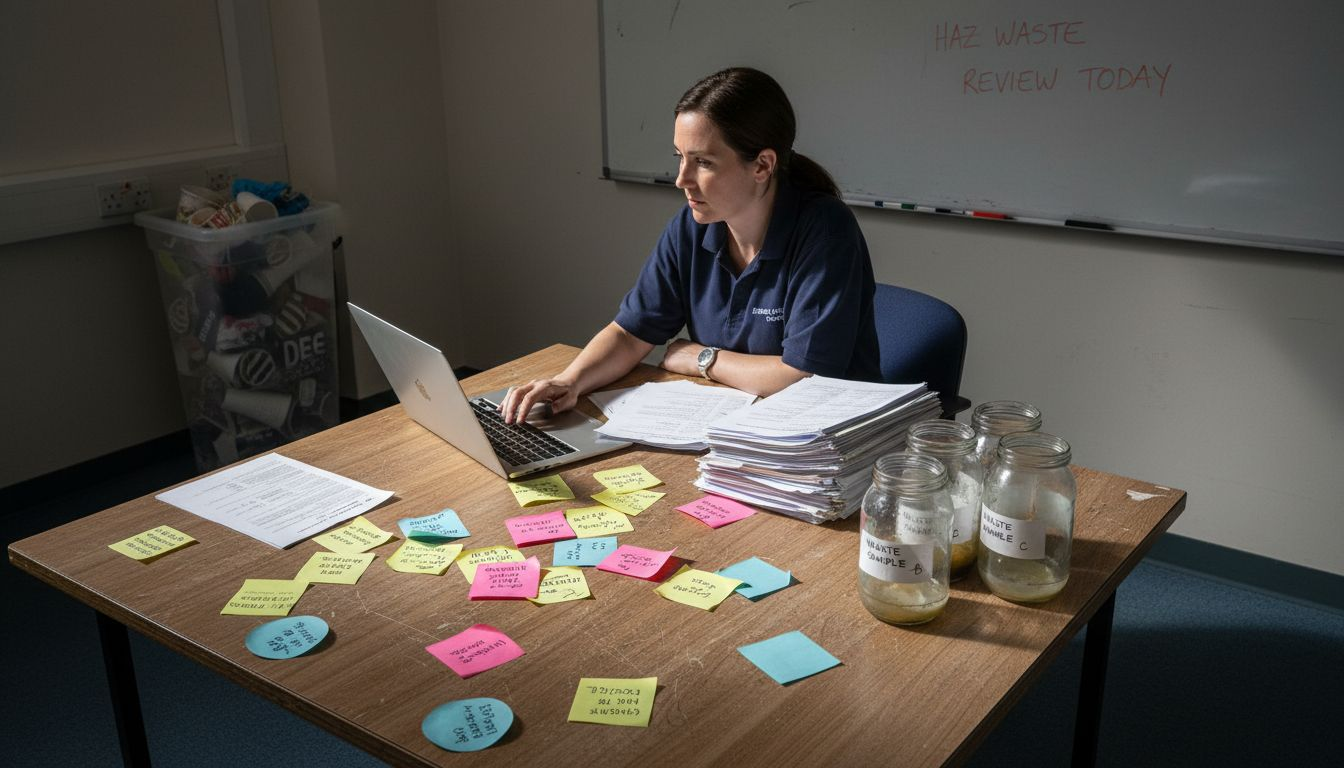
Your materials safety data sheets (MSDS) are your starting point. They list hazard classifications, and if a substance has any hazard label, it is almost certainly classified as hazardous waste once it becomes waste.
Pro tip: Create a simple visual guide for your staff showing which materials in your facility are hazardous and how to store them separately—this prevents accidental mixing and reduces confusion on the floor.
Categories and Examples in Healthcare and Industry
Hazardous waste falls into distinct categories depending on its origin, composition, and the threat it poses. Knowing which category applies to your waste stream determines how you store it, transport it, and ultimately dispose of it. Getting this wrong creates compliance gaps that regulators will find.
Healthcare sector hazardous waste
Healthcare facilities generate hazardous waste daily, often without thinking about it. Medical staff focus on patient care, but facilities managers must track what is being discarded.
Pharmaceutical waste includes expired medications, unused prescriptions, and controlled drugs. These cannot go in standard disposal streams because they contaminate water supplies and harm aquatic life. Hospitals in Leeds, Liverpool, and Sheffield must segregate these strictly.
Chemical and disinfectant waste includes sterilising agents, laboratory reagents, and cleaning products used in hospitals. Formalin from pathology labs, glutaraldehyde from endoscopy departments, and mercury from old equipment all require specialist disposal.
Biological and infectious waste includes:
- Contaminated sharps (needles, scalpels, broken glass)
- Pathological waste (tissues, organs, body parts)
- Microbiological cultures and blood-soaked materials
- Swabs and dressings from infectious patients
This category represents the highest infection risk and demands incineration at approved facilities.
Radioactive waste from diagnostic imaging and nuclear medicine requires separate licensing and specialist handlers. Most healthcare facilities outsource this entirely to specialist contractors.
To clarify the differences between hazardous waste types in healthcare and manufacturing, see this summary table:
| Waste Category | Healthcare Examples | Manufacturing Examples |
|---|---|---|
| Chemicals & Solvents | Sterilising agents, reagents | Paint thinners, degreasing solvents |
| Biological/Infectious | Blood-contaminated dressings, sharps | Not applicable |
| Heavy Metal Content | Mercury in equipment, old devices | Metal-laden sludges, batteries |
| Asbestos/Radiation | Radioactive waste from imaging | Asbestos insulation from buildings |
Manufacturing sector hazardous waste
Manufacturing plants produce hazardous waste at scale. Understanding types of commercial waste helps you establish proper segregation systems from the start.
Spent oils and solvents are among the most common. Industrial plants accumulate hydraulic oils, machining coolants, and cleaning solvents that are contaminated with metal particles and cannot be reused.
Metal-laden sludges form at the bottom of treatment tanks and contain chromium, lead, or cadmium. These are highly toxic and require secure landfill or specialist recovery.
Paint, coatings, and adhesive waste includes:
- Spray booth residues containing volatile organic compounds
- Dried paint and varnish from production lines
- Epoxy resins and industrial adhesives
- Thinners and strippers
Batteries and accumulators from forklifts, backup power systems, and equipment contain lead, nickel, or lithium. These have recovery value but present fire and explosion risks if damaged.
Asbestos-containing materials from older buildings present extreme hazards. Removal and disposal must follow strict protocols with licensed contractors only.
Different waste categories require completely different handling protocols—mixing them creates unpredictable chemical reactions and regulatory breaches.
Cross-sector categories
Some hazardous waste appears in both healthcare and manufacturing settings.
Electrical and electronic waste (WEEE) includes broken equipment, monitors, and circuit boards containing heavy metals and persistent organic pollutants. Proper disposal recovers valuable materials and prevents environmental contamination.
Fluorescent tubes and lamps contain mercury and require specialist recycling. Breaking during storage or transport releases toxic vapours.
Lead-acid batteries appear everywhere from emergency lighting to forklift power systems. They must go to licensed battery recyclers who recover the lead and acid safely.
Pro tip: Photograph and label all hazardous waste storage areas with clear signage showing waste category, hazard symbols, and the date the container was filled—this creates an instant audit trail and prevents accidental mishandling.
Legal Duties and 2026 Regulatory Changes
Your legal obligations around hazardous waste are not static. Regulations evolve, and 2026 brings significant changes that will affect how you classify, track, and dispose of hazardous waste. Understanding these changes now prevents costly compliance failures later.
Your current legal duties
The duty of care remains your primary legal obligation under UK waste law. This means you must ensure hazardous waste is handled safely from the moment it is produced until it leaves your site.
Your specific duties include:
- Identifying all hazardous waste produced in your facility
- Storing it safely in appropriate containers and locations
- Keeping detailed records of all hazardous waste movements
- Using only authorised waste carriers and disposal contractors
- Obtaining waste transfer notes before waste leaves your site
- Retaining documentation for at least three years
Breaching your duty of care can result in unlimited fines and criminal prosecution for you personally, not just your organisation.
Facilities managers in Manchester, Birmingham, and the North East are already seeing enforcement action from the Environment Agency for incomplete records and unauthorised disposal. Do not assume you are too small to be inspected.
The 2026 regulatory overhaul
The Hazardous Waste (England and Wales) Regulations 2005 are undergoing substantial reform. Digital waste tracking improvements will streamline compliance and reduce administrative burdens, but they also mean tighter monitoring and faster detection of breaches.
Key changes coming in 2026 include:
- Mandatory digital tracking systems for all hazardous waste transfers
- Simplified classification guidance aligned with European standards
- Enhanced producer responsibility for certain waste streams
- Stricter penalties for non-compliance and late reporting
- New record-keeping timeframes and audit requirements
Digital waste tracking requirements
Your facility will need to adopt digital systems to track hazardous waste from generation to final disposal. This is not optional. Paper-based systems will no longer meet regulatory requirements after the transition period.
Digital tracking means:
- Real-time recording of all hazardous waste movements
- Automatic alerts when waste sits in storage beyond safe limits
- Digital signatures from waste carriers and disposal contractors
- Immediate reporting to environmental regulators
- Reduced paperwork but increased accountability
Venture Waste Management already operates within these emerging frameworks, ensuring your facility stays compliant with both current and upcoming requirements.
Key regulatory differences between current UK law and the 2026 reforms are summarised below:
| Requirement | Current Law (2024) | From 2026 Reform |
|---|---|---|
| Waste Tracking | Paper or digital permitted | Digital tracking compulsory |
| Classification Standards | UK-specific guidance | Aligned with EU protocols |
| Record Retention Period | Minimum 3 years | 3 years with stricter audits |
| Enforcement Focus | Mainly organisations | Also individual managers |
| Penalties | Large fines, prosecutions | Higher fines, faster action |
Classification changes and alignment
The 2026 review proposes streamlined classification provisions that align more closely with European Union standards. Some materials you currently classify as hazardous may move to different categories, whilst others face stricter controls.
This affects storage protocols, transport requirements, and disposal routes. You must revisit your hazardous waste inventory and reclassify materials based on updated guidance when it is released.
Penalties and enforcement
The new regulations introduce sharper penalties for non-compliance. Fines have increased significantly, and regulators now prioritise prosecution of individual managers, not just organisations.
Common violations that trigger enforcement include:
- Incomplete or missing waste transfer notes
- Using unauthorised waste carriers
- Inadequate storage conditions
- Late reporting to regulatory systems
- Mixing incompatible hazardous waste streams
Pro tip: Start preparing now by conducting an audit of your current hazardous waste systems, digitising your paper records, and training staff on the new classifications—this positions you ahead of 2026 deadlines and demonstrates good faith to regulators.
Safe Handling, Storage, and Digital Record-Keeping
Proper handling and storage of hazardous waste prevents accidents that could injure staff, contaminate your site, or trigger regulatory enforcement. Yet many facilities treat storage as an afterthought. Digital record-keeping is no longer optional—it is mandatory and increasingly scrutinised.
Safe handling protocols
Hazardous waste handling starts the moment a material is identified as waste. Your staff need clear, practical procedures they can follow without thinking twice.
Essential handling practices include:
- Using appropriate personal protective equipment (PPE) for each waste type
- Transporting waste in closed, labelled containers
- Avoiding direct contact with unknown substances
- Keeping incompatible wastes separated during handling
- Preventing spillage through careful movement and secure grip
- Reporting spills immediately to your supervisor
One drop of hazardous waste can contaminate thousands of litres of water—handle everything like it matters, because it does.
Healthcare and manufacturing workers in Leeds, Sheffield, and Nottingham have all suffered serious injuries from improper handling. Training is not optional.
Storage requirements that actually prevent problems
Proper storage practices include safe segregation and labelling to minimise risk during daily operations and emergency situations.
Your storage area must have:
- Segregation – Keep incompatible wastes apart (never mix solvents with oxidising agents, for example)
- Containment – Secondary containment trays beneath containers to catch leaks
- Labelling – Clear hazard symbols and content descriptions on every container
- Access control – Restricted to trained personnel only
- Ventilation – Proper airflow to prevent fume accumulation
- Spill kit – Emergency equipment within arm’s reach
- Temperature control – Appropriate conditions for reactive or temperature-sensitive waste
Containers must be sturdy, corrosion-resistant, and clearly marked with the date they were filled. Never store hazardous waste beyond its maximum holding period—typically 90 days for most waste types.
Digital record-keeping systems
Paper records are finished. Regulators now expect mandatory digital tracking for hazardous waste movements to ensure accuracy and transparency throughout the waste lifecycle.
Your digital system must capture:
- Date waste was produced and classified
- Container volume and hazard classification
- Storage location and dates
- Waste carrier details and authorisation numbers
- Destination facility and authorisation details
- Digital signatures from all parties involved
- Proof of final disposal or recovery
These records must be kept for a minimum of three years and made available to regulators within 48 hours of request.
What digital tracking prevents
Digital systems catch problems immediately. You will receive alerts when waste exceeds storage limits, when documents are missing, or when carriers fail to complete transfers properly.
This reduces:
- Accidental breaches of duty of care
- Lost or incomplete paperwork
- Unauthorised waste movements
- Regulatory fines and enforcement action
- Reputational damage from waste violations
Facilities managers across the North East who have already adopted digital systems report fewer compliance headaches and faster waste collection confirmations.
Pro tip: Integrate your digital waste tracking system with your facility management software so that hazardous waste alerts reach the right person automatically—create a simple workflow rule that flags containers approaching their storage limit date and routes notifications to your waste coordinator.
Risks, Liabilities, and Common Compliance Errors
Hazardous waste mismanagement creates cascading problems. You face health risks to staff, environmental contamination in your area, and personal liability that extends beyond your facility. Regulators prosecute individuals, not just companies—this can affect your career and finances permanently.
Health and environmental risks
Improper handling exposes workers to toxic fumes, chemical burns, and infections. Staff in healthcare facilities across Manchester, Birmingham, and Newcastle have suffered permanent respiratory damage from inadequate ventilation in waste storage areas.
Environmental contamination spreads beyond your site boundaries. Risks from improperly managed hazardous waste include human health hazards and environmental contamination that can affect groundwater, local communities, and wildlife for decades.
Your facility becomes liable for cleanup costs, which can reach hundreds of thousands of pounds. You also face claims from affected neighbours and employees.
Personal and corporate liability
Liability extends across the entire waste chain. Producers (your facility), carriers, and disposal contractors all share responsibility. This means you cannot simply pass the problem to a waste contractor and forget about it.
You remain liable if:
- Your waste carrier is unauthorised or later loses their licence
- Your waste is dumped illegally after leaving your site
- Documents are falsified or incomplete
- Waste is misclassified before being handed over
- You fail to conduct due diligence on contractors
A single mistake in hazardous waste management can result in unlimited fines, criminal prosecution, and personal imprisonment for up to five years.
This is not exaggerated. Facilities managers have been prosecuted individually for corporate waste violations.
The most common compliance errors
We see the same mistakes repeatedly. Most are preventable with basic attention.

Error 1: Misclassification
Facilities staff misidentify waste types. They think something is non-hazardous when it is clearly hazardous. This cascades into wrong storage, wrong transport, and wrong disposal. Always err on the side of caution.
Error 2: Inadequate documentation
Incomplete waste transfer notes, missing carrier authorisation numbers, and undated containers create audit failures. Regulators assume the worst when paperwork is sloppy.
Error 3: Using unauthorised carriers
Staff book the cheapest waste contractor without checking their Environment Agency licence. Unlicensed carriers often dump waste illegally, and you become jointly liable.
Error 4: Exceeding storage limits
Waste sits in your facility for months beyond the 90-day limit. This violates duty of care and creates safety hazards from container deterioration and chemical reactions.
Error 5: Mixing incompatible wastes
Staff combine different hazardous wastes in the same container to save space. This creates unpredictable chemical reactions and makes disposal impossible.
Prevention through diligence
Vetting your waste contractor matters more than you think. Demand proof of their Environment Agency authorisation. Call their previous clients. Inspect their facilities. This due diligence protects you legally.
Documentation systems prevent most errors. Digital tracking systems reduce human mistakes and create audit trails that protect you if regulators investigate.
Pro tip: Create a simple checklist that your staff must complete before any hazardous waste leaves your facility: waste classification confirmed, container labelled with date, transfer note completed with carrier details, and carrier licence verified—laminate it and post it at your waste collection point.
Stay Ahead of Hazardous Waste Compliance Challenges with Venture Waste Management
Navigating the evolving landscape of hazardous waste regulations in 2026 can be complex. This article highlights critical issues like duty of care obligations, mandatory digital tracking, and stricter penalties that your facility must address now to avoid heavy fines and legal risks. With the pressure to correctly classify, store, and document hazardous waste increasing, you need a trusted partner who understands these challenges and can simplify your compliance journey.

Venture Waste Management offers comprehensive hazardous waste handling solutions tailored to meet these new regulatory demands. From secure waste collection using authorised carriers to digitised record-keeping that meets upcoming legislative standards, our expert services are designed to protect your staff, your environment, and your business reputation. Explore our hazardous waste Archives – Venture Waste and stay informed about the latest regulation Archives – Venture Waste to ensure your facility’s procedures remain flawless. Take the first step to safeguard your operations today at Venture Waste Management. Act now and turn complex compliance into confident control.
Frequently Asked Questions
What is classified as hazardous waste in the UK?
Hazardous waste includes harmful materials that pose threats to human health or the environment, such as medical sharps, chemicals, solvents, and contaminated materials that require special handling and disposal.
What are the key responsibilities under the duty of care for hazardous waste?
Under the duty of care, businesses must identify, classify, and store hazardous waste safely, transfer it only to authorised waste handlers, keep detailed movement records, and ensure all documentation is complete before waste leaves their site.
What are the penalties for non-compliance with hazardous waste regulations?
Failure to comply with hazardous waste regulations can result in unlimited fines, criminal prosecution, and personal liability for individuals responsible for waste management within facilities.
How will the hazardous waste regulations change in 2026?
In 2026, new regulations will introduce mandatory digital tracking for hazardous waste, simplified classification guidance aligned with European standards, stricter penalties for non-compliance, and new record-keeping timeframes and audit requirements.
Recommended
- Hazardous Waste Regulations 2025: A Guide for UK Businesses – Venture Waste
- Hazardous Waste Disposal for UK Businesses: A 2025 Guide – Venture Waste
- Hazardous Waste Identification: A 2025 Guide for UK Businesses – Venture Waste
- Hazardous Waste Regulations UK 2025: Essential Guide for Businesses – Venture Waste
- What is Waste Disposal? Understanding Its Importance and Impact – Onyx Removals
- Strategies for High-Risk Areas: 9 Proven Approaches That Reduce Risk


Leave a Reply
Want to join the discussion?Feel free to contribute!