

Effective Recycling Signage UK 2026: Cut Contamination 30%
Recycling bins alone don’t guarantee effective waste separation. Without clear, compliant signage, UK facilities face contamination rates exceeding 60%, undermining recycling efforts and risking legal penalties. New legislation mandates precise signage requirements by March 2026, making this a critical year for facilities managers to overhaul their approach. This guide walks you through the legal framework, proven design principles, behavioural insights, and practical implementation strategies to transform your workplace recycling programme.
Table of Contents
- Introduction To Recycling Signage In UK Workplaces
- Legal And Regulatory Framework For Recycling Signage
- Design Principles For Effective Recycling Signage
- Behavioural Impact Of Signage On Recycling Compliance
- Common Misconceptions About Recycling Signage
- Operational Benefits And Implementation Strategies
- Summary And Next Steps For Facilities Managers
- Enhance Your Facility’s Recycling Compliance With Venture Waste
- Frequently Asked Questions
Key Takeaways
| Point | Details |
|——-|———||
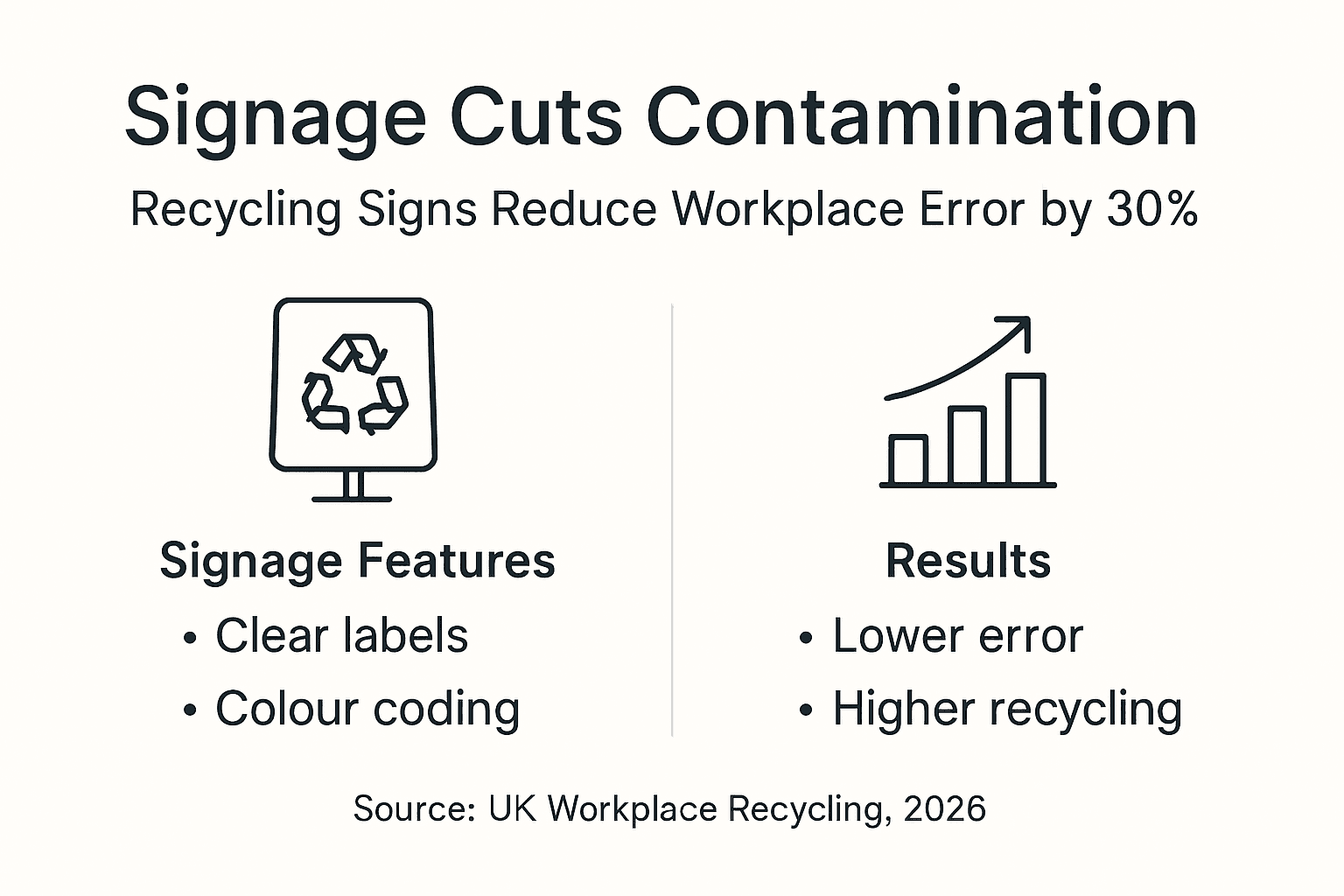
| Clear signage cuts contamination | Proper recycling signage reduces contamination by up to 30% in UK workplaces. |
| Legal mandate in force | UK law requires separation of dry recyclables, food waste, and general waste with clear signage from March 2026. |
| Simple design wins | Colour-coded icons boost understanding and compliance more than text-heavy labels. |
| Training multiplies impact | Signage effectiveness increases when paired with staff engagement and regular monitoring. |
| Sustainability gains | Compliant signage supports organisational environmental goals and operational efficiency. |
Introduction to Recycling Signage in UK Workplaces
The Simpler Recycling legislation effective from March 2026 mandates UK workplaces with 10+ employees to separate and recycle dry recyclables, food waste, and general waste, requiring clear signage to ensure compliance. This legislative shift fundamentally changes how facilities managers must approach waste separation. Signage isn’t a minor detail anymore; it’s a legal requirement and operational necessity.
Facilities managers across the UK face mounting pressure. Employee confusion about what goes where, evolving waste stream classifications, and the need to demonstrate legal compliance create daily challenges. Signage serves as the frontline communication tool, translating complex recycling rules into instant, actionable decisions at the bin. When designed correctly, it transforms recycling from guesswork into routine.
Your UK business recycling obligations extend beyond simply providing bins. The new framework requires systematic waste segregation backed by visible, understandable instructions. For organisations pursuing sustainability certifications or ESG targets, effective signage demonstrates commitment to environmental responsibility whilst protecting against regulatory penalties.
The stakes are high. Poorly labelled bins lead to contaminated waste streams, rejected recycling loads, increased disposal costs, and potential enforcement action. Conversely, well-executed signage programmes reduce contamination, improve recycling rates by 20 to 30%, and create a culture of environmental awareness that extends throughout your organisation.
Legal and Regulatory Framework for Recycling Signage
The Environmental Protection Act 1990 and Waste (England and Wales) Regulations 2011 impose legal duties on businesses to separate recyclables, with signage playing a key role. These foundational laws establish your organisation’s duty of care for waste management. However, the Simpler Recycling legislation mandates separation into at least three waste streams and clear signage by 2026 deadlines, significantly raising compliance expectations.
Under current regulations, mandatory waste streams requiring signage include dry recyclables, food waste, and general waste bins. Each stream must be clearly identified to prevent cross-contamination. Dry recyclables typically include paper, cardboard, plastic bottles, metal cans, and glass. Food waste encompasses organic material from kitchens and canteens. General waste covers non-recyclable items that cannot be recovered.
| Legal Requirement | Details | Compliance Deadline |
|---|---|---|
| Waste separation | Minimum three streams: dry recyclables, food waste, general waste | March 2026 |
| Clear signage | Visible labels identifying each waste stream at collection points | March 2026 |
| Bin colour coding | Standardised colours recommended for consistency | Strongly advised |
| Staff awareness | Training to support signage effectiveness | Ongoing |
Non-compliance carries serious consequences. The Environment Agency can issue enforcement notices, financial penalties, and in severe cases, prosecution. Beyond legal risks, poor waste management damages your organisation’s reputation with clients, investors, and employees who increasingly value environmental responsibility.
Facilities managers should treat signage as documentation of compliance efforts. Clear, professional labels demonstrate due diligence if questions arise during inspections. Understanding how to sort waste legally protects your organisation whilst supporting broader sustainability commitments.
Design Principles for Effective Recycling Signage
Visual clarity determines signage effectiveness. Colour-coded, icon-led labels and simplified signage increase recycling rates by up to 20-30% compared to text-only alternatives. Your brain processes images 60,000 times faster than words, making icons the most efficient communication method at busy disposal points.

Universally recognised symbols transcend language barriers. In diverse UK workplaces, visual symbols on signage that transcend language barriers are essential in multilingual workplaces. A recycling triangle, food waste apple core, or general waste bin icon communicates instantly without requiring English proficiency. This inclusive approach ensures every team member can participate in recycling efforts regardless of background.
Following waste segregation colour codes UK standards creates consistency across your facilities. Blue typically indicates dry recyclables, brown or green signals food waste, and black or grey marks general waste. Standardised colours help employees quickly identify correct bins, especially when moving between different areas or buildings.
| Signage Type | User Comprehension | Contamination Rate | Implementation Cost |
|---|---|---|---|
| Text-heavy detailed labels | Moderate | Higher | Low |
| Icon-based simplified signs | High | Lower | Moderate |
| Colour-coded with icons | Very high | Lowest | Moderate |
Material selection matters for longevity. Professional, durable signage reduces contamination significantly compared to generic signs. Choose weather-resistant materials for outdoor locations and high-traffic areas. Laminated labels fade and peel; rigid plastics maintain clarity for years.
Pro Tip: Invest in polypropylene or aluminium composite signs for industrial areas and outdoor bin stores. These materials withstand moisture, temperature fluctuations, and rough handling whilst maintaining visibility.
Key design elements for maximum effectiveness:
- Large, bold icons positioned above text
- Minimal text: bin name and 3 to 5 example items maximum
- High contrast colour combinations for visibility
- Consistent sizing across all bins in your facility
- Laminated or sealed surfaces for easy cleaning
Simplified design principles for recycling signs recognise that decision fatigue increases contamination. When employees face detailed lists or confusing instructions, they default to the easiest choice, often the general waste bin. Strip away complexity. Your signage should enable split-second correct decisions, particularly in office waste solutions where employees dispose of items whilst focused on other tasks.
Behavioural Impact of Signage on Recycling Compliance
Clear recycling signage reduces waste contamination, which commonly results in over 60% of recyclable material being missed or contaminated due to confusion. This staggering statistic reveals the true cost of poor communication. Every contaminated load sent for recycling ends up in landfill, wasting collection efforts and increasing disposal costs.
Clear recycling signage reduces waste contamination rates by addressing confusion that causes over 60% of recyclable material to be missed or contaminated.
Real-world evidence supports signage effectiveness. Hackney Council’s signage campaign significantly increased recycling compliance and reduced contamination through strategic visual communication. The project demonstrated that well-designed labels change behaviour by removing barriers to correct disposal. When people understand exactly what belongs in each bin, they recycle correctly.
However, signage alone doesn’t guarantee results. Combining signage with training and engagement is essential for consistent behaviour change. Initial awareness campaigns, ongoing reminders, and visible leadership support multiply signage impact. Think of labels as enablers rather than solutions; they work best within comprehensive recycling programmes.
Key behavioural factors influenced by effective signage:
- Cognitive ease: Simple visuals reduce mental effort required for correct disposal
- Social proof: Visible recycling infrastructure signals organisational norms
- Immediate feedback: Clear categories provide instant confirmation of correct choices
- Habit formation: Consistent signage across locations builds automatic behaviour
Pro Tip: Involve frontline staff in signage design reviews. Employees who use bins daily spot confusing elements and suggest improvements that designers might miss. This consultation builds ownership and increases compliance.
Understanding recycling benefits at work helps frame signage as part of broader organisational value. When employees see recycling as contributing to company sustainability goals rather than just another rule, engagement increases. Link signage to visible outcomes like waste reduction metrics or environmental achievements.
The behavioural impact of recycling signage extends beyond immediate disposal decisions. Well-executed programmes create cultural shifts where environmental responsibility becomes embedded in workplace identity. Employees take pride in high recycling rates and hold colleagues accountable for proper waste separation.
Common Misconceptions About Recycling Signage
Many facilities managers assume installing signs completes their recycling programme. Misconception: signage alone guarantees recycling compliance; correction: it must be combined with training and clear bin placement. Signage provides necessary information, but successful programmes require supportive infrastructure, accessible bin locations, and ongoing communication reinforcing correct practices.
Another persistent myth suggests complex, detailed signage improves compliance. Reality contradicts this belief. Overly complicated labels overwhelm users, increasing cognitive load at the exact moment when quick decisions matter. Brain research shows people default to habitual behaviour under cognitive pressure. If your signage requires reading and analysing, employees will ignore it during busy periods.
Key misconceptions and corrections:
- Myth: More information on signs improves accuracy. Reality: Simplified labels with icons outperform text-heavy alternatives.
- Myth: Expensive custom signage is necessary. Reality: Clear, standardised designs using recognised symbols work better and cost less.
- Myth: Signage only affects compliance metrics. Reality: It shapes workplace culture and environmental values.
- Myth: Once installed, signage needs no maintenance. Reality: Regular reviews and updates maintain effectiveness as waste streams evolve.
Some organisations believe signage effectiveness is binary: it either works or doesn’t. Actual performance exists on a spectrum influenced by design quality, placement, visibility, material durability, and integration with training. Understanding myths about recycling signage helps facilities managers optimise their approach rather than accepting subpar results.
The misconception that signage impacts only waste management overlooks broader organisational benefits. Effective recycling infrastructure demonstrates environmental commitment to clients, investors, and prospective employees. It supports ESG reporting, reduces operational costs, and creates visible proof of sustainability values.
Operational Benefits and Implementation Strategies
Systematic implementation maximises signage effectiveness whilst ensuring legal compliance. Start with a comprehensive waste audit identifying current disposal patterns, contamination sources, and bin locations. This baseline data reveals specific challenges your signage must address.
Implementation steps for facilities managers:
- Conduct waste audit to identify contamination patterns and volumes
- Map bin locations against employee traffic flows and waste generation points
- Select signage designs following colour-coding standards and icon principles
- Source durable, professional signs from reputable suppliers
- Install signs at consistent height and position across all bins
- Launch awareness campaign explaining new signage and recycling requirements
- Monitor contamination rates monthly and adjust approach as needed
- Schedule quarterly signage condition inspections and replacements
Simplified signage improves waste collection efficiency by reducing sorting errors and speeds up waste management by up to 15%. This operational benefit extends beyond environmental impact. Faster, more accurate waste processing reduces staff time spent managing bins, lowers collection frequencies for contaminated waste, and decreases overall disposal costs.
Operational benefits of effective recycling signage:
- Reduced contamination rates leading to lower disposal costs
- Improved sorting accuracy minimising staff correction time
- Faster waste collection through clear bin identification
- Enhanced legal compliance reducing enforcement risks
- Stronger sustainability credentials supporting ESG goals
Pro Tip: Partner with professional signage providers who understand UK recycling regulations. Quality suppliers offer compliant designs, durable materials, and replacement guarantees ensuring long-term value.
Integrate signage with waste collection best practices across your operations. Coordinate label designs with collection schedules, bin sizes, and waste contractor requirements. This holistic approach prevents mismatches between signage instructions and actual waste processing capabilities.
Sustaining improvements requires ongoing attention. Establish regular review cycles aligned with waste audits. Track contamination trends, employee feedback, and regulatory updates that might require signage modifications. Boost workplace recycling through continuous refinement rather than one-time installation.
Consider effective signage implementation as an evolving programme rather than a fixed project. Waste streams change as products and packaging evolve. New regulations introduce different requirements. Your signage must adapt accordingly to maintain effectiveness and compliance.
Summary and Next Steps for Facilities Managers
Effective recycling signage forms the foundation of workplace waste compliance in 2026. Clear, colour-coded labels reduce contamination by up to 30%, protect against legal penalties, and support organisational sustainability objectives. The Simpler Recycling legislation makes proper signage mandatory, not optional, for UK workplaces.
Successful implementation combines professional signage design with comprehensive training, strategic bin placement, and ongoing monitoring. Simplified, icon-based labels outperform text-heavy alternatives by enabling instant correct decisions at disposal points. Regular maintenance and updates sustain performance as waste streams and regulations evolve.
Facilities managers should approach signage as part of integrated waste management strategy rather than standalone solution. Partner with experienced waste management providers who understand regulatory requirements and can support your compliance journey. Venture Waste Management offers expertise in UK recycling regulations and practical implementation guidance.
Your next steps: audit current signage effectiveness, identify contamination sources, select compliant designs following colour-coding standards, and integrate labels with staff training programmes. Monitor results monthly and refine your approach based on measurable contamination and recycling rate data.
Enhance Your Facility’s Recycling Compliance with Venture Waste
Navigating 2026 recycling legislation requires expert support and proven systems. Venture Waste Management delivers tailored waste collection and recycling solutions aligned with current UK legal requirements, helping facilities managers achieve compliance whilst reducing operational costs.

Our team provides practical guidance on implementing effective signage programmes that reduce contamination and improve recycling rates. We understand the challenges facilities managers face and offer comprehensive support from initial waste audits through ongoing compliance monitoring. Explore our detailed resources on waste collection best practices and boost workplace sustainability through proven strategies.
Partner with Venture Waste Management to transform your recycling programme from compliance burden into operational advantage. Contact our team for site-specific recommendations and discover how professional waste management support protects your organisation whilst advancing sustainability goals.
Frequently Asked Questions
What are the primary waste streams requiring signage under UK law?
Dry recyclables, food waste, and general waste are the mandatory streams requiring clear identification. Signage must distinguish each stream to comply with Simpler Recycling legislation effective March 2026. Additional streams like hazardous waste may require separate labelling depending on your operations.
How often should recycling signage be updated or maintained?
Inspect signage quarterly and replace immediately if worn, faded, or damaged. Conduct comprehensive reviews annually alongside waste audits to ensure labels reflect current waste streams and regulations. Material degradation, regulatory changes, or operational modifications may trigger earlier updates.
Can signage alone guarantee reduced contamination rates?
No, signage must integrate with employee training, strategic bin placement, and ongoing engagement campaigns. Clear labels enable correct disposal but require supportive infrastructure and reinforced messaging. Combining multiple interventions delivers sustained contamination reduction beyond what signage achieves independently.
What design features make recycling signage most effective?
Large icons, standardised colour-coding, minimal text, and high-contrast designs maximise effectiveness. Durable materials suitable for installation environments ensure longevity. Simplified labels with 3 to 5 example items outperform detailed lists by reducing cognitive load at disposal points.
Recommended
- Reducing Business Waste in 2025: Practical Strategies for UK Organisations – Venture Waste
- 7 Key Recycling Innovations 2025 for UK Facilities Managers – Venture Waste
- Recycling Hazardous Materials: Safe Disposal for UK Businesses 2025 – Venture Waste
- Recycling Contamination – How It Affects UK Healthcare – Venture Waste


Leave a Reply
Want to join the discussion?Feel free to contribute!