

Confidential Paper Shredding UK: Secure Your Business
Did you know that over 60 percent of data breaches start with paper records falling into the wrong hands? Protecting confidential business information goes far beyond just tossing papers in the bin. Companies face strict legal standards and heavy fines for poor handling of sensitive documents. A clear and secure paper shredding strategy protects your reputation and keeps personal details safe from leaks or misuse.
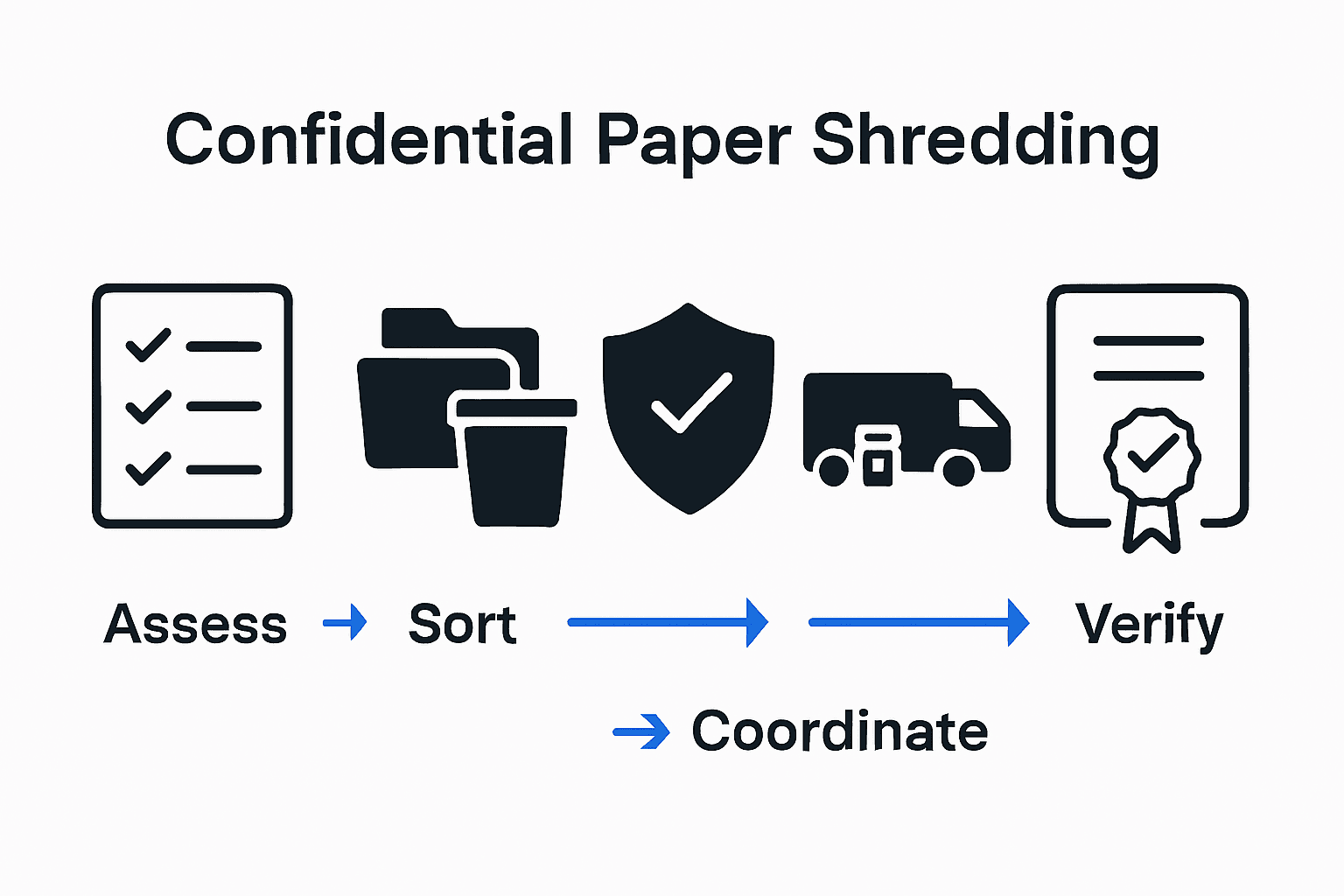
Quick Summary
| Key Point | Explanation |
|---|---|
| 1. Assess document disposal needs | Conduct a thorough audit of document types to identify sensitive materials for secure destruction. |
| 2. Sort documents by risk level | Create distinct categories for documents based on their sensitivity to ensure proper disposal. |
| 3. Choose a certified shredding service | Select a shredding provider with proven credentials and industry certifications for secure data disposal. |
| 4. Coordinate for secure collection | Ensure a responsible team member oversees the collection and that documents are stored securely. |
| 5. Obtain a destruction certificate | Request a detailed certificate of destruction post-process to document the disposal and protect against breaches. |
Table of Contents
- Step 1: Assess Confidential Paper Shredding Needs
- Step 2: Sort And Prepare Sensitive Documents
- Step 3: Select A Certified Shredding Service
- Step 4: Coordinate Secure Collection Or Drop-Off
- Step 5: Verify Destruction And Obtain Compliance Certificate
Step 1: Assess Confidential Paper Shredding Needs
Confidential paper shredding starts with a thorough assessment of your business’s specific document disposal requirements. This crucial first step helps you understand exactly what sensitive materials you generate and how to protect them effectively.
Begin by conducting a comprehensive audit of your document types. Look closely at papers containing personal information such as staff records, customer details, financial statements, legal contracts, and internal correspondence. According to ICO guidance, you must securely dispose of records containing personal or sensitive information to prevent potential data breaches under the Data Protection Act 2018.
Create an inventory that categorises documents by sensitivity level. Classify materials into high risk (requiring immediate secure destruction) and standard risk categories. High risk typically includes documents with names, addresses, financial data, medical records, or corporate strategies. Standard risk might involve general correspondence or meeting notes.
Here’s a comparison of common document types and their confidentiality risk levels:
| Document Type | Example Contents | Risk Level |
|---|---|---|
| Staff Records | Names, addresses, HR notes | High |
| Customer Details | Contact info, account data | High |
| Financial Statements | Banking details, forecasts | High |
| Legal Contracts | Agreements, compliance papers | High |
| Internal Correspondence | Memos, work email | Standard |
| General Notes | Meeting plans, reminders | Standard |
Pro Tip: Involve team members from different departments to ensure no sensitive documents are overlooked during your assessment.
Consider your current document volume and frequency of disposal. How many boxes or files do you generate monthly? This will help determine whether an on site shredding solution or professional confidential waste service makes more sense for your organisation.
The next step involves selecting the right destruction method that aligns with your security requirements and compliance standards. You’re now ready to move forward with developing a robust confidential document disposal strategy that protects your business information.
Step 2: Sort and prepare sensitive documents
Now that you have assessed your confidential document needs, it is time to sort and prepare sensitive materials for secure destruction. This critical step ensures that every document is handled with appropriate care and tracked systematically.
Start by separating your documents into clear categories. As Derbyshire County Council advises, carefully review your departmental retention schedules before disposal. Create distinct piles for documents requiring immediate destruction and those with longer retention periods.
Establish a secure staging area for sensitive materials. This space should be a locked room or secure cabinet where documents can be temporarily stored before shredding. Never leave confidential papers unattended in public spaces or open work areas. Your goal is to minimise potential exposure and maintain strict document control.
Pro Tip: Assign a specific team member to manage the document sorting and preparation process to ensure consistency and accountability.
Prepare a detailed log for each batch of documents you plan to destroy.
IMAGE:descriptive_key_1] As guidance from [school record management protocols suggests, record specific details including document description, total number of files, and the name of the person authorising destruction. This documentation provides an audit trail and demonstrates your commitment to proper information management.
Before final destruction, do a final cross check of your sorted materials. Remove any staples, paperclips, or binding that might interfere with the shredding process. Stack documents neatly and ensure they are ready for secure disposal.
You are now prepared to move to the next crucial stage of confidential document destruction.
Step 3: Select a certified shredding service
Choosing the right confidential document destruction service is critical to protecting your business’s sensitive information. This step ensures you partner with a professional provider that meets stringent security standards and legal requirements.
Begin by researching shredding companies with proven credentials. According to ICO guidance, when using an external company for record destruction, the shredding must occur on site and in the presence of an employee. Look for providers who can demonstrate this level of transparency and accountability.
Pay close attention to industry certifications. ADISA represents a gold standard in the UK, offering rigorous certification schemes that validate a company’s commitment to secure data disposal. Their ICT Asset Recovery Standard provides an excellent benchmark for assessing potential shredding partners.
Pro Tip: Request proof of certification and ask to see their staff training protocols before signing any agreements.
Evaluate potential services based on several key criteria. Can they provide a comprehensive certificate of destruction? Do they have trained handling staff? Will they shred documents on your premises? Are their staff background checked? These questions will help you narrow down to the most reliable providers.
Consider your specific business needs. Some companies offer mobile shredding services that come directly to your location, while others provide secure off site destruction. Your document volume, sensitivity level, and operational requirements will help determine the most suitable approach.
You are now ready to make an informed decision about your confidential document destruction strategy.
Step 4: Coordinate secure collection or drop-off
Now comes the critical moment of transferring your sensitive documents for secure destruction. Proper coordination ensures your confidential materials remain protected throughout the entire disposal process.
As government guidance stipulates, third party shredding must occur on site and under staff supervision. This means you need to be actively involved during the document destruction process. When scheduling collection, confirm that a responsible team member will be present to oversee the entire procedure.
Prepare a secure staging area for your documents prior to collection. Derbyshire County Council’s policies emphasise the importance of keeping confidential waste in secured bins or designated shredding containers. Never leave sensitive documents in communal or unsecured spaces.
Pro Tip: Establish a formal handover protocol where you personally verify the number and type of documents being collected.
If your chosen service offers drop off options, select a location with robust security measures. Ensure the facility has controlled access and can provide immediate secure storage for your documents. Ask about their chain of custody procedures to understand exactly how your sensitive materials will be handled.
Document everything. Take photographs of the documents before collection, maintain a detailed log of what is being destroyed, and request a formal certificate of destruction from the service provider. These steps create an auditable trail and provide legal protection for your business.
You are now ready for the final stage of secure document disposal.
Step 5: Verify destruction and obtain compliance certificate
The final crucial step in your confidential document disposal process is obtaining definitive proof that your sensitive materials have been securely and completely destroyed. This verification protects your business from potential data breach risks and demonstrates your commitment to information security.
Immediately after the destruction process, request a detailed certificate of destruction from your shredding service provider. According to government guidance, external shredding providers must prove records have been destroyed and provide comprehensive documentation. This certificate should include specific details such as the total number of documents destroyed, the date of destruction, and the method used.
Carefully review the destruction certificate against your original inventory. ADISA certification standards recommend maintaining a meticulous log that records exactly what was destroyed, including the quantity of files and the individual who authorised the disposal. This creates an auditable trail that can protect your organisation in case of future inquiries.
Pro Tip: Keep digital and physical copies of your destruction certificate in separate secure locations for redundancy.
Pay special attention to providers offering independently audited destruction processes. ADISA certified services provide an additional layer of assurance that your documents have been handled according to the highest industry standards. Their certification schemes involve rigorous verification protocols that go beyond standard destruction practices.
Store your compliance documentation systematically. Create a dedicated file for each destruction event, including the original inventory, photographs taken before destruction, and the official certificate. This comprehensive approach demonstrates your organisation’s proactive stance on data protection and information security.
You have now completed a thorough and secure confidential document disposal process.
Secure Your Confidential Documents with Venture Waste Management
Struggling to keep your business compliant and protected during confidential paper shredding? You are not alone. Many organisations face uncertainty around legal requirements, retention schedules and the need for an auditable destruction process. It is easy to worry about data breaches or mishandled information, but the right partner turns risk into reassurance. For a seamless and fully compliant solution, explore our expert services on the confidential waste page and discover how we help safeguard your sensitive documents from start to finish.

Take control of your confidential waste today through Venture Waste Management. Our trusted team ensures every step meets best practice, from document sorting right through to your compliance certificate. Book now to protect your business and enjoy peace of mind knowing your information remains secure.
 Do not wait until a data breach puts your reputation at risk.
Frequently Asked Questions
How can I assess my business’s confidential paper shredding needs?
To assess your business’s confidential paper shredding needs, conduct a thorough audit of the types of sensitive documents you generate, such as staff records and financial statements. Create an inventory categorizing documents by their sensitivity level to determine which require immediate destruction and which have longer retention periods.
What should I include in my document inventory for shredding?
Your document inventory for shredding should include a detailed list of document types along with their contents and sensitivity levels. Classify documents into categories such as high risk and standard risk, ensuring that sensitive information like personal data and financial records is prioritized for immediate destruction.
What criteria should I use when selecting a shredding service?
When selecting a shredding service, look for companies that offer on-site destruction in the presence of your staff and possess industry certifications, such as those verifying their commitment to secure data disposal. Ensure they provide a certificate of destruction and confirm that their personnel are trained in handling sensitive information.
How should I prepare my documents for shredding?
Prepare your documents for shredding by sorting them into distinct categories based on their need for immediate destruction or longer retention. Additionally, establish a secure staging area for temporary storage, and create a detailed log of documents scheduled for destruction.
What should I do after the shredding process?
After the shredding process, request a certificate of destruction that outlines the total number of documents destroyed and the method used. Keep this certificate along with your original inventory and any photographs taken before destruction to create a comprehensive, auditable record.
How do I ensure compliance with data protection guidelines during shredding?
Ensure compliance with data protection guidelines during shredding by following proper document management procedures and maintaining a clear audit trail. Implement a systematic approach that includes logs of document types, destruction dates, and certificates of destruction to demonstrate your commitment to protecting sensitive information.


Leave a Reply
Want to join the discussion?Feel free to contribute!