

Client Confidentiality and Waste – Protecting Privacy in Practice
Every facility manager in a UK healthcare institution faces the daily challenge of safeguarding patient information wherever it appears—even in the waste stream. With strict legal definitions under the UK General Data Protection Regulation and Data Protection Act 2018, confidential waste demands more than routine disposal. This article explains how protecting sensitive client data throughout collection, storage, and destruction supports compliance and helps maintain trust within your organisation and community.
Table of Contents
- Defining Client Confidentiality In Waste Management
- Types Of Confidential Waste In Healthcare Settings
- Legal Obligations Under Uk Laws And Standards
- Secure Collection, Storage, And Destruction Processes
- Risks Of Mishandling And Ensuring Compliance
Key Takeaways
| Point | Details |
|---|---|
| Importance of Client Confidentiality | Protecting sensitive information in waste management is crucial to maintain client privacy and legal compliance. |
| Operational Best Practices | Facilities must implement secure identification, separation, storage, and destruction protocols for confidential waste. |
| Legal Responsibilities | Facility managers are legally accountable for client information until it is completely destroyed, necessitating strict adherence to UK data protection laws. |
| Risks of Mishandling | Improper handling of confidential waste can lead to severe legal, financial, and reputational consequences for organisations. |
Defining Client Confidentiality in Waste Management
Client confidentiality in waste management means protecting sensitive information contained within discarded materials. Healthcare facilities, solicitors’ offices, financial institutions, and other professionals handle documents and waste that could expose client details if mishandled.
In the healthcare sector across the North East, from Newcastle to Durham, patient records often end up in waste streams. Similarly, practices in Manchester, Leeds, and Sheffield deal with prescription details, medical histories, and personal health information daily.
Why Confidentiality Matters in Waste
Confidential waste includes far more than just documents. It encompasses:
- Patient records and medical notes
- Financial statements and bank details
- Legal correspondence and privileged communications
- Staff personnel files and employment records
- Client lists and business information
- Identification documents and passport copies
When this material reaches general waste or is improperly handled, it creates serious privacy breaches. A single unsecured skip or poorly managed collection can expose hundreds of clients’ sensitive details.
Data confidentiality in waste necessitates special controls in collection, transport, and destruction to prevent unauthorised access. Your facility’s compliance depends on these protective measures being in place.
What Confidentiality Actually Means Operationally
For facility managers, confidentiality isn’t just a policy—it’s a practical system. It means:
- Identifying which waste streams contain sensitive information
- Separating confidential waste from general waste at the point of disposal
- Storing materials securely until destruction
- Using certified destruction services that provide audit trails
- Maintaining records of what was destroyed and when
Unlike general waste collection, confidential waste requires accountability. You need to know exactly where materials go and who handles them.
Your facility is legally responsible for client information until it’s completely destroyed—not just when it leaves your premises.
This responsibility stems from UK data protection laws. Whether you’re a GP surgery in Sunderland, a hospital in Liverpool, or a legal practice in York, you cannot simply pass materials to any waste contractor.
Confidential waste management protects three critical areas: client privacy, your professional reputation, and your legal compliance. Failing in any one creates cascading problems that affect the others.
Pro tip: Establish a simple colour-coded system in your facility—clearly marked confidential waste bins separate from recycling and general waste—so staff never accidentally mix sensitive materials with routine disposal.
Types of Confidential Waste in Healthcare Settings
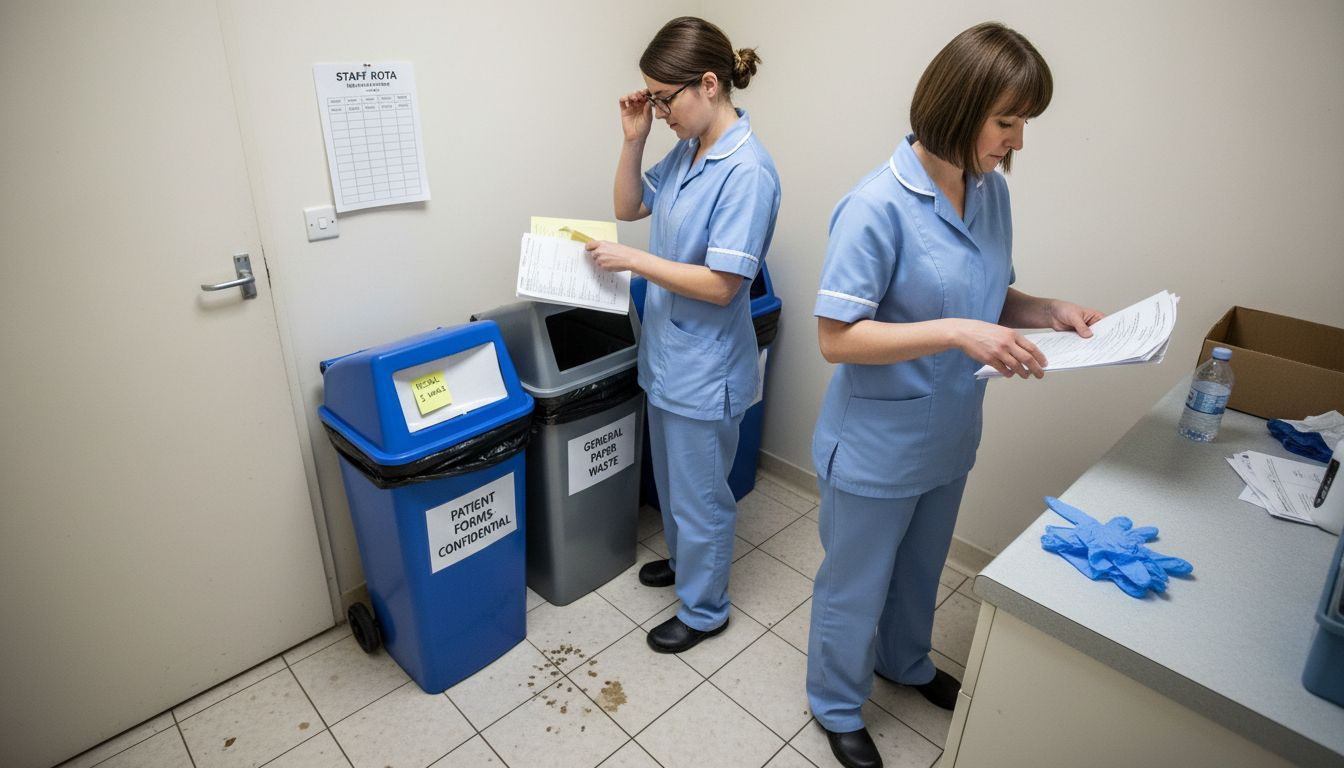
Healthcare facilities generate confidential waste constantly. From patient consultations to medication records, every day produces materials that must be handled with precision and care.
Understanding what counts as confidential waste helps your team classify materials correctly at the point of disposal. Misclassification is the most common compliance failure across UK healthcare.
Patient Records and Medical Documentation
Patient records form the largest category of confidential healthcare waste. This includes:
- Handwritten clinical notes and appointment cards
- X-ray films and diagnostic imaging reports
- Pathology results and laboratory reports
- Prescription documentation and medication records
- Patient consent forms and medical history sheets
- Discharge summaries and outpatient correspondence
A single GP surgery in Bristol or a dental practice in Glasgow handles dozens of these items daily. Each one contains personally identifiable information tied directly to a patient.
Administrative and Financial Records
Beyond clinical materials, healthcare settings generate administrative confidential waste. This encompasses:
- Patient billing and insurance claim forms
- Staff payroll records and employment files
- Supplier contracts and business agreements
- Bank statements and financial transaction records
- Access codes and security credentials
Staff often overlook administrative waste as confidential because it seems less medical. Yet financial data is equally protected under data protection law.
Contaminated Materials and Sharps
Some confidential waste requires dual classification. Materials contaminated with bodily fluids may be both hazardous clinical waste and confidential. Confidential waste bin types serve different purposes depending on contamination levels.
Used needles with patient identifiers, swabs with names, or dressings with medical information require specialist handling beyond standard confidential destruction.
Not all confidential waste is the same—mixing contaminated and non-contaminated materials complicates disposal and increases costs significantly.
Technology and Digital Waste
Hardware disposal often gets forgotten. Old computers, mobile phones, printers, and storage devices may contain patient data even after deletion. Hard drives can be recovered and read without specialist tools.
SSD drives, USB sticks, and backup tapes must be treated as confidential waste requiring certified destruction methods that go beyond simple wiping.
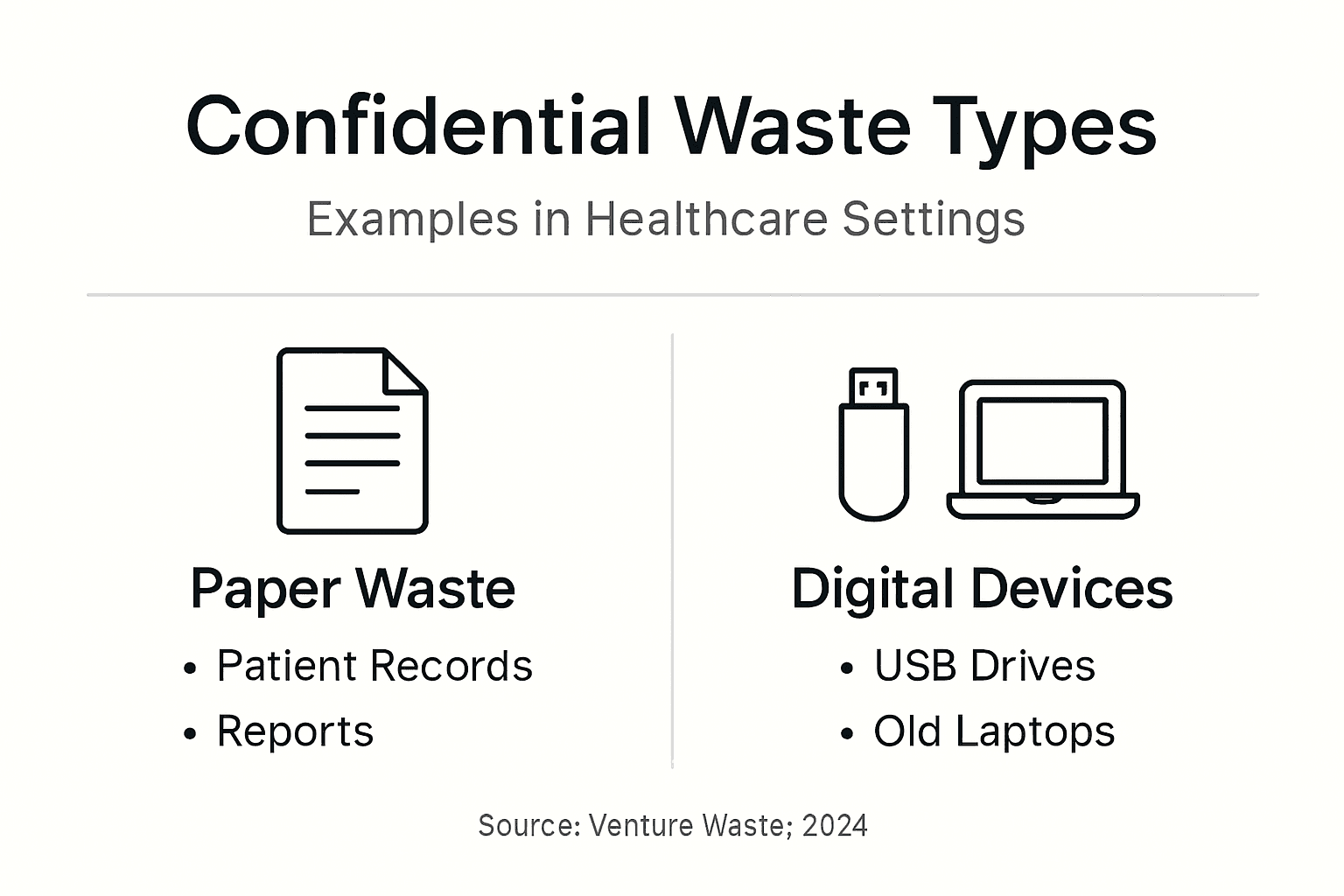
Pro tip: Create a visual reference poster for your staff showing examples of each waste category—post it near disposal bins so anyone can quickly identify what counts as confidential versus general waste, reducing classification errors.
Legal Obligations Under UK Laws and Standards
Your facility operates within a complex legal framework protecting client data. Failing to comply isn’t just a breach—it exposes your organisation to enforcement action, financial penalties, and reputational damage.
The UK General Data Protection Regulation (UK GDPR) and Data Protection Act 2018 form the backbone of confidentiality law. These aren’t optional guidelines; they’re statutory requirements with serious consequences.
Core Legal Principles
Personal data requires fair, lawful, transparent processing with appropriate security measures. Your organisation must follow strict principles:
- Data minimisation: collect only what you need
- Purpose limitation: use data only for stated purposes
- Accuracy: keep information correct and current
- Storage limitation: delete data when no longer needed
- Integrity and confidentiality: protect against unauthorised access
These principles apply whether data is on paper or digital systems. A patient record in a filing cabinet has the same legal protection as a database entry.
Specific Healthcare Regulations
Healthcare settings face additional legal layers. The NHS Data Security and Protection Toolkit, HIPAA considerations for cross-border work, and Health and Social Care (Safety and Quality) Regulations all apply depending on your setting.
GP practices in Newcastle, hospital trusts in Manchester, and private clinics in Edinburgh must all meet baseline Information Governance standards. Many facilities underestimate how many regulations actually apply to their waste streams.
Here’s how UK confidentiality laws and standards differ for healthcare waste:
| Regulation/Standard | Applies To | Main Requirement | Impact of Non-Compliance |
|---|---|---|---|
| UK GDPR & Data Protection Act 2018 | All organisations | Secure handling of personal data | Heavy fines, public investigation |
| NHS Data Security Toolkit | NHS, healthcare orgs | Baseline information governance | Loss of NHS contracts, audits |
| Health & Social Care Regulations | Healthcare facilities | Safe waste disposal and privacy | Enforced closure or penalties |
Confidential waste mishandling is treated as a data breach under UK GDPR, potentially triggering mandatory reporting to the Information Commissioner’s Office within 72 hours.
Your Facility’s Specific Obligations
As a facility manager, you’re responsible for:
- Identifying all data held and its classification level
- Ensuring secure storage until destruction
- Choosing certified waste disposal partners
- Maintaining audit trails and destruction certificates
- Training staff on data handling protocols
- Conducting regular compliance audits
You cannot delegate compliance responsibility, even when using external contractors. You remain accountable for what happens to client information.
Penalties for Non-Compliance
The Information Commissioner’s Office can issue fines up to £20 million or 4% of global annual turnover—whichever is higher. More commonly, organisations face £5,000 to £750,000 penalties for confidential waste breaches.
But financial penalties are just the start. Data breaches lead to loss of patient trust, damaged professional reputation, and staff morale problems.
Pro tip: Request destruction certificates from your waste contractor detailing specific dates, batch numbers, and destruction methods—these documents prove compliance if regulators investigate and protect your organisation legally.
Secure Collection, Storage, and Destruction Processes
Secure handling of confidential waste begins long before destruction. Every stage—from initial collection through final destruction—requires documented controls and verified procedures.
Weak processes at any point expose your organisation to data breaches. A single unsecured collection bin or unmonitored storage area undermines everything else you do right.
The Collection Phase
Collection must start with lockable, clearly labelled containers. Standard office bins left open or partially covered invite unauthorised access and accidental mixing with general waste.
Proper collection uses:
- Dedicated confidential waste bins with restricted access
- Regular scheduled pickups on predictable schedules
- Chain of custody documentation from point of collection
- Trained collection staff with background clearance
- Sealed, tamper-evident containers for transport
A hospital in Leeds or GP practice in Sheffield cannot simply phone a contractor and expect secure collection without these controls in place. Your waste provider should be able to document every collection with date, time, and staff details.
Storage Between Collection and Destruction
Storage is often overlooked but critically important. Confidential waste can sit in your facility for days before collection, creating a window of vulnerability.
Secure storage requires:
- Locked rooms or secure cabinets with restricted access
- Limited staff authorisation to enter storage areas
- Climate control to prevent document degradation
- Separation from other waste streams
- CCTV monitoring or regular security checks
Temporary storage in an unlocked corridor or open skip invites theft, accidental damage, or exposure to unauthorised personnel. A document left unattended for hours can be photographed or removed entirely.
Destruction Methods
Secure shredding facilities use continuous CCTV monitoring and vetted staff to ensure accountability. This isn’t just about noise and dust—it’s about verifiable destruction.
Common destruction methods include:
- Cross-cut shredding: reduces documents to particles under 4mm
- Pulping: transforms paper into unrecognisable pulp
- Incineration: burns materials at high temperature
- Secure data destruction: overwrites or physically destroys digital media
The destruction method matters less than the audit trail proving it happened exactly as documented.
Certificates of Destruction
Your waste contractor must provide detailed Certificates of Destruction showing:
- Specific dates and times of destruction
- Batch numbers or collection references
- Weight or quantity destroyed
- Destruction method used
- Authorised signatures from facility staff
These certificates aren’t optional paperwork—they’re your proof of compliance during regulatory audits. An auditor from the Information Commissioner’s Office will ask to see these immediately.
Pro tip: Request onsite shredding options for sensitive batches—witnessing destruction firsthand removes any doubt about what happened to client information and provides peace of mind that nothing was diverted or mishandled.
Risks of Mishandling and Ensuring Compliance
Mishandling confidential waste creates cascading problems that affect your facility, patients, and organisation for years. The risks extend far beyond a single data breach.
One poorly managed collection or unsecured storage area can expose hundreds of clients’ personal information. The consequences ripple outward to damage trust, finances, and reputation simultaneously.
Immediate Risks of Mishandling
When confidential waste isn’t handled securely, several things can happen:
- Accidental exposure: documents end up in general waste or recycling, visible to cleaners or waste workers
- Theft: confidential materials removed for identity fraud or blackmail
- Data aggregation: criminals collecting scraps from multiple sources to build complete profiles
- Unauthorised access: staff, contractors, or visitors photographing or removing information
- Environmental contamination: sensitive data reaching landfills where anyone can access it
A hospital in Belfast or healthcare practice in Southampton may discover years later that patient records were sold or misused. By then, damage to individuals and your facility is irreversible.
Financial and Legal Consequences
The Information Commissioner’s Office treats confidential waste breaches as serious data protection violations. Regulatory fines range from £5,000 to £750,000 depending on breach severity and your organisation size.
But fines only represent direct costs. Indirect costs include:
- Legal fees defending against claims
- Compensation payments to affected individuals
- Credit monitoring services for victims
- Breach notification communications and support
- Reputation recovery and marketing rebuilding
Proper waste handling training ensures staff understand their responsibilities and reduces accidental exposures significantly.
Reputational Damage
A confidential waste breach damages trust far more than financial penalties. Patients switch to competitors when they learn their information was mishandled. Staff morale drops when they see management failures.
Local media in Manchester, Liverpool, or Glasgow will report healthcare data breaches prominently. Once published, that story follows your facility online permanently.
This table highlights business risks of mishandling confidential waste versus compliant handling:
| Risk Area | Mishandling Confidential Waste | Compliant Waste Disposal |
|---|---|---|
| Legal Exposure | Regulatory fines and lawsuits | Legal protection, audit trails |
| Financial Impact | Compensation, reputation costs | Reduced liabilities, avoided fines |
| Patient Trust | Loss of confidence, bad press | Enhanced patient and staff trust |
| Operational Cost | Crisis management, recovery | Predictable costs, efficient ops |
Compliance isn’t about avoiding punishment—it’s about protecting the people who trust you with their most sensitive information.
Ensuring Ongoing Compliance
Compliance requires continuous effort, not one-time actions. Effective compliance includes:
- Regular audits of storage areas and collection procedures
- Staff training refreshed annually on data handling protocols
- Contractor verification ensuring waste providers meet your standards
- Documentation maintaining records of all collections and destructions
- Policy reviews updating procedures when regulations change
Schedule quarterly compliance checks where you inspect collection bins, storage areas, and contractor certifications personally. Don’t assume everything is fine without verification.
Pro tip: Assign one staff member as your data protection champion responsible for monthly compliance spot-checks, contractor communications, and staff training—centralising accountability prevents gaps and ensures someone actively owns the process.
Protect Your Clients’ Privacy with Trusted Confidential Waste Solutions
Managing confidential waste securely is essential to safeguard client information and maintain regulatory compliance. The article emphasises that confidential waste handling requires clear identification, secure storage, and certified destruction to avoid costly data breaches. At Venture Waste, we understand the critical nature of protecting sensitive healthcare and legal documents with uncompromising standards.
Explore our comprehensive confidential waste Archives – Venture Waste to discover tailored services designed to meet UK GDPR and NHS Data Security requirements. With expert hazardous waste management support from our hazardous waste Archives – Venture Waste, your facility can ensure all types of sensitive disposals are handled correctly and securely.

Take control of your confidential waste management today. Visit https://venturewaste.co.uk to streamline your secure waste disposal process, protect your professional reputation, and guarantee legal compliance. Act now to safeguard your clients and your organisation from the risks of mishandling confidential information.
Frequently Asked Questions
What is client confidentiality in waste management?
Client confidentiality in waste management refers to the protection of sensitive information and materials containing personal data during disposal. This is especially crucial for sectors like healthcare and finance, where improper handling could expose client details.
Why is confidentiality important in healthcare waste management?
Confidentiality is vital in healthcare waste management to protect patient privacy, adhere to legal regulations, and maintain trust between healthcare providers and patients. Mishandling confidential waste can lead to serious privacy breaches and legal repercussions.
What are the best practices for managing confidential waste?
Best practices for managing confidential waste include identifying sensitive materials, securely separating and storing them until destruction, using certified waste disposal services, and maintaining detailed records of destruction to ensure compliance with data protection regulations.
What types of materials are considered confidential waste?
Confidential waste includes a variety of materials such as patient records, financial statements, legal correspondence, staff personnel files, and any documents containing personal identification information. It is essential to handle these materials with care to prevent data breaches.


Leave a Reply
Want to join the discussion?Feel free to contribute!