

Choosing Waste Suppliers for Healthcare Compliance Success
Finding a trustworthy partner for hazardous waste disposal in large UK healthcare facilities often feels challenging when every misstep could risk safety or legal compliance. As hospitals and clinics in England must strictly follow detailed hazardous waste regulations, getting your process right from the start is crucial. This guide sets out a clear framework, highlighting key steps and compliance checks so you can select a waste supplier that ensures both safety and efficient collection for your facility.
Table of Contents
- Step 1: Define Your Hazardous Waste Requirements
- Step 2: Assess Supplier Regulatory Compliance
- Step 3: Evaluate Service Reliability And Coverage
- Step 4: Compare Waste Management Solutions And Costs
- Step 5: Verify Ongoing Supplier Performance
Quick Summary
| Key Message | Explanation |
|---|---|
| 1. Identify hazardous waste types | Conduct a thorough inventory to categorise waste and ensure compliance with regulations. |
| 2. Verify supplier compliance | Assess potential waste carriers for necessary certifications and operational standards for safety. |
| 3. Evaluate service reliability | Review supplier performance metrics and client references to ensure dependable waste management services. |
| 4. Compare costs effectively | Use a detailed comparison matrix to evaluate all financial aspects and ensure value for money in waste management solutions. |
| 5. Implement ongoing performance checks | Establish regular audits and monitoring strategies to maintain high standards and compliance throughout the supplier relationship. |
Step 1: Define your hazardous waste requirements
Healthcare facilities must meticulously identify and categorise hazardous waste types before engaging waste suppliers. This critical first step ensures regulatory compliance and minimises potential environmental and health risks.
To effectively define your hazardous waste requirements, you’ll need a comprehensive assessment strategy. Start by conducting a thorough inventory of all waste materials generated across your healthcare facility. Healthcare waste management standards mandate precise classification of potentially dangerous substances.
Key areas to examine include:
- Medical sharps and contaminated equipment
- Chemical waste from laboratories
- Pharmaceutical residues
- Infectious biological materials
- Radioactive diagnostic waste
Each waste category requires specific handling protocols and disposal mechanisms. Work closely with your clinical teams to document the exact volume, composition, and frequency of waste generation in each department.
Accurate waste classification is the foundation of safe and compliant healthcare waste management.
Documentation becomes crucial. Maintain detailed records of waste types, including chemical compositions, potential hazards, and recommended disposal methods. These comprehensive logs will help waste suppliers understand your specific requirements and develop tailored collection strategies.
Here is a summary comparing key hazardous waste categories relevant to healthcare facilities:
| Waste Category | Main Risk | Typical Disposal Method |
|---|---|---|
| Medical sharps | Needle-stick injuries | Specialised sharps container |
| Chemical waste | Toxic exposure to staff | Chemical neutralisation plant |
| Pharmaceutical waste | Contamination of environment | Incineration or return schemes |
| Infectious materials | Spread of infections | Autoclave or high-temp steam |
| Radioactive waste | Radiation hazards to humans | Decay-in-storage, specialist sites |
Expert tip: Consider creating a standardised waste inventory template that can be updated monthly to track changing waste profiles across different clinical departments.
Step 2: Assess supplier regulatory compliance
Ensuring your healthcare waste supplier meets rigorous regulatory standards is paramount for maintaining safety and legal compliance. This critical assessment involves a comprehensive evaluation of potential waste management partners.
Begin by requesting detailed documentation from each potential supplier. Hazardous waste disposal regulations mandate specific licensing and permit requirements that waste carriers must demonstrate. Your verification process should include examining:
- Current waste carrier registration certificates
- Environment Agency permits
- Proof of professional indemnity insurance
- Detailed waste transfer documentation protocols
- Compliance history and environmental performance records
Thorough supplier compliance checks are your first line of defence against potential regulatory breaches.
Document verification becomes a crucial step in your selection process. Request and meticulously review each supplier’s waste management credentials, paying special attention to their track record of regulatory adherence. Cross-reference their documentation with official Environment Agency registers to confirm legitimacy.

Additionally, conduct site visits or request comprehensive audits to validate the supplier’s operational standards. This hands-on approach allows you to assess their waste handling procedures, safety protocols, and commitment to environmental responsibility.
Expert tip: Create a standardised compliance checklist that you can consistently apply across all potential waste management suppliers to ensure uniform and thorough assessment.
Step 3: Evaluate service reliability and coverage
Assessing a healthcare waste supplier’s service reliability requires a strategic and comprehensive approach that goes beyond surface-level promises. Your goal is to determine whether the supplier can consistently meet your facility’s complex waste management requirements.
Begin by examining the supplier’s operational capabilities across multiple dimensions. Healthcare waste management standards emphasise consistent service delivery and rigorous infection control protocols. Your evaluation should focus on:
- Geographic service coverage
- Response time and emergency handling capabilities
- Fleet and transportation infrastructure
- Technological capabilities for waste tracking
- Contingency planning for service disruptions
Service reliability is not just about promises, but about demonstrated performance and adaptability.
Performance history becomes a critical indicator of future reliability. Request detailed service records, including:
- Client retention rates
- Average response times
- Incident management documentation
- Compliance violation history
Additionally, conduct reference checks with other healthcare providers to gain insights into the supplier’s real-world performance. Speak directly with current clients to understand their experiences with service consistency, communication, and problem resolution.
Expert tip: Request a comprehensive service level agreement that clearly defines performance metrics, response times, and specific consequences for service disruptions.
Step 4: Compare waste management solutions and costs
Navigating the complex landscape of healthcare waste management solutions requires a methodical approach to comparing both service capabilities and financial implications. Your objective is to identify a waste management partner that delivers optimal compliance while maintaining cost-effectiveness.
Healthcare waste segregation strategies are fundamental to controlling disposal expenses and ensuring regulatory compliance. Develop a comprehensive comparison matrix that evaluates potential suppliers across multiple dimensions:
- Treatment method costs
- Waste segregation complexity
- Transportation and collection fees
- Regulatory compliance expenses
- Long-term contract pricing structures
- Environmental impact and recycling potential
The most economical solution is not always the cheapest, but the one that minimises total lifecycle waste management costs.
Detailed cost analysis requires examining beyond surface-level pricing. Request transparent pricing breakdowns that include:
- Base collection fees
- Per-kilogram disposal charges
- Additional service costs
- Potential penalty or non-compliance fees
Consider engaging multiple suppliers to create competitive pricing scenarios. Some providers might offer volume discounts or more flexible contract terms that could significantly reduce your overall waste management expenditure.
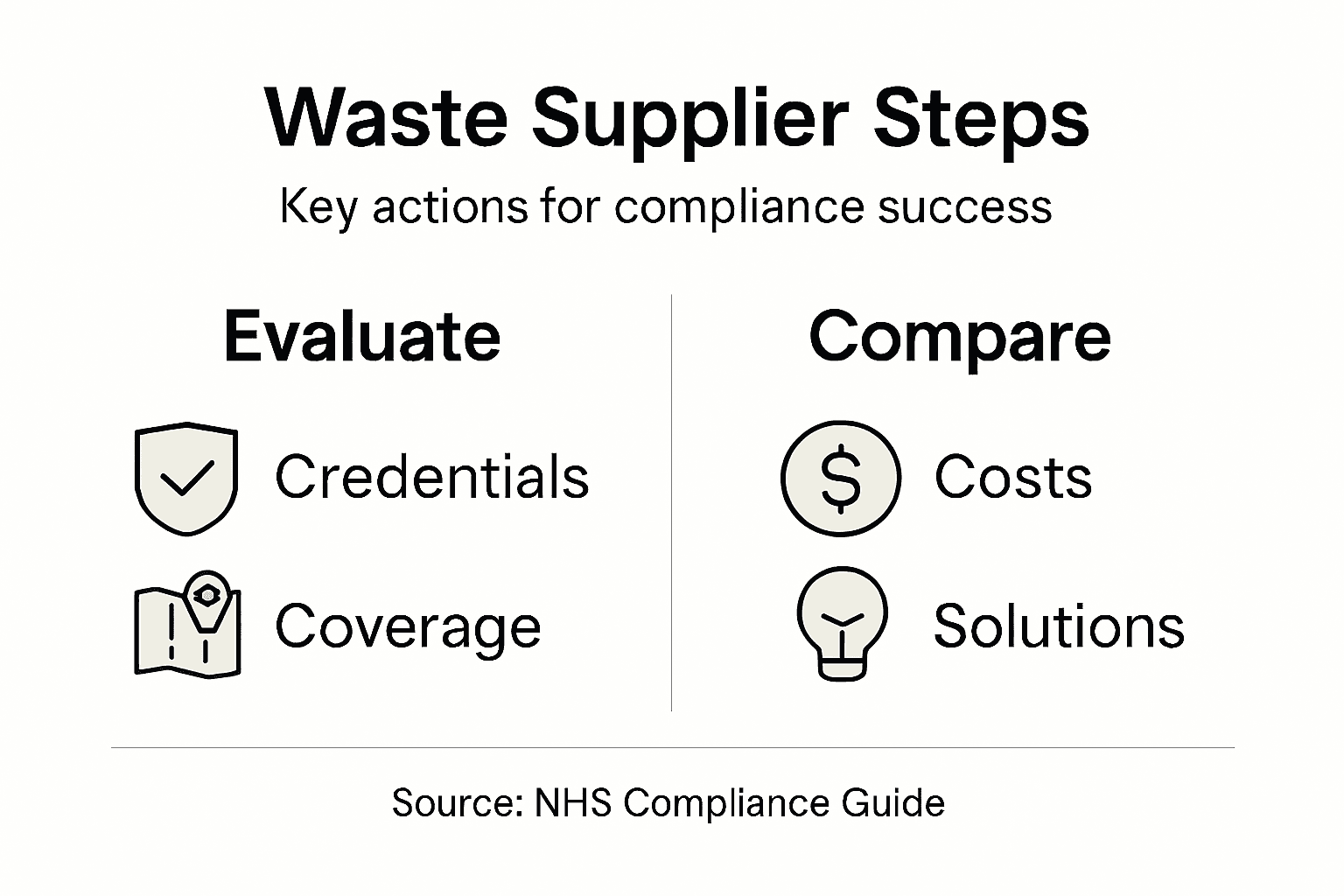
Expert tip: Request comprehensive three-year cost projections from each supplier to understand the true financial implications of your waste management strategy.
The following table contrasts compliance, reliability, and cost factors when evaluating waste suppliers:
| Assessment Dimension | What to Examine | Why It Matters |
|---|---|---|
| Regulatory Compliance | Permits, certification & audit history | Legal operation & safety |
| Service Reliability | Response time, client retention, SLAs | Smooth day-to-day operations |
| Cost Transparency | Pricing breakdown, penalty clauses | Accurate budget forecasting |
Step 5: Verify ongoing supplier performance
Maintaining rigorous oversight of your healthcare waste management supplier requires a systematic approach to continuous performance evaluation. Your goal is to ensure consistent compliance, quality, and reliability throughout your contractual relationship.
Healthcare waste management guidance emphasises the critical importance of regular audits and performance monitoring. Develop a comprehensive verification framework that includes:
- Quarterly performance reviews
- Regular waste tracking and documentation
- Compliance audit schedules
- Key performance indicator (KPI) measurements
- Environmental and safety standard assessments
- Incident response and resolution tracking
Consistent monitoring transforms supplier accountability from a reactive process to a proactive partnership.
Performance documentation is your primary tool for verification. Create a standardised evaluation template that captures critical metrics such as:
- Collection reliability percentages
- Waste processing accuracy
- Compliance violation records
- Response times for service requests
- Environmental impact metrics
Utilise the Environment Agency’s Public Registers to cross-reference your supplier’s ongoing permit and licence status. This additional layer of verification ensures transparency and provides an independent assessment of their regulatory standing.
Expert tip: Implement a weighted scoring system in your performance reviews to objectively quantify and track supplier effectiveness across multiple dimensions.
Ensure Healthcare Waste Compliance with Trusted Partner Solutions
Choosing the right healthcare waste supplier is critical for meeting stringent regulatory compliance and maintaining environmental safety. This article highlights essential challenges such as verifying supplier permits, ensuring service reliability, and managing complex hazardous waste categories like medical sharps and pharmaceutical residues. At Venture Waste Management, we understand these concerns deeply and provide tailored waste solutions designed to simplify compliance while protecting your facility and community.
Our comprehensive UK coverage and commitment to responsible disposal are detailed in How the Waste Collection Network in UK Serves Businesses in 2025 – Venture Waste. Whether you require specialised hazardous waste handling or secure confidential waste services, explored further at confidential waste Archives – Venture Waste, we prioritise transparent operations, accurate documentation, and dependable collection schedules.

Take control of your healthcare waste management today by partnering with a service that values your compliance needs. Visit Venture Waste Management to explore how our expertise and customer-focused procedures can safeguard your facility. Act now to ensure your waste supplier meets every regulatory and operational expectation.
Frequently Asked Questions
How do I define my hazardous waste requirements in a healthcare facility?
Accurately define your hazardous waste requirements by conducting a comprehensive assessment of all waste types generated in your facility. Create an inventory that includes details like volume, composition, and disposal methods for each waste category.
What documentation should I gather from waste suppliers before finalising a partnership?
Gather detailed documentation including waste carrier registration certificates, Environment Agency permits, and proof of professional indemnity insurance from your selected suppliers. This helps ensure they meet regulatory compliance and can provide safe waste management services.
How can I evaluate the service reliability of a healthcare waste supplier?
Evaluate a supplier’s service reliability by examining their geographic coverage, response times, and operational capabilities. Request performance history, including client retention rates and incident management documentation, to assess their reliability over time.
What financial factors should I compare when choosing waste management solutions?
Compare treatment method costs, transportation fees, and potential compliance expenses when evaluating waste management solutions. Create a comprehensive comparison matrix to identify the best balance between cost-effectiveness and compliance to ensure long-term sustainability.
How can I ensure ongoing performance from my waste management supplier?
Ensure ongoing performance by implementing a verification framework that includes quarterly performance reviews and compliance audits. Track key performance indicators (KPIs) and maintain regular communication with your supplier to address any issues proactively.


Leave a Reply
Want to join the discussion?Feel free to contribute!