bulky waste skips housebuilding

Skips, Roll on Roll off and More: North East Bulky Waste Collections for Housebuilding Projects—Best Value via Our Contractor Network

Waste from housebuilding projects in the North East is piling up faster than ever and skipping proper planning can send project costs soaring. Think skips and roll-on-roll-off containers are your only options. Actually, using a contractor network can cut your waste management costs by up to 25 percent compared to sticking with a single supplier. This fresh approach does more than trim expenses—it brings new flexibility and smarter compliance to any construction job.

Table of Contents

Quick Summary

Takeaway Explanation
Conduct a waste assessment first Identify unique waste volumes and types to select the right solution for your project.
Use a contractor network for flexibility Access multiple services and competitive pricing by leveraging various suppliers instead of a single one.
Implement specialist waste management services Tailor waste strategies to specific industry needs for enhanced compliance and efficiency.
Maximise value with advanced technology Use cutting-edge tools for waste tracking and reporting to optimise waste management performance.
Stay compliant with regulatory standards Ensure adherence to local environmental regulations to avoid penalties and enhance sustainability.

Choosing the Right Waste Solution for Your Project

Constructing successful housebuilding projects in the North East requires strategic waste management that balances efficiency, cost-effectiveness, and environmental responsibility. Newcastle, Sunderland, and Durham’s construction landscapes demand tailored waste collection solutions that meet specific project requirements.

Understanding Your Project’s Waste Profile

Every construction project generates unique waste volumes and types. A residential development in Gateshead might produce different waste streams compared to a commercial complex in Middlesbrough. Before selecting a waste solution, contractors must conduct a comprehensive waste assessment. The U.S. Environmental Protection Agency recommends designing for adaptability and disassembly to minimize waste generation.

Key considerations include:

  • Estimated total waste volume
  • Types of materials (concrete, timber, metal, mixed)
  • Project duration
  • Site accessibility
  • Local disposal regulations

Matching Waste Solutions to Project Needs

North East contractors have multiple waste collection options. Skips remain popular for smaller projects, while roll-on-roll-off containers suit larger developments. Web-based tracking tools can help contractors electronically manage waste plans, identify recyclable materials, and generate comprehensive disposal reports.

Consider our guide on reducing waste management expenses to understand how strategic waste collection can drive project cost efficiencies. Different container sizes and types offer varying benefits:

To help you choose the most suitable waste container for your construction project, the following table summarises the key options, their typical applications, and the types of projects they best serve:

Waste Solution Typical Use Best Suited For
Mini Skips Small-scale waste removal Small renovations, tight urban sites
Midi Skips Medium-sized waste volumes Medium residential projects
Maxi Skips Large quantities of mixed construction waste Large-scale construction, industrial
Roll-on-Roll-off Containers Very large, bulky or ongoing construction waste Extensive commercial & infrastructure
  • Mini Skips: Ideal for small renovations or tight urban sites in places like Tynemouth
  • Midi Skips: Perfect for medium residential projects in areas like Gosforth
  • Maxi Skips: Suitable for large-scale construction in industrial zones around Teesside
  • Roll-on-Roll-off Containers: Best for extensive commercial and infrastructure developments

Proper waste management isn’t just about disposal—it’s about creating sustainable, efficient construction processes that minimize environmental impact while maintaining project timelines and budgets. By carefully selecting the right waste solution, North East contractors can optimize their projects’ waste streams, reduce costs, and contribute to more sustainable building practices.
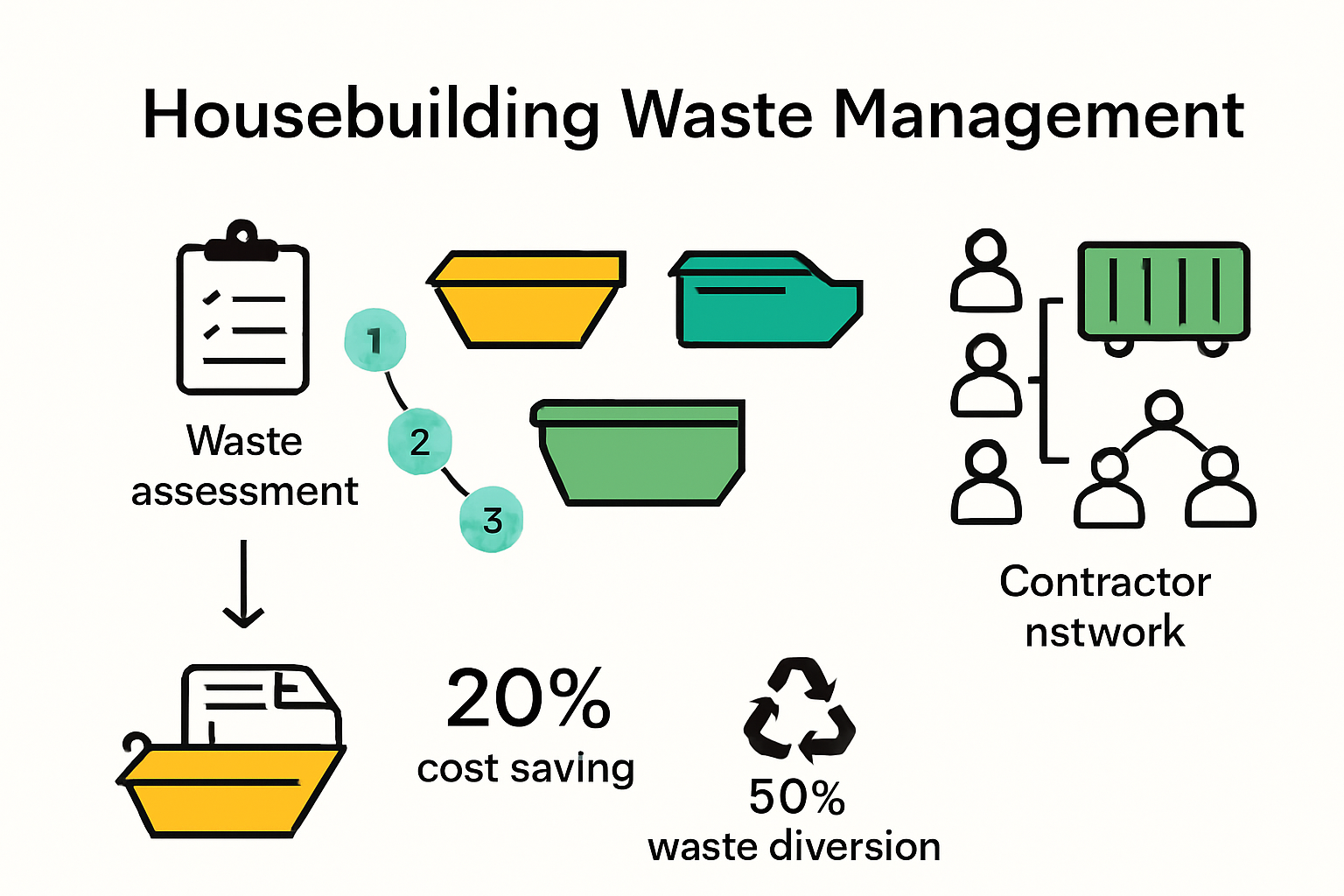
Infographic comparing skip solutions and supplier networks

Benefits of Using a Contractor Network Over a Single Supplier

Navigating waste management for housebuilding projects in the North East requires strategic decision-making that goes beyond simply selecting a single supplier. A robust contractor network offers construction professionals in Newcastle, Durham, and Sunderland unparalleled flexibility, competitive pricing, and comprehensive waste management solutions.

Competitive Pricing and Diverse Options

Relying on a single waste management supplier limits your project’s potential for cost-effectiveness and innovation. The U.S. Environmental Protection Agency emphasizes that separating service procurements can increase competition and reduce conflicts of interest. By leveraging a contractor network, housebuilding projects can access multiple pricing structures, specialised services, and competitive rates across different regions of the North East.

Key advantages of a diverse contractor network include:

  • Dynamic pricing models
  • Specialised expertise for different waste types
  • Geographical flexibility across Newcastle, Sunderland, and rural Northeast areas
  • Reduced risk of service disruption

Performance-Driven Waste Management

A contractor network introduces performance-based incentives that single suppliers often cannot match. EPA research suggests that aligning contractor compensation with waste diversion goals can significantly enhance waste management efficiency. This approach encourages contractors to develop innovative solutions, invest in training, and continuously improve their service delivery.


Additionally, our comprehensive guide on waste management expenses provides insights into how strategic contractor selection can drive cost reductions and operational improvements.

Technological and Operational Advantages

Modern housebuilding projects demand sophisticated waste management solutions. A contractor network provides access to cutting-edge technologies, diverse expertise, and adaptable service models. EPA recommendations highlight the importance of contractors who can compensate, train, and manage workers to achieve higher waste diversion rates.

By working with multiple contractors, construction projects benefit from:

  • Advanced waste tracking technologies
  • Specialised handling for different construction waste streams
  • Faster response times and flexible scheduling
  • Enhanced sustainability reporting capabilities

Ultimately, choosing a contractor network over a single supplier transforms waste management from a mere logistical necessity into a strategic advantage. Construction professionals in the North East can unlock greater operational efficiency, cost savings, and environmental responsibility by embracing a more dynamic and collaborative approach to waste collection and disposal.

Specialist Waste Services for Businesses and Organisations

Businesses and organisations across the North East require sophisticated waste management solutions that extend far beyond simple disposal. From Newcastle’s bustling industrial sectors to Durham’s expanding commercial landscapes, specialist waste services provide tailored strategies that address complex waste streams and regulatory compliance requirements.

Customised Waste Management Solutions

Every business generates unique waste profiles demanding expert handling. The U.S. Environmental Protection Agency highlights the critical importance of specialized waste management approaches that prioritize material recovery and environmental responsibility. Manufacturing facilities in Sunderland, construction companies in Gateshead, and commercial enterprises throughout the region need comprehensive waste collection services that understand their specific operational nuances.

Key considerations for specialist waste services include:

The following table gives a clear overview of specialist waste service features to help North East businesses and organisations assess their needs more quickly:

Feature Description
Industry-specific waste characterisation Handling waste profiles unique to each business sector
Compliance with environmental regulations Ensuring legal disposal & documentation
Advanced sorting and recycling Enhanced material recovery and sustainability
Confidential document/material destruction Secure disposal for sensitive or confidential items
Hazardous waste management protocols Safe and legal handling of dangerous materials
  • Industry-specific waste characterisation
  • Compliance with environmental regulations
  • Advanced sorting and recycling capabilities
  • Confidential document and sensitive material destruction
  • Hazardous waste management protocols

Technological Integration and Reporting

Modern organisations demand more than basic waste collection. They require data-driven insights, transparent reporting, and technologically advanced waste management strategies. Our comprehensive guide for North East waste management companies provides insights into how businesses can leverage cutting-edge waste management technologies.

Advanced specialist services now offer:

  • Real-time waste tracking systems
  • Detailed environmental impact reporting
  • Customised waste reduction strategies
  • Digital waste stream analytics
  • Sustainability performance measurements

waste management technology office

Sector-Specific Waste Management Approaches

Different industries demand nuanced waste management approaches. Healthcare facilities require stringent medical waste protocols, while manufacturing plants need robust industrial waste handling. Construction companies necessitate specialized debris management, and educational institutions demand secure document destruction services.

The North East’s diverse economic landscape requires flexible, intelligent waste management solutions that adapt to each sector’s unique requirements. Our general waste collection services demonstrate our commitment to providing comprehensive, tailored waste management strategies that align with businesses’ operational objectives.

By partnering with specialist waste service providers, organisations can transform waste management from a logistical challenge into a strategic advantage. Businesses gain not just disposal solutions, but comprehensive environmental stewardship that supports operational efficiency, regulatory compliance, and sustainable practices across the North East’s dynamic commercial ecosystem.

Maximising Value and Compliance for Complex Waste Streams

Navigating complex waste streams demands strategic expertise and comprehensive understanding of regulatory requirements. Construction and industrial projects across the North East require sophisticated approaches that transform waste management from a potential liability into a strategic asset.

Strategic Waste Characterisation and Management

The U.S. Green Building Council emphasizes developing comprehensive Construction Waste Management (CWM) plans that identify multiple material streams for diversion from landfills. For businesses in Newcastle, Sunderland, and Durham, this means implementing sophisticated sorting strategies that maximise material recovery and minimise environmental impact.

Key strategies for complex waste stream management include:

  • Detailed waste stream characterisation
  • Early identification of recyclable and reusable materials
  • Implementing on-site segregation protocols
  • Developing material recovery and recycling pathways
  • Tracking and documenting waste diversion metrics

Compliance and Regulatory Navigation

Complex waste streams require meticulous attention to evolving environmental regulations. The Whole Building Design Guide highlights that responsible waste management involves eliminating waste where possible, minimizing waste where feasible, and strategically reusing materials. North East businesses must stay ahead of regulatory requirements while maintaining operational efficiency.

Our comprehensive guide to waste compliance provides insights into navigating these intricate regulatory landscapes. Critical compliance considerations include:

  • Current environmental protection standards
  • Sector-specific waste disposal regulations
  • Documentation and reporting requirements
  • Hazardous material handling protocols
  • Sustainability certification prerequisites

Technology-Driven Waste Performance Optimization

The U.S. Environmental Protection Agency recommends leveraging advanced tracking tools to benchmark waste management activities. By implementing sophisticated digital solutions, businesses can transform waste management from a cost centre into a performance-driven strategic function.

Advanced waste management technologies enable:

  • Real-time waste stream monitoring
  • Predictive analytics for waste generation
  • Automated compliance reporting
  • Cost optimization through data-driven insights
  • Comprehensive sustainability performance tracking

Maximising value in complex waste streams requires a holistic approach that combines regulatory expertise, technological innovation, and strategic material management. By embracing these comprehensive strategies, North East businesses can turn waste management into a competitive advantage, reducing environmental impact while optimizing operational and financial performance.

Frequently Asked Questions

What are the different types of waste containers suitable for housebuilding projects?

There are several waste containers suitable for housebuilding projects, including mini skips for small renovations, midi skips for medium-sized waste, maxi skips for large construction volumes, and roll-on-roll-off containers for extensive commercial or infrastructure developments.

How can a contractor network reduce waste management costs?

Utilising a contractor network can cut waste management costs by up to 25 percent by providing access to competitive pricing, diverse options, and performance-driven waste management strategies compared to relying on a single supplier.

What factors should I consider when choosing a waste management solution for my project?

When selecting a waste management solution, consider the estimated total waste volume, types of materials, project duration, site accessibility, and local disposal regulations to find the most suitable option for your needs.

Why is it important to conduct a waste assessment before starting a housebuilding project?

Conducting a waste assessment is vital as it helps identify the unique waste volumes and types generated by your project. This information is crucial for selecting the right waste management solutions and implementing effective strategies to minimise waste generation.

Stop Letting Complex Construction Waste Derail Your Project Budget

Struggling with unpredictable waste costs and compliance risks on your North East housebuilding site? When bulky materials pile up and traditional skip or roll-on roll-off hire just adds more hassle, it is easy to feel overwhelmed. The article highlights the headaches of finding best-fit waste solutions for unique project needs alongside the chance to unlock up to 25 percent cost savings by using a contractor network. Venture Waste understands the real-world pressures you face to achieve efficiency, meet regulations, and keep your development on track.
https://venturewaste.co.uk

Transform the way you manage construction waste with our flexible waste collection network designed for UK businesses in 2025. Book in seconds and instantly access multiple suppliers who compete to give you the best value across Newcastle, Sunderland and beyond. Do not let waste handling become another delay or hidden cost. Visit Venture Waste now and discover how our streamlined waste collection process for businesses gets your housebuilding project moving forward today.

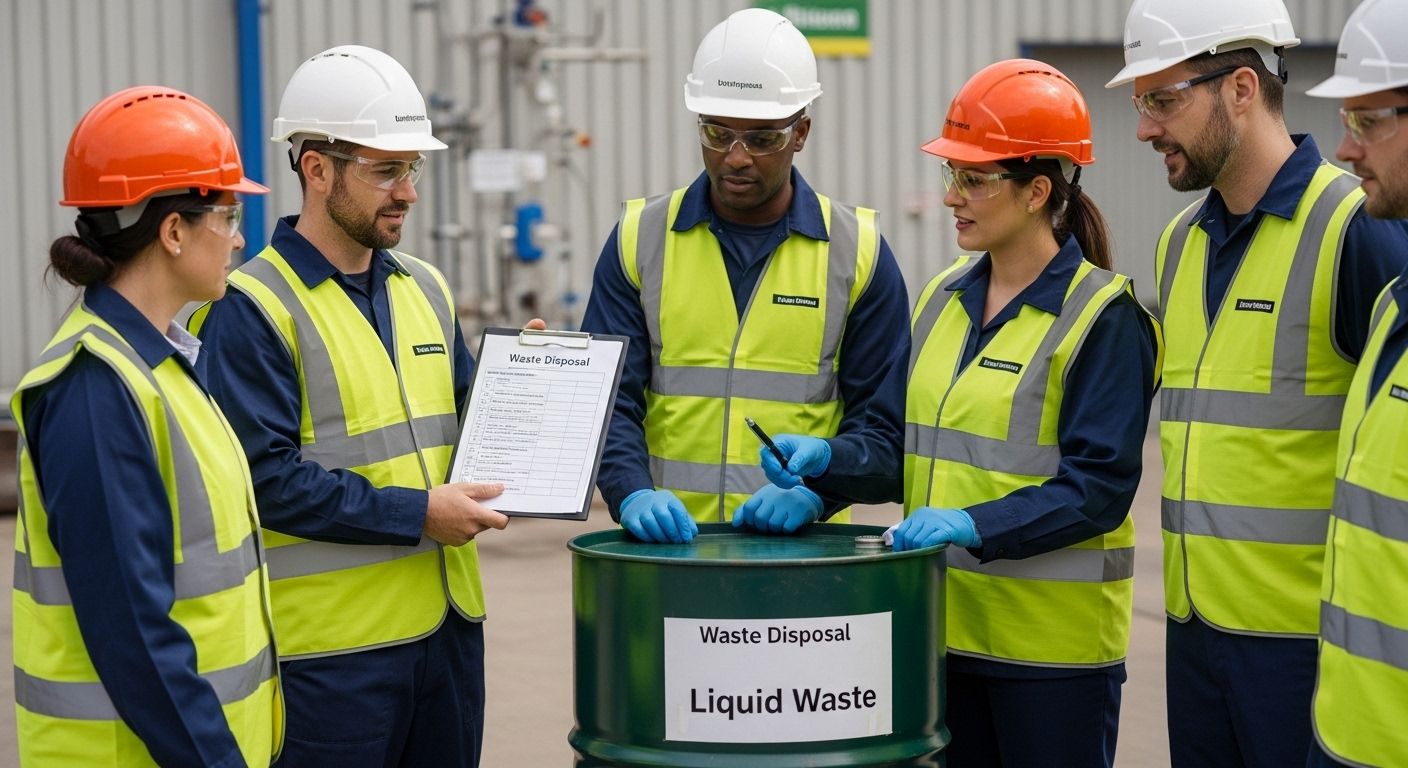
unidentified liquid waste chemists

How to Categorise Unidentified Liquid Waste, Want a Clue? Book Our Chemist!

Unidentified liquid waste turns up in labs and factories across the UK, often causing real headaches for safety and compliance teams. Most people do not realise that over 60 percent of hazardous waste incidents involve materials with unclear origins or composition. You might think you can just barrel it up and ship it off, but that move could lead to massive legal and environmental trouble. The real solution comes from expert chemists who turn a mystery drum into a manageable, compliant strategy—saving far more than just paperwork.

Table of Contents

Quick Summary

Takeaway Explanation
Recognise the risks of unidentified liquid waste Unidentified liquid waste can pose environmental and health hazards that require immediate attention and expert handling.
Employ professional chemists for waste categorisation Expert chemists provide advanced analytical capabilities essential for accurately identifying and managing hazardous substances.
Follow stringent regulatory compliance Proper categorisation according to UK regulations is crucial for legal compliance and environmental protection.
Implement systematic waste identification protocols Businesses should adopt structured processes for sampling and analysis to ensure safe and compliant waste management.
Invest in thorough risk assessment strategies Comprehensive risk assessment can mitigate legal liabilities and protect worker safety associated with unknown waste.

Understanding Unidentified Liquid Waste Risks

Unidentified liquid waste represents a significant environmental and safety challenge for businesses across the UK, particularly in industrial areas like Newcastle, Sunderland, and Durham. These mysterious chemical mixtures pose complex risks that demand immediate professional attention and precise categorisation.

Chemical Composition and Potential Hazards

Every unidentified liquid waste stream carries inherent dangers that cannot be overlooked. Explore our comprehensive liquid waste disposal strategies to understand the critical nature of proper identification. The potential hazards range from environmental contamination to severe health risks for workers and surrounding communities. Chemical compositions might include toxic substances, corrosive materials, or reactive compounds that could trigger unexpected interactions when improperly managed.

According to the Environment Agency’s Hazardous Waste Regulations, unidentified liquid waste must undergo rigorous testing to determine its precise chemical profile. This process involves sophisticated analytical techniques that can detect trace elements, molecular structures, and potential reactive properties.

Risk Assessment and Management Strategies

Professional risk assessment becomes paramount when dealing with unidentified liquid waste. Industrial sites in the North East, from chemical processing plants in Teesside to manufacturing facilities in South Shields, must implement stringent protocols for waste categorisation. The risks extend beyond immediate environmental concerns and include potential legal liabilities, worker safety, and regulatory compliance challenges.

Key risk assessment strategies include:

  • Comprehensive Chemical Analysis: Utilising advanced spectrographic and chromatographic techniques to break down complex chemical compositions.
  • Safety Protocol Development: Creating specific handling and disposal procedures based on initial chemical identification.
  • Cross-Referencing Regulatory Standards: Ensuring waste management aligns with UK environmental protection guidelines.

The Health and Safety Executive emphasises that businesses cannot afford to treat unidentified liquid waste as a routine disposal challenge. Each unknown substance represents a potential threat that requires meticulous scientific evaluation and strategic management.

Working with professional chemists who specialise in waste categorisation becomes not just a recommended practice but a critical necessity. These experts employ sophisticated diagnostic tools and extensive knowledge to transform an ambiguous liquid waste stream into a precisely understood and safely manageable substance.

Businesses across industrial sectors must recognise that the cost of professional waste categorisation pales in comparison to the potential financial and environmental consequences of mishandling unidentified liquid waste. Proactive identification and management represent the most responsible approach to protecting both organisational interests and broader environmental ecosystems.

Key Steps in Waste Identification and Categorisation

Identifying and categorising unidentified liquid waste demands a systematic and scientific approach that combines technical expertise, regulatory knowledge, and strategic methodology. Businesses in industrial regions like Newcastle, Durham, and Sunderland must follow precise protocols to ensure safe and compliant waste management.

Initial Waste Sampling and Documentation

The first critical step in waste identification involves comprehensive sampling techniques. Learn more about our precise waste management protocols to understand the intricate process. According to the Environment Agency’s Technical Guidance WM3, proper sampling requires trained professionals who can collect representative liquid waste samples without compromising safety or sample integrity.

Key documentation requirements include:

  • Chain of Custody Forms: Tracking sample origin, collection method, and transportation details
  • Initial Visual Inspection Logs: Documenting colour, consistency, potential contaminants
  • Site-Specific Waste Stream Records: Capturing contextual information about waste generation

Advanced Chemical Analysis Procedures

Chemical analysis represents the most sophisticated stage of waste identification. Professional chemists employ multiple advanced techniques to deconstruct complex liquid waste compositions. Spectrographic analysis, gas chromatography, and mass spectrometry provide granular insights into molecular structures, enabling precise categorisation.

The Health and Safety Executive emphasises that comprehensive analysis must include:


  • Identifying potential hazardous chemical components
  • Determining pH levels and reactivity
  • Assessing potential environmental and human health risks
  • Evaluating compatibility with different disposal methods

Regulatory Compliance and Categorisation

Once chemical analysis is complete, waste must be categorised according to stringent UK environmental regulations. This process involves matching identified chemical compositions with specific waste classification codes, determining whether the liquid waste is classified as hazardous or non-hazardous.

Businesses must adhere to multiple regulatory frameworks, including:

  • Hazardous Waste Regulations
  • Environmental Protection Act
  • Waste (England and Wales) Regulations
  • Transport of Dangerous Goods legislation

Professional waste management experts play a crucial role in translating complex scientific data into actionable regulatory compliance strategies. They ensure that every unidentified liquid waste stream is thoroughly understood, safely managed, and disposed of in full accordance with legal requirements.

By following these systematic steps, businesses can transform potentially dangerous unknown liquid waste into precisely categorised, safely manageable substances. The investment in professional waste identification represents a critical approach to environmental protection, workplace safety, and regulatory compliance.

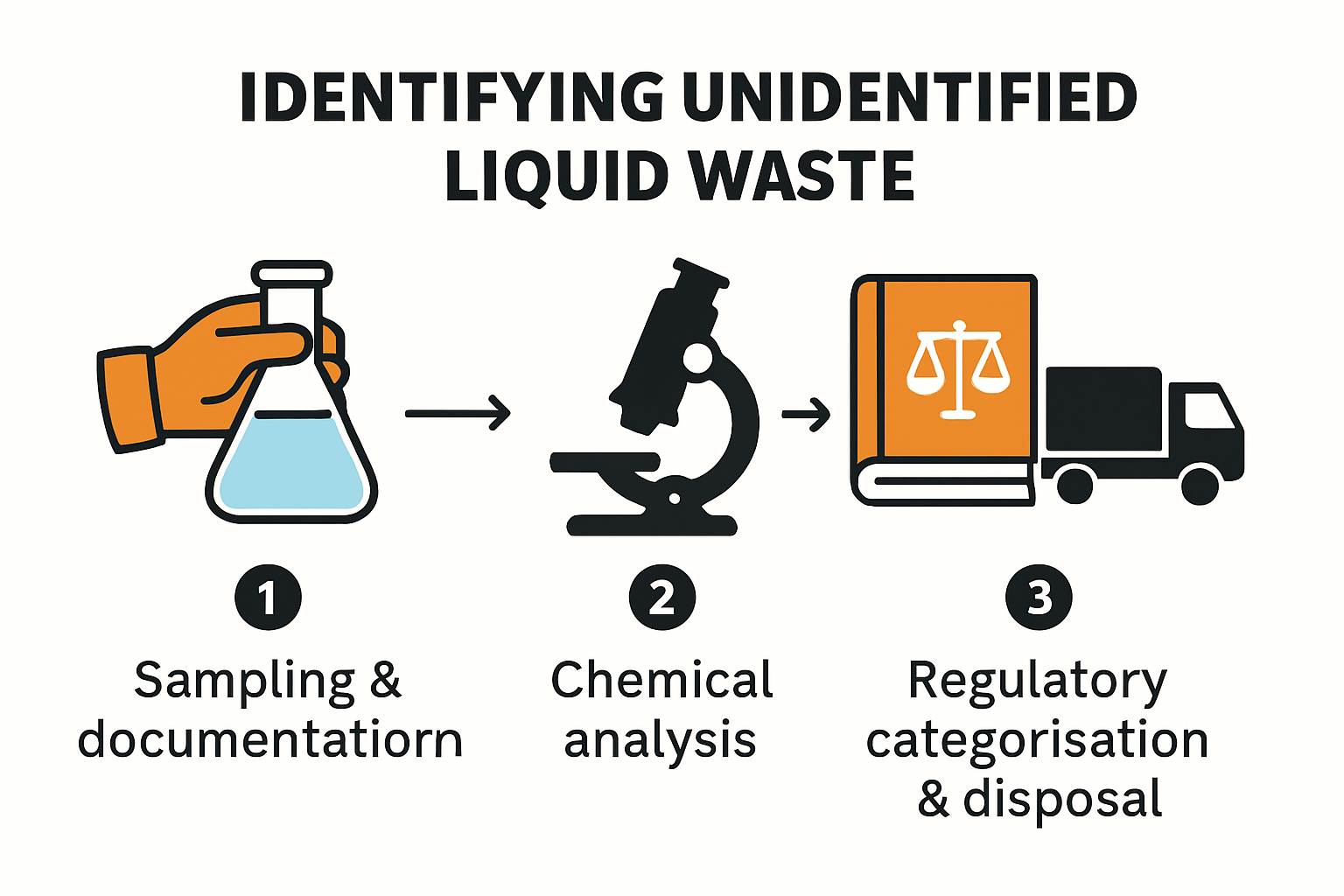
To clarify the process of identifying and categorising unidentified liquid waste, the following table summarises the key steps, who carries them out, and the main purpose of each stage:

Step Responsible Party Purpose
Initial Sampling & Documentation Trained Professionals Collect representative samples and document key details
Advanced Chemical Analysis Professional Chemists Identify chemical composition and potential hazards
Regulatory Compliance & Categorisation Waste Management Experts Match waste type to official codes and ensure legal compliance
Disposal Strategy Development Chemists/Compliance Officers Formulate safe disposal method based on findings

Infographic showing steps to categorise unidentified liquid waste

Why Expert Chemist Support is Essential

Navigating the complex landscape of unidentified liquid waste requires specialised expertise that goes far beyond basic waste management. Expert chemists play a pivotal role in transforming potentially hazardous unknown substances into safely managed and precisely categorised materials.

Advanced Diagnostic Capabilities

Explore our comprehensive waste identification services to understand the critical role of professional chemists. According to the National Academies Press, laboratories and industrial facilities are strictly prohibited from disposing of materials with unknown hazards. Professional chemists bring sophisticated diagnostic capabilities that allow for nuanced and comprehensive waste characterisation.

Their advanced analytical techniques include:

Below is a table outlining the advanced diagnostic capabilities that expert chemists bring to the process of unidentified liquid waste management, highlighting the analytical technique and its main purpose:

Analytical Technique Main Purpose
Spectroscopic Analysis Precisely identify molecular structures
Chromatographic Separation Isolate and analyse complex chemical mixtures
Elemental Composition Testing Determine specific chemical constituents
  • Spectroscopic Analysis: Identifying molecular structures with precision
  • Chromatographic Separation: Isolating complex chemical mixtures
  • Elemental Composition Testing: Determining precise chemical constituents

Regulatory Compliance and Risk Mitigation

Chemical waste identification is not merely a technical challenge but a critical regulatory requirement. As Purdue University’s Environmental Health and Safety department emphasises, proper identification involves comprehensive research, consultation with laboratory personnel, and thorough documentation.

Expert chemists provide essential support by:

  • Interpreting complex safety data sheets
  • Conducting systematic characterisation tests
  • Ensuring alignment with UK environmental regulations
  • Developing targeted disposal strategies

Comprehensive Hazard Assessment

The National Academies Press outlines multiple critical parameters for characterising unknown chemicals. Professional chemists systematically evaluate these parameters, including physical description, water reactivity, solubility, pH levels, ignitability, and the presence of oxidizers or peroxides.

Their comprehensive approach involves:

  • Detailed physical and chemical property assessment
  • Potential reactivity analysis
  • Environmental impact evaluation
  • Worker safety risk assessment

Businesses in industrial regions like Newcastle, Durham, and Sunderland cannot afford to treat liquid waste identification as a routine administrative task. Expert chemists transform potentially dangerous unknown substances into precisely understood and safely manageable materials.

The investment in professional chemical waste identification represents more than a regulatory compliance measure. It is a critical strategy for environmental protection, workplace safety, and responsible industrial management. By leveraging specialised expertise, businesses can convert complex waste challenges into systematic, scientifically validated solutions that protect both organisational interests and broader environmental ecosystems.

Booking a Chemist for Hassle-Free Waste Disposal

Booking a professional chemist for liquid waste disposal transforms a potentially complex and risky process into a streamlined, scientifically validated solution. Businesses across the North East, from industrial complexes in Teesside to manufacturing facilities in Newcastle, can significantly benefit from expert waste management support.

Initial Consultation and Assessment

Discover our comprehensive hazardous waste management solutions to understand the seamless process of professional waste categorisation. The initial consultation represents a critical first step where businesses can provide comprehensive details about their unidentified liquid waste. According to the Health and Safety Executive’s Guidelines, this preliminary assessment helps chemists understand the potential composition, origin, and associated risks of the waste stream.

Key elements of the initial consultation include:

  • Detailed Waste Description: Comprehensive documentation of waste characteristics
  • Site Inspection Scheduling: Arranging on-site evaluation of waste generation environment
  • Preliminary Risk Assessment: Initial identification of potential hazards

Technical Sampling and Analysis Process

Once the initial consultation is complete, professional chemists deploy sophisticated sampling and analytical techniques. The sampling process is meticulously designed to ensure representative analysis while maintaining strict safety protocols. Chemists utilise advanced equipment and methodologies to extract and analyse liquid waste samples with remarkable precision.

The technical analysis typically involves:

  • Collecting multiple representative samples
  • Employing spectrographic and chromatographic techniques
  • Conducting comprehensive chemical composition tests
  • Generating detailed scientific reports

Disposal Strategy and Compliance Reporting

Following thorough analysis, chemists develop a tailored disposal strategy that ensures full regulatory compliance. This strategy goes beyond mere waste removal, providing businesses with a comprehensive approach to environmental responsibility and legal adherence.

The disposal strategy includes:

  • Precise waste categorisation
  • Recommended disposal methodologies
  • Compliance documentation
  • Environmental impact assessment

Businesses in industrial regions like Durham, Sunderland, and Newcastle can dramatically reduce their environmental risk by engaging professional chemists. The investment in expert waste management represents a proactive approach to environmental stewardship, workplace safety, and regulatory compliance.

The booking process is designed to be straightforward and user-friendly. Companies can typically initiate the waste management journey through online platforms, telephone consultations, or direct site assessments. Trained customer service representatives guide businesses through each step, ensuring a smooth and transparent experience.

Ultimately, booking a chemist for liquid waste disposal is more than a service transaction. It is a strategic partnership that transforms potential environmental and safety challenges into systematically managed, scientifically validated solutions. By leveraging professional expertise, businesses can convert complex waste streams into precisely understood and responsibly managed materials.

industrial liquid waste disposal team

Frequently Asked Questions

What is unidentified liquid waste?

Unidentified liquid waste refers to liquids whose composition or origin is unknown, often found in labs and industrial settings. It can pose significant safety and environmental risks.

Why is it important to categorise unidentified liquid waste?

Categorising unidentified liquid waste is crucial for compliance with regulations, ensuring safe handling, and mitigating potential health and environmental hazards associated with unknown chemicals.

How can a chemist help with liquid waste categorisation?

A professional chemist utilises advanced analytical techniques to identify the chemical composition of unknown substances, ensuring accurate categorisation and regulatory compliance for safe disposal.

What steps are involved in the waste identification process?

The waste identification process typically involves initial sampling and documentation, advanced chemical analysis, and regulatory compliance checks to ensure safe and compliant waste management.

Ready to Turn Unknown Liquid Waste Into a Problem Solved?

If you feel overwhelmed by the risks and legal worries that come with unidentified liquid waste, you are not alone. Many UK businesses find the task of safe categorisation and compliant disposal daunting, especially when chemical origins are unclear. Mishandled liquid waste can lead to major fines, environmental harm, and even reputational damage. That is where Venture Waste steps in. Our professional chemists take the uncertainty out of the process, providing you with peace of mind and full compliance every step of the way. Learn more about how our Waste Collection Process for UK Businesses tackles even the toughest unknown waste challenges.

https://venturewaste.co.uk

Do not risk an expensive mistake or regulatory breach when help is just a click away. Visit Venture Waste now and experience our fast three-step booking system. Contact us today to schedule your expert chemist and secure a compliant, hassle-free solution for even the most complex liquid waste issues.

confidential waste legislation

Confidential Waste Legislation: What UK Businesses Must Know

Confidential waste laws in the UK are tighter than ever and businesses are under real pressure to get it right. Many think a quick shred or binning the paperwork does the job. Not even close. Fines now reach up to £17.5 million for serious breaches so a single slip can cost more than most firms ever imagine.

Table of Contents

Quick Summary

Takeaway Explanation
Understand legal obligations UK businesses must comply with the Data Protection Act and UK GDPR for managing confidential waste.
Implement secure disposal methods Use locked containers and certified services for the destruction of confidential materials to prevent unauthorized access.
Maintain thorough records Detailed documentation of all disposal processes is essential for compliance and accountability.
Recognise sector-specific requirements Different industries have unique confidential waste regulations that must be followed to ensure legal adherence.
Train staff effectively Regular training on handling confidential materials is crucial to mitigate operational risks and maintain compliance.

Understanding Confidential Waste Legislation in the UK

Confidential waste legislation in the United Kingdom represents a critical framework for businesses to protect sensitive information and ensure responsible waste management. The legal landscape surrounding confidential waste disposal is complex, involving multiple regulations that mandate how organisations handle potentially sensitive documents and materials.

The cornerstone of confidential waste legislation in the UK is primarily governed by the Data Protection Act 2018 and the UK General Data Protection Regulation (UK GDPR). These regulations establish strict guidelines for how businesses must handle and dispose of documents containing personal or sensitive information. Learn more about our comprehensive guide on office confidential waste policies.

Businesses operating in Newcastle, Durham, and throughout the North East must adhere to these regulations, which require organisations to implement secure destruction processes for confidential documents. The legislation mandates that any materials containing personal data, financial records, or sensitive business information must be destroyed in a manner that prevents potential reconstruction or unauthorized access.

Compliance Requirements for Businesses

According to government guidelines, businesses are legally obligated to minimize waste and ensure proper disposal of confidential materials. This includes several critical requirements:

  • Secure Collection: Implement locked confidential waste containers that prevent unauthorized access
  • Verified Destruction: Maintain detailed records of document destruction
  • Professional Disposal: Use certified waste management services specializing in confidential waste handling

The Separation of Waste (England) Regulations 2025 further emphasize the importance of proper waste management. Research from the UK government indicates that businesses must now carefully segregate different types of waste, including confidential documents, to ensure environmental compliance and information security.

Specifically for businesses in urban centres like Newcastle and Durham, this means developing robust waste management strategies that go beyond simple document shredding. Organisations must now consider the entire lifecycle of confidential waste, from initial collection to final destruction, ensuring that every step meets legal and ethical standards.

Non-compliance can result in significant penalties, including substantial financial fines and potential legal consequences. The Information Commissioner’s Office (ICO) has the authority to investigate and penalize organisations that fail to protect sensitive information adequately.

The following table summarises some of the key legal requirements for confidential waste compliance, helping businesses quickly identify their obligations under UK law.

Legal Requirement Description
Secure Collection Use locked confidential waste containers to prevent unauthorised access
Verified Destruction Maintain detailed records of document destruction
Professional Disposal Employ certified waste management services specialising in confidential waste
Waste Segregation Separate confidential materials from other waste types in line with the Separation of Waste regs
Staff Training Regularly train employees on handling and disposing of confidential material
Systematic Documentation Keep thorough records of all disposal processes for auditing and compliance
Secure Storage Restrict access to confidential materials prior to destruction


Businesses must recognize that confidential waste legislation is not just a legal requirement but a critical component of maintaining trust, protecting sensitive information, and demonstrating professional responsibility in an increasingly data-driven world.

Confidential waste management involves complex legal obligations that UK businesses must meticulously understand and implement. The regulatory landscape demands comprehensive strategies to protect sensitive information while ensuring environmental and data protection compliance.

Comprehensive Data Protection Standards

Businesses must adhere to stringent data protection standards outlined in the Data Protection Act 2018 and UK GDPR. Learn more about secure document handling practices, which require organisations to implement robust mechanisms for handling confidential waste.

According to UK government data protection guidelines, businesses are legally obligated to:

  • Secure Storage: Maintain locked and restricted access to confidential document storage areas
  • Systematic Documentation: Keep detailed records of all confidential waste disposal processes
  • Professional Destruction: Engage certified waste management services specializing in secure document destruction

Regulatory Compliance and Penalties

The Information Commissioner’s Office (ICO) enforces strict regulations regarding confidential waste management. Research from the ICO indicates that businesses failing to implement adequate confidential waste procedures can face significant financial penalties.

In regions like Newcastle, Durham, and across the North East, businesses must develop comprehensive waste management strategies that go beyond basic document shredding. This involves understanding the entire lifecycle of confidential materials, from initial collection to final secure destruction.

Specifically, the Separation of Waste (England) Regulations 2025 mandate precise waste segregation protocols. Government research emphasizes that businesses must carefully categorize different waste types, including confidential documents, to maintain legal and environmental compliance.

Non-compliance can result in severe consequences, including:

  • Substantial financial fines
  • Potential legal investigations
  • Reputational damage
  • Potential criminal prosecution for serious data protection breaches

Businesses must recognize that confidential waste legislation is not merely a regulatory checkbox but a critical component of maintaining organisational integrity, protecting sensitive information, and demonstrating professional responsibility in an increasingly data-driven business environment.

Industries and Waste Types Covered by the Law

Confidential waste legislation in the United Kingdom encompasses a broad spectrum of industries and waste types, recognizing the diverse and complex nature of sensitive information management across different sectors. Understanding the specific requirements for various industries is crucial for comprehensive compliance and effective waste disposal strategies.

Sector-Specific Waste Management Requirements

Learn more about waste management classifications for different business environments. The legal framework applies to multiple industries, each with unique confidential waste challenges:

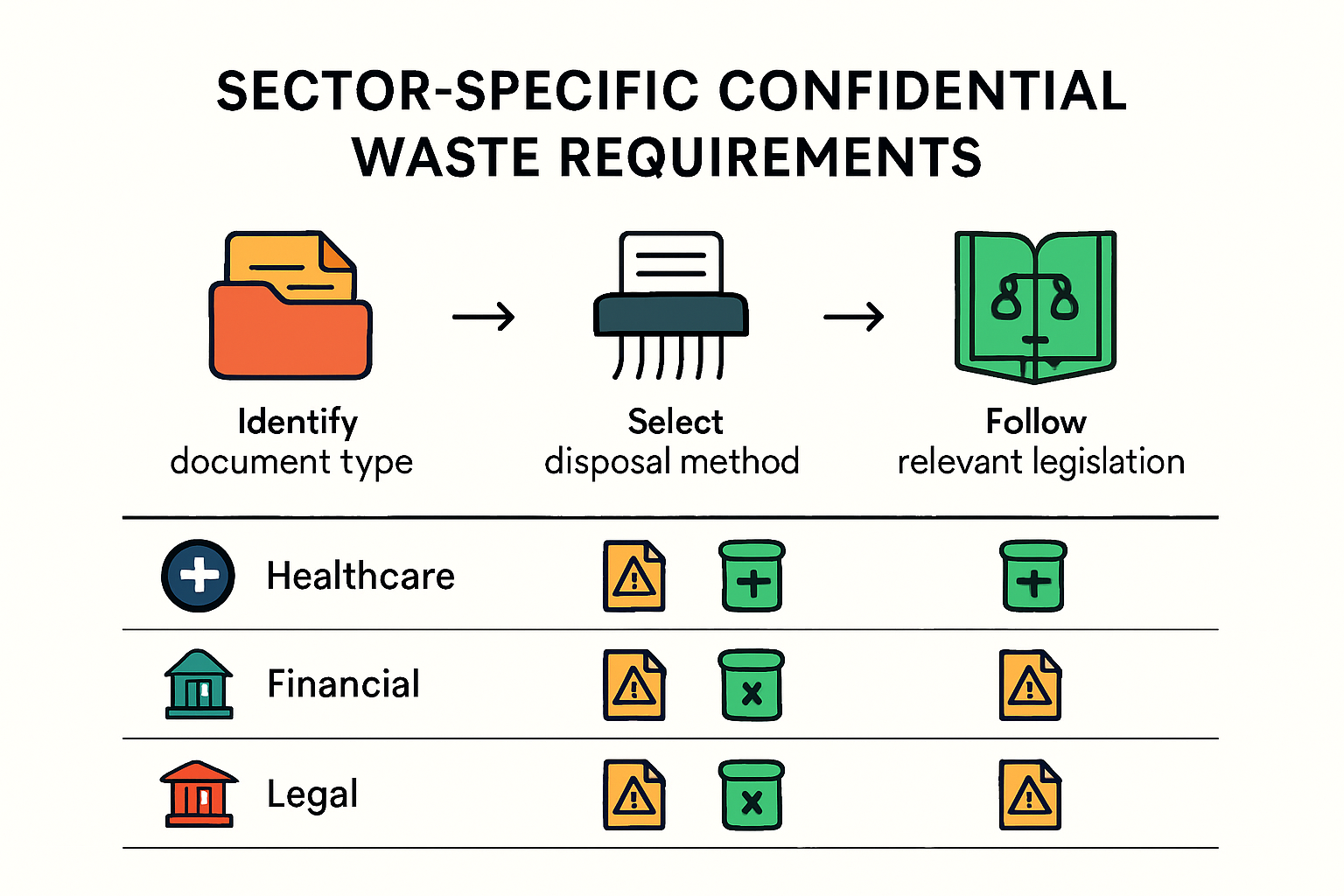
Sector-specific confidential waste requirements visual summary

  • Healthcare Sector: Medical facilities must adhere to stringent regulations for disposing of patient records, medical charts, and sensitive healthcare documentation
  • Financial Services: Banks, insurance companies, and financial institutions require robust destruction protocols for financial statements, customer information, and transaction records
  • Legal Firms: Law practices must implement secure disposal methods for client documents, case files, and confidential legal correspondence
  • Educational Institutions: Schools and universities must protect student records, academic documents, and administrative paperwork

According to government waste classification guidance, businesses must carefully categorize and handle various waste types to ensure legal compliance and environmental responsibility.

Hazardous and Sensitive Waste Categories

The UK government provides detailed guidelines for identifying and managing different waste types. Research from official sources identifies several critical waste categories that require special attention:

  • Hazardous waste (including chemicals, batteries, and electronic equipment)
  • Confidential paper documents
  • Electronic data storage devices
  • Medical and pharmaceutical waste
  • Financial and legal documentation

Businesses in Newcastle, Durham, and across the North East must pay particular attention to the nuanced requirements for different waste types. The Waste Classification Technical Guidance (WM3) provides comprehensive instructions for assessing and classifying waste, ensuring that organizations can accurately identify and manage their confidential waste streams.

Non-compliance can result in significant legal and financial consequences. The regulations are designed to protect sensitive information, prevent data breaches, and ensure environmental responsibility across various industries.

Key considerations for businesses include:

The table below lists sectors that must comply with confidential waste legislation, alongside the specific types of waste they commonly manage and key disposal considerations.

Sector Confidential Waste Types Disposal Considerations
Healthcare Patient records, medical charts Strict protocols, secure shredding/incineration
Financial Services Bank statements, customer information Certified document destruction
Legal Firms Client files, legal correspondence Confidential shredding, documented processes
Educational Institutions Student records, academic paperwork Restricted staff access, data retention policy
All Businesses Paper docs, digital data, legal docs Secure containers, audit trails
  • Implementing industry-specific waste management protocols
  • Investing in secure destruction technologies
  • Training staff on confidential waste handling procedures
  • Maintaining detailed documentation of waste disposal processes

Ultimately, confidential waste legislation represents a critical framework for protecting sensitive information across diverse business environments. Organizations must develop comprehensive strategies that address the unique challenges of their specific industry while maintaining legal compliance and information security.

Best Practices for Compliance and Secure Disposal

Businesses across the United Kingdom must adopt comprehensive strategies to ensure secure confidential waste disposal and maintain rigorous compliance with data protection regulations. Implementing robust practices is crucial for mitigating risks associated with information breaches and potential legal consequences.

Developing a Comprehensive Confidential Waste Management Strategy

Explore our guide to confidential information security for comprehensive insights into protecting sensitive data. Organisations must develop a systematic approach to confidential waste management that encompasses multiple critical elements:

  • Risk Assessment: Conduct thorough evaluations of potential information vulnerability points
  • Staff Training: Implement mandatory training programmes on confidential waste handling
  • Document Classification: Create clear protocols for categorizing and handling different types of sensitive documents
  • Secure Storage: Establish restricted access areas for confidential materials before destruction

According to UK government data protection guidelines, businesses must implement multi-layered security approaches that address both physical and digital confidential waste management.

Technological and Physical Disposal Methods

Modern confidential waste disposal requires a sophisticated approach that combines technological solutions with physical destruction techniques. Research from cybersecurity experts highlights several critical practices:

  • Utilising cross-cut industrial shredders capable of destroying documents into microscopic fragments
  • Implementing secure digital data wiping protocols for electronic storage devices
  • Deploying certified destruction services with comprehensive chain of custody documentation
  • Using locked consoles and secure collection containers for confidential waste

Businesses in regions like Newcastle, Durham, and across the North East must invest in advanced destruction technologies that meet stringent regulatory standards. This includes professional-grade equipment capable of rendering both paper and digital media completely unrecoverable.

Key considerations for secure disposal include:

  • Maintaining detailed audit trails of destruction processes
  • Ensuring complete destruction that prevents potential data reconstruction
  • Selecting certified waste management providers with proven security credentials
  • Regularly updating disposal protocols to address emerging technological challenges

Non-compliance can result in significant financial penalties and reputational damage. The Information Commissioner’s Office emphasizes that businesses must demonstrate proactive approaches to information protection, not merely reactive measures.

Ultimately, successful confidential waste management requires a holistic approach that combines technological solutions, staff training, robust policies, and continuous evaluation. Organisations must view confidential waste disposal not as a mere administrative task but as a critical component of their overall information security strategy.

By implementing these best practices, businesses can effectively protect sensitive information, maintain legal compliance, and demonstrate their commitment to professional data management standards.

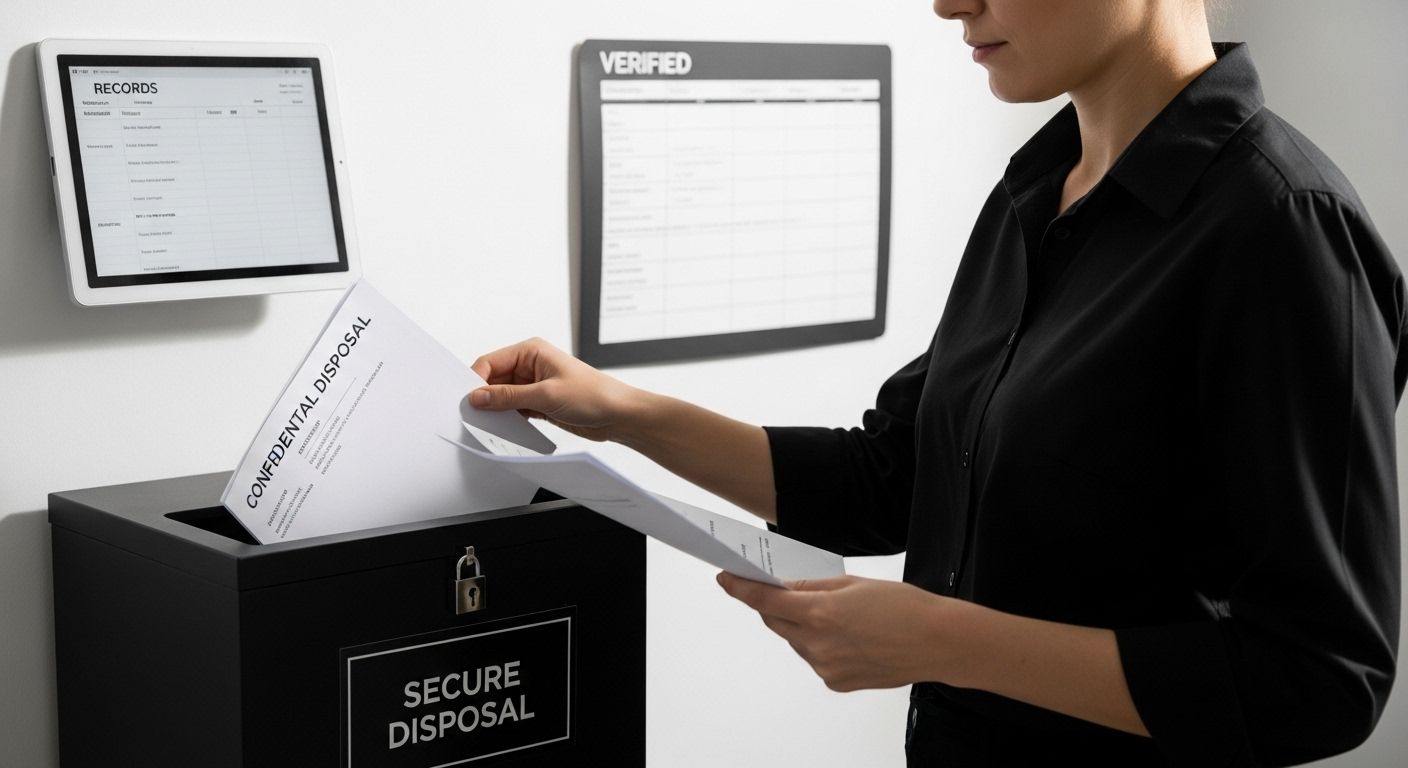
secure disposal compliance

Frequently Asked Questions

Businesses must comply with the Data Protection Act 2018 and UK GDPR, establish secure collection methods, engage certified disposal services, maintain thorough documentation of destruction processes, and implement staff training for handling confidential materials.

How can a business ensure compliance with confidential waste management regulations?

A business can ensure compliance by developing a comprehensive confidential waste management strategy that includes secure storage, systematic documentation, the use of locked containers, professional destruction services, and ongoing staff training.

What penalties can businesses face for non-compliance with confidential waste legislation?

Non-compliance can lead to substantial financial fines, legal investigations by the Information Commissioner’s Office (ICO), reputational damage, and potential criminal prosecution for serious breaches of data protection laws.

What types of waste are classified as confidential under UK law?

Confidential waste includes paper documents containing personal data, financial records, client information, medical and pharmaceutical waste, electronic data storage devices, and any other sensitive information that requires secure disposal.

Take Control of Confidential Waste Compliance Today

Struggling to keep up with complicated confidential waste legislation and worried about costly mistakes that could lead to fines or reputational risk? You are not alone. Many UK businesses are feeling overwhelmed by strict compliance standards and the pressure to handle confidential materials securely at every step. Visit our confidential waste solutions hub to explore how streamlined processes and expert support can help you stay fully compliant.

https://venturewaste.co.uk

Avoid the headache and risk by partnering with a trusted waste management provider who understands every detail of legal requirements, verified document destruction and secure collection. Choose Venture Waste for fast, professional and fully compliant confidential waste services built for businesses like yours. Get started now at https://venturewaste.co.uk and make compliance effortless.

cardboard recycling UK mills

The cardboard recycling market in the UK historic prices at UK mills and trends for businesses

Cardboard recycling is a major force in the UK’s push for sustainability and economic efficiency. Businesses across the country produce millions of tonnes of cardboard waste each year, yet most never realise how much the value of that waste can swing. Prices have shot from £40 to £150 per tonne, leaving many caught out by sudden market shifts. What few expect is that the smartest companies are now turning these unpredictable ups and downs into real competitive advantages, simply by rethinking how they approach sorting, partnerships, and technology.

Table of Contents

Quick Summary

Takeaway Explanation
Invest in Advanced Sorting Technologies Implementing upgraded sorting equipment boosts material quality and efficiency, which leads to better pricing for recycled cardboard.
Understand Market Price Fluctuations Historic prices for cardboard recycling are influenced by factors like global demand and local infrastructure; staying informed helps businesses negotiate better deals.
Build Strategic Partnerships Collaborating with recycling mills enhances negotiation power, providing insights into market trends and potential cost savings in waste management.
Maximise Waste Separation Practices Effective waste separation can enhance the value of recycled materials, impacting the overall profitability of cardboard recycling initiatives.
Leverage Circular Economy Principles Embracing sustainable practices not only meets regulatory requirements but can also create new revenue streams and improve corporate reputation.

Understanding Cardboard Recycling in the UK

Cardboard recycling represents a critical component of sustainable waste management in the United Kingdom, playing a significant role in reducing environmental impact and supporting circular economy principles. The process involves collecting, sorting, and reprocessing used cardboard materials to create new paper and packaging products, thereby minimising waste and conserving natural resources.

The Lifecycle of Cardboard Recycling

In the UK, cardboard recycling follows a comprehensive process that begins with collection and ends with the production of new cardboard products. Businesses can explore detailed cardboard recycling strategies to understand their role in this ecosystem. According to UK government waste management statistics, the nation generates millions of tonnes of cardboard waste annually, with a significant portion originating from commercial and industrial sectors.

The recycling journey typically involves several key stages. First, businesses and households separate cardboard from other waste streams. Commercial establishments in regions like Newcastle, Durham, and Sunderland play a crucial role in this initial sorting process. Once collected, cardboard is transported to specialised recycling facilities where it undergoes thorough cleaning and preparation. The materials are then shredded, pulped, and transformed into new paper or packaging products.

The step-by-step process of cardboard recycling is crucial for businesses aiming to optimise their recycling efforts. The table below outlines each key stage in the lifecycle of cardboard recycling as described in the article.

Stage Description
Separation Businesses/households separate cardboard from other waste at the source
Collection Cardboard is collected by local authority or commercial recycling companies
Transportation Materials are transported to specialist recycling facilities
Cleaning & Preparation Cardboard is cleaned to remove contaminants and prepared for processing
Shredding & Pulping Cardboard is shredded and pulped to create usable material for manufacture
New Product Manufacturing Recycled pulp is turned into new cardboard or paper packaging products

Economic and Environmental Implications

Cardboard recycling offers substantial economic and environmental benefits for UK businesses. By redirecting cardboard waste from landfills, companies can significantly reduce their carbon footprint and contribute to national sustainability goals. The recycling process consumes considerably less energy compared to producing new cardboard from virgin materials. Research indicates that recycling one tonne of cardboard saves approximately 17 trees and reduces water pollution associated with paper manufacturing.

Moreover, the UK waste management sector has witnessed a growing trend towards more sophisticated recycling technologies. Advanced sorting mechanisms and innovative processing techniques have improved the efficiency and quality of recycled cardboard products. This technological advancement not only enhances recycling rates but also creates new economic opportunities within the waste management industry.

Businesses across the North East and beyond are increasingly recognising the strategic importance of effective cardboard recycling. By implementing robust waste management practices, companies can achieve multiple objectives: reducing disposal costs, demonstrating environmental responsibility, and supporting the transition towards a more sustainable economic model.

Understanding the nuances of cardboard recycling requires a holistic approach that considers technological, economic, and environmental factors. As the UK continues to strengthen its commitment to circular economy principles, cardboard recycling will undoubtedly remain a critical component of sustainable waste management strategies.

Historic Prices at UK Cardboard Mills

The cardboard recycling market in the United Kingdom has experienced significant price fluctuations over the past decade, reflecting complex global economic dynamics and environmental regulations. Understanding these historic price trends provides crucial insights for businesses engaged in waste management and recycling strategies.

Market Volatility and Price Determinants

Cardboard mill prices in the UK have been characterised by substantial volatility, influenced by multiple interconnected factors. Learn more about waste management pricing strategies to navigate these complex markets. According to UK government waste data, the national recycling infrastructure plays a significant role in price determination.

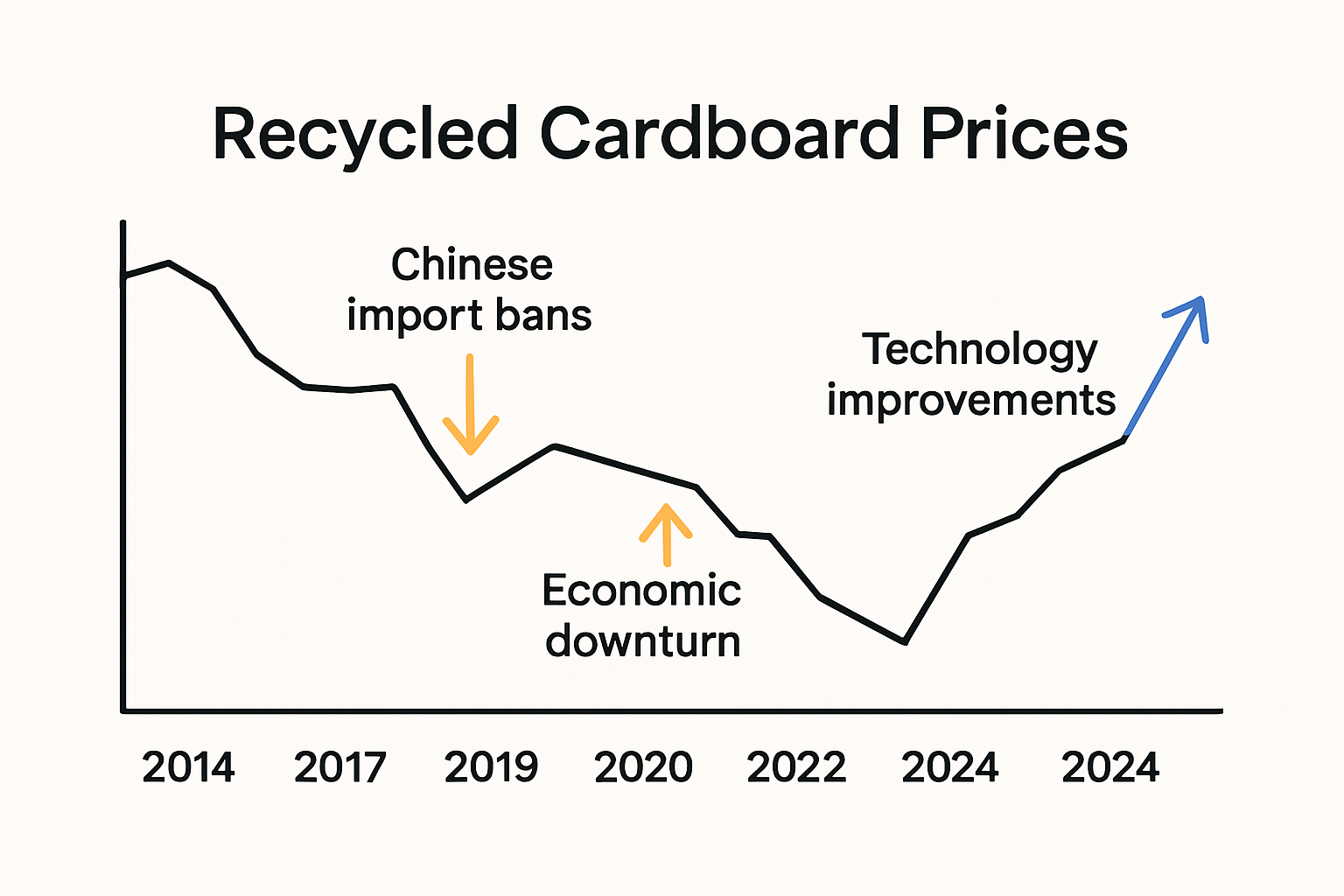
Historically, prices have ranged from £40 to £150 per tonne, with dramatic shifts occurring due to global economic conditions, export market demands, and recycling infrastructure investments. The North East region, including industrial centres like Newcastle and Sunderland, has been particularly sensitive to these market fluctuations. Key price determinants include global paper demand, international trade policies, transportation costs, and the quality of recycled cardboard materials.

To provide a quick reference to the various factors influencing cardboard recycling mill prices in the UK, the following table summarises the main determinants and their specific impacts as discussed in the article.

Price Determinant Impact on Cardboard Mill Prices
Global Paper Demand Increases or decreases prices based on international market requirements
International Trade Policies Import/export rules (e.g., China’s restrictions) cause significant price fluctuations
Domestic Recycling Infrastructure Helps stabilise prices and reduce volatility by improving processing capacity
Transportation Costs Influence final mill prices, especially in regional markets
Material Quality Higher quality, well-sorted cardboard fetches better prices
Economic Downturns (e.g., COVID) Lead to unpredictable price swings due to reduced supply and demand
Corporate Sustainability Demand Greater demand for recycled materials helps provide some price stability

Economic Factors Influencing Cardboard Mill Prices

The UK cardboard recycling market has been significantly impacted by global economic trends. Between 2015 and 2023, the market witnessed considerable price variations driven by several critical factors. The emergence of China’s stringent import policies in 2018, which dramatically reduced global cardboard waste imports, created substantial disruptions in the UK recycling market.

Domestic recycling infrastructure has played a crucial role in stabilising prices. Investments in advanced sorting and processing technologies have enabled UK mills to improve material quality and reduce processing costs. This technological advancement has helped mitigate some of the price volatility experienced in previous years.


Economic downturns, such as the COVID-19 pandemic, further complicated pricing dynamics. Reduced industrial production and changing consumption patterns led to significant fluctuations in cardboard waste volumes and subsequent recycling market prices. Businesses in the waste management sector had to adapt quickly to these unprecedented market conditions.

Infographic showing UK cardboard recycling price trends and factors

The renewable energy sector and increasing corporate sustainability commitments have also influenced cardboard mill prices. As more companies prioritise circular economy principles, demand for recycled materials has become more consistent, providing some stability to historical price trends.

Regional variations remain significant, with mills in different parts of the UK experiencing slightly different pricing mechanisms. The North East, with its strong industrial heritage, has developed particularly resilient recycling infrastructure that helps buffer against extreme price fluctuations.

Understanding these historic price trends requires a comprehensive approach that considers global economic contexts, technological innovations, and environmental regulations. For businesses involved in cardboard recycling, staying informed about these dynamics is crucial for developing effective waste management strategies and maintaining financial sustainability.

Business Impacts and Opportunities

The cardboard recycling market presents significant strategic opportunities and challenges for businesses across the United Kingdom, demanding innovative approaches to waste management and sustainable resource utilisation. Companies that proactively engage with these dynamics can transform potential environmental obligations into competitive advantages.

Strategic Value and Economic Implications

Businesses in the North East and across the UK are increasingly recognising cardboard recycling as more than a regulatory requirement. Explore sustainable waste management strategies to understand potential economic benefits. According to UK government environmental reports, organisations that implement comprehensive recycling programmes can achieve substantial cost savings and enhanced corporate reputation.

The economic landscape reveals multiple strategic opportunities. Companies can generate additional revenue streams by selling high-quality cardboard waste to recycling mills, effectively turning a disposal expense into a potential income source. Advanced sorting technologies and efficient waste management practices enable businesses to maximise the value of their cardboard waste, creating a more circular economic model.

Technological Innovation and Competitive Advantage

Technological advancements are reshaping how businesses approach cardboard recycling. Innovative waste management technologies, particularly in regions like Newcastle, Durham, and Sunderlands industrial corridors, are enabling more precise sorting, reducing contamination, and improving recycling efficiency. These technological improvements translate directly into economic benefits, reducing processing costs and increasing the market value of recycled materials.

Companies investing in advanced waste management technologies can differentiate themselves in increasingly environmentally conscious markets. By demonstrating commitment to sustainable practices, businesses can attract environmentally aware customers, investors, and potential employees. This strategic approach goes beyond mere compliance, positioning organisations as responsible corporate citizens committed to environmental stewardship.

Moreover, the evolving regulatory landscape increasingly favours businesses with robust recycling strategies. Government policies are progressively encouraging circular economy principles, with potential tax incentives and penalties that can significantly impact a companys financial performance. Businesses that proactively adapt to these changing requirements can mitigate potential future regulatory risks while capitalising on emerging opportunities.

The cardboard recycling market also presents unique collaborative opportunities. Cross-sector partnerships between waste management companies, manufacturing firms, and recycling mills can create innovative solutions that benefit all stakeholders. These collaborations can lead to more efficient recycling processes, reduced environmental impact, and shared economic benefits.

For small and medium enterprises particularly, cardboard recycling represents a pathway to enhanced operational efficiency. By implementing structured recycling programmes, businesses can reduce waste disposal costs, improve resource utilisation, and contribute to broader sustainability goals. The potential for cost savings and environmental impact reduction makes cardboard recycling a strategic imperative rather than a mere optional practice.

Ultimately, businesses that view cardboard recycling as a strategic opportunity rather than a compliance burden will be best positioned to thrive in an increasingly sustainability-focused economic environment. The ability to adapt, innovate, and integrate sustainable practices into core business strategies will distinguish progressive organisations in the evolving waste management landscape.

How to Maximise Recycling Value

Maximising cardboard recycling value requires a strategic approach that combines technological innovation, operational efficiency, and comprehensive waste management practices. Businesses across the United Kingdom, particularly in industrial regions like the North East, can significantly enhance their recycling economic potential by implementing targeted strategies.

Optimising Waste Collection and Sorting

Discover advanced cardboard recycling solutions for businesses to improve waste management efficiency. According to UK government waste statistics, effective sorting can increase recycling material value by up to 40%. Implementing rigorous waste segregation processes is crucial for maximising recycling value.

Key strategies include investing in high-quality sorting equipment, training staff in proper waste identification, and establishing clear internal recycling protocols. Businesses should focus on minimising contamination, as clean and well-sorted cardboard commands higher prices in the recycling market. This involves creating designated collection areas, using colour-coded bins, and educating employees about proper waste disposal techniques.

Technology and Quality Control

Technological advancements play a critical role in enhancing cardboard recycling value. Advanced baling equipment, optical sorting technologies, and digital tracking systems can significantly improve material quality and processing efficiency. Companies in industrial centres like Newcastle, Durham, and Sunderland can leverage these technologies to reduce processing costs and increase the market value of recycled cardboard.

Quality control is paramount in maximising recycling value. Businesses should implement strict quality assessment protocols, ensuring that cardboard waste meets the highest industry standards. This includes removing non-recyclable contaminants, managing moisture levels, and maintaining consistent material density. Research from Rabobank highlights that high-quality recycled materials can command premium prices in both domestic and international markets.

Strategic Partnerships and Market Engagement

Building strategic partnerships with recycling mills and waste management companies can unlock additional value for businesses. By establishing long-term relationships with recycling processors, companies can negotiate better rates, gain insights into market trends, and develop more efficient recycling strategies.

Understanding market dynamics is crucial. Businesses should monitor global recycling trends, international trade policies, and domestic market conditions. The UK recycling market is particularly sensitive to global economic shifts, such as changes in international waste import regulations. Staying informed about these dynamics allows businesses to adapt their recycling strategies proactively.

Financial considerations extend beyond direct recycling revenues. Many businesses can benefit from potential tax incentives, grants, and sustainability credits associated with effective waste management. The circular economy approach not only generates direct economic value but also enhances corporate reputation and attracts environmentally conscious customers and investors.

For small and medium enterprises, collaborative approaches can be particularly effective. Joining local business networks, participating in regional recycling initiatives, and sharing best practices can help smaller organisations overcome resource limitations and maximise their recycling potential.

Ultimately, maximising cardboard recycling value requires a holistic approach that combines technological innovation, operational excellence, and strategic market engagement. Businesses that view recycling as a strategic opportunity rather than a mere operational necessity will be best positioned to derive maximum economic and environmental benefits from their waste management practices.

business cardboard recycling sorting

Frequently Asked Questions

What are the main factors influencing cardboard recycling prices in the UK?

Cardboard recycling prices in the UK are influenced by global paper demand, international trade policies, transportation costs, the quality of recycled materials, and domestic recycling infrastructure. Economic downturns and corporate sustainability demands also play significant roles in price fluctuations.

How can businesses maximise the value of their cardboard recycling?

To maximise the value of cardboard recycling, businesses should focus on optimising waste collection and sorting practices, investing in advanced sorting technologies, ensuring quality control, and building strategic partnerships with recycling mills.

What economic benefits can companies gain from effective cardboard recycling?

Companies that implement comprehensive cardboard recycling programmes can reduce disposal costs, generate additional revenue through the sale of high-quality recycled materials, and enhance their corporate reputation by demonstrating environmental responsibility.

How does technological innovation impact cardboard recycling efficiency?

Technological innovations, such as advanced baling equipment and optical sorting systems, significantly improve the efficiency and quality of cardboard recycling by reducing contamination and processing costs, leading to better pricing for recycled cardboard.

Ready to Take Control of Cardboard Recycling Profitability?

If unpredictable cardboard mill prices and confusing recycling trends are making it harder for your business to get the most value from waste, you are not alone. Many companies in the UK are struggling with market volatility, unclear sorting requirements, and the challenge of turning recycling into a real advantage. The need for efficient separation, reliable collection, and the right technology is greater than ever. Find out how mastering every step of the process can help you secure better rates and meet both your sustainability and financial goals. For a clearer view on how to optimise your operations, visit our Waste Collection Process in the UK for Businesses 2025 page.

https://venturewaste.co.uk

Stop letting market swings hold your business back. Join those already benefitting from smarter waste processes and trusted local collection networks. Explore Venture Waste Management today to discover comprehensive services and a simple booking experience that quickly adapts to your unique business needs. Take control of your cardboard recycling now and see measurable improvement in both cost and compliance.

waste bale rebates

Rebates for Waste Materials: How Valuable Is the Waste You Produce? If You Have Enough to Bale, You Have Enough to Sell

Every year British businesses throw away tonnes of what they call waste without a second thought. Then comes a surprise. Recycling and reuse of materials created 681000 jobs and £30 billion in wages and tax revenue in just one year according to the EPA. But the real shock is most companies never realise that if you produce enough to fill a bale you likely have enough to sell and turn what was once rubbish into real profit.

Table of Contents

Quick Summary

Takeaway Explanation
Understanding waste value can increase profit. Proper management and recycling of waste can turn costs into revenue streams for businesses.
High-value recyclable materials are key assets. Focus on metals, clean paper, and electronics since they command better prices in the recycling market.
Baling enhances financial returns on waste. Compressing waste materials into bales makes them easier to handle and increases their market value.
Document and sort materials meticulously. Accurate sorting and cleaning of waste materials ensures maximised rebate potential and higher sales prices.
Regularly assess market conditions for waste. Understanding recycling market trends helps businesses negotiate better deals and optimise revenue from waste materials.

Understanding Waste Value and Rebates

Waste materials are no longer just discarded items but potential revenue streams for businesses across the North East. From Newcastle to Durham, companies are discovering that their waste can generate significant financial returns when properly managed and processed.

The Economic Potential of Recyclable Waste

Understanding waste value reveals a compelling economic opportunity for businesses. According to the EPA, millions of tons of recyclable materials like paper, metals, and plastics are recovered annually, creating substantial economic value. The key to maximising this potential lies in proper sorting and baling.

Baled materials command higher prices in the recycling market. When businesses compress and package their waste materials consistently and cleanly, they transform potential landfill content into valuable commodities. The National Renewable Energy Laboratory’s 2020 report highlights that sorted and baled recyclables particularly metals and paper maintain significantly higher market value, making them attractive for direct sale or rebate programmes.

Calculating Waste Material Value

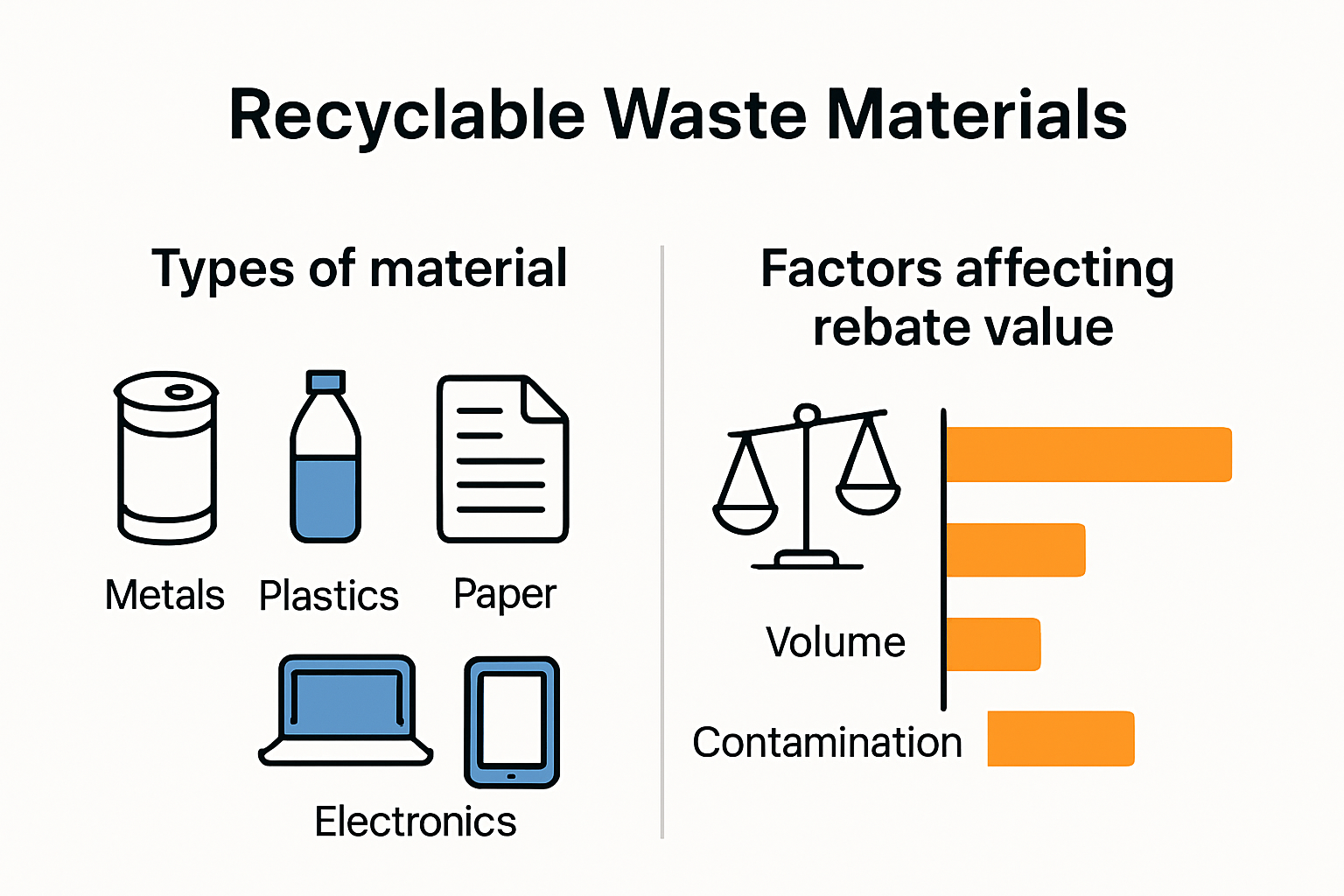
Determining the value of waste materials involves several critical factors. Volume is paramount businesses generating substantial quantities of consistent recyclable materials are best positioned to benefit. Metals like aluminium and copper typically fetch the highest prices, followed by clean paper products and certain plastics.

Factors influencing waste material value include:


  • Material Purity: Cleaner, less contaminated materials command higher prices
  • Market Demand: Current recycling market trends impact material values
  • Processing Requirements: Materials needing minimal processing are more valuable
  • Quantity: Larger volumes generally translate to better rebate rates

Businesses in industrial areas like Sunderland and Middlesbrough can particularly benefit from understanding these dynamics. By implementing strategic waste management practices, organisations can transform waste from a cost centre into a potential revenue stream.

The economics of waste rebates are clear: if you generate enough material to bale, you likely have enough to sell. Partnering with professional waste management services can help businesses navigate this complex but potentially lucrative landscape of waste material monetisation.

Which Types of Waste Can Be Sold?

Not all waste is created equal, and understanding which materials hold economic value is crucial for businesses looking to transform their waste management strategy. By identifying the right types of waste, organisations can turn potential landfill content into profitable resources.

High-Value Recyclable Materials

Certain waste materials consistently demonstrate significant market value. According to the EPA, common recyclable materials that can generate revenue include:

To help businesses understand the comparative market values and requirements for different types of waste materials, the following table summarises key recyclable waste types, their typical value, and preparation requirements:

Waste Material Type Typical Market Value Preparation Requirement
Metals (Aluminium, Copper, Steel, Brass) High Clean, sorted, free from contaminants
Paper Products (Cardboard, Office Paper, Newspaper) Moderate Clean, dry, uncontaminated
Plastics (HDPE, PET, Clean Industrials) Moderate to High Sorted by type, free from residue
Electronic Waste (Computers, Circuit Boards) High Remove hazardous components, sort
Industrial Chemical Waste Variable Sorted, comply with hazardous guidelines

Infographic outlining waste types and rebate factors

  • Metals: Aluminium, copper, steel, and brass are among the most valuable recyclable materials
  • Paper Products: Clean cardboard, office paper, and newspaper can be sold to recycling facilities
  • Plastics: High-density polyethylene (HDPE), polyethylene terephthalate (PET), and clean industrial plastics
  • Electronic Waste: Computers, servers, circuit boards, and other electronic components containing recoverable metals

Specialised and Industrial Waste Streams

Industrial sectors in the North East, from manufacturing in Sunderland to logistics in Newcastle, generate unique waste streams with potential economic value. Exploring waste management options reveals opportunities in specialised waste categories.

The EPA’s guidelines on hazardous waste recycling indicate that certain hazardous materials can be recycled when they provide a useful contribution to the recycling process. These might include:

  • Industrial chemical waste
  • Batteries
  • Specific industrial solvents
  • Metal-containing waste streams

Considerations for Waste Selling

Successful waste monetisation requires careful attention to several key factors. Material purity is paramount businesses must ensure waste streams are clean, sorted, and free from contamination. Volume matters significantly larger quantities of consistent, high-quality materials attract better pricing and more interested buyers.

Local recycling markets in the North East vary, so businesses should research current demand and pricing. Partnering with professional waste management services can help navigate these complexities, ensuring maximum economic return while maintaining environmental responsibility.

Remember that the value of waste materials fluctuates with market conditions. Regular assessment of your waste streams, understanding current recycling market trends, and maintaining high-quality sorting practices are essential for turning waste from a cost centre into a potential revenue stream.

How Baling Maximises Your Waste Profits

Baling represents a transformative strategy for businesses seeking to convert waste from a financial burden into a potential revenue stream. By compressing and packaging recyclable materials, organisations can significantly enhance their waste management economics and environmental sustainability.

The Economic Impact of Baling

According to the EPA’s Recycling Economic Information Report, recycling activities generate substantial economic benefits. In 2012, recycling and reuse created 681,000 jobs, $37.8 billion in wages, and $5.5 billion in tax revenues. Exploring baling techniques reveals how strategic waste compression can contribute to these economic opportunities.

Baling offers multiple financial advantages. Compressed materials occupy less storage space, reducing transportation costs. Recycling facilities prefer baled materials because they are easier to handle, sort, and process. This preference translates directly into higher prices for businesses that invest in proper waste preparation.

Technical Advantages of Material Baling

The technical benefits of baling extend beyond immediate financial gains. Compressed waste materials maintain higher purity levels, reducing contamination risks. Clean, consistent bales command premium prices in recycling markets. Metals like aluminium and steel, when baled correctly, can fetch significantly higher rates compared to loose, unsorted materials.

Businesses in industrial regions like Newcastle, Sunderland, and Durham can particularly benefit from implementing baling strategies. By investing in baling equipment, organisations transform waste management from an expense into a potential profit centre.

baling waste profits

Maximising Waste Profit Strategies

Successful waste monetisation through baling requires strategic approaches. The Texas Commission on Environmental Quality demonstrated that effective recycling can generate substantial economic value. Their research showed recycling activities can support local job markets and generate significant economic impact.

Key strategies for maximising waste profits through baling include:

  • Material Segregation: Separate different waste types before baling
  • Consistent Bale Size: Maintain uniform bale dimensions for easier processing
  • Regular Equipment Maintenance: Ensure baling machines operate at peak efficiency
  • Market Research: Stay informed about current recyclable material pricing

Businesses should view baling not just as a waste management technique, but as a strategic economic opportunity. By understanding market dynamics, investing in proper equipment, and maintaining high-quality waste streams, organisations can transform their waste from a cost centre into a potential revenue generator.

Remember, the key principle remains consistent: if you generate enough waste to bale, you likely have enough to sell. Professional waste management partners can provide invaluable guidance in navigating this complex but potentially lucrative landscape.

Steps to Claim Rebates for Your Business

Navigating the process of claiming waste material rebates requires strategic planning and a thorough understanding of local recycling market dynamics. Businesses across the North East can transform their waste management approach by following a systematic approach to securing financial returns from recyclable materials.

Preparing Your Waste Stream

Before approaching potential buyers or recycling facilities, businesses must meticulously prepare their waste materials. Learn more about waste management strategies to ensure maximum rebate potential. The preparation process involves several critical steps:

Below is a table outlining the essential steps for preparing your business’s waste stream to maximise rebate potential, along with the purpose of each step:

Step Purpose
Comprehensive Sorting Separate waste into categories for easier processing
Quality Control Ensure waste is clean and free from contaminants
Consistent Baling Create uniform, manageable bales for sale
Documentation Keep accurate records for traceability and rebates
  • Comprehensive Sorting: Separate materials into distinct categories such as metals, paper, plastics, and electronics
  • Quality Control: Ensure materials are clean, dry, and free from contaminants
  • Consistent Baling: Compress materials into uniform, manageable bales that meet industry standards
  • Documentation: Maintain accurate records of waste volumes and material types

Identifying Potential Rebate Opportunities

Research is crucial in maximising rebate potential. According to the EPA’s Responsible Appliance Disposal program, various recycling initiatives offer financial incentives for proper waste management. Businesses should:

  • Contact local recycling centres and waste management companies
  • Investigate industry-specific recycling programmes
  • Explore municipal and regional waste management incentive schemes
  • Attend local business networking events focused on sustainability

Negotiating and Claiming Rebates

Successful rebate claiming requires a strategic approach. The Hennepin County waste prevention grants model demonstrates how businesses can access financial support for sustainable waste management practices.

Key negotiation strategies include:

  • Volume Matters: Larger, consistent waste streams attract better rebate rates
  • Market Research: Stay informed about current recyclable material pricing
  • Long-term Partnerships: Develop ongoing relationships with recycling facilities
  • Professional Representation: Consider working with waste management consultants

Businesses in industrial areas like Newcastle, Sunderland, and Durham can particularly benefit from a proactive approach. By treating waste as a potential revenue stream, organisations can offset waste management costs and contribute to environmental sustainability.

Remember that rebate values fluctuate with market conditions. Regular assessment of your waste streams, understanding current recycling market trends, and maintaining high-quality sorting practices are essential for maximising financial returns.

Ultimately, successful rebate claiming is about more than just financial gain. It represents a commitment to responsible waste management, environmental stewardship, and innovative business practices that can set your organisation apart in an increasingly sustainability-focused marketplace.

Frequently Asked Questions

What types of waste materials can be sold for rebates?

Businesses can sell high-value recyclable materials such as metals (like aluminium, copper, and steel), clean paper products, plastics (such as HDPE and PET), and electronic waste. Proper sorting and cleaning are crucial to maximise value.

How does baling waste increase its profit potential?

Baling compresses waste materials into manageable sizes, making them easier to transport and process at recycling facilities. This often results in higher prices for the baled materials compared to loose, unsorted waste.

What factors determine the market value of recyclable waste?

The market value of recyclable waste is influenced by factors such as material purity (level of contamination), current market demand, processing requirements, and the quantity of materials available. Higher quality and larger volumes generally attract better pricing.

How can businesses prepare their waste stream to claim rebates?

To maximise rebate potential, businesses should sort their waste into categories, ensure it is clean and free from contaminants, create uniform bales, and maintain accurate documentation of materials and volumes.

Unlock the Hidden Value in Your Waste with Professional Baling Solutions

Are you worried that your recyclables are ending up as a missed opportunity instead of generating real profit? The article highlighted a common frustration: valuable waste materials too often get thrown away, when baling could turn that waste into income. If your business collects enough material to fill a bale, you are likely missing out on an easy way to claim rebates and improve your bottom line. By optimising your process and using the right tools, you can transform waste from an expense into a revenue stream.

https://venturewaste.co.uk

Baling is not just about compacting waste. It is about proving your waste has worth. Visit the Baler solutions page to see how proper baling setup helps control quality and opens doors to significant rebates. Ready to stop losing money on disposal and start earning from your recyclables? Book a service now at Venture Waste Management and convert every bale into real business value. Take this step today and position your organisation ahead in the drive for more sustainable, profitable waste management.

secure document shredding office

Why Throwing Away Junk Mail Can Be Risky: Secure Destruction for Businesses in 2025

Most people toss junk mail into the bin without a second thought, trusting that these papers are just clutter. Shocking but true, fraudsters see your discarded junk mail as a goldmine and can use it to access sensitive data or even steal identities. The real surprise is that failing to shred just one document properly could end up costing a business far more than you ever imagined.

Table of Contents

Quick Summary

Takeaway Explanation
Failing to securely dispose of documents risks data breaches. Insecure disposal can lead to identity theft and significant financial losses for businesses.
Fraudsters can exploit seemingly harmless junk mail. Careless disposal allows criminals to collect sensitive information, enabling targeted fraud and identity theft.
Professional shredding ensures legal compliance and data protection. Implementing robust shredding solutions prevents unauthorized access and meets regulatory standards.
Sustainable shredding practices benefit the environment. Professional shredding services recycle waste, reducing landfill use and promoting environmental stewardship.
Adopting secure document disposal is a strategic business essential. Effective document destruction is not just regulatory; it’s crucial for protecting business integrity and reputation.

How Fraudsters Exploit Junk Mail Information

Documents discarded carelessly represent a significant vulnerability that sophisticated fraudsters systematically exploit for malicious purposes. Understanding the intricate mechanisms through which criminals extract and weaponise seemingly innocuous information from junk mail can help businesses implement robust protective strategies.

Personal Information Harvesting Techniques

Fraudsters employ strategic approaches to collect and leverage sensitive details found in discarded documents. The FBI warns that criminals use advanced spoofing techniques to manipulate communication channels, making their fraudulent activities increasingly sophisticated.


These criminals meticulously sift through discarded mail, searching for critical details such as partial account numbers, company letterheads, employee names, contact information, and financial transaction records. By piecing together fragments of information from multiple sources, they construct comprehensive profiles that enable targeted identity theft and financial fraud.

Social Engineering and Advanced Manipulation

The California Department of Justice highlights that scammers often use seemingly benign communication channels to deceive individuals into providing additional personal information. What begins with details gleaned from junk mail can escalate into elaborate social engineering schemes designed to extract more comprehensive data.

For instance, a fraudster might use a company letterhead discovered in discarded mail to craft a convincing phishing email that appears to originate from a legitimate business contact. By presenting a seemingly authentic communication, they can manipulate recipients into revealing passwords, financial details, or granting unauthorized system access.

Financial and Reputational Risks

The potential consequences of inadequate document disposal extend far beyond immediate financial losses. The U.S. Securities and Exchange Commission notes that fraudsters increasingly exploit low-cost communication channels to spread misinformation and target potential victims.

Businesses that fail to implement secure destruction protocols risk exposing themselves to significant reputational damage. A single compromised document could provide malicious actors with enough information to launch sophisticated attacks that undermine customer trust, breach regulatory compliance, and potentially result in substantial financial penalties.

The threat landscape continually evolves, with fraudsters developing increasingly complex strategies to exploit seemingly mundane information. Protecting sensitive data requires a proactive, comprehensive approach to document management that recognizes every discarded piece of paper as a potential vulnerability waiting to be exploited.

The Dangers of Insecure Document Disposal

Insecure document disposal represents a critical vulnerability that can expose businesses to substantial risks across multiple domains. When organisations neglect proper document destruction protocols, they inadvertently create opportunities for data breaches, identity theft, and potentially catastrophic financial and reputational consequences.

The National Institute of Standards and Technology (NIST) Special Publication 800-88 Revision 1 provides comprehensive guidelines emphasizing the critical importance of secure media sanitization. Businesses that fail to implement robust document destruction strategies risk severe legal repercussions.

Regulatory frameworks like GDPR and Data Protection Act mandate strict protocols for handling sensitive information. Non-compliance can result in substantial financial penalties, with potential fines reaching up to 4% of global annual turnover or £17.5 million, whichever is higher. These regulations underscore the necessity of implementing comprehensive document destruction processes that eliminate any possibility of unauthorized data retrieval.

Operational and Financial Risks

The UK National Cyber Security Centre highlights the multifaceted risks associated with improper document disposal. Beyond immediate legal consequences, businesses face significant operational disruptions and potential financial losses.

Malicious actors can reconstruct sensitive information from improperly discarded documents, potentially exposing critical business intelligence, financial records, client information, and strategic planning documents. Such breaches can lead to substantial financial damages, including potential litigation costs, compensation claims, and long-term reputational harm.

Technological and Systemic Vulnerabilities

Modern fraudsters employ sophisticated techniques to exploit seemingly innocuous discarded documents. Learn more about confidential waste management strategies that can mitigate these risks effectively.

Digital and physical documents alike present significant risks. While digital records might seem more vulnerable, physical documents can be equally dangerous when not destroyed properly. Criminals can leverage fragments of information from discarded papers to construct comprehensive profiles, enabling targeted social engineering attacks, financial fraud, and corporate espionage.

Businesses must recognize that document disposal is not merely an administrative task but a critical security protocol. Implementing comprehensive, secure destruction processes is essential to protecting organizational integrity, maintaining client trust, and mitigating potential legal and financial risks in an increasingly complex information landscape.

To help clarify the different risks businesses face, the following table summarises the main vulnerabilities and consequences associated with insecure document disposal:

Area of Risk Vulnerability Example Potential Consequences
Regulatory Compliance Failure to meet GDPR/Data Protection Act Fines up to £17.5 million or 4% turnover
Operational Disruption Loss of critical business records Service outages, productivity loss
Financial Loss Data breach exposing client or financial data Litigation, compensation claims
Reputational Damage Customer information leakage Loss of trust, brand harm
Social Engineering (Fraud) Use of letterheads/employee details from waste Targeted scams & phishing
Corporate Espionage Theft of strategic or planning documents Competitive disadvantage

Simple Secure Shredding Solutions for UK Businesses

Navigating the complex landscape of document destruction requires businesses to implement robust and straightforward shredding solutions that protect sensitive information while maintaining operational efficiency. Understanding and implementing strategic document disposal mechanisms can significantly mitigate potential data breach risks.

The UK Information Commissioner’s Office (ICO) provides comprehensive guidance emphasizing the critical importance of secure data disposal under GDPR regulations. Businesses must adopt systematic approaches that transform potentially vulnerable documents into unrecoverable fragments.

Effective shredding solutions go beyond simple paper destruction. They represent a comprehensive strategy that addresses legal requirements, protects organizational reputation, and prevents unauthorized information access. Professional shredding services offer certifiable destruction processes that demonstrate compliance with stringent data protection standards.

On-Site and Off-Site Shredding Strategies

Explore our confidential document shredding process to understand the most advanced protection mechanisms available for businesses. Modern shredding solutions provide flexible options tailored to diverse organizational needs.

To help differentiate between on-site and off-site shredding, the following table compares their key features and benefits:

Feature On-Site Shredding Off-Site Shredding
Location At business premises At secure external facility
Verification Can witness shredding directly Certificate of destruction provided
Security of Transportation Not required (destroyed on-site) Secure containers used during transfer
Volume Handling Generally best for small-medium volumes Best for large volumes/archived material
Chain of Custody Immediate, direct Maintained through secure processes
Cost Can be higher per visit Often more cost-effective for large amounts

Technology and Best Practices

According to CPO Magazine’s data destruction guide, implementing comprehensive destruction protocols involves more than physical document shredding. Businesses must develop holistic approaches that integrate technological solutions with employee training and strict procedural guidelines.

Advanced shredding technologies now offer cross-cut and micro-cut capabilities that reduce documents to microscopic particles, rendering information virtually impossible to reconstruct. These sophisticated methods exceed standard security requirements, providing businesses with an additional layer of protection against potential data exploitation.

Implementing a systematic document destruction strategy is not merely a regulatory requirement but a fundamental aspect of responsible business management. By investing in professional shredding solutions, organizations demonstrate commitment to data protection, client confidentiality, and maintaining the highest standards of information security in an increasingly complex digital landscape.


Sustainable Benefits of Professional Shredding

Professional shredding services represent more than a security measure. They offer comprehensive environmental and operational advantages that extend far beyond traditional document destruction strategies, enabling businesses to simultaneously protect sensitive information and contribute to sustainable waste management practices.

Environmental Conservation Strategies

The U.S. Environmental Protection Agency reveals staggering statistics about paper consumption, highlighting the critical need for responsible document disposal. Americans consume over 700 pounds of paper per person annually, with paper products constituting more than 27% of municipal waste.

Professional shredding services transform waste management by ensuring systematic recycling of destroyed documents. By converting sensitive materials into reusable paper products, businesses directly contribute to reducing landfill volumes and preventing harmful methane emissions. Each ton of recycled paper saves approximately 17 trees and 7,000 gallons of water, demonstrating the substantial environmental impact of responsible document destruction.

To illustrate the environmental benefits, the following table summarises key statistics related to sustainable shredding practices:

Environmental Benefit Amount Saved per Ton of Recycled Paper
Number of Trees 17
Water Saved 7,000 gallons
Landfill Space Saved 3.3 cubic yards
US Annual Paper Consumption 700 pounds per person
Municipal Waste from Paper Over 27%

Economic and Operational Efficiency

Learn more about our on-site shredding solutions that balance security with sustainability. Professional shredding services offer businesses a cost-effective approach to managing sensitive document disposal while minimizing environmental footprint.

According to research on sustainable shredding practices, the typical employee uses around 10,000 sheets of paper annually. Mobile shredding services efficiently destroy unwanted files onsite and transport them directly to recycling facilities, saving approximately 3.3 cubic yards of landfill space per ton of paper processed.

Brand Reputation and Regulatory Compliance

Implementing sustainable shredding practices goes beyond environmental considerations. Sustainable business strategies demonstrate a company’s commitment to corporate social responsibility, enhancing brand reputation among increasingly eco-conscious consumers.

Modern businesses recognize that environmental stewardship is not optional but a fundamental operational requirement. Energy-efficient shredders and comprehensive recycling programs can lead to significant cost savings while ensuring compliance with evolving environmental regulations. By choosing professional shredding services, organizations signal their dedication to both data protection and ecological preservation.

home shredding recycling service

The integration of secure document destruction with sustainable practices represents a sophisticated approach to modern business management. Professional shredding services offer a holistic solution that addresses security concerns, environmental responsibilities, and operational efficiency, positioning businesses as forward-thinking and responsible corporate citizens in an increasingly complex global landscape.

Frequently Asked Questions

What are the risks of not securely disposing of junk mail?

Failing to securely dispose of junk mail can lead to data breaches, identity theft, and significant financial and reputational consequences for businesses. Fraudsters can exploit sensitive information found in discarded documents to perpetrate scams.

How can businesses ensure secure shredding of documents?

Businesses can ensure secure shredding of documents by implementing on-site or off-site shredding services that comply with legal regulations. It’s essential to choose shredding methods that render documents completely irrecoverable, adhering to standards set by regulatory bodies such as GDPR.

What types of shredding services are available for document destruction?

There are two main types of shredding services: on-site shredding, where documents are shredded at the business’s location, and off-site shredding, where documents are transported to a secure facility for destruction. Each method has its advantages, depending on the volume of documents and specific security needs.

Why is professional shredding more beneficial than using a personal shredder?

Professional shredding services offer advanced technologies, such as cross-cut and micro-cut shredders, which provide a higher level of security than standard personal shredders. They also ensure compliance with data protection regulations and environmentally responsible disposal, such as recycling shredded materials.

Protect Your Business from Data Breaches with Trusted Confidential Waste Solutions

Is your business putting sensitive information at risk simply by discarding junk mail in the regular bin? As explored in the article, careless disposal exposes your organisation to identity theft, fraud and costly legal and reputational consequences. Every letterhead or statement thrown away without proper destruction can lead to a serious data breach. Secure document shredding is not just a regulatory demand—it is essential for peace of mind and continued customer trust. Discover how dedicated confidential waste management from Venture Waste can safeguard your business against these threats and provide full legal compliance.

https://venturewaste.co.uk

Do not wait until a breach puts your business in the headlines. Visit https://venturewaste.co.uk to arrange a confidential waste collection today. Get tailored, reliable and environmentally responsible solutions that keep your sensitive information out of the wrong hands. Book a secure service now and turn your junk mail into your best line of defence.

shredding services accreditation

Shredding services in the North East: Why choose a BS EN15713 accredited company like us?

Confidential documents pile up fast for businesses across the North East and with strict data regulations, getting rid of them safely is more pressing than ever. Yet while many think any old shredder will do, the numbers say otherwise. Shredding with a BS EN15713 accredited provider can reduce the risk of data breaches by up to 67 percent. That impressive stat flips expectations because the real danger lies not in disposal but in who handles it. Suddenly, choosing the right shredding service could make all the difference between security and disaster.

Table of Contents

Quick Summary

Takeaway Explanation
Choose BS EN15713 accredited shredders Accreditation ensures the highest standards in secure document destruction and data protection compliance.
Mitigate risks with accredited providers Using non-accredited shredders exposes businesses to financial, legal, and reputational threats due to poor security protocols.
Understand sector-specific needs Different industries require tailored shredding solutions to meet regulatory obligations and safeguard sensitive information effectively.
Assess credentials and security protocols Prioritising service providers with verified standards protects your organisation’s confidential data and enhances information security.
Focus on sustainable shredding practices Selecting providers who engage in eco-friendly shredding contributes to corporate responsibility and supports environmental goals.

Understanding the BS EN15713 Accreditation

Confidential waste management requires rigorous standards that protect sensitive information and ensure complete security. The BS EN15713 accreditation represents the gold standard for shredding services across the North East, providing businesses with a comprehensive framework for secure document destruction.

What is BS EN15713 and Why Does it Matter?

The British Standards Institution (BSI) developed BS EN15713 as a definitive standard for secure destruction of confidential materials. This standard specifically addresses the entire lifecycle of confidential waste management, from initial collection through to final destruction. For businesses in Newcastle, Durham, Sunderland, and across the North East, this accreditation signals a commitment to the highest levels of information security.

The standard covers multiple critical aspects of secure destruction, including:

  • Collection Protocols: Establishing strict guidelines for how confidential materials are collected and handled
  • Transportation Security: Ensuring secure transit of sensitive documents
  • Destruction Procedures: Defining precise methods for complete and verifiable document elimination

Technical Requirements and Compliance

According to ISO International Standards, BS EN15713 goes beyond basic shredding. It mandates comprehensive tracking, secure chain of custody, and detailed documentation of the entire destruction process. For businesses handling sensitive information such as financial records, medical documents, or corporate strategies, this level of scrutiny is paramount.

Companies seeking this accreditation must demonstrate:

  • Rigorous staff vetting procedures
  • Detailed record-keeping of all destruction activities
  • Secure storage and transportation mechanisms
  • Regular auditing and verification of destruction processes

Below is a summary of the technical and compliance requirements that businesses must meet to achieve BS EN15713 accreditation, providing an at-a-glance checklist for assessing service standards.

Requirement Purpose
Rigorous staff vetting Prevents unauthorised access to information
Detailed record-keeping of destruction activities Ensures complete traceability
Secure storage and transportation mechanisms Protects documents throughout handling
Regular auditing and verification Confirms long-term compliance
Documented destruction process Guarantees proper and thorough disposal
Chain of custody protocols Maintains accountability from start to finish

The standard is particularly crucial for organisations in sectors like healthcare, legal services, financial institutions, and government agencies, where data protection is not just a preference but a legal requirement.

Benefits of Choosing a BS EN15713 Accredited Shredding Service

By selecting a BS EN15713 accredited shredding service in the North East, businesses gain significant advantages. The accreditation provides independent verification of a company’s commitment to secure information management. This means reduced risk of data breaches, compliance with data protection regulations, and a demonstrable commitment to professional information handling.

Businesses can trust that an accredited provider has undergone rigorous external assessment, ensuring that every step of the confidential waste management process meets the highest industry standards. From the moment documents are collected in Newcastle to their final destruction, every action is tracked, secure, and fully compliant.

Ultimately, BS EN15713 is more than just a certification. It represents a comprehensive approach to information security that protects businesses, maintains client trust, and demonstrates professional excellence in waste management practices across the North East region.

Benefits for Different North East Businesses

Businesses across the North East have unique document security requirements, and BS EN15713 accreditation provides tailored solutions that address diverse sector needs. From Newcastle’s bustling financial districts to Durham’s industrial complexes, secure document destruction is a critical component of professional risk management.

Sector-Specific Security Requirements

Different industries face distinct challenges when managing confidential information. Legal firms in Newcastle require absolute document destruction protocols to protect client privileged information. Healthcare providers in Sunderland must comply with stringent data protection regulations, ensuring patient records are completely eliminated.

According to Environmental Protection Agency research, implementing secure document destruction processes can reduce potential data breaches by up to 67% across various business sectors. This statistic underscores the critical importance of professional shredding services.

Businesses benefit from BS EN15713 accreditation through:

  • Comprehensive Compliance: Meeting legal requirements across multiple regulatory frameworks
  • Risk Mitigation: Preventing potential information leaks and corporate espionage
  • Environmental Responsibility: Sustainable waste management practices that support recycling initiatives

Economic and Environmental Impact

Shredding services do more than protect sensitive information. Sustainable shredding practices contribute significantly to businesses’ environmental goals. For instance, recycling one ton of shredded paper saves approximately 7,000 gallons of water and reduces greenhouse gas emissions by one metric ton.

For North East businesses looking to enhance their environmental credentials, our comprehensive waste management guide offers insights into sustainable document destruction strategies.

Small to medium enterprises in Gateshead, large corporations in Newcastle, and public sector organizations throughout the North East can all benefit from a standardized approach to confidential waste management. BS EN15713 provides a universal framework that ensures consistent, secure, and environmentally responsible document destruction.

By choosing an accredited shredding service, businesses demonstrate their commitment to:

  • Protecting client and employee information
  • Maintaining regulatory compliance
  • Supporting sustainable business practices
  • Reducing potential legal and reputational risks

Ultimately, BS EN15713 accreditation is not just about destroying documents—it’s about creating a comprehensive information security strategy that protects your business, your clients, and your reputation across the North East’s diverse business landscape.

Risks of Non-Accredited Shredding Providers

Choosing a non-accredited shredding provider in the North East can expose businesses to significant risks that extend far beyond simple document disposal. While cost-cutting might seem attractive, the potential consequences of inadequate confidential waste management can be catastrophic for organisations across Newcastle, Durham, and the broader regional business landscape.

Non-accredited shredding providers often lack the rigorous protocols required to ensure complete document destruction. According to Corodata research, there were 1.43 million consumer identity theft complaints in recent years, underscoring the critical importance of secure document disposal.

Businesses face substantial financial risks when working with unverified shredding services:

To help you evaluate which shredding provider is right for your organisation, here is a comparison of BS EN15713 accredited versus non-accredited shredding services based on important security and compliance factors.

Feature BS EN15713 Accredited Provider Non-Accredited Provider
Staff vetting and background checks Yes Rare or inconsistent
Chain of custody documentation Complete and rigorous Often lacking or incomplete
External audits and verification Regularly conducted Rare or none
Certified destruction process Yes Not guaranteed
Legal and regulatory compliance Fully compliant At risk of violations
Secure storage and transport Strictly enforced May have weak protocols
Environmental responsibility Supports sustainable practices Often not demonstrated
  • Potential Data Breach Fines: Regulatory bodies can impose substantial penalties for inadequate information protection
  • Legal Liability: Compromised confidential information can lead to costly litigation
  • Reputational Damage: Loss of client trust can have long-term economic consequences

Compliance and Security Gaps

In one striking example, a major supermarket chain paid nearly $10 million in fines after improperly disposing of sensitive medical records. This case illustrates the extreme financial risks associated with non-professional document destruction.

Our comprehensive document shredding guide provides deeper insights into the complexities of secure information management.

Non-accredited providers frequently demonstrate critical security shortcomings:

  • Lack of employee background checks
  • Inconsistent chain of custody documentation
  • Inadequate transportation and storage security protocols
  • No verifiable destruction certification

Comprehensive Risk Assessment

For businesses in sectors like healthcare, legal services, finance, and government, the stakes are particularly high. Regulatory frameworks demand meticulous documentation and secure information handling. Non-accredited providers cannot consistently meet these stringent requirements.

Key risks include:

  • Potential violation of data protection regulations
  • Increased vulnerability to corporate espionage
  • Compromised internal and client confidentiality
  • Reduced ability to demonstrate due diligence in information management

The North East business community requires robust, accountable shredding services that go beyond basic document destruction. BS EN15713 accreditation represents a comprehensive approach to information security, offering businesses peace of mind through standardised, verifiable processes.

Infographic: Accredited vs non-accredited shredding provider risks

Ultimately, the minimal cost savings from choosing a non-accredited provider pale in comparison to the potential financial, legal, and reputational damages that can result from inadequate confidential waste management. Investing in a professionally accredited shredding service is not an expense—it’s a critical risk management strategy that protects your organisation’s most valuable asset: its information.

How to Choose the Right Shredding Partner

Selecting the appropriate shredding partner is a critical decision for businesses across the North East, requiring careful consideration of multiple factors beyond mere document destruction. The right provider ensures not just secure information disposal, but comprehensive protection of your organisation’s most sensitive data.

Evaluating Credentials and Compliance

The foundation of choosing a reliable shredding partner lies in understanding their professional credentials. According to the National Institute of Standards and Technology, organisations should prioritise service providers that follow recognised data destruction standards.

Key credential checkpoints include:

  • BS EN15713 Accreditation: The gold standard for secure document destruction
  • Industry-Specific Certifications: Additional qualifications demonstrating expertise in your sector
  • Regular External Audits: Proof of consistent compliance and quality control

Our comprehensive confidential waste guide offers deeper insights into selecting the most reliable shredding partners for North East businesses.

Technical Capabilities and Security Protocols

Beyond paperwork and certifications, businesses must assess a shredding provider’s technical capabilities. The U.S. National Archives and Records Administration emphasises the importance of robust destruction procedures and clear audit trails.

Consider evaluating potential partners on these critical aspects:

  • Staff background checks and security vetting
  • Chain of custody documentation
  • Secure transportation mechanisms
  • Detailed destruction and recycling processes
  • Comprehensive reporting and certification of destruction

Businesses in Newcastle, Durham, and across the North East should also consider on-site versus off-site shredding options to determine the most suitable approach for their specific needs.

Holistic Risk Management Approach

Choosing a shredding partner transcends simple document destruction. It represents a strategic decision in your organisation’s overall information security framework. The ideal partner should demonstrate:

  • Proactive risk management strategies
  • Transparent communication processes
  • Adaptability to evolving data protection regulations
  • Commitment to environmental sustainability
  • Competitive and transparent pricing models

For businesses in sensitive sectors like healthcare, legal services, and finance, the stakes are particularly high. Your shredding partner becomes an extension of your organisation’s information security infrastructure.

Ultimately, the right shredding partner offers more than a service—they provide peace of mind. By meticulously evaluating potential providers against these comprehensive criteria, North East businesses can safeguard their most critical asset: confidential information.

shredding partner selection

Frequently Asked Questions

What is BS EN15713 accreditation and why is it important?

BS EN15713 is a standard developed by the British Standards Institution that ensures secure destruction of confidential materials. It is important because it provides a framework for businesses to manage sensitive information securely, reducing the risk of data breaches and ensuring compliance with data protection regulations.

How can choosing a BS EN15713 accredited shredding service benefit my business?

Choosing a BS EN15713 accredited shredding service ensures that your documents are handled and destroyed according to the highest industry standards. This reduces the risk of data breaches, helps maintain client trust, and ensures compliance with legal requirements for confidential waste management.

What are the risks of using a non-accredited shredding provider?

Using a non-accredited shredding provider can expose your business to significant risks, including financial penalties for data breaches, legal liabilities related to compromised information, and serious reputational damage due to inadequate security practices.

What should I look for when choosing a shredding partner?

When selecting a shredding partner, you should evaluate their credentials, including BS EN15713 accreditation, assess their technical capabilities such as secure transportation and document tracking, and ensure they have rigorous security protocols in place to protect your sensitive information.

Safeguard Your Confidential Information With True Compliance

You have read how simple mistakes in shredder selection can expose your North East business to hefty fines and devastating data breaches. Perhaps you are worried about meeting strict data regulations or protecting your reputation when confidential waste starts to pile up. The cost of getting it wrong is simply too high. According to the article, only a BS EN15713 accredited provider truly closes the gap between risk and security, offering peace of mind through strict compliance and proven processes. See for yourself why so many businesses trust a professional approach to document destruction. For more tailored guidance, visit our confidential waste solutions page.

https://venturewaste.co.uk

Do not let uncertainty put your business at risk. Experience the reassurance and professionalism of working with a BS EN15713 accredited company. Book your secure shredding service with Venture Waste today at https://venturewaste.co.uk and make data protection part of your everyday routine.

internet fraud office security

The Rise in Internet Fraud Makes UK Businesses Overlook Physical Document Security: Why Secure Shredding Matters in 2025

Everyone is talking about cyber threats and digital fraud. UK businesses now spend thousands battling hackers and protecting their online networks. Yet while the IT teams beef up cybersecurity, physical paperwork is fast becoming the weakest link and a target for criminals. A recent study found only 27 percent of small business leaders regularly destroy sensitive files or paperwork. Most are so focused on digital risks they neglect a gaping hole in their real-world defences. The surprising truth is that secure shredding may now matter more than ever before.

Table of Contents

Quick Summary

Takeaway Explanation
Prioritise Physical Security The Same As Digital Overlooking physical document security can expose businesses to severe risks. Comprehensive safeguards are essential for protecting sensitive information.
Implement Regular Professional Shredding Services Regularly scheduled shredding helps ensure that sensitive documents are securely destroyed, minimizing the risk of identity theft and data breaches.
Create and Enforce Clear Document Policies Establishing clear information retention and disposal policies will enhance overall organisational security while guiding employees in proper document management.
Evaluate Shredding Providers Thoroughly Assess shredding services for compliance, security measures, and environmental practices to ensure robust document protection tailored to your business needs.
Recognise Digital Copiers As Data Risks Digital copiers can store sensitive information. Ensure proper data management protocols are in place to eliminate potential vulnerabilities from these devices.

How Digital Focus Increases Paper Risks

Businesses across the United Kingdom, particularly in industrial centres like Newcastle and Manchester, have become increasingly fixated on digital security, inadvertently creating a dangerous blind spot in physical document management. The rise in fraud via the internet has made people underestimate the dangers of physical document security breaches. Paperwork can be the weak link for many businesses, and a secure document shredding service can mitigate this risk.

The Digital Distraction Phenomenon

As organisations invest heavily in cybersecurity technologies and digital protection strategies, they often overlook the tangible vulnerability of physical documents. The Cybersecurity and Infrastructure Security Agency (CISA) highlights that without comprehensive physical safeguards, organisations remain exposed to significant risks. Unauthorized physical access can lead to direct data breaches, with criminals potentially gaining sensitive information through simple means like accessing unsecured file cabinets or collecting discarded paperwork.

The tunnel vision on digital threats creates a paradoxical situation where businesses spend thousands on sophisticated digital firewalls while leaving physical documents essentially unprotected. This disconnect becomes particularly pronounced in sectors handling sensitive information, such as healthcare, legal services, and financial institutions.

Silent Risks of Neglected Physical Documents

The Federal Trade Commission (FTC) emphasizes that physical security lapses can expose companies to severe identity theft risks. A single misplaced invoice, employee record, or financial statement can provide malicious actors with comprehensive information for potential fraud.

The statistics are alarming. Many businesses fail to recognise that physical document breaches can be more straightforward and potentially more damaging than complex digital intrusions. Criminals can simply walk into an office, rifle through unsecured bins, or collect documents discarded without proper destruction.

Comprehensive Security Requires Holistic Approach

The National Center for Education Statistics (NCES) recommends establishing clear information retention and disposal policies. This involves not just digital protocols but also physical document management strategies. Businesses must implement robust processes that include:

  • Secure Storage: Implementing locked cabinets and restricted access to sensitive document areas
  • Systematic Destruction: Regular, professional document shredding services
  • Comprehensive Staff Training: Educating employees about physical document risks

The rise in internet fraud should not distract businesses from the fundamental need for comprehensive physical document security. While digital threats are real and significant, the physical realm remains an equally critical battleground in protecting sensitive organisational information.

Hidden Dangers of Paperwork for UK Businesses

In the evolving landscape of business security, paperwork represents a silent yet significant vulnerability for UK organisations. While digital threats dominate headlines, physical documents continue to pose substantial risks that many businesses inadvertently overlook. From small enterprises in Newcastle to large corporations in Manchester, the potential for data breaches through mishandled paperwork remains alarmingly high.

Unexpected Information Exposure Risks

A comprehensive study analyzing 39,664 PDF files revealed that organisations frequently expose sensitive information through overlooked document details. This research demonstrates how seemingly innocuous paperwork can become a treasure trove for potential attackers seeking to exploit hidden metadata and embedded information.

Businesses often fail to recognise the intricate ways sensitive data can be compromised. The Federal Trade Commission warns that something as simple as an employee accidentally leaving a document on a coffeehouse table or disposing of financial records incorrectly can lead to significant security breaches. The risks extend beyond mere physical theft, encompassing complex information footprinting that can compromise entire organisational systems.

Digital Copiers: The Unexpected Data Vault

Modern digital copiers represent an often-overlooked risk vector for businesses. The Federal Trade Commission advises that digital copiers store comprehensive data about processed documents, creating potential vulnerabilities if not properly managed. These devices essentially function as computer systems, retaining copies of every document they process.

Organisations must involve IT specialists when acquiring copiers, utilising advanced security features like encryption and data overwriting. The failure to properly sanitise or destroy copier hard drives can inadvertently expose sensitive corporate information, customer details, and confidential business strategies.

Comprehensive Document Management Strategy

Addressing these hidden dangers requires a holistic approach to document management. Businesses need to implement rigorous protocols that go beyond simple paper disposal. This includes understanding the nuanced process of secure document destruction and developing comprehensive staff training programs.

Key strategies for mitigating paperwork risks include:

For a quick overview of recommended strategies to address hidden paperwork risks, the following checklist table summarises key actions outlined in the article:

Risk Mitigation Strategy Description Implemented? (✓/✗)
Strict Access Controls Limit physical access to sensitive documents
Regular Document Audits Systematic review and purging of paperwork
Secure Destruction Protocols Use professional shredding services
Staff Training Educate employees on document security
Proper Management of Copier Data Secure/erase digital copier hard drives


  • Strict Access Controls: Limiting physical access to sensitive documents
  • Regular Document Audits: Systematically reviewing and purging unnecessary paperwork
  • Secure Destruction Protocols: Implementing professional shredding services for comprehensive document elimination

The interconnected nature of modern business demands a sophisticated approach to document security. While digital threats receive significant attention, the physical realm of paperwork continues to represent a critical vulnerability that cannot be ignored. UK businesses must recognise that true security encompasses both digital and physical information management strategies.

Benefits of Professional Shredding Services

In the complex landscape of data protection, professional shredding services have emerged as a critical safeguard for UK businesses seeking comprehensive document security. Beyond simple paper destruction, these services offer a multifaceted approach to protecting sensitive organizational information across various industries.

A systematic review highlights that effective destruction of paper records through professional shredders is essential for organizational data protection and legal compliance. The systematic approach ensures a complete chain of custody, dramatically reducing liability related to confidential data leakage.

The US Federal Trade Commission emphasizes that proper disposal of sensitive records is necessary under federal regulations. Professional shredding services help businesses navigate complex legal requirements, protecting them from potential data breaches and costly regulatory penalties.

Comprehensive Security Beyond Basic Destruction

Professional shredding goes far beyond basic document destruction. Learn more about our comprehensive on-site shredding solutions that provide businesses with a secure, verifiable process of document elimination. These services offer several critical advantages:

  • Certified Destruction: Providing official documentation of complete document disposal
  • Secure Chain of Custody: Tracking documents from collection to final destruction
  • Environmental Responsibility: Ensuring shredded materials are properly recycled

Cost-Effective Risk Management

Contrary to popular belief, professional shredding services can be more cost-effective than managing in-house document destruction. Businesses save on equipment costs, staff training, and potential legal risks associated with improper document disposal. The investment in professional shredding represents a proactive approach to data protection, preventing potential financial losses from data breaches.

Moreover, these services offer peace of mind for businesses across various sectors. From medical practices in Newcastle to financial institutions in Manchester, professional shredding provides a standardized, secure method of handling sensitive documents. The comprehensive approach ensures that no potentially compromising information remains intact, protecting businesses from potential information security risks.

In an era where data is increasingly valuable and vulnerable, professional shredding services represent more than just a document destruction method. They are a critical component of a robust information security strategy, offering businesses a reliable, compliant, and efficient solution to protecting their most sensitive information.

Visual comparison of physical and digital data breaches

Choosing Secure Shredding for Your Needs

Selecting an appropriate secure shredding service is a critical decision for UK businesses seeking comprehensive document protection. The landscape of information security demands a nuanced approach that goes beyond simple paper destruction, requiring careful consideration of specific organisational needs and potential vulnerabilities.

Understanding Your Document Security Requirements

The 2022 Shred-it Data Protection Report revealed a startling statistic: only 27% of small business leaders regularly collect and destroy sensitive materials. This gap underscores the importance of developing a targeted document destruction strategy tailored to your specific business context.

Our comprehensive guide to on-site versus off-site shredding can help businesses navigate the complexities of document destruction. Different industries and organisational sizes require unique approaches to secure document management. For instance, healthcare providers in Newcastle might need more frequent and stringent destruction protocols compared to smaller retail businesses in Manchester.

Evaluating Shredding Service Providers

Business experts emphasize that secure paper shredding extends far beyond mere document disposal. When selecting a shredding service, businesses should consider several critical factors:

To help readers compare key features and considerations when selecting a secure shredding service, the following table organises the main evaluation points discussed in the article:

Evaluation Factor What to Look For Why It Matters
Compliance Credentials Certification, regulatory adherence Ensures legal compliance and data protection
Chain of Custody Document tracking from collection to destruction Prevents information leaks
Destruction Methods Industrial-grade shredding, prevents reconstruction Ensures sensitive data is fully destroyed
Environmental Responsibility Provider recycles shredded materials Reduces environmental impact
Service Suitability Frequency, type (on-site/off-site), tailored to business size Matches specific company needs and requirements
  • Compliance Credentials: Verify certification and adherence to data protection regulations
  • Chain of Custody: Ensure comprehensive tracking from document collection to destruction
  • Destruction Methods: Confirm industrial-grade shredding that prevents document reconstruction
  • Environmental Responsibility: Choose providers that recycle shredded materials

Mitigating Reputational Risks

Research indicates that inadequate document destruction can lead to devastating data breaches. The potential fallout includes:

  • Permanent loss of customer trust
  • Significant reputational damage
  • Potential legal and financial consequences

Businesses must view secure document shredding as more than an administrative task. It is a critical component of comprehensive risk management. The right shredding service acts as a protective barrier, preventing sensitive information from falling into unauthorized hands and safeguarding the organisation’s most valuable asset: its reputation.

In the evolving landscape of information security, proactive document destruction is no longer optional. It is an essential strategy for businesses committed to protecting their stakeholders, maintaining regulatory compliance, and preserving their hard-earned reputation in an increasingly complex digital world.

document shredding UK business

Frequently Asked Questions

What is secure shredding, and why is it important for UK businesses?

Secure shredding is the process of destroying sensitive documents to prevent data breaches and identity theft. It is essential for UK businesses to protect confidential information, comply with legal requirements, and maintain customer trust, especially as internet fraud rises.

How often should businesses utilise professional shredding services?

Businesses should implement regular shredding services based on the volume of sensitive documents they handle. It is advisable to schedule shredding at least monthly or more frequently for industries dealing with highly sensitive information, such as healthcare and finance.

UK businesses are required to comply with data protection laws, such as the General Data Protection Regulation (GDPR), which mandates the secure disposal of personal data. Employing professional shredding services helps ensure compliance with these regulations, reducing the risk of legal penalties.

How can businesses assess the quality of shredding service providers?

When evaluating shredding service providers, businesses should consider their compliance credentials, the chain of custody for document tracking, destruction methods used, and their environmental responsibility. Ensuring that the provider has the necessary certifications and follows best practices is crucial for optimal data protection.

Close the Gaps in Your Document Security Now

Are you worried that your business is well protected online, yet vulnerable offline? The article has shown how internet fraud drives many UK companies to focus only on digital defences, leaving sensitive paperwork exposed. It is easy to overlook the dangers of physical documents piling up or being disposed of without care. Even as IT departments work hard to block cyber attacks, physical paperwork can make your business a target for information theft and regulatory breaches. Your reputation and compliance depend on safeguarding every link in the chain, not just on the screen.

https://venturewaste.co.uk

Take back control with professional support. The confidential waste solutions at Venture Waste are designed for UK businesses that want real peace of mind. We provide secure, regular collections and certified shredding, so you can be sure your paperwork never goes astray. Do not wait for a costly incident to reveal weaknesses in your physical document management. Visit Venture Waste Management and make document security a foundation of your business resilience today.

waste transport compliance

Waste Transport Compliance in 2025: Essential UK Business Guide

UK businesses are facing sweeping changes in waste transport regulations in 2025 and ignoring them could land companies in serious trouble. This might sound like just another box to tick, but the risks involved go far beyond paperwork. With the Environment Agency now able to hand out fines of up to £50,000 for non-compliance, the real story is how businesses can turn strict rules into an advantage for responsible management. Curious how legal duties can actually improve your business and protect the planet at the same time? You are about to find out.

Table of Contents

Quick Summary

Takeaway Explanation
Understand waste transport regulations Familiarise yourself with the Environmental Protection Act and additional local regulations for compliance.
Obtain necessary waste carrier licenses Ensure your business registers as a waste carrier, broker, or dealer with the Environment Agency.
Prioritize accurate waste documentation Maintain detailed waste transfer notes and compliance records for every movement of waste materials.
Evaluate waste transport partners thoroughly Assess potential partners for compliance, technical capabilities, and risk management before selection.
Implement tailored waste management strategies Different sectors require unique approaches; customize your strategy according to your industry’s specific challenges.

Understanding UK Waste Transport Regulations

Waste transport compliance represents a critical legal obligation for businesses across the United Kingdom, requiring meticulous attention to environmental regulations and operational standards. In 2025, companies must navigate a complex landscape of legislative requirements that govern the safe, responsible, and legal movement of waste materials.

Legislative Framework and Key Regulations

The waste transport regulatory environment in the UK is primarily governed by several pivotal pieces of legislation. The Environmental Protection Act 1990 established fundamental principles for waste management, while more recent regulations have significantly expanded compliance requirements. The Waste (England and Wales) Regulations 2011 specifically outline the legal obligations for waste transportation, emphasising the principles of waste hierarchy and responsible disposal.

Businesses operating in regions like Newcastle, Durham, and Sunderland must understand that these regulations apply universally, regardless of geographical location. The regulations mandate strict protocols for waste classification, tracking, and transportation, ensuring that every stage of waste movement is documented and environmentally responsible.

Compliance Requirements for Waste Transport

To maintain legal compliance, businesses must obtain specific waste carrier licenses from the Environment Agency. This process involves demonstrating technical competence, financial stability, and a comprehensive understanding of waste management protocols. Companies must register as waste carriers, brokers, or dealers, depending on their specific operational model.

Key compliance elements include:

  • Waste Documentation: Maintaining accurate waste transfer notes for every waste movement
  • Vehicle Standards: Ensuring transportation vehicles meet environmental and safety regulations
  • Training Requirements: Providing comprehensive staff training on waste transport regulations

Interested businesses can explore our detailed waste collection process guide for more comprehensive insights into navigating these complex requirements.

Non-compliance with waste transport regulations can result in significant financial penalties and potential legal consequences. The Environment Agency has the authority to impose substantial fines, ranging from £300 to £50,000, depending on the severity of the violation. Companies may also face potential prosecution, which could include criminal charges for serious breaches.

Moreover, these regulations extend beyond mere legal compliance. They represent a critical mechanism for protecting environmental resources, reducing pollution, and promoting sustainable waste management practices across industrial sectors in the United Kingdom.

Businesses must recognize that waste transport compliance is not just a legal requirement but a fundamental responsibility towards environmental stewardship. By understanding and implementing these regulations rigorously, companies can contribute to a more sustainable and environmentally conscious future.

Key Compliance Challenges For Different Sectors

Different industrial sectors face unique waste transport compliance challenges that demand tailored strategies and comprehensive understanding of regulatory requirements. The complexity of waste management regulations varies significantly across industries, creating a nuanced landscape of legal and environmental responsibilities.

Below is a comparison table outlining the unique compliance challenges faced by key sectors in waste transport:

Sector Unique Compliance Challenges
Manufacturing & Industrial – Managing hazardous waste streams
– Precise documentation for complex waste materials
– Maintaining vehicle compliance for specialized transportation
Healthcare & Pharmaceutical – Strict segregation of different waste categories
– Specialized containment and transportation
– Comprehensive staff training
Commercial & Office – Confidential document disposal needs
– Adapting to new recycling legislation
– Balancing legal, environmental, and security requirements

Manufacturing and Industrial Sectors

Manufacturing industries encounter particularly intricate waste transport compliance challenges. According to a recent industry survey, industrial sites are experiencing 12–18% increases in waste management costs, primarily driven by escalating landfill fees and stringent transportation regulations. Companies must develop robust waste classification systems, implement sophisticated tracking mechanisms, and invest in specialized transportation infrastructure.

Key challenges for manufacturing sectors include:

  • Managing hazardous waste streams
  • Ensuring precise documentation for complex waste materials
  • Maintaining vehicle compliance for specialized waste transportation

Healthcare and Pharmaceutical Waste Management

Healthcare facilities face exceptionally rigorous waste transport compliance requirements due to the sensitive nature of medical waste. Regulatory frameworks mandate strict protocols for handling potentially infectious, chemical, and pharmaceutical waste materials. Hospitals and medical research institutions must develop comprehensive waste segregation, packaging, and transportation strategies that minimize environmental and health risks.

Particular challenges in this sector include:

  • Strict segregation of different waste categories
  • Specialized containment and transportation requirements
  • Comprehensive staff training on waste management protocols

Commercial and Office Waste Compliance

Commercial environments present unique waste transport compliance challenges, particularly concerning confidential document disposal. A July 2024 survey revealed that 64% of English businesses have not yet adapted to new recycling legislation, highlighting significant implementation gaps. Companies must develop holistic waste management approaches that balance legal compliance, environmental responsibility, and information security.

UK waste transport compliance sector comparison infographic
Learn more about our confidential waste management strategies to understand how businesses can effectively navigate these complex requirements.

Cross-sector waste transport compliance demands a proactive, strategic approach. Businesses must continuously educate themselves, invest in robust waste management infrastructure, and maintain meticulous documentation. The evolving regulatory landscape requires adaptable, forward-thinking strategies that prioritize environmental protection, legal compliance, and operational efficiency.

Ultimately, successful waste transport compliance is not merely about avoiding penalties but demonstrating corporate responsibility and commitment to sustainable business practices. Each sector must develop nuanced approaches that address its specific waste management challenges while contributing to broader environmental conservation efforts.

Secure and legal waste disposal requires a systematic approach that combines regulatory compliance, environmental responsibility, and strategic planning. Businesses must implement a comprehensive waste management strategy that minimizes risks and maximizes operational efficiency.

Here is a step-by-step summary table outlining the key stages of secure and legal waste disposal as described in this section:

Step Description
Waste Characterization and Classification Identify precise waste composition, hazardous materials, and environmental impact through audits and testing
Documentation and Tracking Protocols Maintain transfer notes, carrier certificates, manifests, and disposal site records for every movement
Secure Disposal and Environmental Compliance Partner with licensed providers, ensure certified facilities, and comply with environmental regulations

Waste Characterization and Classification

The first critical step in secure waste disposal involves thorough waste characterization. Research from the Environment Agency emphasizes the importance of accurate waste classification, which determines the appropriate disposal method and transportation requirements. Businesses must conduct detailed waste audits, identifying:

  • Precise waste composition
  • Potential hazardous materials
  • Environmental impact of waste streams

Technical analysis and laboratory testing become essential for complex waste materials, particularly in manufacturing and industrial sectors. This process ensures compliance with UK waste management regulations and prevents potential environmental contamination.

Documentation and Tracking Protocols

Comprehensive documentation represents the backbone of legal waste disposal. Businesses must maintain meticulous waste transfer notes, tracking every stage of waste movement from generation to final disposal. Key documentation requirements include:

  • Detailed waste transfer notes
  • Carrier registration certificates
  • Transportation manifests
  • Disposal site confirmation records

Our step-by-step waste management guide provides businesses with comprehensive insights into developing robust documentation systems.

Secure Disposal and Environmental Compliance

The final stage of waste disposal demands rigorous environmental and security protocols. Businesses must partner with licensed waste management providers who can demonstrate:

  • Certified disposal facilities
  • Environmentally responsible recycling processes
  • Comprehensive waste tracking systems
  • Compliance with current environmental regulations

Regional considerations remain crucial. Businesses operating in areas like Newcastle, Durham, and Sunderland must understand local environmental regulations and disposal requirements. Each geographical region may have specific nuanced requirements that impact waste disposal strategies.

Successful waste disposal is not merely a legal obligation but a fundamental aspect of corporate environmental responsibility. By implementing systematic approaches that prioritize documentation, classification, and secure disposal, businesses can transform waste management from a regulatory challenge into a strategic opportunity for environmental stewardship.

Companies must recognize that waste disposal is an ongoing process requiring continuous education, investment in technology, and a commitment to sustainable practices. The most effective waste management strategies integrate technological solutions, staff training, and a proactive approach to environmental compliance.

legal waste disposal

Choosing Safe and Reliable Waste Transport Partners

Selecting the right waste transport partner is a critical decision that directly impacts a business’s legal compliance, environmental responsibility, and operational efficiency. In 2025, companies must adopt a strategic approach to evaluating and partnering with waste management providers.

Regulatory Compliance and Certification Assessment

The UK government’s Waste Duty of Care Code of Practice emphasizes the importance of thoroughly vetting waste transport partners. Businesses must conduct comprehensive assessments of potential providers, focusing on several key compliance indicators:

  • Valid waste carrier licenses
  • Environmental Agency registration
  • Demonstrated track record of regulatory compliance
  • Comprehensive insurance coverage
  • Transparent waste tracking systems

Companies should request and verify documentation, including waste transfer licenses, environmental permits, and proof of ongoing compliance with current regulations. This diligence helps mitigate potential legal and environmental risks associated with improper waste management.

Technical Capabilities and Environmental Standards

Guidance from the Health and Safety Executive highlights the critical importance of assessing a waste transport partner’s technical capabilities. Businesses must evaluate potential providers based on:

  • Fleet maintenance and vehicle standards
  • Specialized equipment for different waste types
  • Advanced tracking and documentation systems
  • Environmental management certifications
  • Sustainable disposal and recycling practices

Learn more about waste management solutions in the North East to understand regional-specific considerations for waste transport partnerships.

Risk Management and Due Diligence

Comprehensive risk management is crucial when selecting waste transport partners. UK government guidelines on waste export and import underscore the complexity of waste transportation compliance. Businesses should implement a rigorous due diligence process that includes:

  • Comprehensive background checks
  • Site visits and operational audits
  • Review of historical compliance records
  • Assessment of financial stability
  • Verification of environmental credentials

Particularly for businesses operating in regions like Newcastle, Durham, and Sunderland, understanding local regulatory nuances becomes essential. Each geographical area may have specific requirements that impact waste transport partnerships.

Choosing a waste transport partner is more than a transactional decision. It represents a strategic partnership that reflects a company’s commitment to environmental responsibility, legal compliance, and sustainable business practices. Businesses must approach this selection process with thoroughness, considering not just immediate operational needs but long-term environmental and regulatory implications.

Ultimately, the right waste transport partner becomes an extension of a company’s environmental strategy. By conducting comprehensive assessments, maintaining transparent communication, and prioritizing compliance and sustainability, businesses can develop robust waste management partnerships that protect both their operational interests and environmental responsibilities.

Frequently Asked Questions

What are the key compliance requirements for waste transport in the UK in 2025?

Businesses must obtain specific waste carrier licenses, maintain accurate waste documentation, ensure vehicle compliance with environmental regulations, and provide thorough staff training on waste transport regulations.

How can businesses ensure their waste disposal methods are environmentally compliant?

To ensure environmental compliance, businesses should partner with licensed waste management providers, verify their compliance with current regulations, and utilise facilities that adhere to sustainable disposal and recycling practices.

What are the potential penalties for non-compliance with waste transport regulations?

The Environment Agency can impose fines ranging from £300 up to £50,000 depending on the severity of the violation. Furthermore, companies may face legal prosecution for serious breaches of waste transport regulations.

Accurate waste documentation is crucial as it ensures traceability of waste movements, provides evidence of compliance with regulations, and helps mitigate potential legal and environmental risks associated with improper waste management.

Struggling to Keep Up with Waste Transport Compliance? Let Venture Waste Make It Easy

Businesses across the UK are being challenged by new waste transport compliance rules, from complex documentation to the threat of costly penalties. If you feel overwhelmed by waste carrier licensing, record keeping, or safely managing hazardous materials, you are not alone. In 2025, accurate processes and up-to-date compliance are essential, and even a small mistake can put your business at risk.

Discover how the Waste Collection Network is supporting UK businesses

https://venturewaste.co.uk

Do not let compliance uncertainty slow your business down. At Venture Waste, our expert team handles everything, from arranging licensed waste transport and collecting confidential documents to ensuring your documentation always meets regulations. Book in three simple steps and keep your business on the right side of the law. If you are ready to streamline your waste process and take the stress out of 2025’s changing regulations, explore our full waste collection process for businesses here.

waste handling safety

Waste Handling Safety Tips for UK Businesses in 2025

Waste handling may seem like a straightforward chore for UK businesses, with bins, bags, and safety gloves lining every workplace. Yet the hidden dangers are often overlooked, leading to shocking costs whenever things go wrong. In fact, fines for improper waste handling can reach hundreds of thousands of pounds and that is only part of the story. Most surprisingly, it is not just the environment at risk. The health and safety of every staff member, and the reputation of your entire company, can be shattered by simple mistakes—unless you know how to protect what matters most.

Table of Contents

Quick Summary

Takeaway Explanation
Prioritise Personal Protective Equipment (PPE) Equip staff with appropriate PPE to mitigate risks associated with handling waste effectively.
Implement Safe Handling Procedures Ensure staff are trained in proper waste handling techniques to prevent accidents and injuries.
Conduct Regular Staff Training Continuous training on legal requirements and best practices ensures competence in waste management.
Establish a Comprehensive Waste Management Strategy Develop a holistic approach to waste management that includes risk assessments and emergency protocols.
Understand Legal Compliance Requirements Familiarise staff with waste segregation and regulatory standards to avoid significant financial and legal penalties.

Understanding the Risks of Improper Waste Handling

Improper waste handling represents a significant operational and safety challenge for businesses across the United Kingdom. The potential consequences extend far beyond mere regulatory non-compliance, encompassing serious health, environmental, and financial risks that can devastate organisational infrastructure and reputation.

Health and Safety Hazards

Workplace waste management is not simply an administrative task but a critical safety protocol. Learn more about hazardous waste risks reveals that improper handling can expose workers to substantial physical dangers. The Health and Safety Executive (HSE) emphasises that inadequate waste management can lead to multiple workplace injury scenarios, including needle stick injuries, chemical exposures, and musculoskeletal disorders from incorrect lifting techniques.

Specifically, workers handling unsorted waste face elevated risks of:

  • Direct Physical Injuries: Cuts from sharp objects, potential infection from contaminated materials
  • Chemical Exposure: Potential respiratory issues, skin irritations, and long-term health complications
  • Ergonomic Strain: Back injuries and repetitive stress disorders from improper waste handling procedures

Beyond immediate personnel risks, improper waste handling carries profound environmental consequences. The Health and Safety Executive reports numerous incidents where inadequate chemical waste storage precipitated fires, explosions, and hazardous material releases, causing substantial environmental contamination.

UK businesses must recognise that environmental breaches can result in:

  • Significant Financial Penalties: Potential fines ranging from thousands to hundreds of thousands of pounds
  • Legal Prosecution: Potential criminal charges for severe environmental violations
  • Reputational Damage: Public perception of environmental irresponsibility

Moreover, industries in regions like Newcastle, Durham, and Sunderland are increasingly scrutinised for their waste management practices. Local environmental regulations demand stringent compliance, making comprehensive waste handling strategies not just recommended but essential.

The complexity of waste handling requires businesses to adopt a holistic approach. This involves not merely following regulations but implementing proactive safety protocols, continuous staff training, and investing in appropriate personal protective equipment. Proper waste categorisation, secure storage, and systematic disposal are fundamental to mitigating these multifaceted risks.

UK waste handling risk and consequences infographic

To help clarify the types of risks and consequences discussed, the following table summarises key dangers and impacts of improper waste handling for UK businesses:

Risk Type Specific Examples Potential Impact
Physical Injury Needle sticks, cuts, musculoskeletal disorders Worker injury, absenteeism, compensation
Chemical Exposure Respiratory issues, skin irritation, spills Chronic illness, emergency response
Environmental Incident Chemical fires, contamination, hazardous material releases Fines, legal action, environmental harm
Legal/Regulatory Breach Lack of documentation, poor segregation Heavy fines, criminal prosecution
Reputational Damage Publicised non-compliance incidents Lost business, negative media exposure

Essential Waste Handling Safety Tips for Staff


Effective waste handling requires comprehensive staff training and adherence to stringent safety protocols. Businesses across the United Kingdom must equip their employees with the knowledge and skills necessary to manage waste safely, minimising potential risks and ensuring regulatory compliance.

Personal Protective Equipment and Risk Assessment

Personal protective equipment (PPE) forms the first line of defence in waste handling safety. Explore our comprehensive hazardous waste disposal guide highlights the critical importance of selecting appropriate protective gear. According to the UK Health and Safety Executive, staff must be provided with and trained to use:

  • Protective Gloves: Chemical-resistant variants for handling potentially contaminated materials
  • Safety Goggles: To prevent splashes or airborne particle exposure
  • Respiratory Protection: Masks or respirators for environments with potential chemical or particulate risks
  • Protective Clothing: Disposable or specialised workwear that prevents direct skin contact

Risk assessment remains fundamental. Employees should systematically evaluate potential hazards before engaging with waste streams, identifying specific risks associated with different waste categories and implementing corresponding safety measures.

Safe Handling and Transportation Procedures

Proper waste handling extends beyond protective equipment. Staff must understand and implement precise techniques for safe waste management. Key considerations include:

  • Manual Handling Techniques: Utilising correct lifting methods to prevent musculoskeletal injuries
  • Waste Segregation: Understanding how to separate different waste types to minimise cross-contamination risks
  • Secure Transportation: Using appropriate containers and following strict protocols during waste movement
  • Emergency Response: Knowing immediate actions required in case of spills, exposures, or accidents

Businesses in industrial regions like Newcastle, Durham, and Sunderland must pay particular attention to these protocols, given the diverse range of waste generated across manufacturing and service sectors.

Training and Continuous Education

Ongoing staff education represents the most critical aspect of waste handling safety. Regular training sessions should cover:

  • Updated regulatory requirements
  • Latest safety technologies
  • Emerging waste management best practices
  • Specific workplace-related waste handling scenarios

Companies must develop comprehensive training programmes that combine theoretical knowledge with practical, hands-on experience. This approach ensures staff remain competent, confident, and capable of managing waste safely in dynamic workplace environments.

Ultimately, waste handling safety is a collective responsibility. By investing in proper equipment, training, and a culture of safety awareness, businesses can protect their employees, comply with regulations, and contribute to environmental sustainability.

The following table outlines the main Personal Protective Equipment (PPE) types mentioned and their protective purpose for staff handling waste:

PPE Type Protective Purpose Example Scenario
Protective Gloves Shields hands from chemicals and contaminants Handling chemical-laden waste
Safety Goggles Prevents eye injuries from splashes or particles Sorting waste with risk of splashing
Respiratory Protection Protects respiratory tract from harmful substances Working in dusty or chemical environments
Protective Clothing Prevents skin contact with hazardous materials Managing liquid hazardous spills

Managing Hazardous and Specialist Waste Safely

Managing hazardous and specialist waste represents one of the most complex and critical responsibilities for UK businesses. The potential risks associated with improper handling can lead to severe environmental, health, and legal consequences that extend far beyond simple regulatory compliance.

Hazardous Waste Classification and Identification

Consult our comprehensive hazardous waste disposal guide to understand the nuanced world of waste classification. According to the UK Government’s official guidance, businesses must meticulously categorise waste streams based on their potential harm to human health and the environment.

Hazardous waste typically includes materials that are:

  • Toxic: Substances capable of causing immediate or long-term health damage
  • Corrosive: Chemicals that can destroy living tissue or materials
  • Reactive: Compounds that can cause violent chemical reactions
  • Flammable: Materials with potential to ignite or contribute to fire risks

Businesses in industrial regions like Newcastle, Durham, and Sunderland must pay particular attention to precise waste categorisation, especially in manufacturing and chemical processing sectors.

Safe Storage and Transportation Protocols

The Occupational Safety and Health Administration (OSHA) emphasises the critical importance of implementing rigorous storage and transportation protocols for hazardous waste. Key considerations include:

  • Containment Integrity: Using specialised containers resistant to chemical interactions
  • Segregation: Preventing potential cross-contamination between different waste types
  • Labelling Standards: Clearly marking containers with comprehensive hazard information
  • Environmental Protection: Implementing secondary containment measures to prevent potential spills

Transportation requires specialised vehicles, trained personnel, and comprehensive documentation to ensure legal compliance and minimise environmental risks.

Comprehensive Waste Management Strategy

Developing a holistic waste management strategy goes beyond mere compliance. The U.S. Environmental Protection Agency’s guidance suggests businesses should:

  • Conduct regular waste audits
  • Implement continuous staff training programmes
  • Develop emergency response protocols
  • Maintain meticulous record-keeping systems
  • Explore waste reduction and recycling opportunities

Businesses must adopt a proactive approach, recognising that effective hazardous waste management is not just a legal obligation but a fundamental aspect of corporate social responsibility. By investing in comprehensive training, advanced containment technologies, and robust disposal strategies, organisations can protect their workforce, surrounding communities, and the broader environment.

Ultimately, managing hazardous and specialist waste safely requires a combination of technical expertise, stringent protocols, and an unwavering commitment to environmental stewardship.

hazardous waste handling

Legal compliance in waste management represents a critical responsibility for UK businesses, demanding comprehensive understanding and proactive implementation of complex regulatory frameworks. As environmental regulations continue to evolve, organisations must develop robust strategies that ensure both legal adherence and operational efficiency.

Regulatory Framework and Waste Segregation Requirements

Understand the latest waste disposal legal requirements for comprehensive compliance. As of 31 March 2025, the UK government mandates specific waste segregation protocols for all workplaces in England. According to official government guidance, businesses must systematically separate waste into distinct categories:

  • Dry Recyclable Materials: Including plastic, metal, glass, paper, and cardboard
  • Food Waste: Requiring separate collection and processing
  • Non-Recyclable Waste: Designated for alternative disposal methods

Businesses operating in industrial regions like Newcastle, Durham, and Sunderland must pay particular attention to these requirements, ensuring precise waste categorisation across diverse operational environments.

Staff Training and Regulatory Competence

The Health and Safety Executive (HSE) emphasises that employers have a legal obligation to provide comprehensive waste management training. This training must encompass multiple critical components:

  • Legislative Understanding: Detailed knowledge of current waste management regulations
  • Practical Handling Procedures: Specific techniques for safe waste management
  • Risk Assessment Skills: Ability to identify and mitigate potential workplace hazards
  • Documentation Compliance: Maintaining accurate waste management records

The Chartered Institution of Wastes Management (CIWM) offers specialised virtual training courses that provide in-depth insights into permitting processes, waste duty of care, and hazardous waste controls.

Consequences of Non-Compliance

Businesses must recognise the significant risks associated with regulatory breaches. Non-compliance can result in:

  • Substantial Financial Penalties: Potential fines ranging from hundreds to thousands of pounds
  • Legal Prosecution: Potential criminal charges for severe violations
  • Reputational Damage: Negative public perception and potential loss of business contracts

Moreover, the financial implications extend beyond immediate penalties. Companies may face increased insurance premiums, potential contract terminations, and long-term reputational challenges.

Successful legal compliance requires more than mere adherence to regulations. It demands a holistic approach that integrates continuous staff training, proactive risk management, and a genuine commitment to environmental responsibility. By investing in comprehensive training programmes and maintaining rigorous waste management protocols, businesses can transform regulatory compliance from a mandatory requirement into a strategic advantage.

Frequently Asked Questions

What are the key health and safety hazards of improper waste handling?

Improper waste handling can expose workers to serious physical dangers, including cuts from sharp objects, chemical exposure leading to respiratory issues or skin irritations, and ergonomic strain from improper lifting techniques.

How can businesses ensure compliance with waste segregation requirements?

Businesses should familiarise themselves with the latest regulations requiring distinct categories for waste such as dry recyclables, food waste, and non-recyclable materials. Staff training and regular audits can help maintain compliance.

Recommended PPE includes chemical-resistant gloves, safety goggles to protect eyes, respiratory protection for harmful environments, and protective clothing to prevent skin contact with hazardous materials.

Why is continuous staff training important for waste handling safety?

Continuous staff training ensures that employees are updated on current regulations, safety practices, and waste management techniques, which is vital for maintaining a safe working environment and regulatory compliance.

Turn Waste Handling Worries into Seamless Safety with Venture Waste Management

Struggling to keep up with evolving waste handling rules and concerned about the safety of your team? If you feel overwhelmed by complex health, legal, and environmental risks discussed in our safety tips, you’re not alone. Many UK businesses want peace of mind about compliance and protection from costly mistakes. Our Waste Collection Process in the UK for Businesses 2025 page guides you through simple, effective steps to handle every waste stream properly—giving you clarity and confidence while removing the guesswork.

https://venturewaste.co.uk

Now is the time to act. Choose a partner who puts your safety, compliance, and efficiency first. Visit Venture Waste Management today and see how easy responsible waste handling can be. Book your tailored waste collection and start protecting your business, your people, and your reputation.