

Understanding Business Waste Responsibilities: A Clear Guide
Business waste is more than just rubbish to be carted off. UK businesses can save up to £3 billion each year by rethinking how they manage waste. Most people see waste as a headache or extra paperwork but smart companies in places like Newcastle and Durham treat it as a way to stay ahead and show true environmental leadership.
Table of Contents
- Defining Business Waste Responsibilities
- The Importance Of Managing Business Waste
- Types Of Business Waste And Their Management
- Legal Obligations And Best Practices
- Real-World Impacts Of Effective Waste Management
Quick Summary
| Takeaway | Explanation |
|---|---|
| Understand legal waste responsibilities | Businesses must comply with UK waste management laws to avoid penalties and protect public health. |
| Implement waste reduction strategies | Reducing waste at the source is essential for cost savings and environmental preservation. |
| Train staff on waste handling | Educating employees ensures proper waste management and minimizes environmental impact. |
| Categorise waste streams effectively | Each type of waste requires specific management strategies to ensure regulatory compliance. |
| Engage certified waste management providers | Professional waste services can enhance compliance and streamline disposal processes. |
Defining Business Waste Responsibilities
Business waste responsibilities encompass a comprehensive set of legal and ethical obligations that organisations must fulfil when managing their waste disposal processes. At its core, these responsibilities revolve around ensuring environmentally responsible, legally compliant waste management strategies that minimise environmental impact and protect public health.
Legal Framework and Compliance
Under UK legislation, businesses are legally required to manage their waste systematically and safely. According to the UK Government’s Waste Duty of Care Code of Practice, organisations must adhere to several critical principles:
- Prevent waste generation wherever possible
- Ensure safe storage and segregation of different waste types
- Use registered waste carriers for transportation
- Maintain accurate waste transfer documentation
- Implement responsible disposal methods
Understanding Waste Management Obligations
Business waste responsibilities extend beyond mere disposal. They involve a strategic approach to waste management that considers environmental sustainability, legal compliance, and potential financial implications. Read our detailed guide on waste management for UK businesses to understand the comprehensive requirements.
Key considerations for businesses include:
- Identifying and classifying different waste streams
- Developing internal waste reduction strategies
- Training staff on proper waste handling procedures
- Maintaining accurate records of waste generation and disposal
- Regularly reviewing and updating waste management practices
Businesses across various sectors in Newcastle, Durham, and other North East regions must recognise that waste management is not just a regulatory requirement but a critical component of corporate social responsibility.
By proactively managing waste, organisations can reduce environmental impact, potentially lower disposal costs, and demonstrate commitment to sustainable practices.
The Importance of Managing Business Waste
Effective business waste management goes far beyond mere regulatory compliance. It represents a critical strategic approach that intersects environmental responsibility, financial prudence, and organisational reputation. In the contemporary business landscape, waste management is no longer a peripheral concern but a fundamental operational consideration.
Environmental and Ecological Impact
Businesses play a pivotal role in environmental preservation through responsible waste management. By implementing robust waste reduction and recycling strategies, organisations can significantly minimise their ecological footprint. According to Environment Agency research, effective waste management contributes directly to national sustainability goals, helping the UK progress towards ambitious waste reduction targets.
Key environmental benefits include:
- Reducing greenhouse gas emissions
- Conserving natural resources
- Minimising landfill usage
- Protecting local ecosystems
- Supporting circular economy principles
Financial and Operational Advantages
Waste management is not just an environmental imperative but also a significant financial strategy. Learn how UK businesses can save money on waste management by implementing efficient practices. Strategic waste reduction can lead to substantial cost savings through decreased disposal expenses, improved resource utilisation, and potential revenue from recyclable materials.
Businesses across Newcastle, Durham, and the broader North East region are increasingly recognising that comprehensive waste management provides multiple economic advantages. By treating waste as a resource rather than a cost centre, organisations can transform potential environmental liabilities into opportunities for innovation and efficiency.
Moreover, proactive waste management enhances corporate reputation, demonstrating a commitment to sustainable practices that resonates with environmentally conscious customers, investors, and stakeholders. In an era where corporate social responsibility is paramount, effective waste management is not just a choice but a strategic imperative for forward-thinking businesses.
Types of Business Waste and Their Management
Businesses generate diverse waste streams, each requiring specific management strategies to ensure environmental compliance, workplace safety, and regulatory adherence. Understanding the nuanced categorisation of business waste is fundamental to developing comprehensive waste management protocols.
Categorising Business Waste Types
Business waste can be broadly classified into several critical categories, each demanding unique handling and disposal approaches. According to UK Government waste management guidelines, these categories include:
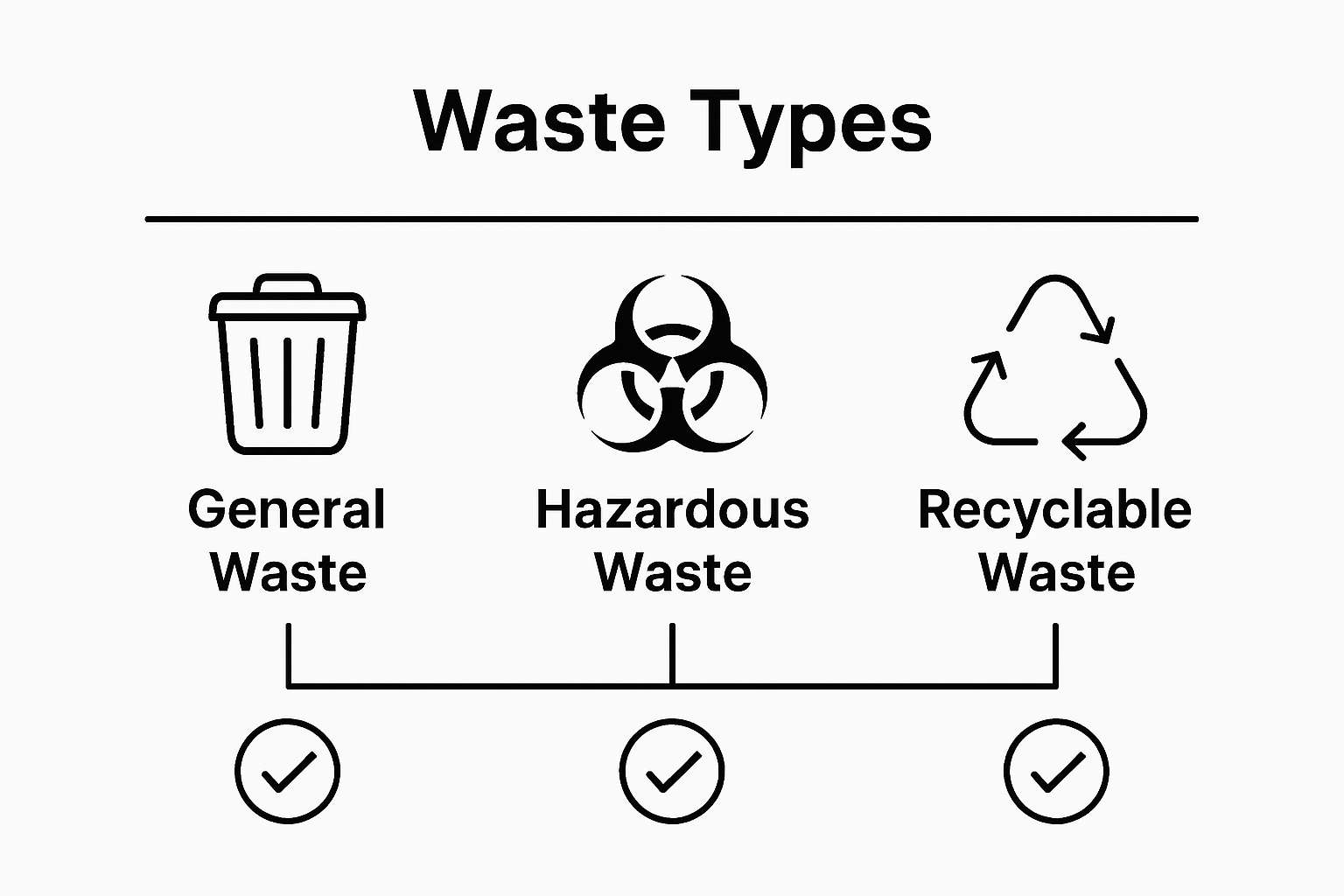
- General Waste: Non-hazardous materials typically from office and commercial environments
- Hazardous Waste: Materials posing potential risks to human health or environment
- Recyclable Waste: Materials that can be reprocessed and reused
- Electronic Waste (WEEE): Discarded electrical and electronic equipment
- Clinical/Medical Waste: Specialised waste from healthcare and research facilities
Management Strategies for Different Waste Streams
Explore our comprehensive guide on differentiating general waste and recycling to understand optimal waste segregation techniques. Effective waste management requires businesses to implement tailored strategies that address the specific characteristics of each waste type.
Businesses in Newcastle, Durham, and across the North East must recognise that improper waste management can result in significant environmental, legal, and financial consequences. Each waste stream demands a unique approach:
- Hazardous waste requires specialised containment and licensed disposal
- Recyclable materials need careful sorting and clean handling
- Electronic waste demands secure destruction and responsible recycling
- Clinical waste necessitates stringent safety protocols
By developing comprehensive waste management systems that recognise the distinct nature of different waste streams, businesses can minimise environmental impact, reduce disposal costs, and demonstrate corporate responsibility. The key lies in understanding, classifying, and implementing targeted waste management strategies that align with regulatory requirements and sustainable practices.
Below is a table summarising the main categories of business waste discussed in the article and the key management strategies required for each type.
| Waste Category | Description | Key Management Strategy |
|---|---|---|
| General Waste | Non-hazardous materials from offices and commercial premises | Standard disposal or recycling where possible |
| Hazardous Waste | Poses potential risk to health or environment | Specialised containment and licensed disposal |
| Recyclable Waste | Materials suitable for reprocessing and reuse | Careful sorting and clean handling |
| Electronic Waste (WEEE) | Discarded electrical/electronic items | Secure destruction and responsible recycling |
| Clinical/Medical Waste | Specialised waste from healthcare and research | Stringent safety protocols and disposal |
Legal Obligations and Best Practices
Business waste management is not merely an operational consideration but a legal requirement with significant implications for organisational compliance, environmental responsibility, and potential financial penalties. Understanding the intricate legal landscape surrounding waste management is crucial for businesses across all sectors.
Statutory Requirements and Regulatory Framework
According to UK Government waste management guidelines, businesses have comprehensive legal obligations that extend far beyond simple disposal. The Environmental Protection Act 1990 and Waste (England and Wales) Regulations 2011 establish a robust framework of legal responsibilities that businesses must rigorously follow.
Key statutory requirements include:
- Minimising waste generation through prevention and reduction strategies
- Implementing proper waste segregation and storage protocols
- Maintaining accurate waste transfer documentation
- Ensuring waste is transported by licensed carriers
- Demonstrating a clear audit trail of waste disposal
Compliance and Risk Management
Learn more about confidential waste disposal practices for businesses to understand the nuanced legal landscape. Non-compliance can result in substantial financial penalties, legal repercussions, and potential reputational damage.
Businesses in Newcastle, Durham, and across the North East must recognise that waste management is a dynamic regulatory environment. Best practices demand:
- Regular staff training on waste management protocols
- Comprehensive internal audit processes
- Engagement with certified waste management providers
- Continuous monitoring of regulatory changes
- Proactive adaptation of waste management strategies
The legal framework surrounding business waste is designed to protect environmental resources, promote sustainable practices, and hold organisations accountable for their ecological impact. By understanding and implementing these obligations, businesses can transform waste management from a potential liability into a strategic opportunity for environmental stewardship and corporate responsibility.
The following table highlights the core statutory requirements established by UK legislation for business waste management, clarifying each main obligation and its purpose.
| Statutory Requirement | Description | Purpose |
|---|---|---|
| Waste minimisation | Reduce waste generation through prevention strategies | Lower environmental impact and disposal costs |
| Proper segregation and storage | Separate and safely store different waste types | Avoid contamination and legal breaches |
| Waste transfer documentation | Maintain accurate records of all waste transfers | Provide audit trail for compliance |
| Licensed waste transportation | Use registered carriers for waste removal | Ensure lawful and safe transport |
| Clear disposal audit trail | Demonstrate how waste is disposed | Ensure accountability and transparency |

Real-World Impacts of Effective Waste Management
Effective waste management transcends theoretical environmental principles, delivering tangible economic, social, and ecological benefits that fundamentally transform how businesses operate and contribute to sustainable development. The practical implications of strategic waste management extend far beyond regulatory compliance.
Economic Transformation and Resource Efficiency
According to UK Government research, businesses can achieve substantial economic advantages through intelligent waste management strategies. Implementing comprehensive waste reduction approaches can generate annual savings of up to 3 billion by redesigning product lifecycles and minimising resource consumption.
Key economic benefits include:
- Reduced operational costs through waste minimisation
- Enhanced resource utilisation and efficiency
- Potential revenue generation from recyclable materials
- Lower waste disposal and transportation expenses
- Improved supply chain sustainability
Environmental and Social Impact
Explore strategies to save money on waste management and understand the broader implications of responsible waste practices. Businesses in Newcastle, Durham, and across the North East can significantly contribute to environmental preservation by adopting holistic waste management approaches.
Practical environmental impacts encompass:
- Reduction of greenhouse gas emissions
- Conservation of natural resources
- Decreased landfill dependency
- Protection of local ecosystems
- Mitigation of climate change effects
The real-world impacts of effective waste management demonstrate that environmental responsibility and economic prosperity are not mutually exclusive. By viewing waste as a potential resource rather than a disposal problem, businesses can unlock innovative solutions that benefit their bottom line while contributing to a more sustainable future. This approach represents a paradigm shift from traditional linear economic models to a more circular, regenerative economic framework.
Ready to Take Control of Your Business Waste Responsibilities?
Feeling overwhelmed by the demands of legal compliance, safe waste handling, and effective record-keeping? Many UK businesses are unsure where to begin, especially when faced with complex regulations and the risk of heavy fines. But you do not have to navigate these challenges alone. Discover how our tailored services can simplify the entire process and keep your organisation on track. For step-by-step assistance, start with our helpful overview of the Waste Collection Process in the UK for Businesses 2025, designed to bring clarity to your legal obligations and best waste practices.

Now is the moment to secure both environmental peace of mind and operational efficiency. Visit Venture Waste Management to access expert support, transparent service options, and a straightforward booking experience. If you want to see how the UK’s waste network can support your business further, our Waste Collection Network in UK Serves Businesses in 2025 page is a great resource. Make waste compliance an opportunity for your business instead of a burden. Arrange your solution today and protect your business for tomorrow.
Frequently Asked Questions
What are the key responsibilities of businesses regarding waste management?
Businesses are responsible for adhering to legal requirements which involve preventing waste generation, ensuring safe storage and segregation of waste types, using registered waste carriers for transportation, and maintaining accurate waste transfer documentation.
How can businesses minimise their environmental impact through waste management?
Businesses can minimise their environmental impact by implementing waste reduction strategies, recycling materials, and developing comprehensive waste management systems that align with sustainability goals and legal compliance.
What are the financial benefits of effective waste management for businesses?
Effective waste management can lead to substantial cost savings through reduced disposal expenses, improved resource utilisation, and potential revenue from recyclable materials, while also enhancing corporate reputation.
What types of waste do businesses need to manage?
Businesses generate several types of waste, including general waste, hazardous waste, recyclable waste, electronic waste (WEEE), and clinical/medical waste, each requiring specific management strategies to ensure compliance and safety.


Leave a Reply
Want to join the discussion?Feel free to contribute!