

Business Waste Penalties UK: Avoid Fines in 2025
Thousands of UK businesses are feeling the pressure as new waste management rules come into force in 2025. Fines for improper waste disposal are set to reach up to £5,000 per offence and unlimited for the most serious breaches. Yet the real shock is that nearly half of businesses do not even know where their waste ends up. Most see penalties as the main threat but not paying attention could mean much worse than financial loss. A simple paperwork mistake or missed training could put your reputation and contracts on the line.
Table of Contents
- Understanding Business Waste Laws In The UK
- Common Penalties And How They Apply
- Sectors At Risk: Who Needs To Comply
- Practical Steps To Avoid Business Waste Fines
Quick Summary
| Takeaway | Explanation |
|---|---|
| Understand waste laws compliance | Familiarise yourself with UK waste management laws to avoid penalties. Awareness of legal obligations ensures proper practices are developed. |
| Document waste management activities | Maintain accurate records of waste disposal and recycling efforts to demonstrate compliance with regulations. Proper documentation is essential for legal and operational purposes. |
| Conduct comprehensive waste audits | Regularly assess and categorize waste streams to identify areas for improvement in recycling and disposal. Waste audits foster better resource management. |
| Train staff on waste protocols | Ensure all employees know proper waste management procedures to prevent violations and foster environmental responsibility. Training is key to effective implementation. |
| Invest in waste management infrastructure | Equip your business with necessary facilities and tools for effective waste segregation. Proper infrastructure supports compliance and enhances sustainability efforts. |
Understanding Business Waste Laws in the UK
Navigating the complex landscape of business waste regulations in the United Kingdom requires a comprehensive understanding of legal obligations and environmental responsibilities. The UK government has implemented stringent waste management laws designed to promote sustainable practices and reduce environmental impact across various industries.
Key Regulatory Frameworks for Business Waste Management
Businesses operating in the UK must comply with multiple regulatory frameworks that govern waste disposal and recycling. The Environment Act 2025 represents a pivotal piece of legislation that fundamentally transforms waste management requirements. According to the UK Environment Agency, businesses are now legally mandated to separate their waste into specific categories, including dry recyclable materials (plastic, metal, glass, paper, and card), food waste, and non-recyclable waste.
The Separation of Waste (England) Regulations 2025 introduce critical changes that businesses must understand. These regulations, effective from 31 March 2025, legally require the segregation of waste streams to facilitate more efficient recycling and reduce environmental impact. Micro-businesses with fewer than 10 full-time equivalent employees will receive a temporary extension until 31 March 2027 to implement these new requirements.
Compliance and Potential Penalties
Non-compliance with waste management regulations can result in significant financial penalties and legal consequences. The Environment Agency has proposed introducing hourly rate charges for businesses that fail to meet the new ‘Simpler Recycling’ requirements. These charges are designed to enforce compliance and encourage businesses to adopt more sustainable waste management practices.
Businesses must be proactive in understanding their specific waste management obligations. This includes:
- Proper Waste Segregation: Ensuring all waste is correctly separated into designated categories
- Documentation: Maintaining accurate records of waste disposal and recycling activities
- Staff Training: Educating employees about new waste management protocols
The regulatory landscape continues to evolve, with an increasing emphasis on environmental responsibility. Companies that fail to adapt risk not only financial penalties but also potential reputational damage. By staying informed and implementing robust waste management systems, businesses can navigate these complex regulations effectively and contribute to broader environmental sustainability goals.
Ultimately, understanding and complying with business waste laws is no longer optional but a critical requirement for operating responsibly in the modern UK business environment. Proactive management, continuous education, and a commitment to sustainable practices will be key to successfully meeting these regulatory challenges.
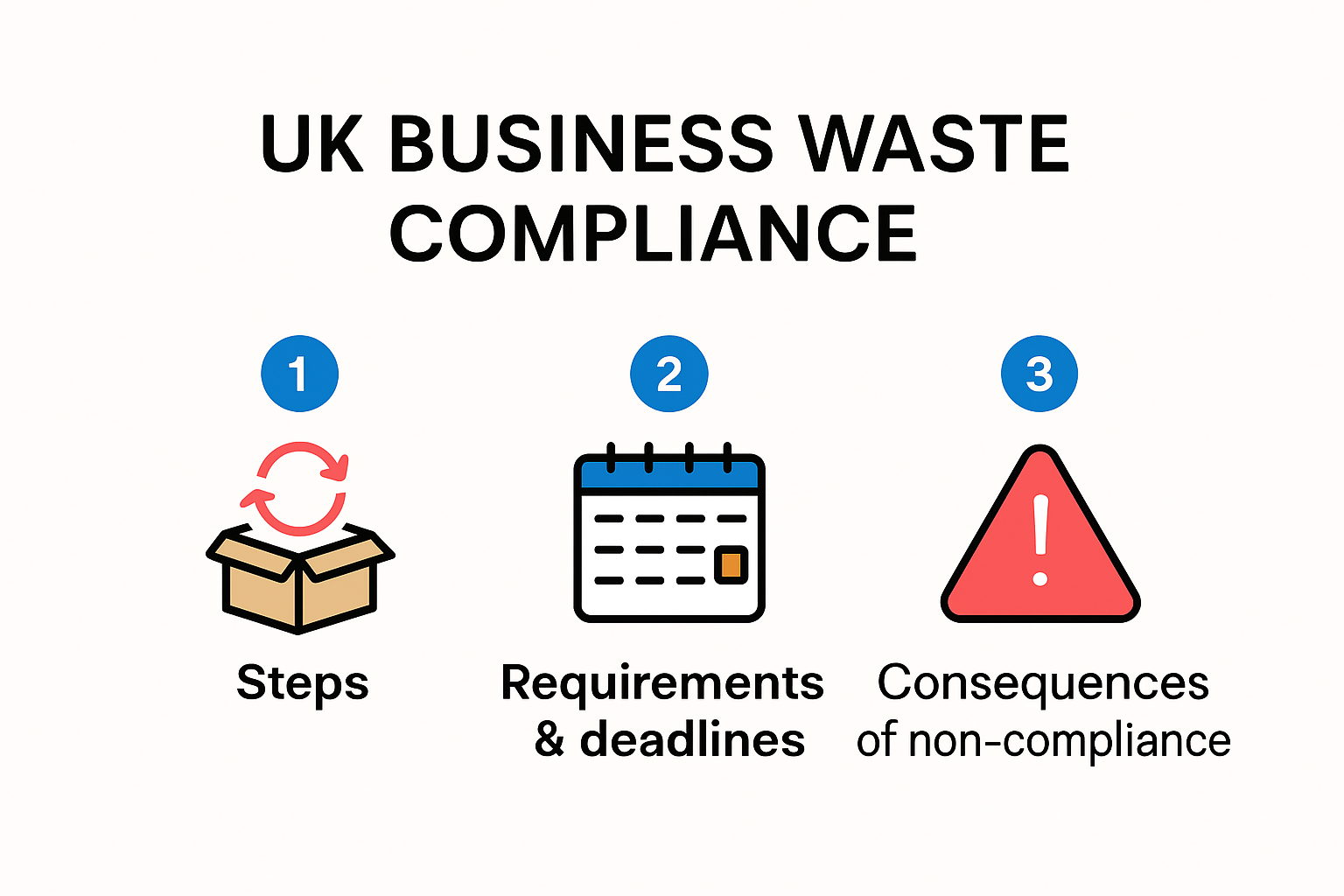
Common Penalties and How They Apply
Businesses in the United Kingdom face significant financial and legal consequences for non-compliance with waste management regulations. Understanding these potential penalties is crucial for organisations to avoid substantial financial risks and legal complications.
Financial Penalties and Enforcement Actions
The UK’s waste management enforcement framework imposes strict financial penalties for businesses that fail to meet their legal waste disposal obligations. According to the Environment Agency, non-compliant businesses can face substantial fines ranging from fixed penalty notices to more extensive legal proceedings.
The Waste Duty of Care Code of Practice outlines specific enforcement mechanisms. Businesses that do not properly segregate waste, maintain accurate documentation, or demonstrate responsible waste management can be subject to the following penalties:
- Fixed Penalty Notices: Immediate financial penalties for minor infractions
- Prosecution Costs: Legal expenses and potential court-imposed fines
- Environmental Restoration Charges: Costs associated with remedying environmental damage
Escalating Penalty Structures
Penalties for waste management violations are designed to be progressively more severe. Initial infractions might result in warning notices and modest fines, while repeated or serious violations can lead to significantly higher financial penalties. The Environment Agency has proposed introducing hourly rate charges for businesses that consistently fail to meet ‘Simpler Recycling’ requirements.
For instance, businesses that do not comply with the Separation of Waste (England) Regulations 2025 could face:
- Initial warning and compliance notice
- Fixed penalty charges between £300 and £5,000
- Potential prosecution with unlimited fines
- Potential business operation restrictions
Long-Term Consequences Beyond Financial Penalties
Beyond immediate financial penalties, non-compliance can result in long-lasting reputational damage. Modern consumers and stakeholders increasingly value environmental responsibility, and businesses found in violation of waste management regulations may experience:
- Negative public perception
- Reduced customer trust
- Potential loss of business contracts
- Challenges in obtaining environmental certifications
The regulatory landscape emphasises proactive compliance rather than punitive measures. Businesses are encouraged to invest in proper waste management infrastructure, staff training, and systematic waste reduction strategies. By understanding and anticipating these potential penalties, organisations can develop robust waste management protocols that not only ensure legal compliance but also contribute to broader environmental sustainability goals.
Ultimately, the penalties framework is designed to motivate businesses to adopt responsible waste management practices. Investing in proper waste segregation, documentation, and staff education is far more cost-effective than risking substantial financial and reputational consequences.
To help clarify the consequences and escalation of penalties for non-compliance, here’s a summary table of potential enforcement actions and their outcomes:
| Enforcement Action | Description | Potential Outcome |
|---|---|---|
| Initial Warning & Compliance Notice | Formal notification highlighting areas of non-compliance | Opportunity to remediate without fine |
| Fixed Penalty Notice | Immediate fine for minor infractions | Financial penalty (£300–£5,000) |
| Hourly Rate Charges (ongoing non-compliance) | Charges accrued for continuous breaches | Accumulating financial penalties |
| Prosecution & Unlimited Fines | Legal proceedings for serious or repeated breaches | Unlimited fines and/or court costs |
| Business Operation Restrictions | Potential closure or restriction orders | Temporary or permanent business impact |
| Environmental Restoration Charges | Costs to remedy environmental harm | Direct additional financial burden |
Sectors at Risk: Who Needs to Comply
The new waste management regulations impact businesses across various sectors, with some industries facing higher compliance risks and more complex waste management challenges. Understanding which sectors are most vulnerable to potential penalties is crucial for effective waste management strategy.
High-Risk Industrial Sectors
Some industries generate significantly more waste and therefore face greater scrutiny under the new regulations. According to KPMG’s research, waste crime costs the UK economy approximately 3 billion annually, with certain sectors bearing the brunt of potential legal and financial risks.
The most at-risk sectors include:
- Construction and Manufacturing: These industries produce substantial volumes of potentially hazardous and recyclable waste
- Healthcare and Pharmaceutical: Require specialized waste disposal protocols for medical and chemical waste
- Hospitality and Food Service: Must manage complex food waste segregation requirements
- Retail and Wholesale: Dealing with packaging, expired goods, and diverse waste streams
Micro and Small Business Compliance
Contrary to popular belief, small businesses are not exempt from these regulations. The Local Government Association emphasizes that micro-firms with fewer than ten full-time employees must also implement recycling collections by the end of March 2025. This requirement places additional pressure on smaller organisations to develop robust waste management systems.
The Chartered Institution of Wastes Management highlights a critical issue: nearly half of surveyed businesses were unaware of their waste’s final destination, which significantly increases the risk of unintentional non-compliance.
Cross-Sector Compliance Challenges
Regardless of industry, businesses must recognize that waste management is no longer a peripheral concern but a critical operational requirement. Every sector faces unique challenges in implementing effective waste segregation and disposal strategies.
Key compliance considerations include:
- Accurate waste stream identification
- Implementing proper segregation techniques
- Maintaining comprehensive documentation
- Training staff on new waste management protocols
- Regular waste management audits
The evolving regulatory landscape demands proactive approaches. Businesses that invest in understanding and implementing comprehensive waste management strategies will not only avoid potential penalties but also demonstrate environmental responsibility.
Ultimately, compliance is about more than avoiding fines. It represents a commitment to sustainable business practices, environmental protection, and responsible resource management. Companies across all sectors must view waste management as an integral part of their operational excellence and corporate social responsibility.
To highlight which UK sectors are most at risk and their specific waste management challenges, refer to the following table:
| Sector | Main Waste Compliance Risks | Special Considerations |
|---|---|---|
| Construction & Manufacturing | Hazardous/recyclable waste volume, segregation | Safety, risk of environmental harm |
| Healthcare & Pharmaceutical | Medical/chemical waste disposal | Regulated waste protocols |
| Hospitality & Food Service | Food waste segregation compliance | Perishable waste, contamination risks |
| Retail & Wholesale | Packaging, expired products waste | Diverse waste streams |
| Micro/Small Businesses | Lack of awareness, compliance lag | Implementation time extensions allowed |
Practical Steps to Avoid Business Waste Fines
Businesses across the United Kingdom must take proactive measures to ensure compliance with waste management regulations and avoid potentially substantial financial penalties. Implementing a strategic approach to waste management is crucial for maintaining legal and environmental responsibility.
Comprehensive Waste Audit and Management Plan
The first critical step in avoiding waste fines is conducting a thorough waste audit. According to the Environmental Protection Act 1990, businesses have a legal duty of care to manage waste responsibly. This involves:
- Identifying all waste streams generated by the business
- Categorizing waste into recyclable, non-recyclable, and hazardous materials
- Developing a detailed waste management strategy
- Creating a systematic approach to waste reduction and segregation
Businesses must maintain accurate documentation of waste transfers and ensure that waste is only transferred to authorized waste management providers. The UK government guidelines mandate that all workplaces in England separate their waste into specific categories by 31 March 2025.
Staff Training and Implementation Strategies
Effective waste management goes beyond documentation. Comprehensive staff training is essential to ensure successful implementation of waste management protocols. Key training components should include:
- Proper waste segregation techniques
- Understanding different waste categories
- Recognizing potential environmental risks
- Implementing correct disposal procedures
- Maintaining accurate waste transfer records
Companies should develop clear, accessible guidelines and provide regular training sessions to keep staff informed about the latest waste management requirements. This approach not only helps prevent unintentional non-compliance but also demonstrates a commitment to environmental responsibility.

Technical and Operational Compliance Measures
Preventing pollution and managing waste requires practical operational strategies. Government pollution prevention guidelines emphasize the importance of:
- Implementing proper material and waste storage systems
- Using correct drainage systems
- Developing spill prevention and management protocols
- Conducting regular waste management equipment maintenance
- Installing appropriate waste segregation infrastructure
Businesses must also invest in appropriate waste management equipment and infrastructure. This might include color-coded waste bins, specialized containment for hazardous materials, and tracking systems for waste movement and disposal.
Non-compliance can result in severe consequences, including unlimited fines, potential imprisonment for up to 5 years, cleanup costs, and compensation expenses. By taking a proactive and comprehensive approach to waste management, businesses can not only avoid financial penalties but also contribute to broader environmental sustainability goals.
Ultimately, successful waste management is about creating a culture of environmental responsibility. It requires ongoing commitment, continuous learning, and a systematic approach to waste reduction, segregation, and responsible disposal.
Frequently Asked Questions
What are the penalties for improper waste disposal in the UK?
Businesses in the UK face penalties of up to £5,000 per offence for improper waste disposal, with potential unlimited fines for more serious breaches.
How can businesses prepare for the new waste management regulations coming into effect in 2025?
Businesses should conduct a comprehensive waste audit, maintain accurate documentation, train staff on waste management protocols, and invest in proper waste segregation infrastructure to meet the new regulations.
Which sectors are most at risk of facing waste management penalties?
High-risk sectors include construction, healthcare, hospitality, retail, and micro/small businesses, each facing unique challenges in complying with waste management laws.
What steps can I take to avoid business waste fines?
To avoid fines, businesses should ensure proper waste segregation, maintain detailed records of waste disposal, provide staff training on waste protocols, and implement strategic waste management plans.
Ready to Eliminate the Risk of Business Waste Penalties in 2025?
Do you feel uncertainty when it comes to new waste segregation rules, staff training requirements, and the looming threat of hefty fines? With penalties reaching up to £5,000 per offence, and unlimited fines for repeated breaches, ignoring compliance can cost you much more than money. Even a simple documentation mistake could put your reputation at risk. Do not let confusion about legal obligations or the pressure of waste audits leave your business exposed.

Let Venture Waste Management take the stress out of business waste compliance. Our team stays ahead of evolving regulations so you do not have to. We support UK businesses with reliable general waste collection, recycling solutions, hazardous waste handling and more, all designed for legal and environmental peace of mind. Visit Venture Waste Management to see how our secure, easy-to-arrange services can protect your business. Start now to stay one step ahead of the 2025 law changes. Book your waste audit or collection today and move confidently towards full compliance.


Leave a Reply
Want to join the discussion?Feel free to contribute!