

Business Recycling Obligations for UK Healthcare
Sorting bins in a busy hospital corridor is becoming more than just a daily routine. The new Simpler Recycling rules, active since 31 March 2025, set out mandatory steps for separating recyclable waste across all healthcare facilities in England. Facilities managers must adapt quickly to avoid fines, protect public trust, and keep up with strict legal duties. This guide clarifies business recycling obligations, showing how to handle key waste streams and support safe, compliant operations in every corner of your site.
Table of Contents
- Defining Business Recycling Obligations in the UK
- Key Waste Streams in Healthcare Facilities
- Legal Duties Under the Simpler Recycling Law
- Steps to Achieve Full Regulatory Compliance
- Enforcement Measures and Penalties for Breaches
Key Takeaways
| Point | Details |
|---|---|
| Compliance Deadline | Healthcare organisations must comply with the new recycling obligations by 31 March 2025, or face penalties; micro-businesses have until 31 March 2027. |
| Waste Separation Requirements | Facilities must establish distinct waste streams for dry recyclables, paper and cardboard, and food waste to comply with Simpler Recycling rules. |
| Risks of Non-Compliance | Non-compliance can lead to criminal prosecution, significant financial penalties, and reputational damage, impacting public trust in healthcare facilities. |
| Documented Compliance Strategy | Maintain thorough documentation of waste management practices, staff training, and contractor agreements to demonstrate compliance efforts if regulations are questioned. |
Defining Business Recycling Obligations in the UK
Business recycling obligations in the UK have undergone significant changes, particularly with the introduction of the Simpler Recycling rules that came into effect on 31 March 2025. These regulations establish clear, mandatory requirements for how organisations must manage their waste streams. For healthcare facilities, understanding these obligations is not optional—it directly impacts your operational compliance, environmental responsibility, and potential penalties. The rules apply to all workplaces across various sectors, including health and social care settings, and establish a standardised approach to waste separation that you’ll need to implement across your entire facility.
Under the new legislation, healthcare organisations must now separate recyclable waste before collection. This means your facility needs to establish distinct waste streams for three primary categories: dry recyclables (plastic, metal, and glass), paper and cardboard, and food waste. Each of these must be kept separate at source, rather than being mixed together for collection. What makes this different from previous arrangements is the specificity—paper and cardboard cannot be mixed with other dry recyclables, and food waste must be completely isolated from dry materials. For healthcare facilities in areas like Newcastle, Durham, or Sunderland, this often means reassessing your current waste management infrastructure and potentially investing in additional bins and collection systems to accommodate these separate streams.
The compliance timeline matters significantly for your facility’s planning. If your healthcare organisation employs 10 or more full-time equivalent staff members, you must comply by 31 March 2025. However, if you operate as a micro-business with fewer than 10 employees, you have an extended deadline until 31 March 2027 to comply with workplace recycling requirements. This two-year extension applies only to genuinely smaller operations, so you’ll want to verify your staff headcount carefully. Non-compliance carries consequences, including potential enforcement action and reputational damage, which is particularly sensitive for healthcare providers where public trust matters enormously.
Implementing these obligations effectively requires auditing your current waste arrangements and identifying gaps. Start by mapping where waste is currently generated in your facility—clinical areas, staff rooms, administrative offices, patient reception areas—and determine which waste streams are produced in each location. You’ll need sufficient capacity for each waste type, clearly labelled containers to prevent cross-contamination, and staff training to ensure consistent separation. Consider how your waste collection contractor will access and transport these separate streams; this might require adjusting collection schedules or finding a provider who specialises in healthcare waste management and understands the unique challenges of clinical environments.
Pro tip Conduct a waste audit before 31 March 2025 to identify exactly what materials flow through your facility, then design your separation system based on actual volumes rather than assumptions—this prevents over-investing in containers you won’t fill and under-sizing those you will.
Key Waste Streams in Healthcare Facilities
Healthcare facilities generate multiple distinct waste streams, each requiring different handling procedures and disposal methods. Understanding these streams is essential for your facility to comply with current regulations and maintain safe operations. The waste produced in healthcare settings falls into three broad categories: clinical and medical waste, pharmaceutical waste, and household-like recyclables. Each stream carries different risks and regulatory requirements, and mishandling any of them can result in infections, environmental contamination, and legal penalties. For facilities managers across the UK, from busy hospitals in Newcastle to smaller clinics in Durham, recognising these streams forms the foundation of effective waste management.
Clinical and medical waste represents the highest-risk stream in your facility. This includes items contaminated with bodily fluids, such as bandages, syringes, swabs, and blood-stained dressings. It also encompasses sharps like needles, scalpels, and broken glass that pose injury risks. Pharmaceutical waste includes expired medications, unused drugs, and chemotherapy waste that require specialist disposal. These two streams must be kept completely separate from all other waste because they pose infection risks and environmental hazards. Healthcare waste categorisation helps reduce infection risks and ensures compliance with health and safety legislation. Your facility must have dedicated containers, clearly marked and colour-coded, to prevent cross-contamination. Clinical and pharmaceutical waste cannot be mixed with recyclables under any circumstances, even if they appear clean.

Household-like recyclables form your third major waste stream and represent the materials now covered by Simpler Recycling obligations. These include materials generated by staff, patients, and visitors during everyday activities: food waste from patient meals and staff areas, paper and cardboard from packaging and administrative work, plastic bottles and containers from drinks and products, glass bottles and jars from beverages, and metal cans and tins. These materials require separation at source into distinct categories. Food waste must remain completely separate from dry recyclables like paper, plastic, metal, and glass. In a typical healthcare facility in Leeds or Manchester, you might generate significant volumes of food waste from patient catering operations alone, making this stream particularly important to manage efficiently.
The distinction between these streams matters because each requires completely different collection, transportation, and disposal routes. Clinical waste demands specialist incineration facilities, pharmaceutical waste requires licensed disposal contractors with specific expertise, whilst household-like recyclables go to standard recycling operations. Many facilities managers mistakenly assume they can combine some streams to simplify collection, but this creates serious compliance issues. Recycling best practices for UK healthcare facilities provide guidance on implementing proper separation systems without compromising infection control. Your waste management contractor should understand these distinctions thoroughly and provide separate collections for each stream.
Here’s a quick summary of the three main healthcare waste streams and their associated risks:
| Waste Stream | Examples | Risks and Consequences | Required Disposal Method |
|---|---|---|---|
| Clinical and Medical Waste | Bandages, syringes, dressings | Infection, injury, contamination | Specialist incineration |
| Pharmaceutical Waste | Expired drugs, chemotherapy waste | Environmental hazard, legal risk | Licensed disposal contractor |
| Household-like Recyclables | Food waste, packaging, bottles | Contamination, non-compliance | Standard recycling operations |
Pro tip Create a simple visual guide showing staff where each type of waste belongs, using photographs of actual items rather than just text labels—this dramatically improves segregation accuracy and reduces contamination of your recycling streams.
Legal Duties Under the Simpler Recycling Law
The Simpler Recycling law represents a fundamental shift in your legal obligations as a healthcare facilities manager. From 31 March 2025, the law is not advisory—it is mandatory, and non-compliance carries serious consequences. Your healthcare organisation must legally separate dry recyclable materials, food waste, and residual waste before collection. This applies to hospitals, GP surgeries, clinics, and any healthcare setting that produces waste similar to household waste. The legislation covers workplaces across England, affecting facilities in Sunderland, Middlesbrough, and every healthcare provider between. Ignoring these duties is not an option; the law imposes specific obligations on your organisation and potential criminal liability if you fail to meet them.
Your facility has two primary routes to compliance under the law. You can either provide suitable, separate bins on your premises for staff and visitors to use for different waste types, or you can ensure your waste contractor complies with separation requirements on your behalf. Many facilities managers assume the second option means they have no responsibility, but that is incorrect. Even if your contractor handles the separation, you remain legally accountable for ensuring it happens. Legally separate recyclable materials means the law explicitly requires either your facility or your contractor to divide waste streams before disposal. You cannot simply dump all waste together and hope the contractor sorts it later. This places a direct duty on your organisation to verify your waste management arrangements meet legal standards.
Compare the two compliance options under Simpler Recycling law:
| Compliance Route | Facility Actions | Contractor’s Responsibility | Accountability |
|---|---|---|---|
| On-site Separation | Install separate bins, train staff | Collect pre-separated streams | Facility remains liable |
| Contractor Separation | Verify contractor’s procedures and records | Separate waste before disposal | Facility still responsible |
Non-compliance carries enforcement mechanisms that should concern any facilities manager. Regulatory bodies can issue compliance notices requiring you to rectify breaches within specified timeframes. Failure to comply with a compliance notice can result in criminal prosecution. Prosecution could lead to unlimited fines and reputational damage that affects patient and staff confidence in your facility. For healthcare organisations, reputation matters enormously—families choosing between hospitals or GP surgeries consider cleanliness and environmental responsibility. Beyond legal penalties, non-compliance demonstrates poor governance to regulators, inspectors, and accreditation bodies. Your board and senior leadership bear ultimate responsibility for ensuring the organisation meets these legal duties.
Implementing compliance requires clear internal documentation. You need written procedures showing how your facility achieves separation, staff training records demonstrating staff understand the requirements, and contracts with waste contractors that explicitly require compliance. Document your verification process—how you confirm your contractor is actually separating waste as promised. Site visits to your contractor’s facilities, photographic evidence of separate containers, and regular audits of your waste management system all provide documented proof of due diligence. If a regulator investigates, this documentation protects your organisation by demonstrating you took reasonable steps to comply. For facilities in busy areas like Newcastle or smaller operations in rural locations, the practical steps are identical: document everything, verify compliance, and maintain records.
Pro tip Request written confirmation from your waste contractor that they comply with Simpler Recycling requirements, then conduct quarterly audits by collecting photographic evidence of separated waste streams at their facility—this creates a paper trail proving your due diligence if regulators ever question your compliance.
Steps to Achieve Full Regulatory Compliance
Achieving compliance with Simpler Recycling is not something you can approach haphazardly. You need a structured, methodical plan that addresses every aspect of your facility’s waste management system. The process begins months before the March 2025 deadline, not days before. Your first step is conducting a thorough audit of your current waste disposal practices. Walk through your facility in Sunderland, Newcastle, Leeds, or wherever you operate and observe exactly what waste is being generated, where it originates, and how it is currently handled. Examine your kitchens, clinical areas, staff rooms, administrative offices, and patient reception zones. Document existing bin arrangements, capacity levels, and current contractor relationships. This baseline assessment reveals the gaps between where you are now and where you need to be.
Once you understand your current situation, you must implement a comprehensive waste segregation system. This means installing distinct containers for food waste, paper and cardboard, dry recyclables, and residual waste in every location where waste is generated. Comprehensive waste segregation systems require proper placement and capacity planning to prevent overflowing bins that undermine your entire compliance effort. Each container must be clearly labelled with visual graphics showing what belongs inside. Colour coding helps staff intuitively understand the system without reading text. For clinical areas, your segregation must never compromise infection control protocols, so work with infection prevention specialists to design systems that meet both recycling and safety requirements. Beyond containers, you need signage throughout your facility explaining the separation requirements in simple, direct language. Poor signage is one of the leading causes of contamination in new recycling systems.
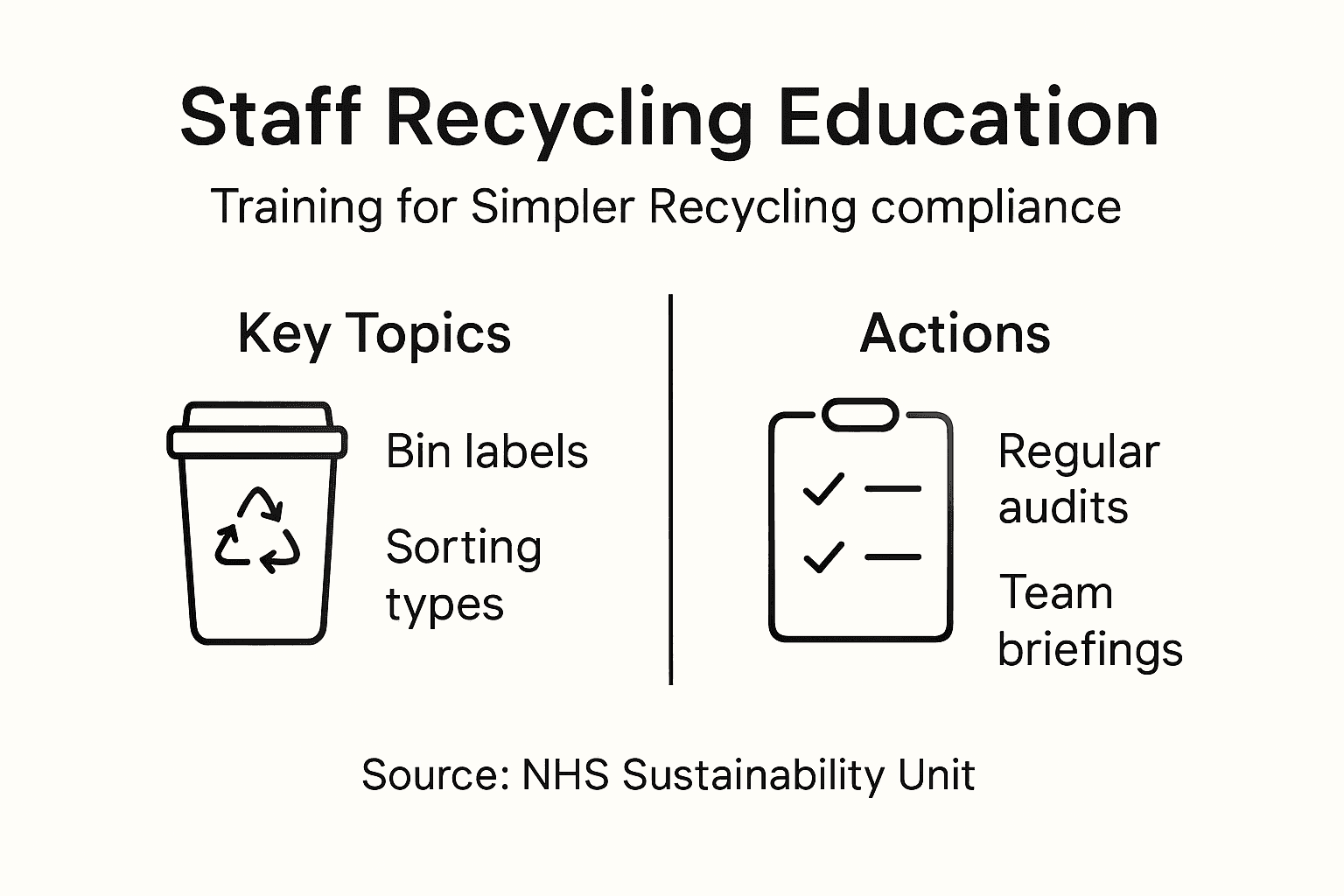
Staff education forms the backbone of any successful waste separation programme. Your team members must understand not just what to separate, but why separation matters. Conduct mandatory training sessions for all staff, contractors, cleaners, and anyone who handles waste. Include specific guidance on avoiding contamination, such as ensuring food waste does not touch dry recyclables and that sharps never enter recycling streams. Create refresher training schedules to reinforce these messages quarterly. Staff turnover means new employees arrive constantly, so you need an induction programme that covers waste management alongside other essential training. Test staff understanding through simple quizzes or observations to identify individuals or areas requiring additional support.
Formalising your waste collection arrangements requires reviewing your current contractor relationships and ensuring they meet legal requirements. You need a licensed waste contractor who explicitly understands healthcare waste management and can handle separate streams appropriately. Get written confirmation that they comply with Simpler Recycling obligations. Establish clear collection schedules that prevent bin overflow. Maintain detailed records documenting your compliance efforts, contractor certifications, staff training completion, and any incidents or contamination issues you identify. These records prove your due diligence if regulators ever question your compliance. Schedule periodic reviews of your system monthly initially, then quarterly once established, to identify problems early and make adjustments before they become serious issues.
Pro tip Create a simple waste management checklist that staff complete weekly, recording bin fill levels and any contamination observed, then review these checklists monthly to identify patterns like specific areas struggling with separation—this identifies problem zones before inspectors do.
Enforcement Measures and Penalties for Breaches
The Environment Agency takes enforcement of Simpler Recycling seriously. This is not a regulation where regulators issue gentle reminders or overlook minor infractions. If your healthcare facility fails to comply with waste separation requirements, you face real consequences that extend beyond financial penalties. The enforcement process typically begins with the Environment Agency identifying a breach through inspection, complaint, or routine monitoring. Once they identify non-compliance, they issue a formal compliance notice requiring you to rectify the breach within a specified timeframe. This notice is not negotiable. It establishes a legal obligation to take specific corrective actions by a defined deadline. For facilities managers, receiving a compliance notice represents a serious governance failure that your board will want to understand immediately.
Failure to comply with a compliance notice escalates the matter significantly. Non-compliance with a notice becomes a criminal offence under environmental law. This means the Environment Agency can pursue prosecution through the courts, not just administrative penalties. Enforcement actions for recycling breaches can result in criminal prosecution and substantial financial penalties. The fines are not capped at token amounts either. Prosecution can lead to unlimited financial penalties, which for a larger healthcare organisation could run into hundreds of thousands of pounds. Beyond the direct financial cost, a criminal conviction creates reputational damage that affects staff morale, patient confidence, and relationships with local communities. For healthcare organisations where trust is fundamental to your mission, this reputational harm can be more damaging than the financial penalty itself.
The penalties extend beyond fines imposed by courts. A criminal conviction or sustained pattern of non-compliance affects your operational standing with regulators. The Care Quality Commission, NHS England, and other oversight bodies note enforcement actions in their assessments of your organisation. This can influence accreditation decisions, funding allocations, and contractual relationships. Staff recruitment becomes harder when your organisation is known for poor environmental compliance. Patients and their families may question your commitment to responsibility and safety. Waste contractors become reluctant to work with non-compliant organisations because they face their own liability for breaches. Insurance providers may increase premiums or restrict coverage. What begins as a simple failure to separate waste properly cascades into broader operational and financial consequences.
The best approach is avoiding enforcement entirely through proactive, documented compliance. Begin your compliance journey immediately, not in March 2025. Document every step: your waste audits, staff training records, contractor agreements specifying compliance obligations, bin installation photographs, signage creation and placement, staff competency assessments, and regular monitoring reports. Create a compliance file that demonstrates your due diligence to regulators. This documentation protects your organisation if the Environment Agency ever investigates by showing you took reasonable steps to comply. Conduct internal audits to identify problems before external regulators do. If you discover breaches during your own audits, correct them promptly and document the corrections. Regulators view organisations that self-identify and self-correct far more favourably than those discovered through enforcement action.
Pro tip Appoint a named waste compliance officer responsible for monthly audits and reporting directly to your board, then maintain detailed meeting minutes showing board awareness and oversight—this evidence of governance protects your organisation if enforcement ever occurs and demonstrates you took breaches seriously.
Simplify Your Healthcare Facility’s Recycling Compliance with Venture Waste
Navigating the complex recycling obligations for UK healthcare organisations can feel overwhelming. The new Simpler Recycling rules demand strict separation of dry recyclables, paper, cardboard and food waste right at the source. Facilities managers face challenges like managing multiple waste streams, training staff effectively and ensuring documentation meets legal standards. If your healthcare setting operates in Newcastle, Durham or elsewhere in the UK, you need a reliable partner to help streamline these processes and avoid costly enforcement actions.
Venture Waste provides expert support tailored to healthcare facilities to meet these requirements seamlessly. Our service focuses on clear waste segregation systems, staff education support and transparent, compliant waste collection. Familiarise yourself with the Waste Collection Process in the UK for Businesses 2025 – Venture Waste to understand how we align with evolving regulations. We work closely with your team to ensure your waste contractor fully complies and that you maintain thorough records of all recycling efforts.

Stay ahead of compliance and protect your organisation from legal risks and reputational damage. Visit Venture Waste today to discover how our efficient and compliant waste collection solutions can support your healthcare facility’s recycling obligations. Learn more about How the Waste Collection Network in UK Serves Businesses in 2025 – Venture Waste and take the first step in safeguarding your facility’s environmental responsibility with confidence.
Frequently Asked Questions
What are the new recycling obligations for healthcare facilities in the UK?
The new recycling obligations require healthcare facilities to separate their recyclable waste before collection into three main categories: dry recyclables (plastic, metal, and glass), paper and cardboard, and food waste. These regulations take effect on 31 March 2025.
How can healthcare organisations prepare for the compliance deadline?
Healthcare organisations can prepare by conducting a waste audit to assess current waste generation and disposal methods. They should also implement a comprehensive waste segregation system, train staff on separation requirements, and establish clear collection schedules with licensed waste contractors.
What types of waste must be kept separate in healthcare settings?
Clinical and medical waste, pharmaceutical waste, and household-like recyclables are the main types of waste that must be kept separate. Clinical waste includes contaminated items like bandages and sharps, while pharmaceutical waste covers expired medications. Household recyclables include food waste, paper, and packaging materials.
What are the penalties for non-compliance with recycling regulations?
Non-compliance can result in serious penalties, including enforcement notices from regulatory bodies, criminal prosecution, and substantial financial fines. Facilities may also suffer reputational damage, affecting patient trust and operational viability.
Recommended
- Recycling Contamination – How It Affects UK Healthcare – Venture Waste
- Recycling Contamination – How It Affects UK Healthcare – Venture Waste
- Sustainable Waste Solutions – Enhancing UK Healthcare Compliance – Venture Waste
- 7 Essential Tips for Reuse vs Recycle in Healthcare Waste – Venture Waste
- Benefits of Solar EV Carports for UK Homes & Businesses in 2025


Leave a Reply
Want to join the discussion?Feel free to contribute!