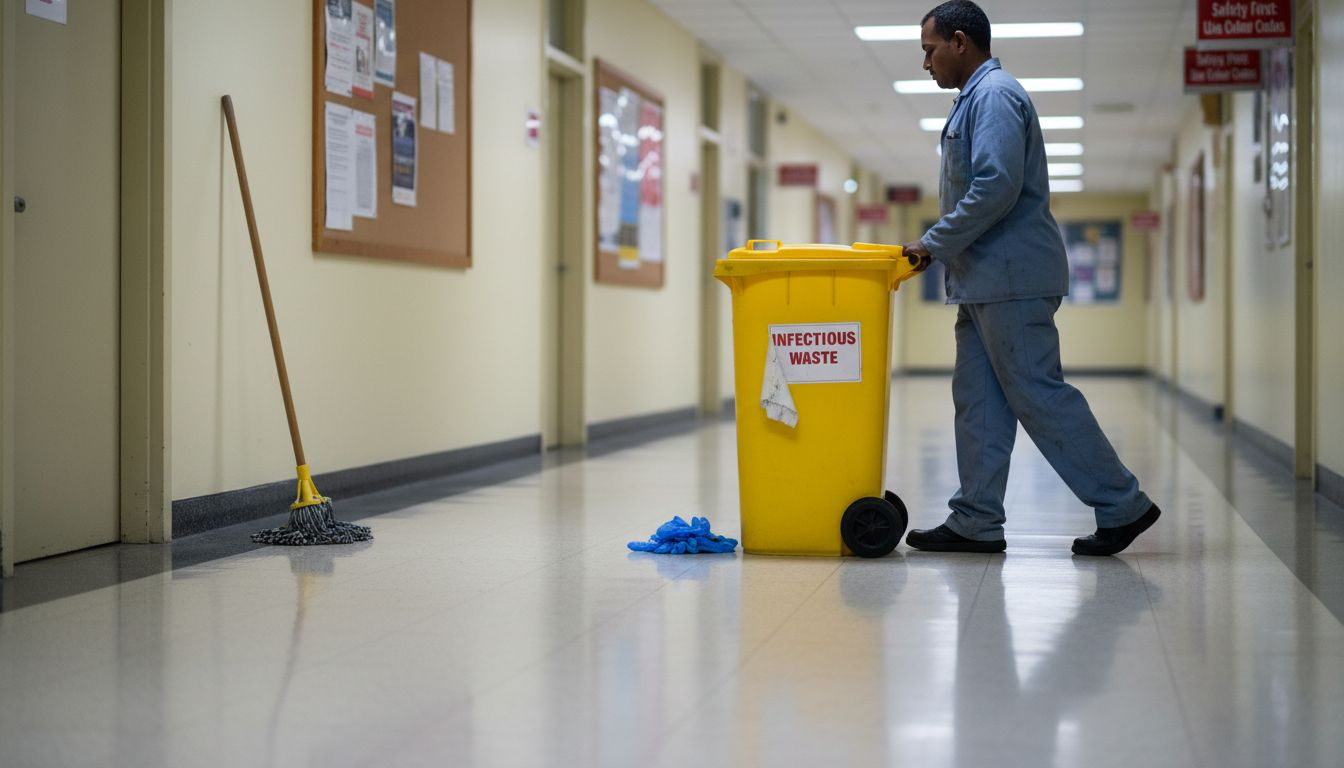
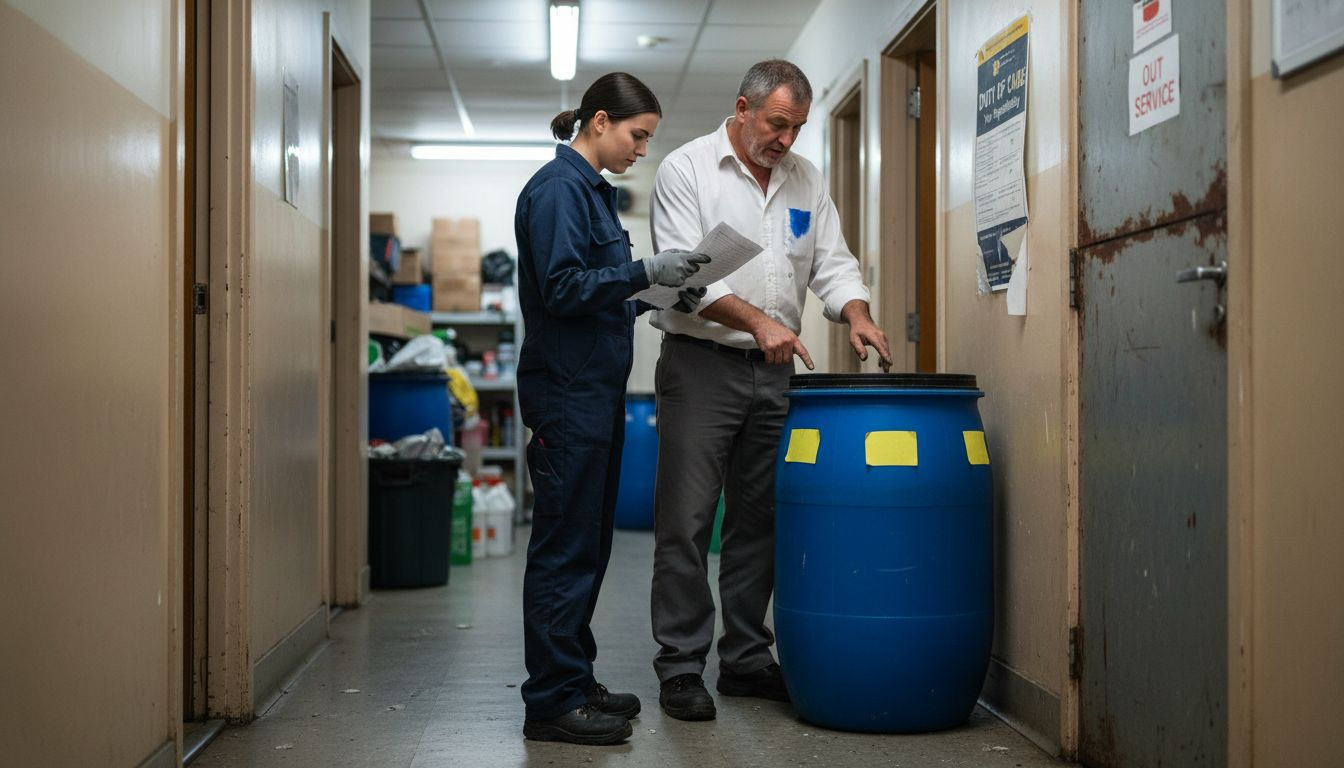
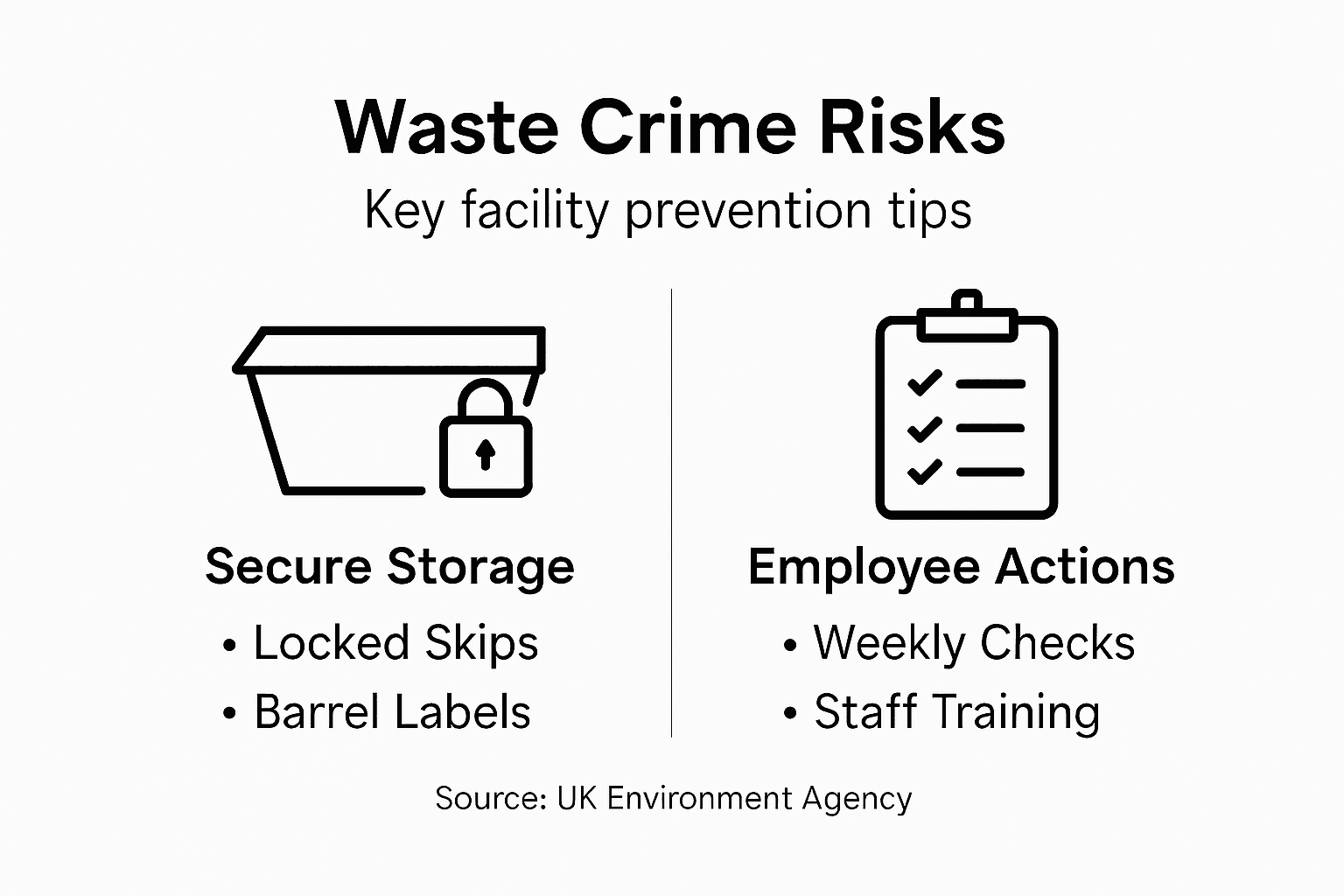
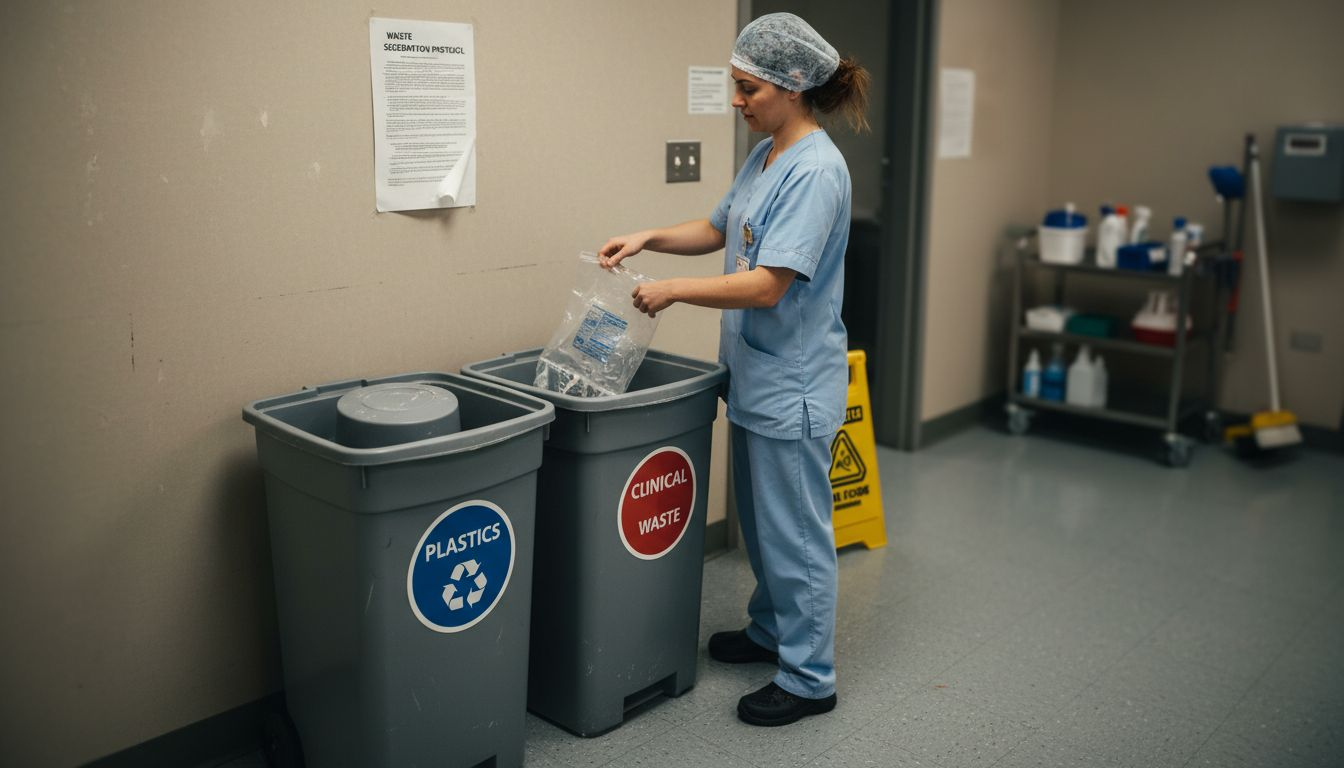
NHS staff sort recycling in hospital corridor

What Can Be Recycled in UK Healthcare Facilities

Balancing patient safety with environmental responsibility is a daily challenge for managers overseeing busy healthcare facilities across the United Kingdom. Effective recycling in British hospitals goes beyond basic sorting and disposal, pressing institutions to adopt comprehensive practices in line with national regulations. With the National Health Service generating 156,000 tonnes of clinical waste each year, this guide highlights actionable core principles that help you optimise recycling, support legal compliance, and protect both staff and the planet.

Table of Contents

Key Takeaways

Point Details
Importance of Waste Management Sustainable waste management is crucial in UK healthcare, balancing patient safety and ecological responsibility.
Effective Waste Segregation Segregation of healthcare waste is essential for successful recycling and safety; distinct protocols are required for different waste types.
Legal Compliance Healthcare facilities must adhere to numerous legal obligations to ensure safe and environmentally responsible waste management practices.
Training and Awareness Regular staff training on waste segregation and management is vital to minimise contamination risks and ensure compliance with regulations.

Recycling in UK Healthcare: Core Principles

Healthcare facilities in the United Kingdom are increasingly recognising the critical importance of sustainable waste management practices. The healthcare sector, which contributes significantly to environmental impact, must adopt comprehensive recycling strategies that balance patient safety with ecological responsibility. Sustainability in healthcare involves a holistic approach that considers social, economic, and environmental factors.

The core principles of healthcare recycling in the UK revolve around several key objectives:

  • Minimising waste generation
  • Implementing precise waste segregation protocols
  • Reducing environmental footprint
  • Ensuring patient and staff safety
  • Complying with national waste management regulations

The NHS clinical waste strategy provides a comprehensive framework for sustainable waste management. According to recent guidelines, healthcare facilities should aim for an optimal waste distribution that includes:

  1. 20% high-temperature incineration
  2. 20% infectious waste processing
  3. 60% offensive waste management

Healthcare professionals play a pivotal role in implementing these strategies. By understanding clinical waste strategies, they can contribute to reducing unnecessary waste and improving overall environmental sustainability.

Waste Segregation Principles

Effective waste segregation is fundamental to successful recycling in healthcare settings. Different types of waste require distinct handling procedures:

  • Pharmaceutical Waste: Requires special disposal methods
  • Biological Waste: Must be handled with strict safety protocols
  • Recyclable Materials: Includes paper, certain plastics, and non-contaminated packaging

Healthcare waste management is not just an environmental imperative but a critical aspect of responsible patient care and institutional management.

Pro tip: Implement comprehensive staff training programmes on waste segregation to ensure consistent and effective recycling practices across all departments.

Types of Waste: What Can Be Recycled

Healthcare facilities generate substantial quantities of waste across multiple categories, with comprehensive waste segregation strategies being crucial for effective recycling and environmental management. The National Health Service (NHS) produces approximately 156,000 tonnes of clinical waste annually, requiring meticulous sorting and processing to ensure sustainability and safety.

The primary types of recyclable waste in healthcare settings include:

  • Paper and Cardboard: Office documents, packaging materials
  • Plastic Containers: Non-contaminated bottles, packaging
  • Glass: Clean medical containers and laboratory glassware
  • Metals: Clean aluminium and steel items
  • Electronic Equipment: Functional medical devices and computer hardware

Waste Categorisation

Healthcare waste is typically classified into several distinct streams:

  1. Non-hazardous Recyclable Waste
  2. Infectious Clinical Waste
  3. Pharmaceutical Waste
  4. Sharps and Contaminated Materials
  5. Electronic and Electrical Equipment

Specific waste streams require unique handling protocols. NHS waste segregation guidance recommends using colour-coded containers to prevent cross-contamination and facilitate proper recycling:

Porter moves colour coded clinical bins

Below is a comparison of common colour-coded NHS waste containers and the risks of improper usage:

Container Colour Intended Use Risks if Misused
Yellow Medicine-contaminated infectious waste Spread of infection, legal breach
Purple striped Cytotoxic/cytostatic waste Chemical hazard, environmental harm
Orange Infectious clinical waste Cross-contamination risk
Tiger Offensive waste from non-infectious patients Odour issues, non-compliance fines

The following table summarises the typical waste streams in UK healthcare alongside their preferred treatment and environmental considerations:

Waste Stream Preferred Treatment Key Environmental Consideration
Non-hazardous Recyclable Waste Recycling facilities Minimises landfill and resource use
Infectious Clinical Waste Specialised processing Prevents spread of pathogens
Pharmaceutical Waste High-security disposal Avoids chemical contamination
Sharps and Contaminated Items Incineration Ensures safety and compliance
Electronic Equipment Specialist recycling Reduces e-waste pollution
  • Yellow bags: Medicine-contaminated infectious waste
  • Purple striped bags: Cytotoxic and cytostatic waste
  • Orange bags: Infectious clinical waste
  • Tiger bags: Offensive waste from non-infectious patients

Effective waste segregation is not just an environmental requirement but a critical aspect of healthcare safety and sustainability.

Recycling Limitations

Not all healthcare waste can be recycled. Contaminated materials, biological waste, and hazardous substances must undergo specialised treatment processes to ensure public health and safety. Proper training and strict adherence to waste management protocols are essential for healthcare professionals.
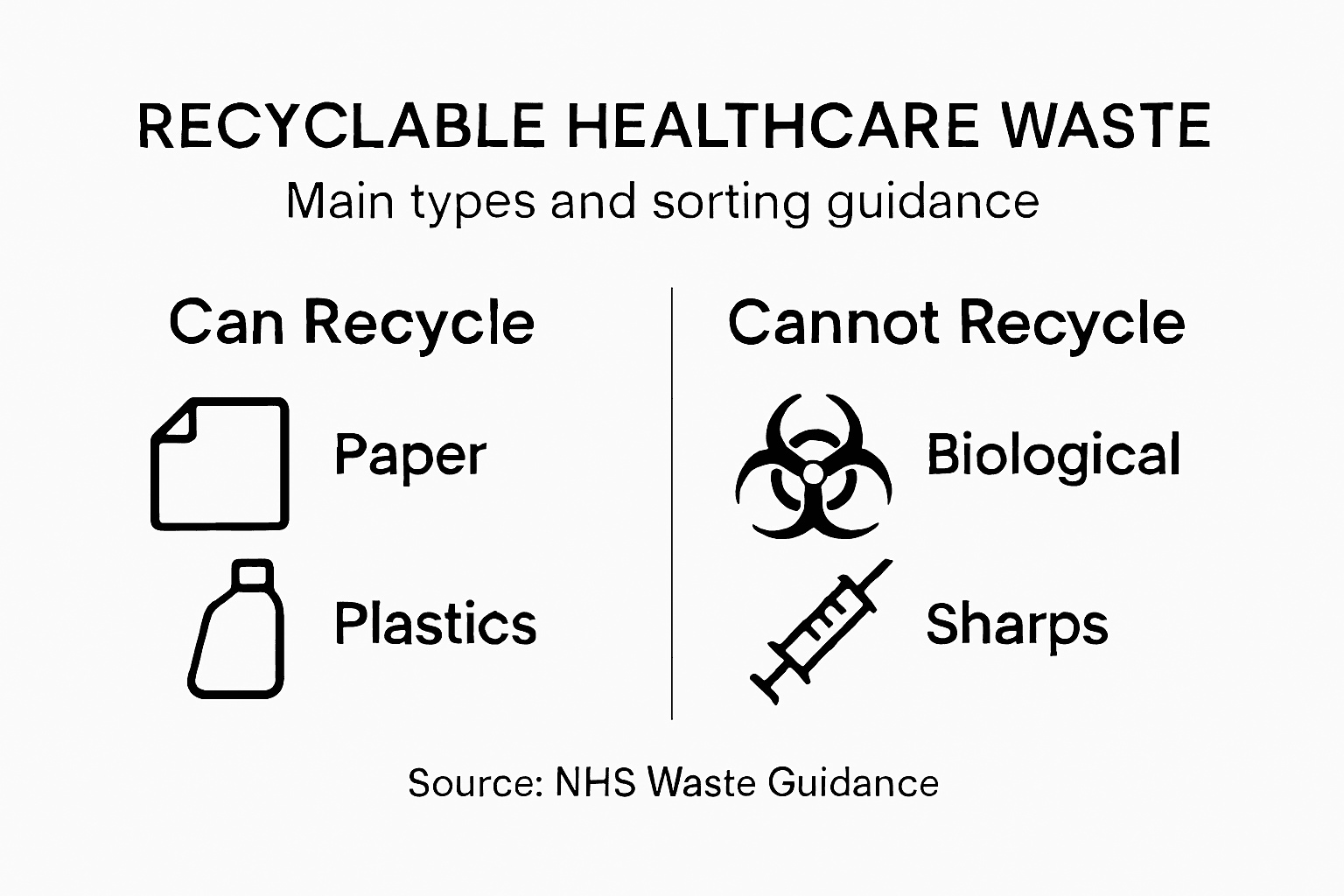
Infographic with recyclable and non-recyclable healthcare waste

Pro tip: Conduct regular staff training sessions on waste segregation to maintain high standards of recycling and minimize contamination risks.

Healthcare Recycling Processes and Requirements

Healthcare facilities must adhere to rigorous waste management protocols, with comprehensive best practice guidance forming the cornerstone of sustainable waste disposal strategies. The Health Technical Memorandum 07-01 (HTM 07-01) provides detailed frameworks for managing healthcare waste, emphasizing environmental sustainability, cost reduction, and safety.

Key processes in healthcare recycling include:

  • Waste Segregation: Immediate sorting at point of generation
  • Risk Assessment: Evaluating potential contamination levels
  • Appropriate Containment: Usingspecialised containers
  • Staff Training: Ensuring consistent waste handling procedures
  • Monitoring and Reporting: Tracking waste streams and disposal methods

Pharmaceutical Waste Management

Pharmaceutical waste requires particularly meticulous handling. Pharmaceutical waste management guidelines stress several critical requirements:

  1. Strict segregation of different medication types
  2. Use of approved pharmaceutical waste containers
  3. Comprehensive staff training
  4. Adherence to local and national disposal policies
  5. Comprehensive risk assessment protocols

The recycling process typically involves multiple stages:

  • Initial waste identification
  • Segregation by waste category
  • Decontamination where possible
  • Selection of appropriate disposal method
  • Documentation and reporting

Effective healthcare waste management is a complex process requiring precision, knowledge, and consistent implementation.

Compliance and Environmental Considerations

Healthcare facilities must balance legal compliance with environmental responsibility. This involves reducing waste generation, maximizing recycling opportunities, and selecting disposal methods that minimise environmental impact. The NHS’s net zero ambitions are driving innovative approaches to waste management across healthcare settings.

Pro tip: Develop a comprehensive waste management training programme that is regularly updated to reflect the latest environmental and safety guidelines.

Healthcare facilities face complex legal requirements when managing waste, with comprehensive legal frameworks governing every aspect of waste disposal and environmental protection. The Health Technical Memorandum 07-01 (HTM 07-01) provides detailed guidance that healthcare providers must rigorously follow to ensure compliance and safety.

Key legal obligations encompass multiple regulatory domains:

  • Environmental Protection Acts: Minimising ecological impact
  • Hazardous Waste Regulations: Controlling dangerous materials
  • Clinical Waste Controls: Managing infectious substances
  • Data Protection Guidelines: Securing confidential medical information
  • Workplace Safety Standards: Protecting staff and patients

Regulatory Compliance Requirements

Healthcare facilities must adhere to several critical legal mandates:

  1. Conduct regular waste audits
  2. Implement comprehensive staff training programmes
  3. Maintain detailed waste management documentation
  4. Use approved waste containment systems
  5. Follow strict segregation protocols

Pharmaceutical waste management involves additional specific legal considerations, including:

  • Controlled drug legislation compliance
  • Secure disposal of pharmaceutical materials
  • Local risk assessment protocols
  • Staff certification for handling controlled substances

Legal compliance in healthcare waste management is not just a regulatory requirement but a fundamental aspect of patient and environmental safety.

Risk Management and Liability

Healthcare providers must proactively manage legal risks by developing robust waste management strategies that anticipate potential regulatory changes. This includes maintaining flexible systems that can adapt to evolving environmental and safety standards while consistently protecting public health.

Pro tip: Establish a dedicated compliance team responsible for staying updated on the latest waste management regulations and implementing necessary organisational changes.

Common Pitfalls and Contamination Risks

Healthcare facilities face numerous challenges in waste management, with critical contamination risks threatening both environmental safety and operational efficiency. Improper waste segregation can lead to significant complications that compromise health, safety, and regulatory compliance.

Key contamination pitfalls include:

  • Inappropriate Waste Mixing: Combining different waste streams
  • Inadequate Staff Training: Lack of proper segregation knowledge
  • Incorrect Labelling: Misidentifying hazardous materials
  • Poor Container Management: Using inappropriate waste receptacles
  • Insufficient Monitoring: Failing to track waste disposal processes

Pharmaceutical Waste Challenges

Pharmaceutical waste presents unique contamination risks that healthcare facilities must carefully manage:

  1. Incorrect chemical waste classification
  2. Improper handling of cytotoxic substances
  3. Inadequate disposal of controlled medications
  4. Cross-contamination of sensitive materials
  5. Potential environmental hazards

Pharmaceutical waste management highlights several critical contamination scenarios:

  • Mixing cytotoxic waste with general waste streams
  • Failing to follow strict handling protocols
  • Overlooking chemical compatibility issues
  • Inadequate staff protection measures

Contamination in healthcare waste management is not merely a procedural issue but a critical risk to public health and environmental safety.

Prevention and Management Strategies

Healthcare facilities must implement comprehensive strategies to mitigate contamination risks. This includes robust staff training, clear waste segregation protocols, regular compliance audits, and maintaining up-to-date knowledge of evolving waste management regulations.

Pro tip: Develop a comprehensive colour-coded waste management system with clear visual guides to minimise human error in waste segregation.

Streamline Your Healthcare Waste Recycling with Venture Waste Management

Managing recyclable waste in UK healthcare facilities demands strict adherence to segregation principles and legal compliance to safeguard public health and the environment. If your facility is grappling with challenges such as effective segregation of pharmaceutical, infectious, and non-hazardous waste or seeking to reduce contamination risks, Venture Waste Management can provide tailored solutions that align with national standards and sustainability goals.

https://venturewaste.co.uk

Discover how our expert services simplify your waste collection needs through a clear three-step process covering general waste, hazardous materials, and secure recycling. Stay compliant and improve your environmental impact by partnering with us. Explore our comprehensive Waste Collection Process in the UK for Businesses 2025 and learn how the waste collection network in the UK serves businesses in 2025. Take the next step today by visiting Venture Waste Management and book a service designed to meet your healthcare facility’s precise recycling requirements.

Frequently Asked Questions

What types of waste can be recycled in healthcare facilities?

In healthcare facilities, recyclable waste includes paper and cardboard, non-contaminated plastic containers, clean glass, metals, and functional electronic equipment.

How is waste sorted in healthcare settings for recycling?

Waste is typically sorted at the point of generation, using colour-coded containers to prevent cross-contamination and ensure proper handling according to specific waste categories.

What are the key principles of waste segregation in UK healthcare?

Key principles include precise waste segregation protocols, minimising waste generation, ensuring patient and staff safety, and complying with national waste management regulations.

Can contaminated materials be recycled in healthcare facilities?

No, contaminated materials, biological waste, and hazardous substances cannot be recycled and must be disposed of through specialised treatment processes to ensure safety and public health.

Hospital staff managing recycling in corridor

7 Key Benefits of Recycling for Healthcare Facilities

Managing waste in healthcare facilities is a constant challenge, with overflowing bins, rising costs, and mounting environmental impact. Finding solutions that genuinely make a difference can feel out of reach without clear, practical guidance. The right strategies do more than keep corridors tidy—they help protect the environment, support legal compliance, and even reduce operational costs.

This practical guide reveals how clever recycling practices and smarter waste management transform not just facility workflows but also community health and financial performance. You will discover clear steps and real-world examples that show how sustainable change is both achievable and rewarding for your organisation.

Table of Contents

Quick Summary

Key Message Explanation
1. Implement Rigorous Waste Sorting Comprehensive waste segregation protocols greatly reduce landfill contributions in healthcare settings.
2. Ensure Regulatory Compliance Adhere to UK healthcare waste regulations to avoid financial penalties and enhance operational integrity.
3. Leverage Cost-Cutting Strategies Innovative waste management methods can save significant costs, transforming disposal into an investment in efficiency.
4. Promote Staff and Patient Wellbeing Effective recycling improves workplace health and patient care, fostering a culture of stewardship and collaboration.
5. Enhance Reputation Through Sustainability Visible recycling efforts strengthen organisational credibility and trust among patients and the community.

1. Reduces Waste Sent to Landfill

Healthcare facilities generate substantial waste daily, with significant environmental implications. Implementing strategic recycling practices can dramatically reduce the volume of waste destined for landfills, offering both ecological and economic benefits.

By adopting comprehensive waste segregation protocols, healthcare organisations can substantially minimise their landfill contributions. Clinical waste processing techniques enable medical institutions to transform potentially hazardous materials into reusable resources.

Key strategies for reducing landfill waste include:

  • Implementing rigorous waste sorting systems
  • Investing in specialised clinical waste treatment technologies
  • Training staff on proper waste segregation techniques
  • Partnering with environmentally responsible waste management providers

Effective waste management can reduce landfill contributions by up to 60% in healthcare settings.

Community Health Partnerships demonstrates an exemplary approach by collaborating with waste management specialists to disinfect and repurpose clinical waste. This innovative method not only diverts waste from landfills but also reduces carbon emissions and generates potential cost savings.

Healthcare facilities in regions like NHS Wales are already developing recycling protocols that significantly minimise landfill reliance. By adopting similar strategies, organisations can transform waste management from an environmental challenge into an opportunity for sustainable practice.

Expert tip: Conduct a comprehensive waste audit every six months to identify and implement continuous improvement strategies for waste reduction.

2. Supports Compliance with UK Regulations

Healthcare facilities operate in a complex regulatory landscape where waste management is not just an environmental concern but a legal requirement. Proper recycling practices are essential for meeting stringent UK healthcare waste disposal regulations.

The healthcare sector must adhere to multiple regulatory frameworks that govern waste management. Sustainable Healthcare Recycling Framework provides comprehensive guidelines ensuring organisations remain compliant with current legislation.

Key regulatory compliance aspects include:

  • Following Health Technical Memorandum (HTM) 07-01 standards
  • Implementing proper waste segregation protocols
  • Maintaining detailed waste tracking documentation
  • Ensuring appropriate disposal of clinical and hazardous materials

Compliance is not optional: Failure to meet waste management regulations can result in significant financial penalties.

The NHS Clinical Waste Strategy mandates healthcare providers develop robust waste management systems that prioritise safety, environmental responsibility, and legal adherence. These regulations require organisations to demonstrate systematic approaches to waste reduction and responsible disposal.

By integrating comprehensive recycling practices, healthcare facilities can transform regulatory compliance from a challenging obligation into a strategic advantage. Proactive waste management demonstrates organisational commitment to both environmental sustainability and patient safety.

Expert tip: Conduct quarterly internal audits to ensure continuous alignment with the latest waste management regulatory requirements.

3. Cuts Disposal Costs for Facilities

Healthcare facilities are constantly seeking innovative strategies to manage operational expenses while maintaining high-quality patient care. Effective recycling and waste management represent a significant opportunity to reduce disposal costs and improve financial efficiency.

UK waste management strategies demonstrate substantial potential for cost reduction through strategic waste handling. The NHS Clinical Waste Strategy projects potential savings of approximately £11 million annually by implementing more sophisticated waste management approaches.

Key cost-cutting strategies include:

  • Transitioning to reusable medical containers
  • Implementing precise waste segregation protocols
  • Standardising waste management contracts
  • Investing in alternative treatment technologies
  • Reducing single-use medical product consumption

Strategic waste management can transform disposal expenses from a financial burden into an opportunity for organisational savings.

One compelling example comes from Surrey and Sussex Healthcare NHS Trust, which saved £23,000 through innovative waste management. By switching to reusable sharps containers, they dramatically reduced procurement and disposal expenses while simultaneously supporting sustainability objectives.

Healthcare facilities can leverage recycling not just as an environmental initiative but as a sophisticated financial strategy. Reducing waste volume directly translates to lower disposal costs, more efficient resource allocation, and improved operational budgeting.

Expert tip: Conduct a comprehensive waste audit annually to identify specific areas where recycling and alternative disposal methods can generate significant cost savings.

4. Promotes Staff and Patient Wellbeing

Healthcare environments are complex ecosystems where waste management directly impacts overall organisational health and human experience. Effective recycling strategies do more than manage refuse they fundamentally transform workplace wellness and patient care quality.

NHS waste reduction initiatives demonstrate how sustainable practices create healthier, more positive healthcare settings. By reimagining waste management, facilities can significantly enhance staff morale and patient comfort.

Key wellbeing improvements include:

  • Reducing workplace hazardous exposure
  • Creating cleaner, more organised environments
  • Encouraging collaborative sustainable behaviours
  • Minimising stress associated with inefficient systems
  • Supporting a culture of environmental responsibility

A healthier workplace is not just about physical spaces but about cultivating a mindset of collective care and responsibility.

By involving clinical leaders and interdisciplinary teams in waste reduction strategies, healthcare facilities can transform organisational culture. This approach not only improves environmental outcomes but also empowers staff to contribute meaningfully to sustainable practices.

Research from the Royal College of Emergency Medicine highlights that efficient resource management allows reinvestment into frontline patient care. This creates a virtuous cycle where waste reduction directly supports enhanced healthcare delivery and staff well-being.

Expert tip: Establish monthly sustainability workshops that engage staff across all departments to share waste reduction ideas and celebrate collective environmental achievements.

5. Protects the Local Environment

Healthcare facilities play a crucial role in environmental stewardship, with their waste management practices directly impacting local ecosystems and community health. By adopting strategic recycling approaches, medical centres can transform their environmental footprint from potential harm to positive community contribution.

Sustainable healthcare waste frameworks demonstrate innovative approaches to reducing environmental impact through advanced waste treatment technologies. These strategies go beyond traditional disposal methods, embracing circular economy principles.

Key environmental protection strategies include:

  • Implementing the ‘5 Rs’ approach (Reduce, Reuse, Reprocess, Renewable, Recycle)
  • Utilising on-site waste treatment technologies
  • Minimising carbon emissions from waste transportation
  • Supporting local ecosystem preservation
  • Reducing energy consumption in waste management

Environmental responsibility in healthcare is not an option but a fundamental obligation to community wellbeing.

Innovative technologies like pyrolysis and bio-digesters enable healthcare providers to transform waste into valuable resources. These approaches not only reduce landfill volumes but also generate alternative energy sources and minimise carbon emissions.

By adopting comprehensive waste management strategies, healthcare facilities can demonstrate leadership in environmental protection. This proactive approach supports local ecosystems, reduces pollution, and creates a sustainable model for community health infrastructure.

Expert tip: Develop a quarterly environmental impact assessment to track and continuously improve your facility’s waste management and sustainability practices.

6. Enhances Reputation and Trust

In an era of heightened environmental awareness, healthcare facilities are increasingly judged not just by their medical services but by their commitment to sustainability. Effective recycling practices have emerged as a powerful tool for building organisational credibility and demonstrating social responsibility.

Recycling initiatives within NHS trusts reveal how waste management strategies can significantly enhance public perception and institutional reputation. These efforts communicate a profound commitment to environmental stewardship beyond traditional healthcare delivery.

Key reputation-building strategies include:

  • Making recycling efforts visible to patients and visitors
  • Developing transparent sustainability reporting
  • Engaging staff in environmental initiatives
  • Showcasing measurable environmental achievements
  • Communicating ecological commitments clearly

Reputation is built through consistent actions that demonstrate genuine commitment to community and environmental wellbeing.

Surrey and Sussex Healthcare NHS Trust exemplifies how strategic recycling infrastructure can transform public perception. By making recycling accessible and visible, they have elevated their institutional profile as a forward-thinking, responsible healthcare provider.

Beyond environmental benefits, these initiatives create meaningful narratives about organisational values. They demonstrate that healthcare institutions can be leaders in sustainability, inspiring confidence among patients, staff, and local communities.

Expert tip: Develop an annual sustainability report that clearly communicates your facility’s recycling achievements, making your environmental commitments transparent and engaging.

7. Encourages Sustainable Best Practices

Sustainability in healthcare extends far beyond simple waste management. It represents a fundamental cultural transformation that requires strategic commitment, innovative thinking, and comprehensive organisational engagement.

Sustainable healthcare recycling frameworks provide critical infrastructure for embedding environmental best practices across medical institutions. These initiatives transform sustainability from an abstract concept into actionable, measurable strategies.

Key sustainable practice strategies include:

  • Developing comprehensive waste minimisation programmes
  • Investing in innovative treatment technologies
  • Creating staff training and engagement initiatives
  • Implementing circular economy principles
  • Tracking and reporting environmental performance

Sustainable practices are not optional extras but essential components of modern healthcare delivery.

The NHS Clinical Waste Strategy demonstrates how systematic approach drives cultural change. By focusing on staff training, infrastructure investment, and continuous improvement, healthcare facilities can transform their environmental impact.

Moreover, these practices extend beyond immediate waste management. They cultivate an organisational culture that values resource efficiency, environmental responsibility, and proactive sustainability planning.

Expert tip: Establish a dedicated sustainability working group with representatives from different departments to drive continuous improvement and maintain momentum in sustainable practice implementation.

Below is a comprehensive table summarising the environmental, compliance, and organisational benefits associated with implementing strategic recycling practices in healthcare facilities, as outlined in the article.

Topic Description Key Benefits/Outcomes
Reducing Waste Implementing waste sorting systems and treatment technologies to minimise landfill contributions. Lower landfill waste, decreased carbon emissions, cost savings.
Regulatory Compliance Adhering to UK healthcare waste regulations through proper segregation and documentation. Legal adherence, avoidance of fines, enhanced environmental responsibility.
Cost Reduction Transitioning to reusable solutions and precise waste management strategies to cut disposal expenses. Significant operational cost savings, improved resource allocation.
Staff and Patient Wellbeing Developing clean and organised environments while fostering sustainable behaviours. Improved morale and comfort, reduced exposure to hazards.
Environmental Protection Utilising innovative waste treatment technologies and eco-friendly practices. Preservation of local ecosystems, energy savings, reduced pollution.
Reputation Enhancement Transparency in waste management practices communicates ecological commitment. Strengthened trust and credibility among staff and the community.
Promoting Sustainability Establishing recycling programmes and integrating circular economy principles. Long-term organisational cultural transformation and efficiency.

Achieve Sustainable Waste Management in Healthcare with Venture Waste

Managing healthcare waste effectively is a vital challenge for facilities aiming to reduce landfill contributions, cut disposal costs, and maintain strict regulatory compliance. The article highlights the importance of strategic recycling practices, precise waste segregation, and innovative treatment technologies—areas where Venture Waste excels by offering tailored solutions that meet these exact needs.

https://venturewaste.co.uk

Discover how our specialised services can support your healthcare facility in implementing robust recycling programmes and compliant waste management strategies. From hazardous waste handling to confidential waste destruction and efficient waste transport, our seamless three-step booking process simplifies your environmental efforts immediately. Start transforming waste into value for your institution today by exploring how the waste collection network in the UK serves businesses like yours. Contact us now through Venture Waste and take the first step towards operational savings and improved sustainability.

Frequently Asked Questions

What are the main benefits of recycling for healthcare facilities?

Recycling offers numerous benefits, including reduced waste sent to landfill, compliance with UK regulations, and lower disposal costs. Begin implementing comprehensive recycling programmes to experience these benefits in your organisation.

How can recycling improve compliance with waste management regulations?

By adopting effective recycling practices, healthcare facilities can align with regulations such as the Health Technical Memorandum (HTM) 07-01. Establish a systematic waste segregation protocol to ensure compliance and mitigate the risk of financial penalties.

What steps can my healthcare facility take to reduce disposal costs through recycling?

To cut disposal costs, consider transitioning to reusable medical containers and conducting precise waste segregation. Aim to evaluate your waste management strategies annually, which can potentially lead to significant savings, such as the £11 million projected by the NHS Clinical Waste Strategy.

How does recycling contribute to staff and patient wellbeing?

Implementing effective recycling strategies creates a cleaner and more organised healthcare environment, which can boost staff morale and enhance patient comfort. Engage staff in sustainability workshops to foster a culture of environmental responsibility within your facility.

What can be done to enhance the environmental impact of our waste management practices?

To protect the local environment, facilities should adopt the ‘5 Rs’ approach—Reduce, Reuse, Reprocess, Renewable, Recycle—and utilise innovative waste treatment technologies. Conduct an environmental impact assessment every quarter to track progress and identify areas for improvement.

How can our facility build a positive reputation through recycling initiatives?

Making recycling efforts visible to patients and staff enhances your healthcare facility’s reputation as a responsible organisation. Regularly report on sustainability achievements and engage in community outreach to demonstrate your commitment to environmental stewardship.

Hospital staff managing chemical waste disposal

Why Manage Chemical Waste – Impact for UK Healthcare

Managing chemical waste in the United Kingdom healthcare sector presents daily challenges that go beyond ticking regulatory boxes. Facilities managers must navigate a web of hazardous substances, from cytotoxic medicines to contaminated sharps, all while safeguarding both human health and the environment. With strict legal duties and the goal of reducing environmental impact, gaining clarity on what constitutes chemical waste in healthcare and how proper management supports operational efficiency is vital for every responsible facility.

Table of Contents

Key Takeaways

Point Details
Importance of Waste Management Effective management of chemical waste is essential for protecting public health and the environment.
Legal Compliance Healthcare providers must adhere to strict legal regulations to ensure safe handling and disposal.
Risks of Improper Handling Mishandling chemical waste can lead to serious health risks and environmental contamination.
Benefits of Proper Protocols Robust chemical waste strategies improve operational efficiency and enhance environmental sustainability.

What Constitutes Chemical Waste in Healthcare

Healthcare chemical waste represents a complex and critically important category of medical byproducts that require meticulous management and disposal. Healthcare waste classifications reveal a sophisticated range of materials that demand specialised handling and treatment.

Chemical waste in healthcare encompasses several distinct categories that pose potential risks to human health and environmental safety. These include:

  • Cytotoxic and cytostatic medicines with hazardous properties like toxicity and carcinogenicity
  • Contaminated sharps containing medicinal chemical residues
  • Chemical substances used in diagnostic and treatment processes
  • Pharmaceutical waste from expired or unused medications
  • Chemical cleaning and disinfection agents
  • Laboratory chemical reagents

The Health and Safety Executive (HSE) emphasises that effective chemical waste management is crucial for preventing infection risks and environmental contamination. Healthcare providers must implement rigorous classification, storage, and transportation protocols to ensure safe disposal.

Chemical waste in healthcare is not just a disposal challenge – it’s a critical public health and environmental protection responsibility.

Specifically, chemical waste includes substances that exhibit one or more hazardous characteristics such as:

  1. Toxicity
  2. Carcinogenicity
  3. Mutagenicity
  4. Corrosiveness
  5. Reactivity

Radioactive materials, while technically part of healthcare waste, are subject to separate regulatory frameworks and require distinct management strategies.

Pro tip: Implement a comprehensive chemical waste tracking system to monitor the entire lifecycle of hazardous medical substances from generation to final disposal.

Categories and Examples of Chemical Waste

Healthcare facilities generate a wide range of chemical waste that requires specialised management and careful waste classification. Understanding these categories is crucial for ensuring safe disposal and minimising environmental and health risks.

The primary categories of chemical waste in healthcare settings include:

  • Cytotoxic and Cytostatic Medicines
  • Pharmaceutical Waste
  • Laboratory Chemical Reagents
  • Disinfection and Cleaning Agents
  • Contaminated Medical Sharps
  • Chemical Diagnostic Materials

Each category presents unique challenges and requires specific handling protocols. For instance, cytotoxic medicines used in chemotherapy are particularly dangerous due to their carcinogenic and mutagenic properties. These substances can cause significant harm if not managed correctly.

Health officer sorting chemical waste types

To clarify the differences, here is a comparison of key chemical waste categories in healthcare and their primary risks:

Waste Category Typical Examples Main Risks
Cytotoxic and Cytostatic Medicines Chemotherapy drugs Carcinogenic, mutagenic
Pharmaceutical Waste Expired medicines Toxic environmental impact
Laboratory Chemical Reagents Diagnostic chemicals Corrosive, reactive
Disinfection and Cleaning Agents Bleaches, solvents Skin burns, air pollution
Contaminated Sharps Syringes with drug residues Injury, toxin exposure
Chemical Diagnostic Materials X-ray developer solutions Waterway contamination

Chemical waste in healthcare is not merely a disposal issue – it represents a critical public health and environmental protection responsibility.

Detailed examples of hazardous chemical waste include:

  1. Chemotherapy drugs containing toxic compounds
  2. Expired or unused prescription medications
  3. Mercury-containing medical devices
  4. Chemical solutions used in medical diagnostics
  5. Contaminated equipment with chemical residues

The clinical waste regulations mandate precise segregation and colour-coded waste streams to isolate hazardous chemical materials safely. Healthcare providers must implement robust tracking and disposal systems to mitigate potential risks associated with chemical waste exposure.

Infographic of chemical waste categories in UK healthcare

Pro tip: Develop a comprehensive chemical waste inventory system that tracks each hazardous substance from generation through final disposal, ensuring complete traceability and compliance.

Healthcare organisations in the United Kingdom must navigate a complex landscape of legal requirements governing chemical waste management. NHS clinical waste strategies outline comprehensive frameworks for responsible waste handling that extend beyond mere disposal protocols.

The primary legal foundations for chemical waste management include:

  • Environmental Protection Act 1990
  • Hazardous Waste Regulations 2005
  • Control of Substances Hazardous to Health (COSHH) Regulations
  • Health and Safety at Work Act
  • Waste (England and Wales) Regulations

These regulations impose a ‘Duty of Care’ on healthcare providers, mandating rigorous processes for waste segregation, packaging, transportation, and final disposal. Each organisation must demonstrate a systematic approach to managing potentially harmful chemical substances.

Compliance is not optional – it represents a fundamental responsibility to protect public health and environmental integrity.

Key legal obligations for healthcare facilities include:

  1. Proper classification of chemical waste
  2. Using licensed waste carriers
  3. Maintaining comprehensive waste transfer documentation
  4. Implementing safe storage protocols
  5. Ensuring staff training on waste management procedures

The legal requirements for waste disposal are designed to minimise environmental risks and prevent potential contamination. Non-compliance can result in substantial financial penalties and potential legal prosecution.

Pro tip: Develop a centralised compliance tracking system that documents every stage of chemical waste management, ensuring transparent and verifiable adherence to legal standards.

Risks of Improper Chemical Waste Management

Healthcare facilities face substantial risks when chemical waste management protocols are not rigorously implemented. NHS clinical waste strategies highlight the critical importance of comprehensive waste handling to prevent potential health and environmental hazards.

The primary risks associated with improper chemical waste management include:

  • Direct Health Risks
    • Exposure to toxic substances
    • Potential infectious disease transmission
    • Chemical burns and contamination
  • Occupational Hazards
    • Increased worker injury potential
    • Long-term health complications
  • Environmental Consequences
    • Soil and water contamination
    • Ecosystem disruption
    • Carbon emission increases

Healthcare workers are particularly vulnerable to immediate and long-term risks from mishandled chemical waste. Contaminated sharps, improperly stored chemical reagents, and inadequately disposed pharmaceutical substances can cause serious injuries and chronic health conditions.

Improper chemical waste management is not merely an administrative failure – it represents a direct threat to human health and environmental sustainability.

The potential consequences of negligent waste management extend beyond immediate health risks:

  1. Significant financial penalties
  2. Legal prosecution
  3. Institutional reputation damage
  4. Potential loss of healthcare licensing
  5. Environmental remediation costs

The clinical waste management guidelines emphasise that comprehensive staff training and robust waste segregation protocols are essential to mitigate these substantial risks.

Pro tip: Conduct quarterly comprehensive risk assessments of chemical waste management processes, involving multidisciplinary teams to identify and address potential vulnerabilities.

Benefits of Effective Chemical Waste Handling

Healthcare organisations across the United Kingdom can significantly enhance their operational efficiency and environmental sustainability through comprehensive waste management strategies. Effective chemical waste handling offers a multifaceted approach to organisational improvement and risk mitigation.

The primary benefits of robust chemical waste management include:

  • Environmental Protection
    • Reduced carbon emissions
    • Minimised pollution
    • Conservation of natural resources
  • Operational Efficiency
    • Lower disposal costs
    • Streamlined waste processes
    • Improved resource allocation
  • Regulatory Compliance
    • Adherence to health and safety standards
    • Reduced legal risks
    • Enhanced institutional reputation

Healthcare facilities that implement systematic chemical waste management protocols can achieve substantial operational and environmental advantages. By carefully segregating, storing, and disposing of hazardous substances, organisations demonstrate their commitment to both staff safety and ecological responsibility.

The following table summarises benefits of effective chemical waste handling and the operational outcomes:

Benefit Area Organisational Impact Measurable Outcome
Environmental Reduces pollution Lower hazardous releases
Operational Efficiency Improves workflows Reduced disposal costs
Regulatory Compliance Avoids legal breaches Fewer fines, inspections passed
Staff Wellbeing Minimises exposure Decreased workplace injuries
Public Reputation Demonstrates responsibility Enhanced patient and community trust

Effective chemical waste handling transcends mere compliance – it represents a strategic approach to organisational excellence and environmental stewardship.

Specific measurable benefits include:

  1. Significant reduction in potential workplace injuries
  2. Decreased environmental contamination risks
  3. Enhanced staff training and awareness
  4. Potential cost savings through efficient waste management
  5. Alignment with national sustainability goals

The healthcare waste management guidelines emphasise that comprehensive waste strategies contribute to healthier workplaces and more sustainable healthcare ecosystems.

Pro tip: Implement a digital tracking system to monitor chemical waste volumes, disposal methods, and associated costs, enabling data-driven improvements in waste management protocols.

Take Control of Your Healthcare Chemical Waste with Expert Solutions

Managing chemical waste in healthcare is a critical responsibility that safeguards public health, meets stringent legal obligations, and protects the environment. If you are facing challenges such as safe segregation, hazardous substance tracking, or regulatory compliance, you are not alone. Chemicals like cytotoxic medicines and contaminated sharps require specialised handling to avoid costly penalties and health risks.

At Venture Waste Management, we understand these pressing demands. Our expert hazardous waste services are designed specifically to help healthcare providers across the United Kingdom navigate complex waste disposal requirements effectively. Explore our hazardous waste services to discover tailored solutions for chemical waste management including safe collection, transport, and disposal that align with the latest regulations.

https://venturewaste.co.uk

Act now to protect your staff, patients, and community from the dangers of improper chemical waste handling. Simplify compliance and reduce operational risks with Venture Waste Management. Visit our main website at Venture Waste to book your service in three easy steps or learn more about how we support businesses with our comprehensive waste collection network in the UK. Partner with us and turn chemical waste challenges into safe, sustainable solutions today.

Frequently Asked Questions

What constitutes chemical waste in healthcare?

Chemical waste in healthcare includes cytotoxic and cytostatic medicines, contaminated sharps, pharmaceutical waste, chemical cleaning agents, and laboratory chemical reagents. Each type requires specific handling and disposal methods to prevent risks to health and the environment.

Why is managing chemical waste important for healthcare facilities?

Effective chemical waste management is crucial to prevent health hazards, protect employees from harmful exposure, and reduce environmental contamination. It also ensures compliance with regulatory standards and enhances the institution’s reputation.

What are the risks associated with improper chemical waste management?

Improper management can lead to direct health risks such as exposure to toxic substances, injury from contaminated sharps, and potential environmental consequences like soil and water contamination, which can disrupt ecosystems.

How can healthcare organisations improve their chemical waste handling practices?

Healthcare organisations can improve practices by implementing comprehensive waste tracking systems, providing staff training, ensuring proper waste segregation, and adhering to legal guidelines to minimise risks and enhance operational efficiency.

Waste carrier by registered van at UK depot

Responsible Waste Carriers – Ensuring Legal Compliance UK

Managing waste responsibly can feel daunting when the legal definitions and registration rules keep changing across the United Kingdom. Facilities managers in hospitals and schools must cut through complicated terminology to avoid costly mistakes, yet confusion about terms like ‘waste carrier’ and ‘waste broker’ is still widespread. This article clears up these misconceptions and outlines how to achieve compliant waste carrier registration so your institution stays protected and environmentally responsible.

Table of Contents

Key Takeaways

Point Details
Legal Requirement Waste carrier registration is mandatory for all entities transporting controlled waste in the United Kingdom.
Tier Classification Waste carriers are classified into lower and upper tiers, affecting registration requirements based on the type and volume of waste handled.
Documentation Obligations Waste carriers must maintain precise records for waste transfers, including accurate waste transfer notes and compliance with Waste Duty of Care regulations.
Risks of Non-Compliance Failing to comply with registration and documentation can lead to severe penalties, including substantial fines and potential criminal prosecution.

Responsible Waste Carriers Defined and Misconceptions

Waste carriers represent a critical component of the United Kingdom’s environmental management infrastructure, yet significant misconceptions persist about their precise legal roles and responsibilities. Waste carrier registration is not merely an optional administrative process, but a mandatory legal requirement for businesses and individuals transporting controlled waste across the country.

According to official government guidelines, waste carriers can be categorised into distinct operational types. Some transport waste directly, while others arrange waste handling and disposal through brokerage services. The Department for Environment, Food and Rural Affairs (Defra) has been working to clarify these definitions, proposing to replace current complex terminology with more straightforward classifications like ‘waste controllers’ and ‘waste transporters’ to reduce public confusion.

Most businesses do not realise that waste carrier registration extends beyond traditional waste management companies. Even organisations that generate minimal waste and transport it themselves might require official registration. This includes sectors ranging from construction and healthcare to retail and hospitality. Critically, failing to register can result in substantial financial penalties and potential legal prosecution, making compliance a non-negotiable aspect of responsible business operations.

Pro tip: Before transporting any waste, always verify your specific registration requirements with local environmental authorities to ensure full legal compliance.

Types of Waste and Carrier Distinctions

Understanding the nuanced categories of waste carriers is essential for legal compliance in waste management across the United Kingdom. Upper and lower tier waste carriers represent distinct classifications that determine registration requirements and operational responsibilities.

Lower tier waste carriers typically handle specific, limited waste scenarios. These might include businesses transporting only their own waste, excluding construction and demolition materials. Agricultural enterprises and organisations managing animal by-products also fall into this category. Conversely, upper tier waste carriers have broader responsibilities, including transporting waste for other businesses, managing construction waste, or functioning as waste brokers and dealers.

The regulatory framework distinguishes these carrier types based on the nature and volume of waste handled. Construction companies, waste management firms, and large industrial organisations often require upper tier registration due to the complex and varied waste streams they generate. Small businesses and independent contractors might qualify for lower tier registration, providing a more streamlined approach to legal compliance that matches their specific operational needs.

Pro tip: Carefully assess your waste transportation activities and consult local environmental authorities to determine the precise carrier tier appropriate for your business.

To clarify the distinctions between waste carrier tiers, the following table summarises key differences:

Tier Type Typical Activities Example Businesses Key Requirement
Lower Tier Transporting own non-construction waste Farms, veterinary practices Simple registration
Upper Tier Transporting waste for others, or construction Waste management firms, builders Detailed registration and fees

Navigating the legal landscape of waste carrier registration demands meticulous attention to detail and comprehensive understanding of regulatory frameworks. Waste carrier registration is a mandatory process enforced by the Environment Agency for businesses and individuals involved in waste transportation, management, and brokerage across England.

The registration process encompasses two distinct tiers with specific requirements. Businesses transporting exclusively their own waste may qualify for lower tier registration, with notable exceptions for construction and demolition materials. Upper tier registration becomes mandatory for organisations that transport waste on behalf of other entities, broker waste services, or manage complex waste streams. Each registration tier involves precise documentation, accurate information submission, and associated fees that must be paid during initial registration and subsequent renewals.

Woman reviewing UK waste transfer notes

Non-compliance carries significant legal consequences. Businesses found operating without appropriate waste carrier registration risk substantial financial penalties, potential license revocation, and legal prosecution. The Environment Agency maintains stringent enforcement mechanisms to ensure businesses adhere to waste management regulations, making proactive registration and ongoing compliance crucial for operational legitimacy and environmental responsibility.

Pro tip: Maintain detailed records of your waste transportation activities and set calendar reminders for registration renewal to prevent inadvertent non-compliance.

Duties, Documentation, and Record Keeping

Waste carriers in the United Kingdom bear substantial legal responsibilities that extend far beyond simple transportation. Waste Duty of Care regulations mandate comprehensive documentation and meticulous record-keeping to ensure environmental protection and regulatory compliance.

The documentation process requires waste carriers to maintain precise records for each waste transfer. This includes creating accurate waste transfer notes that comprehensively describe the waste type, quantity, and destination. Critical information must be captured, such as the waste classification, the parties involved in the transfer, and the specific handling requirements. These documents serve as legal evidence of responsible waste management and must be retained for a minimum of two years, providing a transparent audit trail for environmental regulators.

Infographic about UK waste carrier compliance

Beyond documentation, waste carriers have a legal obligation to prevent waste from causing environmental damage during transportation. This involves selecting appropriate containment methods, ensuring secure packaging, and implementing robust protocols to mitigate potential waste escape or contamination risks. Carriers must also verify that waste is transferred exclusively to authorised and licensed waste management facilities, maintaining a chain of responsibility that upholds environmental protection standards and legal compliance.

Pro tip: Implement a digital document management system to streamline record-keeping and ensure easy retrieval of waste transfer documentation during regulatory inspections.

Risks, Penalties, and Avoiding Illegal Disposal

Illegal waste disposal represents a significant threat to both environmental sustainability and business integrity across the United Kingdom. Waste crime economic impact reveals that unregulated waste activities cost the national economy over a billion pounds annually, underscoring the critical importance of responsible waste management.

The legal consequences of improper waste handling are severe and multi-faceted. Businesses found engaging in illegal disposal can face substantial financial penalties, including unlimited fines that can potentially cripple organisational finances. Moreover, criminal prosecution is a genuine risk, with potential imprisonment for directors and senior managers responsible for systematic non-compliance. These penalties extend beyond monetary sanctions, potentially damaging a company’s reputation, professional credibility, and future business opportunities.

Preventing illegal disposal requires a proactive and comprehensive approach. Waste carriers must implement rigorous internal controls, including thorough staff training, detailed waste tracking systems, and regular compliance audits. This involves verifying waste destination credentials, maintaining meticulous documentation, and ensuring all transportation and disposal activities align strictly with current environmental regulations. Establishing clear accountability mechanisms and investing in robust waste management infrastructure are essential strategies for mitigating risks and demonstrating corporate environmental responsibility.

Here is a summary of primary legal risks and mitigation strategies for waste carriers:

Risk Area Potential Consequence Mitigation Strategy
Operating unregistered Large fines, prosecution Verify and maintain valid registration
Incomplete record keeping Regulatory penalties Implement digital tracking of transfers
Using unauthorised facilities License revocation, reputation damage Maintain current list of licensed outlets
Illegal waste disposal Imprisonment, financial loss Conduct regular compliance audits

Pro tip: Conduct quarterly internal compliance reviews and maintain an up-to-date register of authorised waste management facilities to minimise potential legal vulnerabilities.

Stay Legally Compliant with Expert Waste Carrier Services in the UK

Navigating the complex rules around waste carrier registration and waste duty of care can feel overwhelming for businesses big and small. This article highlights key challenges such as the distinction between upper and lower tier carriers, mandatory documentation, and risks of illegal disposal. At Venture Waste, we understand how crucial it is to remain fully compliant with UK environmental regulations while managing your waste responsibly. Explore our regulation Archives – Venture Waste for up-to-date insights and best practices on legal compliance.

https://venturewaste.co.uk

Take control of your waste management now with a trusted partner committed to legal compliance and environmental protection. From general waste collection to specialised waste transport services, Venture Waste simplifies your journey with a straightforward three-step booking process. Discover how our network supports UK businesses by reading How the Waste Collection Network in UK Serves Businesses in 2025 – Venture Waste. Ready to ensure your waste operations meet all legal requirements while benefiting from expert service? Visit us at Venture Waste and book your compliant waste solution today.

Frequently Asked Questions

What is the purpose of waste carrier registration?

Waste carrier registration is a mandatory legal requirement for businesses and individuals transporting controlled waste. It ensures compliance with environmental regulations and helps maintain responsible waste management practices.

What are the differences between upper tier and lower tier waste carriers?

Upper tier waste carriers handle a broader range of waste, including that from other businesses and construction sites. Lower tier carriers mainly transport their own non-construction waste, with simpler registration requirements.

Operating without the appropriate waste carrier registration can result in significant financial penalties, potential legal prosecution, and reputational damage to the business involved.

How can waste carriers ensure compliance with the Duty of Care regulations?

Waste carriers can ensure compliance by maintaining accurate records for each waste transfer, selecting suitable containment methods, and verifying that waste is only transferred to licensed waste management facilities.

Man documenting waste tracking in bright office

Waste Tracking Requirements: Legal and Practical Impact

Waste tracking across the UK is undergoing a significant transformation as the government replaces paper records with a mandatory digital system beginning October 2026. For facilities managers in hospitals and universities, adapting to these changes means mastering new protocols for documenting every waste movement and ensuring all contractors comply. This guide explains how comprehensive digital tracking supports regulatory compliance and transparency, while highlighting what your institution must do to avoid legal and operational risks.

Table of Contents

Key Takeaways

Point Details
Digital Tracking Compliance All waste businesses in the UK must transition to digital waste tracking systems by October 2026, impacting healthcare and educational institutions directly.
Responsibilities for Facilities Managers Facilities managers must ensure contractors comply with digital tracking obligations and verify the accuracy of waste data.
Types of Waste Requiring Tracking Nearly all waste generated by healthcare and educational facilities falls under the digital tracking system, necessitating comprehensive documentation.
Consequence of Non-compliance Failing to adhere to waste tracking regulations can lead to significant financial penalties and regulatory scrutiny for organisations.

Defining Waste Tracking Requirements in the UK

Waste tracking in the UK has fundamentally changed. The government now requires all waste businesses to move away from paper-based records and shift to digital waste tracking systems. For facilities managers at healthcare and educational institutions, this shift means understanding what waste tracking actually entails and how it applies to your operations.

At its core, waste tracking means documenting the journey of every waste material from the point it leaves your facility until it reaches its final destination. This includes recording who handled the waste, where it went, what happened to it, and whether it was ultimately recycled, treated, or disposed of. The system creates a complete audit trail that demonstrates compliance with environmental regulations and accountability throughout the waste management process.

The UK Government’s Digital Waste Tracking service mandates that all waste receiving sites must log waste data digitally, eliminating the previous patchwork of handwritten records. Implementation begins with phased beta testing in 2025, with mandatory use commencing in October 2026. This affects you directly if your hospital or school produces waste that gets collected and transported by external contractors.

What makes this requirement particularly relevant to your role is that you become responsible for ensuring your waste contractor complies with digital tracking obligations. You cannot simply hand over waste and assume everything is handled correctly. Instead, you must verify that waste documentation is submitted digitally, that data matches your own records, and that your facility is correctly represented in the tracking system. Healthcare waste, confidential document destruction, and hazardous materials all require meticulous documentation under these new standards.

The regulatory framework covers producers (that is, your institution), waste carriers, and treatment facilities. Each party must input their own data at each stage. If you produce clinical waste in Newcastle or run a large educational campus in Durham, your waste management practices will feed directly into this national tracking system. Inconsistencies or missing records can result in regulatory scrutiny, fines, or enforcement action against your organisation.

Here is a summary of how digital waste tracking changes responsibilities for key parties:

Party Involved Main Responsibility Impact on Compliance
Waste Producers Accurate initial data entry Ensures full traceability
Waste Carriers Timely record submission Reduces discrepancies
Receiving Facilities Confirm receipt and treatment details Closes audit trail
Facilities Managers Record verification and oversight Prevents legal penalties

Pro tip: Request your waste contractor’s digital tracking login credentials and establish a monthly verification routine to cross-check that all waste movements recorded in the system match your internal disposal records, catching discrepancies before they escalate into compliance issues.

Types of Waste and Digital Tracking Coverage

Not all waste falls under the digital tracking system, but most of what your healthcare or educational facility produces will. Understanding which waste types require tracking is essential for compliance. The system covers controlled waste encompassing hazardous and non-hazardous materials, including household, commercial, and industrial streams. If you manage a hospital in Leeds or a university campus in Manchester, nearly every waste stream you generate falls within this scope.

Controlled waste includes clinical waste from medical procedures, pharmaceutical waste, chemical waste from laboratories, and general household or commercial refuse. Confidential document destruction also requires digital tracking since it involves waste handling and movement. Even waste that seems minor—such as redundant electrical equipment or empty aerosol cans—must be logged within the system.

Extractive waste from mining and quarrying operations also requires tracking, though this typically does not apply to educational or healthcare settings. However, if your institution participates in any demolition projects or maintains quarried materials on site, those streams trigger digital tracking obligations.

What catches many facilities managers off guard is that hazard classification does not determine whether waste needs tracking. A non-hazardous cardboard box containing office waste must be tracked just as carefully as clinical waste from an operating theatre. The system applies universally across all controlled waste types, creating comprehensive traceability. This universal approach means you cannot pick and choose which waste streams to monitor.

Waste containing Persistent Organic Pollutants (POPs) requires particularly detailed recording. These include legacy chemicals found in old equipment, certain pesticides, and contaminated materials. If you are disposing of equipment manufactured before the 2000s, check whether POPs documentation applies before handing waste to your contractor.

Your role demands familiarity with all waste types your institution generates. Create an inventory listing every waste stream you produce, from general refuse to specialist clinical or laboratory waste. This proactive approach prevents tracking gaps and ensures your facility remains compliant across every waste category.

Infographic showing UK waste tracking roles and impacts

Pro tip: Audit your facility’s waste streams with your environmental coordinator or facilities team, then cross-reference each against the government’s waste classification list to confirm all types are accounted for in your digital tracking records before the October 2026 deadline.

October 2026 marks the moment when waste tracking shifts from optional to legally mandatory. Your institution will face real legal obligations, not voluntary guidelines. Licensed and permitted waste receiving sites must report waste receipt data digitally as a primary legal duty from this date onwards. This means every waste contractor you work with in Newcastle, Brighton, Edinburgh, or anywhere else in the UK must comply.

As a facilities manager, you become part of this enforcement chain. Your organisation produces the waste, and your contractor receives and processes it. Both of you have separate but interconnected legal duties under the new regulations. If your contractor fails to submit data, you could face scrutiny for selecting an unreliable partner. The responsibility flows both ways.

Waste receiving site operators must familiarise themselves with their duties ahead of enforcement, which includes compliance with revised waste carrier regulations and potentially new restrictions on exemptions. Some exemptions may vary across waste sectors, meaning clinical waste handling might differ from general commercial waste tracking requirements. Healthcare facilities often face stricter scrutiny than educational institutions because clinical waste involves greater regulatory complexity.

Educational institutions have slightly different obligations depending on waste type. General refuse from a school cafeteria follows standard tracking rules. However, laboratory waste from science departments or IT equipment disposal requires additional documentation. University campuses in areas like Durham or Bristol must account for these variations when establishing their tracking systems.

The phased rollout initially focuses on licensed and permitted waste receiving sites, but regulations will expand to other waste operators later. Exemptions for certain household waste at recycling centres will apply initially, but do not assume your institution qualifies. Most healthcare and educational facilities operate at a scale requiring full compliance from day one.

Non-compliance carries financial and reputational consequences. Regulatory bodies can impose fines, revoke waste handling licences, or initiate enforcement action. Your institution’s environmental credentials matter, particularly for educational facilities with sustainability commitments or healthcare providers promoting responsible practice.

Pro tip: Schedule a meeting with your waste contractor before 2026 to confirm they hold current licences, understand the digital tracking system, and agree in writing on who manages data submission for each waste stream from your facility.

How the Digital Waste Tracking System Works

The Digital Waste Tracking System operates as a centralised UK-wide platform where waste data flows continuously from point of origin to final destination. Think of it less like a filing cabinet and more like a live tracking system similar to parcel delivery software. Authorised waste receiving sites must log all incoming waste data using application programming interfaces (APIs) or compatible software, enabling seamless digital submission across the entire waste journey.

When your healthcare facility in York or educational institution in Belfast hands waste to a contractor, that contractor immediately enters the data into the system. Instead of paper waste transfer notes that sit in filing cabinets for years, you now have real-time, auditable digital records. The system creates an automatic audit trail, meaning every movement gets logged, timestamped, and verified. No more lost paperwork or unclear handoffs between parties.

Your waste contractor inputs specific information at each stage: waste type, quantity, origin point, destination, and treatment method. The system then moves the record forward as waste progresses through the supply chain. When waste arrives at a treatment facility, operators confirm receipt and log what happens next. This continuous documentation prevents waste disappearing mid-journey without explanation.

Woman entering waste data at cluttered facility

Integration with existing software matters for practical implementation. Most waste management companies use their own systems, but the Digital Waste Tracking platform connects via APIs, meaning your contractor’s software talks directly to the government system. You do not need to manually re-enter data multiple times. Data flows seamlessly between your internal records, your contractor’s system, and the regulatory platform.

The phased rollout approach means you have time to prepare. Private beta testing occurs during 2025, allowing waste operators to identify technical issues before mandatory compliance begins in October 2026. This staged approach gives you breathing room to work with your contractors, test procedures, and resolve software compatibility issues before enforcement takes effect.

Accessing the system yourself depends on your contractor’s permissions, but you can request read access to your facility’s waste records. This allows you to verify that submissions match your internal documentation and catch discrepancies early.

Pro tip: Request direct access to your waste tracking records from your contractor now, during the beta testing phase, so you can familiarise yourself with the interface and identify any data mismatches before the October 2026 deadline becomes legally binding.

Common Compliance Risks and Avoidable Errors

Waste tracking compliance failures rarely stem from malice. Most errors occur because facilities managers underestimate the system’s complexity or assume their contractor handles everything. The truth is more nuanced. You share responsibility for data accuracy, timing, and completeness. Missing this distinction costs organisations money and credibility.

Incomplete waste descriptions represent the most common early error. Your facility generates clinical waste, but does the system record what type of clinical waste? Infectious? Pharmaceutical? Chemical? Vague entries create audit flags. Regulators cannot verify compliance when descriptions lack specificity. A hospital in Manchester might record “medical waste” when the system requires “sharps and contaminated instruments.” That gap invites scrutiny.

Timing mismatches cause significant problems. Your facility generates waste on Monday, but your contractor does not submit the digital record until Wednesday. Meanwhile, you have already recorded the disposal in your internal system. When regulators cross-reference records, discrepancies emerge. The waste appears to vanish for two days. Always verify submission timelines with your contractor in writing.

Incorrect waste classification creates regulatory chaos. Your school’s science department produces laboratory chemicals, but the waste gets classified as general commercial refuse. This error cascades through the system, potentially triggering hazard investigations or fines. Audit your internal waste categorisation against the official government classification scheme before handing anything to your contractor.

Data entry errors in quantity fields invite questions too. If your facility consistently reports vastly different waste volumes week to week, regulators may suspect unreliable tracking procedures. Establish baseline waste volumes and flag unusual variations immediately.

Confidential document destruction requires meticulous attention. Patient records from a healthcare facility or student information from a school must be tracked with particular care. Handling confidential waste improperly exposes your organisation to data protection violations beyond simple waste tracking failures. Verify your contractor holds appropriate confidentiality certifications and submits records within legally mandated timeframes.

Contractor selection matters enormously. Choosing an unreliable waste management partner shifts compliance burdens onto your shoulders. Demand proof of digital tracking readiness, software compatibility testing, and staff training completion before October 2026.

The table below outlines typical errors in waste tracking and how to prevent them:

Common Error Consequence Prevention Method
Vague waste descriptions Regulatory audit queries Use precise classification terms
Timing mismatches Apparent gaps in audit trail Synchronise submission schedules
Incorrect waste classification Fines or investigations Cross-check with official categories
Data entry mistakes Unusual volume trends flagged Implement double-check routines

Pro tip: Run a waste tracking audit with your current contractor now, generating sample submissions through the beta system and comparing their data against your internal records to identify and correct systematic errors before mandatory enforcement begins.

Stay Ahead of Waste Tracking Compliance with Venture Waste

Navigating the new legal and practical waste tracking requirements can feel overwhelming for facilities managers responsible for ensuring full traceability and accuracy in your waste records. The shift to mandatory digital tracking demands careful oversight of waste descriptions, timing, and data submission alongside your waste contractors. Explore how the Waste Collection Process in the UK for Businesses 2025 – Venture Waste supports your need for seamless compliance and reliable waste management solutions.

https://venturewaste.co.uk

Take control today by partnering with Venture Waste. Benefit from our transparent three-step booking system, industry expertise, and a comprehensive waste collection network designed for modern UK businesses. Verify your digital tracking readiness, prevent costly compliance risks, and protect your organisation’s reputation. Visit Venture Waste and learn more about How the Waste Collection Network in UK Serves Businesses in 2025 – Venture Waste to secure your facility’s waste management future now.

Frequently Asked Questions

What are the main responsibilities of waste producers under the new digital tracking system?

Waste producers must ensure accurate initial data entry for their waste. This is crucial to guarantee full traceability throughout the waste management process and to comply with legal obligations.

How does the digital waste tracking system enhance compliance for healthcare and educational facilities?

The digital waste tracking system creates an automatic audit trail, ensuring that all waste movements are logged, timestamped, and verified. This prevents discrepancies and helps facilities demonstrate compliance with environmental regulations.

What types of waste require tracking under the UK government’s new requirements?

Almost all controlled waste, including clinical waste, pharmaceutical waste, chemical waste, and even non-hazardous materials, must be tracked digitally. This also includes confidential document destruction and redundant electrical equipment.

What are the consequences of non-compliance with the new waste tracking regulations?

Non-compliance can lead to financial penalties, revocation of waste handling licences, or enforcement actions by regulatory bodies. It can also damage an organisation’s reputation, particularly for educational institutions and healthcare providers committed to sustainability.

Manager inspecting hospital coloured waste bins

Waste Segregation Colour Codes: Legal Compliance and Safety

Sorting waste in a bustling hospital or busy university campus often becomes a race against time and distractions. For facilities managers, mistakes in segregation can endanger staff safety, disrupt recycling, and result in breaches of UK regulations. Colour coding bins is not just a visual aid—it forms the core of legal compliance and safer workplaces, as emphasised by the Health and Safety Executive. Understanding these waste segregation colour codes brings clarity, reduces confusion and contamination risks, and helps your institution protect both people and the environment.

Table of Contents

Key Takeaways

Point Details
Waste segregation colour codes Utilising a standardised colour coding system simplifies waste disposal for staff, enhancing compliance and safety in healthcare and educational settings.
Legal documentation is essential Facilities must maintain accurate records of waste segregation and disposal methods to comply with UK regulations and avoid fines or legal issues.
Training and communication are key Regular staff training on waste segregation protocols and clear labelling can significantly reduce contamination and improve compliance rates.
Proactive monitoring practices Conducting routine audits and documenting discrepancies helps identify training gaps and ensures continuous improvement in waste management processes.

Waste Segregation Colour Codes Defined

Waste segregation colour codes form the backbone of responsible waste management across UK healthcare facilities and educational institutions. These standardised visual systems enable staff to quickly identify which bin or container accepts specific types of waste, reducing contamination and ensuring compliance with environmental regulations. Rather than relying on written labels alone, colour coding provides an immediate, intuitive method that works regardless of language or literacy levels, making it particularly valuable in busy clinical or campus environments where decisions happen fast.

The UK employs a structured approach to waste classification that goes beyond simple colour coding. The List of Waste codes and waste classification guidance establish the legal framework for categorising different waste streams. In healthcare settings, you’ll typically encounter four main colour categories: yellow for infectious and hazardous waste, black for general non-recyclable waste, blue for paper and cardboard, and green for compostable materials. However, the specific colour scheme your institution uses may vary slightly depending on local authority requirements and your waste contractor’s specifications. For example, some healthcare providers in Newcastle and Durham follow slightly different protocols than those in Sheffield, so verification with your local waste management partner remains essential.

Educational institutions follow similar principles but often adapt the system to their context. Universities in Leeds and Manchester frequently implement modified colour schemes that account for research laboratory waste, which requires additional hazard identification beyond standard office recycling. Clinical waste in particular demands rigid adherence to colour codes, as improper segregation can create serious health risks for waste handlers and contaminate recycling streams. Understanding the reasoning behind each colour designation helps staff internalise the system more effectively than memorising rules by rote. Black bins contain general refuse that poses no special hazard. Yellow containers hold items contaminated with bodily fluids, pharmaceuticals, or infectious materials. Blue receptacles receive clean paper and cardboard only. Green bins accept food waste and biodegradable materials suitable for composting or anaerobic digestion. Each colour represents a distinct end-of-life pathway, with different treatment processes and legal handling requirements.

Pro tip: Create laminated reference cards showing your facility’s specific colour codes and acceptable contents, then position them at eye level near each segregation point; refresh them quarterly and whenever your waste contractor updates protocols to ensure staff always follow current requirements.

UK Colour Coding Categories and Materials

Understanding which materials go into which coloured bins forms the practical foundation of waste segregation. The UK regulatory framework establishes clear categories that healthcare facilities and educational institutions must follow, though the visual presentation through colour codes makes compliance straightforward for staff at the point of disposal. Each colour represents not just a container, but an entire treatment pathway with different legal requirements, environmental outcomes, and handling protocols.

Yellow bins capture infectious and hazardous clinical waste that poses genuine health risks. This includes items contaminated with bodily fluids, blood-stained dressings, needles, syringes, anatomical waste, and pharmaceutical residues. In healthcare settings, yellow waste undergoes high-temperature incineration or specialised treatment to eliminate pathogens before any potential disposal. Educational institutions rarely use yellow bins unless they operate on-campus health centres or research laboratories. Black bins receive general non-recyclable waste that contains no hazardous properties. Think of items like contaminated food packaging, non-recyclable plastics, soiled paper towels, and general refuse that cannot enter other streams. The recyclable waste categories defined in current regulations clarify what should never reach black bins.

Janitor moving yellow hazardous waste bin

Blue bins accept clean paper and cardboard exclusively. This means office paper, printed materials, cardboard boxes, and packaging paper. Contaminated paper that has absorbed liquids or biological material must go to yellow or black bins instead. Green bins receive compostable and food waste suitable for industrial composting or anaerobic digestion. This includes food scraps, garden waste, and biodegradable packaging. Some facilities also implement additional colours: brown for garden waste alone, red for certain hazardous chemicals, or orange for specific pharmaceutical waste streams. The variation depends on your facility’s activities and your waste contractor’s capabilities. In Manchester and Birmingham, many NHS trusts implement slightly different secondary colour schemes based on their on-site treatment infrastructure.

Beyond these core categories, some facilities use supplementary colours for specialised streams. Clear or transparent bags sometimes separate confidential paper or sensitive documents requiring destruction. Purple or lilac bins occasionally contain cytotoxic or chemotherapy waste that requires segregated incineration. The key principle remains consistent: segregation at source prevents contamination, reduces treatment costs, and ensures regulatory compliance. Staff confusion about correct placement directly increases costs for your institution, as misplaced items contaminate entire loads and force disposal as hazardous waste rather than recyclable material.

Here is a quick reference guide comparing the main UK waste segregation colour codes and their handling protocols:

Colour Code Typical Waste Contents Required Handling Final Disposal Method
Yellow Infectious clinical items Use PPE, sealed containers High-temperature incineration
Black General non-recyclable waste Minimal precautions, closed bins Landfill or non-recycling
Blue Clean paper and cardboard Keep dry, avoid contamination Recycling facility
Green Food and compostable materials Decant food, exclude non-biodegradables Composting or digestion
Purple/Lilac Cytotoxic/chemotherapy waste Specialist PPE, never compress Specialist incineration

Pro tip: Conduct a quarterly audit by photographing each bin station and cross-referencing contents against the colour coding system; identify problem areas and provide targeted retraining to departments showing persistent contamination, which typically reduces disposal costs by 12-18% annually.

How Colour Codes Ensure Safe Handling

Colour codes transform waste segregation from a theoretical concept into a practical safety system that protects your staff every single day. When waste handlers encounter a clearly colour-coded bin, they make instantaneous decisions about how to approach it, what protective equipment to use, and which disposal pathway applies. This split-second recognition prevents the catastrophic mistakes that occur when workers accidentally mix incompatible materials or handle hazardous waste without proper precautions. The visual clarity of colour coding works far more effectively than written instructions alone, particularly in high-pressure clinical environments where staff manage multiple tasks simultaneously.

The safety mechanism operates on several levels simultaneously. First, colour coding prevents mixing incompatible materials that could trigger chemical reactions. Yellow infectious waste containers never receive general refuse, meaning hazardous pathogens cannot contaminate landfill-bound material. Second, handlers can immediately identify hazard levels and apply appropriate personal protective equipment before opening containers. A staff member approaching a yellow bin knows to wear nitrile gloves and ensure proper hand hygiene procedures, whereas black bin handling requires minimal precautions. Third, hazardous waste handling protocols remain consistent across your facility because visual systems eliminate ambiguity. Workers in different departments segregate materials using identical colour standards, reducing training complexity and human error. Research from the Health and Safety Executive demonstrates that colour-coded waste systems dramatically reduce workplace injuries related to waste handling by enabling workers to recognise hazards quickly and apply protective measures instinctively.

Educational institutions benefit from this safety architecture particularly well. A university laboratory assistant handling cytotoxic research waste immediately recognises a purple bin as requiring specialist incineration and knows not to compress or manipulate contents. Teaching hospital staff in Leeds and Glasgow use identical colour systems, creating muscle memory that prevents dangerous decisions under fatigue. Facilities in Edinburgh managing clinical skills laboratories employ the same visual language as their main hospital departments, ensuring consistent safety culture. When a temporary staff member or contractor arrives, colour codes provide instant orientation without lengthy explanations. This becomes critical during emergencies when communication channels become congested. During a spillage incident, response teams can immediately identify waste type from container colour, enabling appropriate containment strategies and decontamination protocols. The HSE specifically recommends colour coding as a primary control measure because it operates independently of language, literacy, or time pressure.

Consistency across your facility amplifies these benefits exponentially. When every department uses identical colour schemes with the same material definitions, staff develop reliable habits that transfer across contexts. Conversely, facilities using multiple colour systems create confusion that increases contamination and safety incidents. Healthcare workers switching between departments must essentially relearn the system, introducing mental load that leads to mistakes.

Pro tip: Introduce your colour coding system during induction using practical demonstrations rather than lectures, requiring new staff to sort sample waste items into appropriate bins while explaining their reasoning; this active learning approach produces 40% better retention than reading protocols alone.

Complying with waste segregation regulations goes far beyond simply choosing the right coloured bins. UK law mandates that your facility maintains detailed records demonstrating how you classify, segregate, and handle waste. These requirements exist because regulators need auditable proof that your institution manages waste responsibly and according to legal standards. Skipping documentation creates significant liability, and enforcement authorities take this seriously. The Environment Agency and local authorities conduct regular inspections specifically looking for evidence of proper segregation and record-keeping systems.

Infographic of UK waste colour codes for compliance

The Separation of Waste (England) Regulations 2024 establishes mandatory standards for how organisations must handle specific waste streams. Your institution must demonstrate that plastic, paper, glass, metal, and food waste undergo separate collection according to these officially mandated waste segregation requirements. Failure to comply exposes your facility to enforcement action, fines, and reputational damage. Beyond these specified streams, you must maintain duty of care responsibilities that apply to all waste producers in England and Wales. This means documenting waste classification, describing materials accurately, and maintaining transfer notes that track waste from generation through final disposal. When waste leaves your facility, you become legally responsible for ensuring the contractor who collects it possesses proper authorisation and operates legitimate treatment facilities.

Practically speaking, your documentation system must capture several critical elements. First, maintain waste transfer notes whenever external contractors collect segregated waste streams. These documents record waste type, quantity, disposal method, and the contractor’s authorisation details. Second, implement internal segregation records showing which departments generate which waste categories and the volumes segregated monthly. Many NHS trusts and universities in Birmingham, Bristol, and Newcastle now use digital systems that photograph bin contents at segregation points, creating timestamp-verified evidence of compliance. Third, retain records of staff training demonstrating that your team understands colour coding systems and segregation requirements. Regulators increasingly expect proof that staff possess current knowledge, not just that training occurred years ago. Fourth, document any segregation failures or contamination incidents, along with corrective actions taken. This transparency demonstrates genuine commitment to improvement rather than neglect.

The legal consequence of poor documentation extends beyond regulatory penalties. If a waste contractor mishandles your facility’s waste improperly, your institution retains shared liability because you failed to monitor their operations adequately. A healthcare facility in Manchester discovered this painfully when clinical waste supposedly destined for incineration appeared in a landfill; despite the contractor’s primary culpability, the hospital faced significant enforcement action because documentation showed inadequate oversight. Your colour coding system provides the visual foundation for segregation, but documentation provides the legal proof that segregation actually occurred.

Pro tip: Photograph your bin stations quarterly and cross-reference images against your documentation system to identify discrepancies between what staff claim they segregate and what actually appears in containers; this simple audit catches training gaps before regulators do.

Common Mistakes and How to Avoid Them

Waste segregation failures don’t happen because staff lack good intentions. They occur because systems are ambiguous, training becomes outdated, or pressures mount during busy periods. Understanding these mistakes before they occur in your facility allows you to build safeguards that catch problems before regulators do. The most common errors cluster around three areas: contamination through mixing incompatible materials, hazardous waste handling failures, and inadequate system documentation.

Mixing recyclable materials stands as the single most frequent problem across UK healthcare and educational facilities. Staff place cardboard and paper together in blue bins, then add plastic packaging, reducing the entire load’s value and forcing contamination-level disposal costs. Food waste creates similar chaos when someone deposits a yoghurt cup in the paper bin, rendering the entire collection unsuitable for recycling. The separate collection of different recyclable materials requires maintaining distinct streams, yet many facilities ignore this requirement through unclear bin labelling or insufficient staff communication. In Leeds teaching hospitals, one audit discovered that 34 percent of blue bins contained contaminating plastic items, doubling disposal costs for that stream. Prevention requires explicit labelling showing not just the colour but photographic examples of acceptable materials. A label reading “blue bin” means nothing; a label showing “paper and cardboard only” with images of actual acceptable items transforms compliance dramatically. Second, many facilities fail to segregate hazardous waste by category. Prohibited mixing of hazardous wastes with each other creates chemical reaction risks and violates regulations. Yellow bins sometimes receive pharmaceutical residues alongside sharps, when regulations require separate handling. Purple cytotoxic bins occasionally receive standard clinical waste, necessitating expensive reclassification. These errors stem from staff confusion about hazard categories rather than deliberate rule-breaking.

Third, many facilities underestimate documentation requirements. Staff segregate materials correctly at point of generation but maintain inadequate records demonstrating this compliance. Transfer notes lack detail about waste composition, contractor authorisation remains unverified, and staff training records prove non-existent. When regulators inspect, correct segregation becomes irrelevant because the facility cannot prove it occurred systematically. This documentation gap disproportionately affects university research facilities in Manchester and Glasgow where multiple departments generate specialised waste requiring categorisation.

To help prevent common segregation errors, consider how mistakes affect compliance and costs:

Mistake Type Impact on Compliance Financial Consequence Prevention Strategy
Mixing recyclables Breaches recycling protocols Higher disposal fees, lost value Clear labels, staff retraining
Hazardous waste error Regulatory violations Costly reclassification, legal risks Colour-coded bins, regular audits
Poor documentation Inspection failure Fines, reputational harm Systematic record keeping

Pro tip: Conduct monthly bin audits by photographing random selections from each colour category, then cross-reference contents against your facility’s segregation guidelines to catch drift patterns before they become systemic problems.

Simplify Your Waste Segregation Compliance with Expert Support

Navigating the complexities of waste segregation colour codes and legal compliance can be challenging for healthcare facilities and educational institutions alike. The need to prevent contamination, ensure safe handling, and maintain detailed documentation creates pressure on your staff and systems. At Venture Waste, we understand these critical pain points and offer tailored solutions that align with your operational requirements and regulatory responsibilities.

https://venturewaste.co.uk

Benefit from our comprehensive waste management services that make compliance straightforward and efficient. From precise segregation guidance to reliable collection and documentation, we support you at every step. Explore how our Waste Collection Process in the UK for Businesses 2025 and insights into How the Waste Collection Network in UK Serves Businesses in 2025 can enhance your protocols today. Stay informed on regulations through our dedicated regulation Archives. Visit us now at https://venturewaste.co.uk and secure a safer, more legally compliant waste management system for your organisation.

Frequently Asked Questions

What are the waste segregation colour codes used in healthcare settings?

The common waste segregation colour codes in healthcare settings are yellow for infectious and hazardous waste, black for general non-recyclable waste, blue for clean paper and cardboard, and green for compostable materials. Each colour represents specific handling and disposal procedures to ensure safe waste management.

Why is it important to segregate waste properly in healthcare facilities?

Proper waste segregation is crucial in healthcare facilities to reduce contamination, lower disposal costs, and ensure compliance with legal regulations. Incorrectly disposed waste can pose health risks and lead to violations, which may result in fines and reputational damage.

How can staff ensure compliance with waste segregation regulations?

To ensure compliance, staff should be trained on colour coding systems, maintain accurate documentation of waste types and quantities, and conduct regular audits of waste segregation practices. Providing clear labels and visual aids at disposal points can also help prevent mistakes.

What are the consequences of poor waste segregation and documentation?

Poor waste segregation can lead to regulatory violations and increased disposal costs. Inadequate documentation can result in fines, legal risks, and reputational damage, as regulators need proof of compliance. Facilities must ensure they keep accurate records to avoid these pitfalls.

Facilities manager inspecting secure waste area

Waste Crime Prevention: Reducing Legal Risks in the UK

Fly-tipping and illegal waste dumping can quickly turn routine waste management into a serious legal and financial risk for institutions in England and Wales. Facilities managers face a growing threat from organised crime networks exploiting weak compliance systems, leaving healthcare and educational sites exposed to environmental damage, public health risks, and prosecution. This guide uncovers the types of waste crime that impact your facility and outlines practical prevention steps to help protect your organisation from costly mistakes and legal liability.

Table of Contents

Key Takeaways

Point Details
Understanding Waste Crime Waste crime involves illegal activities such as fly-tipping and fraudulent waste management, requiring strict compliance to protect organisational integrity.
Legal Responsibilities Institutions must adhere to the duty of care under UK waste regulations, ensuring proper waste handling and documentation to avoid severe penalties.
Vetting Contractors It is crucial to independently verify waste contractors’ licences and maintain clear documentation to mitigate risks associated with unlicensed operators.
Implementing Prevention Strategies Effective strategies, such as secure storage and staff training, are essential for preventing waste crime and reducing institutional liability.

Defining Waste Crime and Its Impact

Waste crime encompasses far more than simply disposing of rubbish illegally. It includes unlawful dumping of waste, fly-tipping, fraudulent waste management activities, and systematic breaches of environmental regulations. For facilities managers in healthcare and educational institutions, understanding what constitutes waste crime is essential because your organisation’s compliance directly affects your legal exposure and operational integrity.

The definition of waste crime is deliberately broad because the activities it covers are equally varied. At its core, waste crime involves any unauthorised handling, transportation, or disposal of waste materials that violates UK environmental legislation. This ranges from a hospital discarding medical waste without proper documentation to a university paying an unlicensed contractor to remove construction debris. The Environment Agency actively investigates these offences, and organisations face prosecution regardless of whether the illegal activity was intentional or resulted from poor oversight.

Why the Impact Extends Beyond Environmental Damage

When you think about waste crime, the immediate concern is environmental degradation. Illegal dumping sites contaminate groundwater, damage ecosystems, and create public health hazards in communities across the North East and beyond. But the consequences penetrate deeper into your institution’s operations. Academic research highlights that waste crime creates economic consequences, enforcement challenges, and systemic risks to public health that directly affect your organisation’s reputation and finances.

For your healthcare facility or educational institution, the practical impact is significant. Your organisation becomes liable for penalties, remediation costs, and reputational damage if waste crime occurs under your watch. If you unknowingly contract with an unlicensed waste handler who then fly-tips your organisation’s waste, you remain legally responsible. The fines are substantial, and criminal convictions can result in imprisonment for senior managers. Beyond the legal consequences, waste crime disrupts your institution’s ability to operate cleanly and safely, potentially affecting patient care or student wellbeing.

Waste crime also thrives where organised networks exploit weak compliance systems. Fraudulent waste management operations deliberately target institutions with unclear waste procedures or under-resourced facilities teams. They offer discounted rates that seem attractive until investigators arrive at an illegal dumping site and trace the waste back to your organisation. Understanding this ecosystem helps you recognise when something feels wrong, whether that is a contractor who avoids formal contracts or unusually cheap disposal quotes.

Pro tip: Establish a waste contractor vetting checklist that requires proof of correct environmental permits, liability insurance, and waste carrier licensing before signing any disposal agreement. This single step eliminates the vast majority of waste crime risks that catch unprepared facilities teams off guard.

Common Types of Waste Crime Offences

Waste crime offences take many forms, and as a facilities manager, you need to recognise them to avoid inadvertently becoming involved. The most visible offence is fly-tipping, where waste is dumped illegally on land without permission. But this is just one category within a broader spectrum of criminal activities. Illegal waste disposal, unauthorised waste treatment, and fraudulent misclassification represent the main types of waste crime prosecuted across the UK. Understanding each one helps you spot red flags in your own operations.

Fly-tipping itself ranges from a single individual dumping a mattress in a field to sophisticated criminal enterprises disposing of tonnes of contaminated industrial waste. In the North East, enforcement teams have caught operations dumping construction rubble, medical waste, and even hazardous chemicals. What makes fly-tipping particularly problematic for your institution is that you remain liable even if a contractor you hired commits the offence on your behalf. Operating without proper waste carrier licences is another common offence, where individuals or companies transport waste without the required Environment Agency authorisation. These unlicensed operators frequently cut corners on safety, environmental protection, and documentation. Your organisation faces prosecution if you knowingly or negligently use an unlicensed carrier.

Fraudulent Practices and Misclassification

One of the most insidious types of waste crime involves fraudulent practices in waste handling and disposal, including deliberate misclassification of waste types. This happens when hazardous waste is deliberately mislabelled as non-hazardous to avoid expensive disposal costs, or when waste that should undergo specialist treatment gets sent to standard landfills instead. For healthcare facilities and universities handling chemical or biological waste, this risk is particularly acute. Criminals operate what appear to be legitimate waste management businesses but actually divert hazardous materials to illegal dumping sites.

Unauthorised waste treatment is another significant offence category. This occurs when waste processing happens without proper permits or environmental controls. A contractor might claim they can recycle your institution’s materials but actually operate from an unregistered facility without pollution prevention measures. The financial motivation is clear: legitimate waste treatment is expensive, so criminal operations undercut licensed providers by cutting every corner. Your institution’s waste could end up processed in a disused warehouse with no environmental safeguards, potentially creating liability for contamination that persists for years.

The scale of these offences varies dramatically. Small-scale littering might involve a few bags of rubbish, whilst organised criminal networks handle thousands of tonnes. The common thread is that someone profits whilst the environment and public health suffer. For your facilities team, the practical consequence is the same regardless of scale: if your waste is involved in any illegal activity, your institution faces penalties, cleanup costs, and reputational damage.

The following table compares different types of waste crime offences and their key characteristics:

Offence Type Typical Method Main Risk to Institutions
Fly-tipping Illegal dumping of waste on unauthorised land Legal liability if waste traced
Unauthorised transport Using unlicensed waste carriers Prosecution and fines
Fraudulent misclassification Mislabel hazardous waste as general waste Severe clean-up costs
Unauthorised treatment Processing waste without permits Long-term environmental liability

Pro tip: Request and verify your waste contractor’s Environment Agency waste carrier licence number directly on the Environment Agency website before every contract renewal, rather than accepting copies they provide—this single check prevents the vast majority of unlicensed operator risks.

Your institution’s legal obligations under UK waste regulations are not optional suggestions. They are mandatory duties enforced by the Environment Agency with significant penalties for non-compliance. The foundation of these duties is the duty of care, which applies to everyone involved in waste production, handling, and disposal. Under the Environmental Protection Act 1990, you and your institution must ensure that waste is stored, transported, and disposed of in a manner that prevents environmental harm and protects public health. This duty extends across your entire waste management chain, from the moment waste is generated in your healthcare facility or educational institution through to its final disposal.
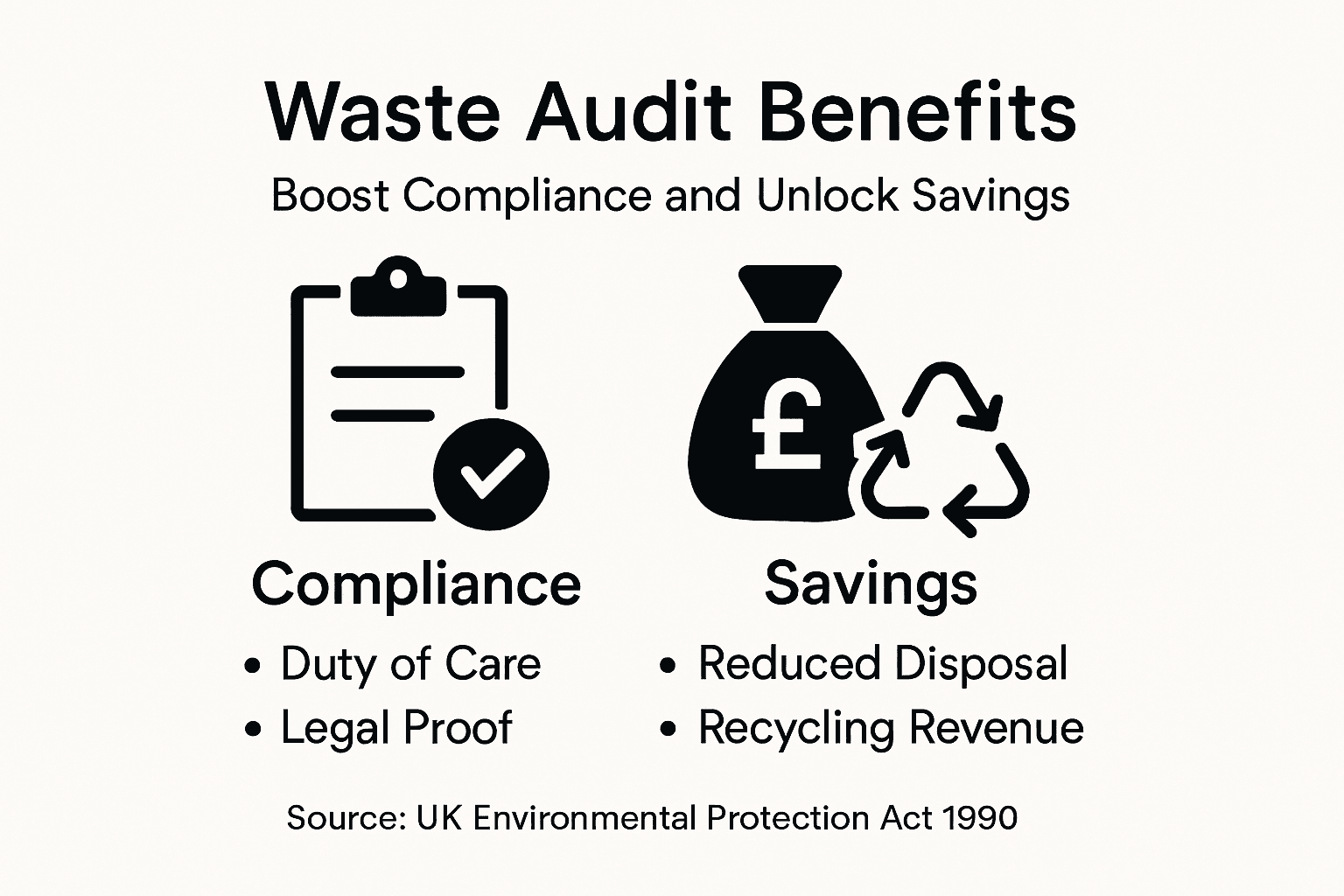
The duty of care creates a cascading responsibility that touches every member of your facilities team. When you produce waste, you become a waste producer with specific obligations. You must classify your waste correctly, store it securely to prevent unauthorised removal or leakage, and only hand it to authorised waste carriers. You cannot simply assume a contractor is legitimate because they offer a competitive price or present themselves professionally. Legal responsibilities require proper documentation and authorised handling throughout the waste management lifecycle, meaning you must maintain records proving that waste left your premises with a licensed carrier who then disposed of it legally. This traceability is your defence against liability if something goes wrong downstream. If waste you handed to a contractor ends up fly-tipped in Sunderland or Newcastle, you need evidence that you fulfilled your duty of care by using a legitimate operator.

Facilities staff reviewing waste duty checklist

Your Specific Institutional Responsibilities

As a facilities manager, your institution’s duties break down into practical, daily actions. You must ensure all waste is properly classified according to its hazard level. Healthcare waste requires different handling than general office waste. Chemical waste from laboratories demands segregation and documentation. You cannot mix waste streams or rely on contractors to sort materials you should have separated. Your team must maintain waste transfer notes for every collection, proving that waste left your building with an authorised carrier and reached its destination. These documents are not paperwork bureaucracy. They are your protection against criminal liability.

Your institution also has a duty to prevent unauthorised persons from accessing your waste. A skip left unlocked overnight where someone deposits illegally dumped materials creates liability for your institution. You must store waste securely, use locked containers when appropriate, and supervise collection to prevent diversion or theft. For hazardous waste, this duty becomes even stricter. You cannot compromise on security or cut corners on storage conditions simply to save money or space.

Breaches of these duties carry real consequences. The Environment Agency prosecutes facilities managers personally, not just institutions, meaning senior staff can face criminal convictions and imprisonment. Your institution faces substantial fines, remediation costs for environmental damage, and reputational harm that affects recruitment, student applications, and public trust.

Pro tip: Create a simple waste management checklist that your team completes weekly, verifying contractor licences are current, transfer notes are filed, and storage areas remain secure and locked—this single document demonstrates your duty of care to regulators and protects your institution from criminal liability.

Effective Prevention Strategies for Facilities

Prevention is far more effective than dealing with the fallout of waste crime. Your facilities team can implement practical strategies that significantly reduce your institution’s legal risk and prevent criminal activity at source. The foundation starts with robust contractor vetting and ongoing monitoring. Before signing any waste management contract, conduct background checks on the company and verify their Environment Agency waste carrier licence independently. Many facilities managers accept documentation provided by contractors, but criminals operate with forged credentials. Ring the Environment Agency directly or check their online register. After contracting, maintain regular contact with your waste provider, requesting proof that collections are occurring on schedule and asking to see their current licensing status quarterly.

Second, implement secure waste storage across your institution. Waste stored in accessible areas overnight or over weekends becomes a target for theft and illegal diversion. Locked containers, fenced enclosures, and restricted access points prevent unauthorised persons from removing waste or depositing illegally dumped materials into your skips. For healthcare facilities handling pharmaceutical or medical waste, segregation and security are not negotiable. Locked storage also demonstrates to regulators that you have implemented reasonable precautions, which strengthens your legal position if something goes wrong. Third, establish a comprehensive waste documentation system. Rigorous auditing and staff training on proper waste management procedures reduce incidents caused by human error. Your team should complete waste transfer notes for every collection, retain copies, and periodically audit them to ensure consistency. These documents prove your institution fulfilled its duty of care.

Infographic showing waste crime prevention strategies

Technology and Surveillance

Technology provides additional layers of protection. Deploying CCTV surveillance to monitor waste storage areas and collection points deters criminal activity and provides evidence if unauthorised dumping occurs. For universities and hospitals in the North East with large waste volumes, consider installing cameras overlooking waste enclosures. The deterrent effect alone prevents opportunistic criminals from targeting your site. Additionally, maintain a waste register documenting the type, quantity, and destination of all waste streams. This register becomes invaluable if investigators later question how your institution managed specific waste. You can quickly prove that hazardous materials were sent to licensed facilities or that general waste reached legitimate landfills.

Finally, engage your entire facilities team through regular training. Staff must understand why waste security matters, how to identify suspicious activities, and what to report. A single employee who questions why a contractor arrived without prior notice might prevent a significant incident. Create a simple reporting mechanism where staff can flag concerns without fear of consequences. When combined with clear procedures and accountability, training transforms your team from passive waste producers into active crime preventers.

Here is a summary of effective prevention strategies and the institutional benefits they offer:

Prevention Strategy Key Action Benefit to Institution
Contractor vetting Independently verify licences Reduces legal risk
Secure storage Lock waste areas and restrict access Prevents theft and illegal dumping
Documentation system Maintain and audit all transfer notes Provides legal defence and traceability
Staff training and awareness Regular education on waste risks Early detection and incident prevention
CCTV and monitoring Use cameras at waste collection points Deters crime and provides evidence

Pro tip: Photograph and document your waste storage area monthly, timestamping images to build a visual record of your security measures and waste management practices—this photographic evidence becomes invaluable if your institution faces enforcement action, proving you maintained proper controls.

Risks and Liabilities for Non-Compliance

The consequences of non-compliance with waste regulations are severe and extend far beyond a simple fine. Your institution faces multiple overlapping liabilities that can cripple operations, drain finances, and damage reputation irreparably. Under UK law, non-compliance exposes organisations to significant legal risks including fines, prosecution, and enforcement notices. These are not abstract legal concepts. They are real penalties enforced by the Environment Agency with criminal conviction records that follow your institution and its managers personally.

Start with financial penalties. The Environmental Protection Act 1990 allows magistrates to impose unlimited fines for serious breaches of waste management duties. A healthcare facility caught disposing of pharmaceutical waste illegally might face fines ranging from tens of thousands to hundreds of thousands of pounds. But fines represent only the beginning. Your institution becomes liable for remedial costs when waste causes environmental contamination. If your waste ends up polluting groundwater or damaging soil, you pay for investigation, assessment, and remediation. These costs spiral quickly. A single fly-tipping incident involving hazardous chemicals discovered in Gateshead or Durham can generate cleanup bills exceeding £50,000. Beyond financial penalties, enforcement officers can issue stop notices requiring your institution to cease specific waste management practices immediately, disrupting operations until you demonstrate compliance. They can also order your institution to take corrective measures at your expense, which might involve hiring environmental consultants or installing new waste infrastructure.

Criminal Liability and Personal Accountability

The most troubling aspect of waste crime non-compliance is personal criminal liability. Facilities managers and senior staff can face prosecution under the Environmental Protection Act. This is not corporate liability that gets absorbed by your institution. This is criminal conviction on your personal record. Depending on offence severity, guilty verdicts can result in imprisonment for up to two years for serious breaches. A facilities manager convicted of knowingly allowing hazardous waste to be dumped faces prison time, loss of professional reputation, and difficulty finding future employment. Your institution must also forfeit vehicles used in illegal waste transport. If a contractor using a vehicle you arranged commits fly-tipping, law enforcement can seize and destroy that vehicle.

Failing to comply with waste management legal obligations can lead to prosecution, enforcement action by regulators, and reputational damage that extends beyond financial penalties. Your institution’s reputation becomes collateral damage. Student recruitment suffers when universities face environmental prosecution. Patient trust diminishes when hospitals are linked to waste crime. Staff morale declines when employees learn their workplace failed basic environmental responsibilities. Insurance companies may refuse to renew coverage for non-compliant facilities, leaving you exposed to uninsured liabilities.

Crucially, your institution bears responsibility not just for direct violations but for due diligence failures in overseeing contracted waste handlers. If you failed to verify a contractor’s licensing or ignored warning signs of illegal activity, you face liability regardless of whether you directly committed the offence. The law presumes you should have known better and taken preventive action. This creates a stark reality: non-compliance is not something that happens to other organisations. It is a realistic risk that demands your constant attention.

Pro tip: Obtain and maintain comprehensive environmental liability insurance that specifically covers waste management risks, ensuring your institution has financial protection if enforcement action occurs despite your best prevention efforts.

Protect Your Institution from Waste Crime with Trusted Waste Solutions

The risk of waste crime brings serious legal challenges for facilities managers in the UK including hefty fines, reputational damage, and personal liability. You must ensure every waste transfer follows strict compliance and is handled by authorised carriers to avoid costly enforcement action. Companies that cut corners with unlicensed operators put your institution at risk of penalties and environmental harm. At Venture Waste Management, we understand these challenges and provide fully licensed, transparent waste services designed to meet your duty of care obligations and safeguard your organisation against waste crime.

https://venturewaste.co.uk

Take control of your waste management with our straightforward approach. Explore how the waste collection process in the UK for businesses supports compliant and secure transfers. Learn more about how the waste collection network in UK serves businesses in 2025 to ensure your waste is handled responsibly from start to finish. Visit Venture Waste today for reliable, fully licensed waste management solutions that protect your legal interests and promote environmental safety. Act now to secure your institution’s future and avoid the devastating consequences of waste crime.

Frequently Asked Questions

What constitutes waste crime in the UK?

Waste crime includes the unlawful disposal, handling, or transportation of waste materials that violate environmental legislation, such as fly-tipping, fraudulent waste management activities, and unauthorized waste treatment.

How can organisations prevent waste crime?

Organisations can prevent waste crime by implementing robust contractor vetting processes, maintaining secure waste storage, creating comprehensive documentation systems, and providing regular staff training on waste management procedures.

Facilities managers must ensure waste is properly classified, securely stored, handed over to licensed carriers, and that thorough records are maintained to demonstrate compliance with the duty of care under UK waste regulations.

What are the potential consequences of failing to comply with waste regulations?

Consequences of non-compliance may include significant financial penalties, remediation costs for environmental damage, potential criminal liability for managers, and reputational harm to the institution, impacting recruitment and public trust.

Facilities manager reviews recycling checklist

Business Recycling Obligations for UK Healthcare

Sorting bins in a busy hospital corridor is becoming more than just a daily routine. The new Simpler Recycling rules, active since 31 March 2025, set out mandatory steps for separating recyclable waste across all healthcare facilities in England. Facilities managers must adapt quickly to avoid fines, protect public trust, and keep up with strict legal duties. This guide clarifies business recycling obligations, showing how to handle key waste streams and support safe, compliant operations in every corner of your site.

Table of Contents

Key Takeaways

Point Details
Compliance Deadline Healthcare organisations must comply with the new recycling obligations by 31 March 2025, or face penalties; micro-businesses have until 31 March 2027.
Waste Separation Requirements Facilities must establish distinct waste streams for dry recyclables, paper and cardboard, and food waste to comply with Simpler Recycling rules.
Risks of Non-Compliance Non-compliance can lead to criminal prosecution, significant financial penalties, and reputational damage, impacting public trust in healthcare facilities.
Documented Compliance Strategy Maintain thorough documentation of waste management practices, staff training, and contractor agreements to demonstrate compliance efforts if regulations are questioned.

Defining Business Recycling Obligations in the UK

Business recycling obligations in the UK have undergone significant changes, particularly with the introduction of the Simpler Recycling rules that came into effect on 31 March 2025. These regulations establish clear, mandatory requirements for how organisations must manage their waste streams. For healthcare facilities, understanding these obligations is not optional—it directly impacts your operational compliance, environmental responsibility, and potential penalties. The rules apply to all workplaces across various sectors, including health and social care settings, and establish a standardised approach to waste separation that you’ll need to implement across your entire facility.

Under the new legislation, healthcare organisations must now separate recyclable waste before collection. This means your facility needs to establish distinct waste streams for three primary categories: dry recyclables (plastic, metal, and glass), paper and cardboard, and food waste. Each of these must be kept separate at source, rather than being mixed together for collection. What makes this different from previous arrangements is the specificity—paper and cardboard cannot be mixed with other dry recyclables, and food waste must be completely isolated from dry materials. For healthcare facilities in areas like Newcastle, Durham, or Sunderland, this often means reassessing your current waste management infrastructure and potentially investing in additional bins and collection systems to accommodate these separate streams.

The compliance timeline matters significantly for your facility’s planning. If your healthcare organisation employs 10 or more full-time equivalent staff members, you must comply by 31 March 2025. However, if you operate as a micro-business with fewer than 10 employees, you have an extended deadline until 31 March 2027 to comply with workplace recycling requirements. This two-year extension applies only to genuinely smaller operations, so you’ll want to verify your staff headcount carefully. Non-compliance carries consequences, including potential enforcement action and reputational damage, which is particularly sensitive for healthcare providers where public trust matters enormously.

Implementing these obligations effectively requires auditing your current waste arrangements and identifying gaps. Start by mapping where waste is currently generated in your facility—clinical areas, staff rooms, administrative offices, patient reception areas—and determine which waste streams are produced in each location. You’ll need sufficient capacity for each waste type, clearly labelled containers to prevent cross-contamination, and staff training to ensure consistent separation. Consider how your waste collection contractor will access and transport these separate streams; this might require adjusting collection schedules or finding a provider who specialises in healthcare waste management and understands the unique challenges of clinical environments.

Pro tip Conduct a waste audit before 31 March 2025 to identify exactly what materials flow through your facility, then design your separation system based on actual volumes rather than assumptions—this prevents over-investing in containers you won’t fill and under-sizing those you will.

Key Waste Streams in Healthcare Facilities

Healthcare facilities generate multiple distinct waste streams, each requiring different handling procedures and disposal methods. Understanding these streams is essential for your facility to comply with current regulations and maintain safe operations. The waste produced in healthcare settings falls into three broad categories: clinical and medical waste, pharmaceutical waste, and household-like recyclables. Each stream carries different risks and regulatory requirements, and mishandling any of them can result in infections, environmental contamination, and legal penalties. For facilities managers across the UK, from busy hospitals in Newcastle to smaller clinics in Durham, recognising these streams forms the foundation of effective waste management.

Clinical and medical waste represents the highest-risk stream in your facility. This includes items contaminated with bodily fluids, such as bandages, syringes, swabs, and blood-stained dressings. It also encompasses sharps like needles, scalpels, and broken glass that pose injury risks. Pharmaceutical waste includes expired medications, unused drugs, and chemotherapy waste that require specialist disposal. These two streams must be kept completely separate from all other waste because they pose infection risks and environmental hazards. Healthcare waste categorisation helps reduce infection risks and ensures compliance with health and safety legislation. Your facility must have dedicated containers, clearly marked and colour-coded, to prevent cross-contamination. Clinical and pharmaceutical waste cannot be mixed with recyclables under any circumstances, even if they appear clean.

Staff transporting medical waste bin in hospital

Household-like recyclables form your third major waste stream and represent the materials now covered by Simpler Recycling obligations. These include materials generated by staff, patients, and visitors during everyday activities: food waste from patient meals and staff areas, paper and cardboard from packaging and administrative work, plastic bottles and containers from drinks and products, glass bottles and jars from beverages, and metal cans and tins. These materials require separation at source into distinct categories. Food waste must remain completely separate from dry recyclables like paper, plastic, metal, and glass. In a typical healthcare facility in Leeds or Manchester, you might generate significant volumes of food waste from patient catering operations alone, making this stream particularly important to manage efficiently.

The distinction between these streams matters because each requires completely different collection, transportation, and disposal routes. Clinical waste demands specialist incineration facilities, pharmaceutical waste requires licensed disposal contractors with specific expertise, whilst household-like recyclables go to standard recycling operations. Many facilities managers mistakenly assume they can combine some streams to simplify collection, but this creates serious compliance issues. Recycling best practices for UK healthcare facilities provide guidance on implementing proper separation systems without compromising infection control. Your waste management contractor should understand these distinctions thoroughly and provide separate collections for each stream.

Here’s a quick summary of the three main healthcare waste streams and their associated risks:

Waste Stream Examples Risks and Consequences Required Disposal Method
Clinical and Medical Waste Bandages, syringes, dressings Infection, injury, contamination Specialist incineration
Pharmaceutical Waste Expired drugs, chemotherapy waste Environmental hazard, legal risk Licensed disposal contractor
Household-like Recyclables Food waste, packaging, bottles Contamination, non-compliance Standard recycling operations

Pro tip Create a simple visual guide showing staff where each type of waste belongs, using photographs of actual items rather than just text labels—this dramatically improves segregation accuracy and reduces contamination of your recycling streams.

The Simpler Recycling law represents a fundamental shift in your legal obligations as a healthcare facilities manager. From 31 March 2025, the law is not advisory—it is mandatory, and non-compliance carries serious consequences. Your healthcare organisation must legally separate dry recyclable materials, food waste, and residual waste before collection. This applies to hospitals, GP surgeries, clinics, and any healthcare setting that produces waste similar to household waste. The legislation covers workplaces across England, affecting facilities in Sunderland, Middlesbrough, and every healthcare provider between. Ignoring these duties is not an option; the law imposes specific obligations on your organisation and potential criminal liability if you fail to meet them.

Your facility has two primary routes to compliance under the law. You can either provide suitable, separate bins on your premises for staff and visitors to use for different waste types, or you can ensure your waste contractor complies with separation requirements on your behalf. Many facilities managers assume the second option means they have no responsibility, but that is incorrect. Even if your contractor handles the separation, you remain legally accountable for ensuring it happens. Legally separate recyclable materials means the law explicitly requires either your facility or your contractor to divide waste streams before disposal. You cannot simply dump all waste together and hope the contractor sorts it later. This places a direct duty on your organisation to verify your waste management arrangements meet legal standards.

Compare the two compliance options under Simpler Recycling law:

Compliance Route Facility Actions Contractor’s Responsibility Accountability
On-site Separation Install separate bins, train staff Collect pre-separated streams Facility remains liable
Contractor Separation Verify contractor’s procedures and records Separate waste before disposal Facility still responsible

Non-compliance carries enforcement mechanisms that should concern any facilities manager. Regulatory bodies can issue compliance notices requiring you to rectify breaches within specified timeframes. Failure to comply with a compliance notice can result in criminal prosecution. Prosecution could lead to unlimited fines and reputational damage that affects patient and staff confidence in your facility. For healthcare organisations, reputation matters enormously—families choosing between hospitals or GP surgeries consider cleanliness and environmental responsibility. Beyond legal penalties, non-compliance demonstrates poor governance to regulators, inspectors, and accreditation bodies. Your board and senior leadership bear ultimate responsibility for ensuring the organisation meets these legal duties.

Implementing compliance requires clear internal documentation. You need written procedures showing how your facility achieves separation, staff training records demonstrating staff understand the requirements, and contracts with waste contractors that explicitly require compliance. Document your verification process—how you confirm your contractor is actually separating waste as promised. Site visits to your contractor’s facilities, photographic evidence of separate containers, and regular audits of your waste management system all provide documented proof of due diligence. If a regulator investigates, this documentation protects your organisation by demonstrating you took reasonable steps to comply. For facilities in busy areas like Newcastle or smaller operations in rural locations, the practical steps are identical: document everything, verify compliance, and maintain records.

Pro tip Request written confirmation from your waste contractor that they comply with Simpler Recycling requirements, then conduct quarterly audits by collecting photographic evidence of separated waste streams at their facility—this creates a paper trail proving your due diligence if regulators ever question your compliance.

Steps to Achieve Full Regulatory Compliance

Achieving compliance with Simpler Recycling is not something you can approach haphazardly. You need a structured, methodical plan that addresses every aspect of your facility’s waste management system. The process begins months before the March 2025 deadline, not days before. Your first step is conducting a thorough audit of your current waste disposal practices. Walk through your facility in Sunderland, Newcastle, Leeds, or wherever you operate and observe exactly what waste is being generated, where it originates, and how it is currently handled. Examine your kitchens, clinical areas, staff rooms, administrative offices, and patient reception zones. Document existing bin arrangements, capacity levels, and current contractor relationships. This baseline assessment reveals the gaps between where you are now and where you need to be.

Once you understand your current situation, you must implement a comprehensive waste segregation system. This means installing distinct containers for food waste, paper and cardboard, dry recyclables, and residual waste in every location where waste is generated. Comprehensive waste segregation systems require proper placement and capacity planning to prevent overflowing bins that undermine your entire compliance effort. Each container must be clearly labelled with visual graphics showing what belongs inside. Colour coding helps staff intuitively understand the system without reading text. For clinical areas, your segregation must never compromise infection control protocols, so work with infection prevention specialists to design systems that meet both recycling and safety requirements. Beyond containers, you need signage throughout your facility explaining the separation requirements in simple, direct language. Poor signage is one of the leading causes of contamination in new recycling systems.

Staff education forms the backbone of any successful waste separation programme. Your team members must understand not just what to separate, but why separation matters. Conduct mandatory training sessions for all staff, contractors, cleaners, and anyone who handles waste. Include specific guidance on avoiding contamination, such as ensuring food waste does not touch dry recyclables and that sharps never enter recycling streams. Create refresher training schedules to reinforce these messages quarterly. Staff turnover means new employees arrive constantly, so you need an induction programme that covers waste management alongside other essential training. Test staff understanding through simple quizzes or observations to identify individuals or areas requiring additional support.

Infographic on staff recycling education in healthcare

Formalising your waste collection arrangements requires reviewing your current contractor relationships and ensuring they meet legal requirements. You need a licensed waste contractor who explicitly understands healthcare waste management and can handle separate streams appropriately. Get written confirmation that they comply with Simpler Recycling obligations. Establish clear collection schedules that prevent bin overflow. Maintain detailed records documenting your compliance efforts, contractor certifications, staff training completion, and any incidents or contamination issues you identify. These records prove your due diligence if regulators ever question your compliance. Schedule periodic reviews of your system monthly initially, then quarterly once established, to identify problems early and make adjustments before they become serious issues.

Pro tip Create a simple waste management checklist that staff complete weekly, recording bin fill levels and any contamination observed, then review these checklists monthly to identify patterns like specific areas struggling with separation—this identifies problem zones before inspectors do.

Enforcement Measures and Penalties for Breaches

The Environment Agency takes enforcement of Simpler Recycling seriously. This is not a regulation where regulators issue gentle reminders or overlook minor infractions. If your healthcare facility fails to comply with waste separation requirements, you face real consequences that extend beyond financial penalties. The enforcement process typically begins with the Environment Agency identifying a breach through inspection, complaint, or routine monitoring. Once they identify non-compliance, they issue a formal compliance notice requiring you to rectify the breach within a specified timeframe. This notice is not negotiable. It establishes a legal obligation to take specific corrective actions by a defined deadline. For facilities managers, receiving a compliance notice represents a serious governance failure that your board will want to understand immediately.

Failure to comply with a compliance notice escalates the matter significantly. Non-compliance with a notice becomes a criminal offence under environmental law. This means the Environment Agency can pursue prosecution through the courts, not just administrative penalties. Enforcement actions for recycling breaches can result in criminal prosecution and substantial financial penalties. The fines are not capped at token amounts either. Prosecution can lead to unlimited financial penalties, which for a larger healthcare organisation could run into hundreds of thousands of pounds. Beyond the direct financial cost, a criminal conviction creates reputational damage that affects staff morale, patient confidence, and relationships with local communities. For healthcare organisations where trust is fundamental to your mission, this reputational harm can be more damaging than the financial penalty itself.

The penalties extend beyond fines imposed by courts. A criminal conviction or sustained pattern of non-compliance affects your operational standing with regulators. The Care Quality Commission, NHS England, and other oversight bodies note enforcement actions in their assessments of your organisation. This can influence accreditation decisions, funding allocations, and contractual relationships. Staff recruitment becomes harder when your organisation is known for poor environmental compliance. Patients and their families may question your commitment to responsibility and safety. Waste contractors become reluctant to work with non-compliant organisations because they face their own liability for breaches. Insurance providers may increase premiums or restrict coverage. What begins as a simple failure to separate waste properly cascades into broader operational and financial consequences.

The best approach is avoiding enforcement entirely through proactive, documented compliance. Begin your compliance journey immediately, not in March 2025. Document every step: your waste audits, staff training records, contractor agreements specifying compliance obligations, bin installation photographs, signage creation and placement, staff competency assessments, and regular monitoring reports. Create a compliance file that demonstrates your due diligence to regulators. This documentation protects your organisation if the Environment Agency ever investigates by showing you took reasonable steps to comply. Conduct internal audits to identify problems before external regulators do. If you discover breaches during your own audits, correct them promptly and document the corrections. Regulators view organisations that self-identify and self-correct far more favourably than those discovered through enforcement action.

Pro tip Appoint a named waste compliance officer responsible for monthly audits and reporting directly to your board, then maintain detailed meeting minutes showing board awareness and oversight—this evidence of governance protects your organisation if enforcement ever occurs and demonstrates you took breaches seriously.

Simplify Your Healthcare Facility’s Recycling Compliance with Venture Waste

Navigating the complex recycling obligations for UK healthcare organisations can feel overwhelming. The new Simpler Recycling rules demand strict separation of dry recyclables, paper, cardboard and food waste right at the source. Facilities managers face challenges like managing multiple waste streams, training staff effectively and ensuring documentation meets legal standards. If your healthcare setting operates in Newcastle, Durham or elsewhere in the UK, you need a reliable partner to help streamline these processes and avoid costly enforcement actions.

Venture Waste provides expert support tailored to healthcare facilities to meet these requirements seamlessly. Our service focuses on clear waste segregation systems, staff education support and transparent, compliant waste collection. Familiarise yourself with the Waste Collection Process in the UK for Businesses 2025 – Venture Waste to understand how we align with evolving regulations. We work closely with your team to ensure your waste contractor fully complies and that you maintain thorough records of all recycling efforts.

https://venturewaste.co.uk

Stay ahead of compliance and protect your organisation from legal risks and reputational damage. Visit Venture Waste today to discover how our efficient and compliant waste collection solutions can support your healthcare facility’s recycling obligations. Learn more about How the Waste Collection Network in UK Serves Businesses in 2025 – Venture Waste and take the first step in safeguarding your facility’s environmental responsibility with confidence.

Frequently Asked Questions

What are the new recycling obligations for healthcare facilities in the UK?

The new recycling obligations require healthcare facilities to separate their recyclable waste before collection into three main categories: dry recyclables (plastic, metal, and glass), paper and cardboard, and food waste. These regulations take effect on 31 March 2025.

How can healthcare organisations prepare for the compliance deadline?

Healthcare organisations can prepare by conducting a waste audit to assess current waste generation and disposal methods. They should also implement a comprehensive waste segregation system, train staff on separation requirements, and establish clear collection schedules with licensed waste contractors.

What types of waste must be kept separate in healthcare settings?

Clinical and medical waste, pharmaceutical waste, and household-like recyclables are the main types of waste that must be kept separate. Clinical waste includes contaminated items like bandages and sharps, while pharmaceutical waste covers expired medications. Household recyclables include food waste, paper, and packaging materials.

What are the penalties for non-compliance with recycling regulations?

Non-compliance can result in serious penalties, including enforcement notices from regulatory bodies, criminal prosecution, and substantial financial fines. Facilities may also suffer reputational damage, affecting patient trust and operational viability.

Cleaner arranging colour-coded recycling bins

Recycling Best Practices for UK Healthcare Facilities

Waste management often feels overwhelming for facility managers in British hospitals and clinics, especially when multiple departments produce diverse materials daily. With NHS providers generating approximately 156,000 tonnes of clinical waste every year in England, the impact of recycling choices is substantial and far-reaching. Understanding and refining your recycling practices can help your institution improve sustainability and stay compliant with strict UK environmental regulations. This article guides you through practical, proven steps to assess, implement, and monitor recycling processes for healthcare facilities.

Table of Contents

Quick Summary

Key Point Explanation
1. Assess your waste streams first Conduct a thorough evaluation of all waste types, volumes, and disposal methods to identify recycling opportunities and needed changes.
2. Implement clear recycling protocols Establish specific procedures and signage for waste disposal to ensure staff understand their responsibilities and the proper waste segregation process.
3. Provide ongoing staff training Develop a structured training programme on waste management principles, ensuring all employees are familiar with recycling protocols and best practices.
4. Regularly monitor and adjust processes Track waste outputs and contamination rates frequently, allowing for data-driven adjustments to recycling practices and improvement measures.
5. Ensure compliance with regulations Identify applicable waste management regulations and conduct audits to ensure practices align with legal requirements and sustainability goals.

Step 1: Assess current waste streams and needs

Assessing your current waste streams is the foundation of any effective recycling programme in your healthcare facility. Without understanding what you’re throwing away, how much of it there is, and where it comes from, you cannot make informed decisions about waste reduction or recycling improvements. This step involves gathering data on your facility’s waste types, volumes, and disposal methods to identify opportunities for change.

Start by mapping out every waste stream your facility produces. Healthcare facilities typically generate multiple types of waste that require different handling and disposal methods. Clinical waste, general waste, packaging, paper and cardboard, glass bottles, metal cans, and confidential documents all represent distinct streams with varying environmental impacts. The NHS clinical waste strategy emphasises that NHS providers across England produce approximately 156,000 tonnes of clinical waste annually, highlighting just how significant waste management is at scale. Walk through your facility with a notebook or tablet and observe where waste is generated. Visit your departments, theatres, wards, offices, and break rooms. Notice what bins exist, what gets thrown into them, and what could potentially be diverted to recycling. In Newcastle, Durham, or across other regions where Venture Waste operates, healthcare facilities often discover surprising amounts of recyclable material mixed into general waste streams simply because staff lack clear guidance or convenient segregation options.

Next, quantify your waste volumes. Work with your waste management provider or conduct your own measurements over a representative period, typically two to four weeks. Weigh or estimate the volume of each waste stream daily, then calculate weekly and monthly totals. Different waste streams vary greatly in their environmental impact, so understanding which waste types dominate your facility helps you prioritise efforts where they matter most. Engage key staff members in this assessment. Speak with porters, domestic staff, laboratory technicians, and ward managers who understand where waste is actually generated and why certain disposal choices are made. They often have insights that managers miss. Collect any existing data from your current waste contractor or previous audits. This historical information provides context for your current situation and reveals trends.

Once you’ve gathered this information, create a simple summary document. List each waste stream, its estimated monthly volume, current disposal method, and any obvious segregation problems. For example, you might discover that your facilities generate 2,000 kilograms of mixed recyclables monthly but only 300 kilograms are actually being recycled because bins are unclear or positioned inconveniently. This assessment becomes your baseline for measuring future improvements and informs all subsequent decisions about where to focus your recycling programme.

Here is a summary of typical healthcare waste streams and the challenges associated with their management:

Waste Stream Typical Volume (kg/month) Key Management Challenge
Clinical waste 2,500 High disposal cost, regulatory control
General waste 4,000 Frequent contamination by recyclables
Mixed recyclables 2,000 Low recycling rate, poor segregation
Paper and cardboard 800 Missed recycling due to unclear bin labels
Confidential documents 120 Risk of information breaches
Glass bottles 300 Requires separate safe handling
Metal cans 100 Frequently binned with general waste

Professional tip Schedule your waste stream assessment during a typical operational week rather than a holiday period or maintenance shutdown, as this captures genuine usage patterns and reflects how staff naturally sort waste under normal working conditions.

Step 2: Implement clear recycling protocols

Clear recycling protocols transform good intentions into consistent action across your entire healthcare facility. Without defined procedures and visible guidance, staff revert to guesswork, resulting in contaminated waste streams and failed recycling efforts. This step involves creating straightforward, written protocols that specify exactly what goes where, who is responsible, and how often collections occur.

Begin by designing your colour coded or labelled bin system based on your facility’s waste streams. Most UK healthcare facilities use standardised systems, though your specific combination depends on what you identified during your waste assessment. Yellow bins typically receive clinical waste, black bins hold general waste, blue or green containers collect paper and cardboard, and clear bags often hold mixed recyclables. Your waste handling best practices should align with established standards like Health Technical Memorandum 07-01, which provides comprehensive guidance on segregating waste correctly at source to reduce contamination. Install these bins strategically throughout your facility. Place them where waste is actually generated rather than in distant centralised locations. A ward that must carry recyclables fifty metres to a collection point will simply use the nearest bin instead. In cities like Leeds, Manchester, or smaller hospitals across the North East, facilities that implemented proximity based bin placement saw recycling compliance increase by 40 percent or more. Create laminated instruction cards for each bin type. Use simple icons and plain language to explain what items belong in each container. For example, your recyclables card might show that syringes go in yellow clinical waste, but plastic bottles go in the clear mixed recycling container. Include examples of items that commonly get sorted incorrectly, such as needles or sharps containers being mistakenly placed in recycling bins.

Nurse sorting recyclable healthcare waste

Establish collection schedules and communicate them clearly to all staff. Specify which waste streams are collected daily, weekly, or on demand. Create a collection log or checklist that porters and waste handlers can initial, creating accountability and revealing if bins are being overfilled or skipped. Assign clear responsibilities. Designate specific individuals or teams to monitor bin integrity, replace full bags, report contamination issues, and ensure protocols are followed. In busy environments, responsibility without accountability simply does not work. Provide training for all new and existing staff. A five minute induction covering bin locations, what goes where, and why proper segregation matters will dramatically improve compliance. Schedule refresher training annually or when procedures change. Document your protocols in a simple one page waste segregation guide that every staff member receives. Finally, monitor your system monthly. Check each bin type for contamination, review your waste contractor’s reports for comments about contaminated loads, and gather feedback from frontline staff about what is working and what is confusing. This data allows you to refine your protocols based on real usage patterns rather than assumptions.

Professional tip Photograph or video record your correctly sorted bins and use these images on instruction cards and staff notice boards, as visual examples of proper segregation prove far more effective than written descriptions alone.

Step 3: Train staff on recycling best practices

Your recycling protocols mean nothing if staff do not understand them or feel unprepared to follow them. Training transforms your written procedures into actual workplace behaviour. This step involves creating a structured training programme that reaches every member of your team, from porters and domestic staff to clinicians and administrators, ensuring everyone grasps their role in your facility’s recycling success.

Develop a training curriculum that covers three core areas. First, explain the segregation rules your facility uses, making clear why each waste type goes into specific containers and what happens to waste after collection. Second, communicate the environmental and financial impact of proper waste management. Staff who understand that better segregation reduces your facility’s disposal costs and carbon footprint tend to maintain better compliance over time. Third, provide practical demonstration of correct sorting using real examples from your facility. The Royal College of Physicians emphasises that training healthcare staff on waste reduction significantly improves compliance and sustainability outcomes across NHS trusts. Schedule your initial training sessions during staff induction, making recycling protocols part of standard onboarding rather than an optional topic. New staff are most receptive to learning new systems before bad habits form. In busy hospital environments across Sunderland, Newcastle, Durham, and other regions, facilities that integrated recycling training into mandatory induction saw first year participation rates above 85 percent. Keep your training sessions short and frequent rather than lengthy and infrequent. A twenty minute session works better than a two hour workshop. Use visual aids and practical demonstrations. Show staff the actual bins they will use, walk them through real sorting scenarios, and let them practise with mock waste items. Provide take home reference cards that staff can keep at their workstations. These laminated cards reduce questions and serve as quick reminders without requiring staff to recall training from weeks prior.

Make training ongoing rather than one time. Staff engagement and continued training remain essential for embedding best practices and improving compliance with waste segregation protocols according to the NHS clinical waste strategy. Schedule refresher sessions annually and whenever you change protocols. Use these sessions to address common mistakes you have observed and celebrate improvements in your recycling metrics. Invite frontline staff to share their suggestions for improving the system. Staff who work with waste daily often spot inefficiencies that managers miss. Create a feedback mechanism where staff can report confusing bins, faulty equipment, or contamination issues. Assign someone to monitor this feedback and respond promptly. When staff see their suggestions implemented, they feel valued and maintain higher engagement with the programme. Track your training completion and measure its impact. Document who has been trained and when. After training, monitor your contamination rates and waste volumes to see whether behaviour has actually changed. If compliance does not improve, investigate whether staff understood the training or whether practical barriers exist. Perhaps bins are inconveniently located or instructions remain unclear despite training. Address the root cause rather than assuming staff simply will not cooperate.

Professional tip Use colour coded training materials and practical demonstrations that match your actual bin system, as staff will retain information far better when they train with the exact equipment they will use daily rather than generic examples.

Step 4: Monitor waste outputs and adjust processes

Monitoring transforms your recycling programme from a static set of rules into a dynamic system that continuously improves. Without regular measurement and analysis, you cannot identify what is working, what is failing, or where to focus your improvement efforts. This step involves establishing systematic tracking of your waste outputs, analysing the data you collect, and making evidence based adjustments to your protocols.

Begin by establishing baseline measurements before or immediately after implementing your new recycling protocols. Work with your waste contractor to obtain accurate data on total waste volumes, waste composition by stream, and contamination rates. Ask your contractor for reports that break down what percentage of your recycling loads are actually contaminated versus genuinely recyclable. Request monthly reports rather than waiting for annual summaries. Monthly data allows you to spot problems quickly and make timely adjustments. Implement data led compliance tracking to gather accurate waste data and identify weak points in segregation and disposal practices. Consider adopting digital tracking systems if your facility’s budget allows. Simple spreadsheets work perfectly well for smaller facilities, recording daily bin weights and contamination incidents. Many waste contractors now offer digital dashboards that show your facility’s performance in real time. Conduct monthly bin audits where you physically inspect each waste stream for contamination. Open a sample of bags from each bin type and document what you find. If your yellow clinical waste bin contains plastic bottles or paper, you have a segregation problem. If your recycling bin contains syringes or clinical items, staff need retraining. These audits reveal exactly where training is failing and which departments need additional support. In hospitals across Gateshead, Leeds, and Manchester that conduct monthly audits, contamination rates typically drop 30 to 50 percent within the first six months.

The table below contrasts manual and digital waste monitoring approaches in healthcare facilities:

Monitoring Approach Benefits Drawbacks
Manual records Low cost, easy to implement Time-consuming, error-prone
Digital dashboards Real-time data, quick analysis Tech investment required
Bin audits Identifies real behaviours Labour intensive, disruptive

Analyse your data monthly and look for patterns. Are certain departments consistently contaminating their bins? Are specific waste types frequently misplaced? Does contamination spike after staff holidays or on particular days of the week? These patterns guide your corrective actions. If one ward consistently has problems, provide targeted retraining for that team. If contamination spikes on Mondays, perhaps your weekend staffing requires different protocols. Share your findings transparently with your team. Create simple monthly reports showing total waste volumes, recycling rates, contamination incidents, and cost per kilogram of waste. Celebrate improvements publicly. When staff see that their efforts resulted in 15 percent less waste or lower disposal costs, they remain motivated. The NHS clinical waste strategy emphasises annual reviews of system performance against national waste and carbon reduction targets, ensuring waste management practices remain effective, compliant, and continuously improving. Adjust your processes based on what your data reveals. If contamination remains high despite training, perhaps your bin placement needs adjustment or your instruction cards require clearer language. If specific waste types consistently get misplaced, introduce colour coded labels or pictorial guides. If a particular department struggles, assign them a dedicated waste champion who monitors compliance daily. Make changes incrementally and measure their impact. Avoid changing everything simultaneously, as this makes it impossible to determine which adjustments actually worked. Revisit your initial baseline metrics annually and measure your overall progress toward waste reduction and recycling goals.

Infographic summarising 5 recycling steps in UK healthcare

Professional tip Establish a waste management working group that meets quarterly to review monitoring data, discuss findings, and jointly decide on process adjustments, as this collaborative approach ensures staff ownership and identifies practical barriers that data alone might not reveal.

Step 5: Verify compliance with UK regulations

Compliance with UK regulations is not optional for healthcare facilities. Failing to meet legal requirements exposes your organisation to enforcement action, financial penalties, and reputational damage. This step involves understanding which regulations apply to your waste streams, auditing your current practices against those standards, and documenting your compliance efforts systematically.

Start by identifying which regulations govern your healthcare facility’s waste management. The primary framework includes the Environmental Protection Act 1990, the Hazardous Waste Regulations 2005, the Duty of Care Regulations, and the Health and Safety at Work Act 1974. Clinical waste specifically falls under additional requirements. The Health and Safety Executive provides guidance on legal and practical requirements for healthcare waste management, outlining compliance with health and safety legislation, waste legislation, and transport legislation to protect patients, staff, and the environment. Beyond these baseline regulations, your facility must comply with local authority requirements, which vary slightly across different UK regions and council areas. Get a copy of Health Technical Memorandum 07-01, which is the definitive technical standard for NHS waste management. Even if your facility is not NHS operated, this document sets the gold standard that regulators and enforcement officers expect healthcare providers to meet. Read through HTM 07-01 carefully or assign someone to do so and summarise the key requirements for your facility. In hospitals across Sunderland, Newcastle, and other North Eastern regions, facility managers often find that HTM 07-01 provides the clarity they need to translate vague regulations into specific, measurable actions.

Conduct a compliance audit by comparing your current practices against regulatory requirements. Create a checklist covering waste segregation procedures, storage requirements, handling protocols, transport arrangements, disposal methods, staff training records, and documentation systems. For each item, record whether you fully comply, partially comply, or do not comply. If you do not comply, identify what needs to change and who is responsible for making that change. Healthcare waste management regulations detailed in HTM 07-01 support organisations in meeting legal obligations for waste segregation, handling, storage, transport, and disposal, serving as the regulatory framework for compliance with national standards. Document everything meticulously. Keep records of your waste contractor’s certifications and accreditations. Maintain training records showing when staff completed induction and refresher training. Document your waste assessments, your segregation protocols, your monitoring data, and any corrective actions you implemented. These records demonstrate your due diligence if an inspector visits or if a problem arises. Regulators want to see that you took waste management seriously and took documented steps to comply. Work closely with your waste management contractor. Verify that they hold the appropriate waste handling licenses and that their facilities meet legal standards. Ask them about their accreditations and compliance history. Ensure your waste contractor provides you with duty of care documentation for each waste collection, proving that waste reached an authorised treatment facility. Review your contracts to confirm they include appropriate liability clauses and compliance warranties. Many enforcement actions against healthcare facilities actually result from using inadequate contractors rather than from facility level failures.

Conduct your compliance audit annually or whenever regulations change. Regulations governing healthcare waste evolve periodically, so staying current requires active monitoring. Subscribe to updates from the Health and Safety Executive, your local authority, and your waste contractor. If new requirements emerge, assess their impact on your facility and adjust your procedures promptly. Keep written records of your compliance verification efforts. If an inspector asks to see your compliance documentation, you should be able to produce evidence that you systematically assessed your practices, identified gaps, and took corrective action. This documentation proves you operated in good faith and took compliance seriously, which regulators view favourably.

Professional tip Assign compliance verification to a specific staff member or team rather than expecting it to happen organically, and schedule an annual compliance review meeting with key stakeholders including your waste contractor, facilities manager, and a health and safety representative to ensure nothing slips through the cracks.

Elevate Your Healthcare Facility’s Recycling Programme Today

Managing diverse and complex waste streams within healthcare settings requires clear protocols, staff training, meticulous monitoring and strict compliance—all essential to reduce contamination and meet regulatory standards. If you are striving to overcome challenges like confusing segregation, inefficient waste collection, or compliance gaps, Venture Waste Management offers tailored solutions designed for UK healthcare providers looking to enhance their recycling best practices.

Our comprehensive services include dependable general waste collection, confidential document destruction to safeguard sensitive information, and expert guidance on hazardous waste handling. Supported by a strong national presence detailed in How the Waste Collection Network in UK Serves Businesses in 2025 – Venture Waste and specialised confidential waste services in confidential waste Archives – Venture Waste we ensure your waste is managed securely and sustainably.

https://venturewaste.co.uk

Do not let waste management challenges compromise your facility’s environmental goals or legal compliance. Visit Venture Waste Management now to book your personalised assessment and start implementing robust recycling practices that protect patients, staff and the planet. Take the first step to make your healthcare facility a model of responsible waste stewardship.

Frequently Asked Questions

How can I assess the waste streams in my healthcare facility?

Assessing your waste streams involves gathering data on the types, volumes, and disposal methods of your waste. Schedule a thorough walk-through of your facility, documenting what waste is generated in different areas for two to four weeks to create a comprehensive overview of your waste situation.

What should be included in recycling protocols for health facilities?

Your recycling protocols should include a clear description of each waste type, its designated bin, and the responsibilities of staff regarding waste disposal. Create laminated instruction cards and strategically place bins throughout your facility to make compliance easier and more efficient.

How can I ensure staff are properly trained on recycling best practices?

To ensure staff are knowledgeable about recycling, implement a structured training programme covering segregation rules, environmental impacts, and practical demonstrations. Schedule training sessions during staff induction and provide ongoing refresher courses annually to reinforce good habits and compliance.

What metrics should I monitor to evaluate the success of my recycling programme?

Monitor waste volumes, recycling rates, and contamination incidents to evaluate your programme’s effectiveness. Conduct monthly audits and provide clear feedback to staff about their recycling efforts; aim for at least a 20% reduction in contamination rates within the first six months.

How do I verify compliance with UK waste management regulations?

To verify compliance, regularly audit your waste management practices against the relevant regulations and document any findings. Assign a staff member to oversee compliance efforts, and ensure all training, waste assessments, and contractor documentation are systematically recorded to demonstrate due diligence.

What should I do if I identify contamination issues in my waste disposal?

If you identify contamination issues, conduct targeted retraining for the staff members in the affected areas. Review bin placement and visual instructions, and monitor the improvements regularly to measure effectiveness and sustain compliance.

Business team meeting about waste audit process

Waste Audits for Businesses: Boosting Compliance and Savings

Every facility manager knows that, in the UK healthcare sector, waste can quickly become more than just a nuisance if left unchecked. Without a clear understanding of your waste streams, hidden costs and compliance risks may undermine your operational goals. Comprehensive waste audits shine a light on exactly what your facility discards, revealing both financial savings and opportunities to meet legal and environmental obligations. This practical guide explains how tailored waste audits can help your institution meet duty of care, reduce unnecessary spend, and strengthen your sustainability credentials.

Table of Contents

Key Takeaways

Point Details
Importance of Waste Audits Waste audits are essential in UK healthcare for compliance, cost reduction, and sustainability, providing insights into waste streams and disposal practices.
Types of Audits Different audit types, such as preliminary assessments and detailed analyses, cater to varying facility needs and objectives, helping to identify specific waste management issues.
Regulatory Compliance Conducting waste audits ensures adherence to legal obligations under the Environmental Protection Act and other regulations, serving as documentation in case of scrutiny.
Financial Benefits Waste audits offer significant cost savings, often recovering their costs within months, by optimising waste disposal practices and enhancing recycling opportunities.

Defining Waste Audits in UK Businesses

A waste audit is a systematic examination of the waste streams your healthcare facility generates, designed to identify exactly what you’re throwing away, how much of it there is, and where it’s going. Think of it as taking an inventory of your rubbish before you bin it. For UK healthcare institutions, this process goes beyond curiosity—it forms the backbone of compliance with environmental regulations, cost reduction strategies, and sustainability commitments.

At its core, a waste audit involves three essential activities: categorising waste types (clinical waste, general waste, recyclables, hazardous materials), quantifying volumes and weights, and tracking disposal routes. Pre-demolition audits and renovation assessments aligned with the EU Waste Framework Directive provide a practical model for this approach, though healthcare facility managers typically focus on operational waste streams rather than construction materials. What makes waste audits particularly valuable for your setting is their ability to reveal patterns you won’t spot from monthly invoices alone. You might discover that certain departments consistently over-order single-use items, or that perfectly serviceable equipment is being discarded when it could be refurbished or donated.

In the UK context, waste audits serve a dual purpose. First, they document your compliance with duty of care obligations under the Environmental Protection Act 1990 and your adherence to hazardous waste regulations such as the Environmental Permitting (England and Wales) Regulations 2016. Second, they identify cost savings by exposing inefficiencies in procurement, handling, and disposal. For instance, many healthcare facilities discover they’re paying for specialist waste collection for items that could be managed through standard waste streams, or they find that segregating waste more rigorously unlocks recycling revenues they didn’t know existed. The Environment Agency expects businesses to demonstrate that they understand what waste they produce and can justify their disposal methods—a waste audit provides exactly that evidence.

Whilst waste audits are not yet legally mandatory for all UK healthcare operations, regulatory pressure continues to increase. The Environment Agency’s Waste and Contaminated Land guidance increasingly emphasises the need for documented waste assessments. Moreover, bodies such as NHS England are embedding waste reduction and circular economy principles into their procurement standards and environmental targets. A formal waste audit also supports your ability to claim sustainability credentials, whether you’re pursuing ISO 14001 environmental management certification or responding to tender requirements that ask for evidence of waste reduction efforts. In healthcare settings from Newcastle to Plymouth, facility managers are discovering that audits pay for themselves within months through identified savings alone, whilst simultaneously strengthening your regulatory position and reputation.

Pro tip: Schedule your initial waste audit over a full operational week that includes your busiest days, not a quiet period, to capture a realistic picture of what your facility actually generates. Request separate collection data from your waste contractor for the past 12 months before the audit begins—this baseline data allows you to measure improvement and identify seasonal variations in waste volumes.

Types of Waste Audits and Key Differences

Not all waste audits are created equal. Depending on your healthcare facility’s size, complexity, and specific regulatory obligations, you’ll encounter several distinct audit types, each serving different purposes and requiring different levels of investigation. Understanding which audit type suits your needs prevents wasted effort and ensures you capture the data that actually matters for your operation.

The most common starting point is a preliminary waste assessment, which provides a high-level overview of your waste streams without exhaustive detail. This type typically takes a few days and involves walking through your facility, photographing waste areas, interviewing staff about disposal practices, and reviewing your waste collection contracts. It’s ideal for facilities new to formal auditing or those wanting a quick snapshot before committing to deeper analysis. Next is the detailed material analysis, sometimes called a comprehensive waste audit, which goes several layers deeper. Here, you’ll actually sort and weigh waste across representative operational periods, categorising everything from clinical sharps containers to food waste to office recyclables. This audit demands more resources and time but gives you granular data that reveals exactly where your disposal costs concentrate and where reduction opportunities hide. A third type, waste characterisation studies, involves systematic segregation and analysis of waste stream components to assess composition, contamination levels, and recycling potential. Healthcare facilities sometimes use this approach when they’re considering new waste processing contracts or want to understand whether their current segregation practices are effective. The methodology differs significantly from simpler audits—you might employ mechanical sampling methods alongside manual sorting, and results get compared against the European Waste Catalogue classifications for standardised reporting.

Key differences between these audit types centre on scope, depth, cost, and duration. A preliminary assessment costs relatively little and takes one to two weeks, but delivers broad-brush findings. A detailed material analysis typically costs more and requires two to four weeks, yet identifies specific cost-saving opportunities worth thousands annually. Waste characterisation studies are the most technical and expensive, sometimes requiring specialist consultants, but they generate defensible data if you’re facing regulatory scrutiny or planning major operational changes. Your choice also depends on your audit objectives. Are you primarily chasing cost reduction? A detailed material analysis focusing on your highest-volume waste streams works best. Facing environmental compliance questions from your NHS trust or local authority? A characterisation study with formal documentation proves your diligence. Simply wanting a baseline to track improvement over time? A preliminary assessment followed by annual repeat audits makes practical sense. For facilities across Greater Manchester, Yorkshire, and the North East, many healthcare managers find that combining a preliminary assessment in year one with an annual detailed analysis of top waste streams creates the optimal balance of insight and resource efficiency.

Another critical distinction relates to who conducts the audit. Internal audits, performed by your own staff trained in waste sorting and documentation, cost nothing beyond staff time and foster operational ownership of waste reduction. External audits, conducted by specialist waste consultants, bring objectivity and technical expertise but carry consultant fees typically ranging from £2,000 to £8,000 depending on facility size. Some facilities use a hybrid approach, with external consultants designing the methodology and training internal teams to execute ongoing audits. One final consideration involves frequency. A one-off audit gives you a snapshot but misses seasonal variations and operational changes. Annual or biennial audits capture these shifts and let you measure progress against baseline data. Many healthcare facilities now schedule their detailed audits every 18 months, using simpler quarterly spot checks to monitor trends between comprehensive reviews.

Pro tip: Choose your audit type based on what question you’re actually trying to answer—if you need to identify cost savings within three months, a detailed material analysis of your top three waste streams delivers faster ROI than a full facility characterisation study.

Here’s a concise comparison of waste audit types often used in UK healthcare facilities:

Audit Type Scope and Depth Typical Duration and Cost Main Benefit
Preliminary Assessment High-level overview, limited detail 1-2 weeks, low cost Quick baseline for improvement
Detailed Material Analysis In-depth, physical sorting and weighing 2-4 weeks, moderate cost Identifies targeted cost savings
Characterisation Study Technical composition and contamination analysis Up to 1 month+, highest cost Regulatory compliance and contract support

How the Waste Audit Process Works

A waste audit might sound like a mysterious process, but it follows a logical sequence that any facility manager can understand and execute. The entire workflow breaks down into distinct phases, each building on the previous one to transform raw waste data into actionable insights. Getting these phases right determines whether you emerge with findings that actually drive change or simply accumulate paperwork that gathers dust.

The process starts with planning and team assembly. Before you touch a single bin, you need to clarify your audit objectives (are you chasing cost savings, environmental targets, or regulatory compliance?), define who will participate, and decide your audit scope and timeline. For healthcare facilities, this means bringing together your waste management contractor, a representative from your clinical areas, someone from your facilities team, and ideally a member of senior management to signal commitment. You’ll also establish your audit period—typically three to five consecutive working days that capture your normal operational rhythm. Don’t audit during a bank holiday week or a department closure; you’ll get skewed data that misrepresents your actual waste patterns. Next comes data collection and waste segregation. During your designated audit period, all waste from selected areas gets collected separately instead of going into your regular bins. Staff place waste into clearly labelled containers organised by category—clinical waste, general waste, recyclables, food waste, and anything else specific to your operation. This is where comprehensive waste segregation and storage procedures become critical; poor segregation at this stage contaminates your findings and invalidates the entire audit.

Once your collection period ends, the sorting and weighing phase begins. You’ll systematically sort all collected waste into your predetermined categories, removing any obvious contaminants (such as food waste mixed with clinical materials). Each category gets weighed using calibrated scales and the results recorded meticulously. This is labour-intensive work—a full audit of a medium-sized hospital department might generate several hundred kilograms of waste to sort and weigh—but the precision matters. You’re establishing your baseline. Record everything: exact weights, percentages of each waste type, contamination rates, and any anomalies you observe. Photograph your sorting process and final results; visual evidence proves invaluable when presenting findings to stakeholders. The next critical step involves analysis and insight generation. Once your data is complete, calculate what percentage of your waste falls into each category. Compare this against your waste disposal invoices to identify cost drivers. Cross-reference your findings against your current waste management contracts—you might discover you’re paying premium rates for waste types that could be handled through standard collections. For facilities across the North West, from Liverpool through to Manchester and beyond, many healthcare managers discover that clinical waste comprises only 15 to 20 percent of total waste volume, yet accounts for 40 to 50 percent of disposal costs due to specialist handling requirements. This insight alone often justifies the entire audit cost.

Facility manager sorting and weighing business waste

Finally comes the documentation and action planning phase. Compile your audit report with clear tables showing waste volumes by category, comparison against previous years if available, identified cost-saving opportunities, and specific recommendations. Don’t just present numbers; propose concrete actions such as department-specific training on proper segregation, changes to procurement to reduce packaging waste, or renegotiation of waste collection contracts. Set realistic timelines and assign ownership. A waste audit delivers maximum value when findings translate into documented changes that you can measure in subsequent audits. Many facilities schedule follow-up mini-audits every six months to verify that waste reduction initiatives are actually delivering the promised results. This cycle of audit, action, and re-audit creates continuous improvement rather than a one-off compliance exercise.

Pro tip: Schedule your waste audit during your busiest operational period, not your slowest, and involve frontline staff in the sorting process itself—they’ll spot inefficiencies in your waste streams that managers miss, and their participation builds buy-in for the waste reduction recommendations that follow.

To clarify core phases in the waste audit process, here’s a summary table:

Phase Key Actions Typical Participants Output Produced
Planning and Team Setup Define objectives, assemble team Facility, clinical, management Audit scope and timeline agreed
Data Collection & Segregation Gather and sort waste by type Staff and contractor input Segregated waste for analysis
Sorting and Weighing Categorise, weigh, record data Dedicated audit team Detailed waste statistics
Analysis & Action Planning Review findings and recommend actions Management and stakeholders Insightful report, action plan

Waste audits matter legally because they provide documented evidence that your healthcare facility understands its waste streams and manages them responsibly. The UK regulatory framework for waste management is layered and demanding, and waste audits function as your primary defence against non-compliance. Without them, you’re essentially flying blind when the Environment Agency or your NHS trust asks you to justify your waste disposal practices.

Your legal obligations centre on several key pieces of legislation. The Environmental Protection Act 1990 imposes a duty of care on businesses regarding waste—you must know what you’re producing, how you’re storing it, and where it’s going. The Environmental Permitting (England and Wales) Regulations 2016 requires you to hold appropriate permits or exemptions for waste operations. The Hazardous Waste Regulations 2005 govern anything classified as hazardous (including many clinical waste streams). Then there’s the overarching waste hierarchy embedded in UK waste management regulations aligned with the EU Waste Framework Directive, which mandates that you prioritise prevention, then reuse, then recycling, before considering energy recovery or disposal. A waste audit directly addresses this framework by demonstrating that you’ve systematically examined your waste streams and can prove you’re moving up the hierarchy.

Specifically, regulatory bodies expect you to maintain detailed documentation of your waste management activities. This means waste transfer notes for every load leaving your facility, contracts with your waste contractors clearly defining what you’re paying for, and records proving you’ve selected contractors properly vetted and licensed. The Environment Agency or Scottish Environmental Protection Agency (depending on your location) can request these documents at any time. A waste audit produces exactly the evidence they’re seeking: documented waste volumes by category, proof of segregation, identification of cost drivers, and action plans showing you’re addressing inefficiencies. For healthcare facilities across Edinburgh, Glasgow, Newcastle, and Leeds, regulators increasingly view audits as evidence of responsible management rather than a nice-to-have initiative. Your audit report becomes your legal insurance policy. Beyond the basic duty of care, the waste hierarchy creates a specific legal imperative. You must demonstrate that you’ve attempted to reduce waste before treating it, reuse materials before recycling them, and recycle before sending material to landfill or incineration. A waste audit quantifies whether you’re actually achieving this. If your audit reveals that 30 percent of your general waste is actually recyclable material going to incineration, that’s a regulatory red flag. You now have documented proof of non-compliance, and worse, the regulators now know you know about it. That documentation obligation cuts both ways—it protects you if you’re genuinely trying, but it exposes you if you’re not.

NHS England and NHS Scotland have also embedded waste reduction targets into their environmental commitments and procurement standards. These aren’t yet legally binding in the way that Environment Agency enforcement is, but they’re moving in that direction. Trusts increasingly ask their facility managers for documented waste reduction evidence during contract negotiations and performance reviews. A waste audit report provides that evidence. Additionally, if your facility is pursuing sustainability certifications like ISO 14001 or responding to tender requirements that specifically ask for waste management documentation, an audit becomes essential. Many healthcare facilities now treat waste audits as a compliance requirement rather than an optional improvement exercise, scheduling them every 18 to 24 months to demonstrate continuous compliance and improvement.

Pro tip: Commission your waste audit during a year when you know your waste management might face scrutiny—perhaps ahead of a contract renewal with your NHS trust or when you’re implementing new waste reduction initiatives—so your audit report can serve as contemporaneous evidence of your compliance efforts.

Financial Benefits and Cost Reduction Impacts

Here’s the reality that motivates most facility managers to commission a waste audit: money. Waste audits pay for themselves. A typical audit costs between £2,000 and £5,000 for a medium-sized healthcare facility, yet the savings identified often exceed £15,000 to £40,000 annually. That’s not hyperbole—that’s what facility managers across Manchester, Birmingham, Bristol, and Newcastle consistently report. The financial case for audits is compelling once you understand where the money actually leaks away in your waste management system.

Infographic showing business waste audit compliance and savings

Most healthcare facilities overpay for waste disposal by failing to understand their waste composition and segregation efficiency. Clinical waste commands premium disposal rates, sometimes £150 to £250 per tonne, because it requires specialist handling and incineration. General waste typically costs £40 to £80 per tonne. If your audit reveals that 20 to 30 percent of what you’re paying to dispose as clinical waste is actually general waste that got mixed in due to poor segregation, you’ve just identified immediate savings. One large hospital trust discovered through audit that they were paying for approximately 15 tonnes of incorrectly classified clinical waste annually—a cost error worth nearly £30,000. The fix wasn’t complicated: staff training on proper segregation. The financial upside became visible only because the audit quantified the problem. Beyond segregation errors, audits expose over-specification in waste contracts. Many healthcare facilities inherit waste collection arrangements from predecessors without questioning whether they match current needs. An audit might reveal that you’re paying for daily collection of a waste stream you only generate three times weekly, or that you’re using a specialist hazardous waste contractor for materials that could be handled through standard waste streams at a fraction of the cost. Identifying inefficiencies through waste audits enables businesses to reduce disposal fees and procurement costs substantially, often recovering audit costs within the first quarter of implementation.

Recycling and recovery opportunities represent another significant financial benefit that audits unlock. Many healthcare facilities assume their recyclable streams are worthless, but that’s increasingly untrue. Cardboard, paper, mixed metals, and certain plastics have genuine market value. If your audit reveals that you’re sending 10 tonnes of mixed cardboard and paper to general waste each month instead of recycling, you’ve identified material worth £200 to £400 monthly to a recycling contractor—potentially £2,400 to £4,800 annually. Some facilities discover they can generate modest revenue from metal scrap, electrical equipment recycling, and even furniture refurbishment. One healthcare facility in Leeds realised through audit that they were discarding functional medical equipment worth thousands simply because departmental staff didn’t know refurbishment options existed. The financial impact extends beyond disposal savings into procurement optimisation. When your audit quantifies exactly how much single-use packaging your facility consumes, you can negotiate volume discounts with suppliers or explore alternatives. Many healthcare facilities have reduced packaging waste by 15 to 25 percent through procurement strategy changes informed by audit data. That translates to lower purchasing costs alongside lower disposal costs—a double saving.

The financial benefits compound over time. A baseline audit costs £3,000. Annual follow-up audits cost £1,500 each. If year one savings total £30,000 and you achieve 60 percent sustainability of those savings in year two (accounting for some slippage), you’ve saved £18,000 net of audit costs. By year three, you’re in pure upside territory. Many healthcare trusts now budget waste audits as standard practice because the financial case is undeniable. Additionally, documented waste reduction feeds into tender evaluations and contract negotiations. When you can demonstrate that your facility reduced waste costs by £30,000 annually through systematic improvement, you strengthen your negotiating position with suppliers and your credibility with procurement teams. For facilities pursuing sustainability certifications or responding to NHS England environmental commitments, the audit also supports your ability to claim verified environmental progress, which increasingly influences contract awards and stakeholder confidence.

Pro tip: Focus your initial audit specifically on your three highest waste cost categories identified from your monthly invoices—this narrow scope reduces audit costs whilst guaranteeing you’ll identify the major savings opportunities within your first 90 days of implementation.

Maximise Compliance and Savings with Expert Waste Audits

Navigating the complexities of waste audits in your UK healthcare or commercial facility can feel overwhelming. The challenge lies in accurately analysing your waste streams to ensure legal compliance while unlocking hidden cost-saving opportunities. From clinical waste segregation to optimising your waste contracts, a thorough understanding of your waste composition is essential. At Venture Waste Management, we specialise in helping businesses like yours streamline this process through our tailored waste collection services and informed guidance on regulatory standards.

https://venturewaste.co.uk

Take control of your waste management strategy today by exploring how our expert team supports comprehensive waste audits and effective disposal solutions that keep your facility compliant and financially efficient. Discover how the Waste Collection Process in the UK for Businesses 2025 – Venture Waste and How the Waste Collection Network in UK Serves Businesses in 2025 – Venture Waste combine to create a seamless experience. Visit Venture Waste now and book your tailored service to start turning waste data into real savings while meeting your legal and environmental commitments.

Frequently Asked Questions

What is a waste audit and why is it important for businesses?

A waste audit is a systematic examination of a business’s waste streams. It helps identify what waste is produced, how much there is, and where it goes. This process is crucial for compliance with environmental regulations, cost reduction, and improving sustainability efforts.

How can a waste audit lead to cost savings for my business?

A waste audit can reveal inefficiencies in waste management, such as misclassified waste that incurs higher disposal costs. By identifying these issues, businesses can optimise waste handling, reduce unnecessary expenditure, and even discover potential revenue from recyclable materials.

Are waste audits legally required for all businesses?

While waste audits are not legally mandatory for all businesses, they can significantly aid in demonstrating compliance with the Environmental Protection Act and other regulations. Regulatory pressure is increasing, and conducting waste audits can help ensure that businesses meet their duty of care obligations.

What are the different types of waste audits?

There are three main types of waste audits: preliminary assessments, detailed material analyses, and waste characterisation studies. Each type serves different purposes and varying levels of detail, allowing businesses to choose based on their specific needs and objectives.